
Moving abroad for higher education is one of the most exciting milestones for an Indian student, but packing your life into two 23-kilogram suitcases can quickly feel overwhelming. Between navigating strict airline baggage allowances, understanding foreign voltage systems, and avoiding heavy fines at border customs, creating a thorough packing list for indian students going abroad is the single best way to ensure a smooth transition. This guide breaks down exactly what to carry, what to buy after you land, and how to pack smart for top study destinations like the USA, UK, Canada, Australia, Germany, and Ireland.
Category-Wise Packing List for Indian Students Going Abroad
To avoid last-minute panic, group your belongings into distinct categories. The golden rule of student packing is simple: items that are critical for your survival during the first 48 hours go into your hand luggage, while heavy utility items and clothing go into your checked bags.
1. Essential Academic & Legal Documents (Cabin Bag Only)
Never place original documents in your checked luggage. Weather delays, lost baggage, or immigration checks require immediate access to these papers. Keep them organized in a single water-resistant document folder in your carry-on backpack:
- Passport: Valid for at least six months beyond your course duration. Keep 2–3 physical photocopies stored separately.
- Student Visa & Entry Approvals: Stamped visa sticker, digital e-Visa printouts, UK BRP decision letter, or Canadian Port of Entry (POE) letter.
- University Documentation: Official admission offer letter, CAS letter (UK), Form I-20 (USA), CoE (Australia), or University Enrolment Confirmation (Germany/Canada).
- Financial Records: Bank loan disbursement slips, education loan sanction letter, official scholarship awards, and university tuition fee payment receipts.
- Academic Transcripts: Attested copies of 10th and 12th mark sheets, Bachelor’s degree certificates, semester transcripts, and official language test scorecards (IELTS, TOEFL, or PTE).
- Housing Proof: Printed lease agreement, student dorm allocation letter, or temporary hotel/Airbnb booking confirmation containing the exact street address and emergency contact numbers for border officials.
- Medical & Insurance Papers: Tuberculosis (TB) clearance certificates (if applicable), international student health insurance policy documents, and immunization/vaccination records.
- Passport Photos: 10 to 15 passport-size photographs taken against a plain white background (check destination-specific dimension requirements).
- Driving Identification: Valid Indian Driving License and an International Driving Permit (IDP) if you plan to drive or rent vehicles abroad.
2. Electronics & Power Compatibility
Navigating different electrical standards is a major hurdle for Indian students going abroad. While modern dual-voltage gadgets like smartphones, iPads, and laptops operate on input ranges from 100V to 240V (50/60Hz) and only require a plug adapter, single-voltage appliances behave very differently.
| Destination / Country | Standard Voltage & Frequency | Plug Type Used | Indian 230V Appliance Behavior |
|---|---|---|---|
| USA & Canada | 110V–120V / 60Hz | Type A (2-pin flat) & Type B (3-pin flat) | Will not operate properly or heat up without an expensive heavy step-up transformer. Do not pack Indian mixies or hair dryers. |
| United Kingdom & Ireland | 230V / 50Hz | Type G (3 rectangular prongs) | Works perfectly with a plug adapter. |
| Germany & EU Region | 230V / 50Hz | Type C (2-pin round) & Type F (Schuko) | Works perfectly with a plug adapter. |
| Australia & New Zealand | 230V / 50Hz | Type I (3 flat angled prongs) | Works perfectly with a plug adapter. |
The Indian Extension Board Hack: Instead of buying 4–5 individual universal adapters, carry 1 universal travel adapter and 1 Indian 3-socket or 4-socket surge-protected power strip. Plug the universal adapter into your room wall socket, then connect your Indian extension board. You can now charge your laptop, phone, power bank, and smartwatch simultaneously using standard Indian plugs.
Essential tech items to bring include:
- Primary Laptop and Original Charger (back up your hard drive to Google Drive or OneDrive before flying). Review the rules for carrying electronic devices on flights if you plan to bring both a personal and work laptop.
- 1 Portable 1TB/2TB External SSD or Hard Drive for heavy university project files.
- 1 Noise-Canceling Headset or Earbuds for flights and long study hours in campus libraries.
- 2–3 Durable USB-C / Lightning charging cables.
- 1 Power Bank (Under 100Wh capacity, roughly 20,000 mAh). Note that under international aviation safety rules, power banks are strictly forbidden in checked baggage and must be kept in your cabin bag. Read our detailed guide on rules for carrying power banks in flights to avoid airport security confiscations.
3. Prescription Medicines & Personal Health Kit
Buying over-the-counter medication in Western countries can be expensive, and strong pain relievers or antibiotics require local prescriptions. Pack a 3-month supply of essential health items along with detailed paperwork.
Customs Compliance Rules for Medicines:
- Every prescription medication must remain in its original, factory-sealed pharmacy packaging displaying your full name matching your passport.
- Carry an official doctor’s prescription letter printed on clinic/hospital letterhead, signed by a registered MBBS/MD physician with their medical council registration number. The letter must list the generic chemical name of the medicine (e.g., *Paracetamol*, not just trade names like *Crocin*), daily dosage, and diagnosis.
- Banned Ingredients Warning: Common Indian cold and sinus remedies containing Pseudoephedrine or Ephedrine (such as Actifed, Sinarest, or Vicks Action 500) are controlled substances or strictly illegal without advance permits in foreign countries. Narcotics and psychotropics (e.g., Alprazolam, Xanax, Adderall, Tramadol) require explicit clearance from destination authorities prior to departure.
Recommended First-Aid Kit:
- Paracetamol / Crocin (pain and fever)
- Digene / Eno / Pantoprazole (acidity and indigestion)
- Norflox-TZ / Loperamide / ORS Sackets (stomach infections and liquid replacement)
- Cetirizine / Allegra (seasonal allergies)
- Volini / Moov spray or ointment (muscle pain and strain)
- Band-Aids, Betadine antiseptic cream, digital thermometer, and cough lozenges
- Eyewear: Optometric checkups and prescription glasses can cost upwards of $150 to $300 in North America and Europe. If you wear glasses, pack at least 2 extra pairs of prescription eyeglasses, along with a hard case and a copy of your eye prescription.
The Ultimate Indian Student Kitchen Packing Checklist
Eating out daily abroad is financially unsustainable for most international students. Cooking your own meals will save thousands of dollars every semester. However, standard student dorms in the UK, USA, Europe, and Australia are overwhelmingly fitted with induction cooktops rather than gas stoves.
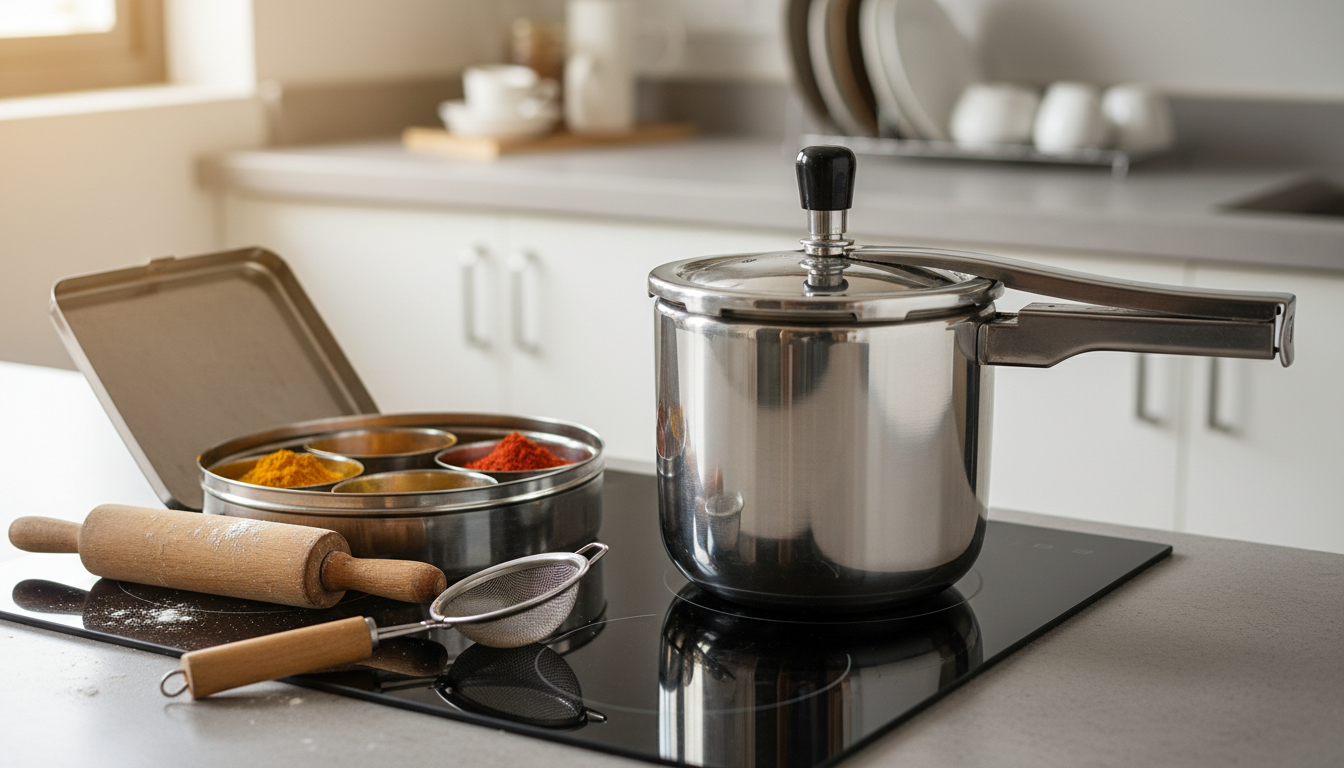
If you pack traditional flat-bottomed gas cookware from home, it will not heat up on an induction hob. Ensure every piece of kitchenware you pack is explicitly certified induction-compatible (magnetic stainless steel or induction-bottom aluminum).
The Pressure Cooker Protocol
A pressure cooker is the absolute heart of an Indian student’s kitchen. To ensure it passes airport security checks cleanly and doesn’t take up excessive luggage space, follow this exact packing procedure:
- Buy a 3-Litre or 5-Litre Induction-Base pressure cooker (an outer-lid model is usually easier to clean in small dorm sinks).
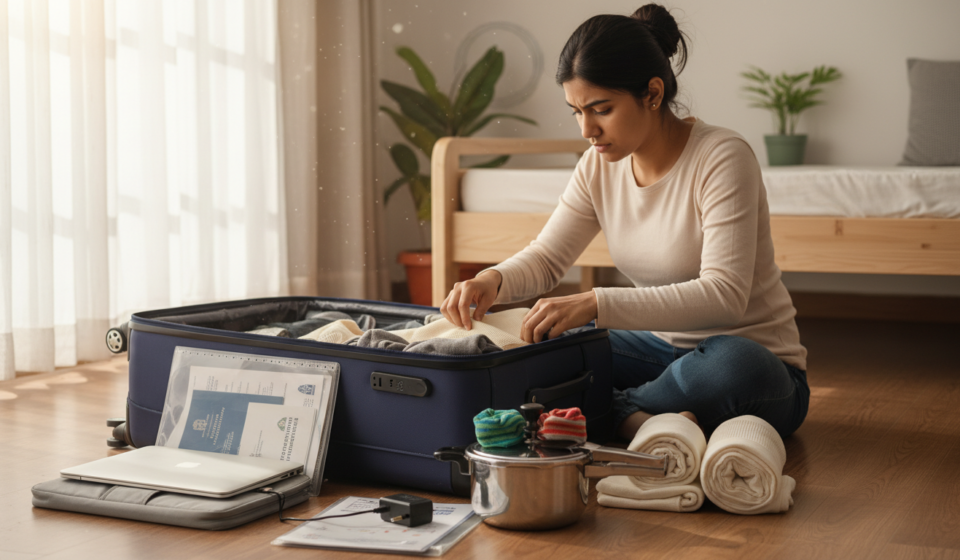
- Do not pack the cooker sealed shut. Remove the rubber gasket (sealing ring) and the metal weight valve (whistle). Place both parts inside a small zip-lock bag and store it inside the cooker pot.
- Pack 2 extra rubber gaskets and 1 spare safety valve/whistle inside the zip-lock bag. These replacement parts are almost impossible to source abroad for brands like Prestige or Hawkins.
- Fill the hollow interior of the pressure cooker pot with rolled-up socks, underwear, or t-shirts. This maximizes your baggage volume and prevents the pot from warping under baggage handling pressure.
Essential Kitchen Utensils to Bring from Home
- 1 Small Induction-Compatible Kadai / Frying Pan.
- 1 Stainless Steel Tea Strainer (Chai Chhani) — durable, fine-mesh metal strainers are surprisingly difficult to find in Western supermarkets.
- 1 Belan (Rolling Pin) paired with a flexible silicone baking mat (much lighter and easier to pack than a heavy wooden or marble *chakla*).
- 1 Spice Box (Masala Dabba) with tight internal lids to store daily spices cleanly.
- 1 Sharp kitchen knife (MUST be stowed in checked luggage; carrying a knife in hand luggage is a severe security offense).
Clothing and Footwear Strategy: What to Pack vs. What to Buy
Overpacking winter gear in India is one of the most common mistakes new students make. Indian winter jackets are designed for mild subcontinental temperatures and are rarely insulated or waterproofed for harsh -10°C to -20°C winter conditions in places like Canada, the US Midwest, or Germany.
Pack from India:
- Base Clothing: 4–5 pairs of durable jeans/trousers, 10–12 casual t-shirts, and 2–3 everyday hoodies or light sweatshirts.
- Thermal Innerwear: 2–3 pairs of high-quality Merino wool thermal tops and bottoms. Thermals are lightweight, pack small, and provide crucial insulation beneath everyday clothes.
- Undergarments & Socks: Pack at least a 3-week supply of cotton undergarments and 6–8 pairs of heavy woollen/thermal socks.
- Formal Wear: 1 complete formal suit or blazer with formal shirts and dress shoes. University career fairs, project presentations, and part-time job interviews require professional attire from week one.
- Traditional Wear: 1 or 2 Indian outfits (Kurta-Pyjama, Saree, or Anarkali) for Diwali celebrations, Holi events, and cultural functions hosted by Indian Student Associations.
- Footwear: 1 pair of durable daily walking sneakers (students frequently walk 8,000 to 15,000 steps daily on large campuses), 1 pair of formal shoes, and 1 pair of rubber flip-flops for indoor/washroom use.
Buy After You Land:
- Heavy Sub-Zero Outerwear: Heavy down parkas, windproof heavy coats, and rated snow jackets should be purchased upon arrival. Student hubs feature arrival sales at stores like Decathlon, Uniqlo, Columbia, Primark, or Target. Local jackets are engineered specifically for the regional humidity, wind-chill, and freezing temperatures.
- Waterproof Snow Boots: Snow footwear requires heavy rubber traction and thermal lining to navigate icy footpaths safely. Buy these locally to get the correct thermal rating and grip.
Financial Prep, Cash Rules, and Foreign Currency Limits
Managing money correctly before departure prevents severe delays when paying initial residence deposits or buying local transit passes.
- RBI Cash Limit (India Departure): Under Reserve Bank of India (RBI) guidelines, outbound Indian citizens can carry up to $3,000 USD (or equivalent in foreign currency notes) per trip in physical cash without making a formal declaration at departure customs. Total foreign exchange per trip (combining physical cash plus Forex cards) can go up to $10,000 USD equivalent.
- EU Customs Threshold: Arriving in Germany or any European Union nation carrying €10,000 or more in cash (or equivalent) requires a mandatory written customs declaration upon arrival.
- Recommended Money Strategy: Carry $300 to $500 (€200–€300 / £200–£300) in physical cash notes of small denominations for immediate airport transit, cab fares, and initial meals. Load the majority of your living budget onto a multi-currency Forex Card, and carry an active Indian international credit/debit card (with international transactions enabled) as an emergency backup.
Destination Customs Rules for Foods and Spices
Customs agencies strictly enforce biosecurity laws to protect local agriculture. Bringing prohibited agricultural or animal products can result in massive fines or instant visa cancellation.
| Destination Country | Allowed Food Items | Strictly Prohibited Food Items | Border Declaration & Penalty Rules |
|---|---|---|---|
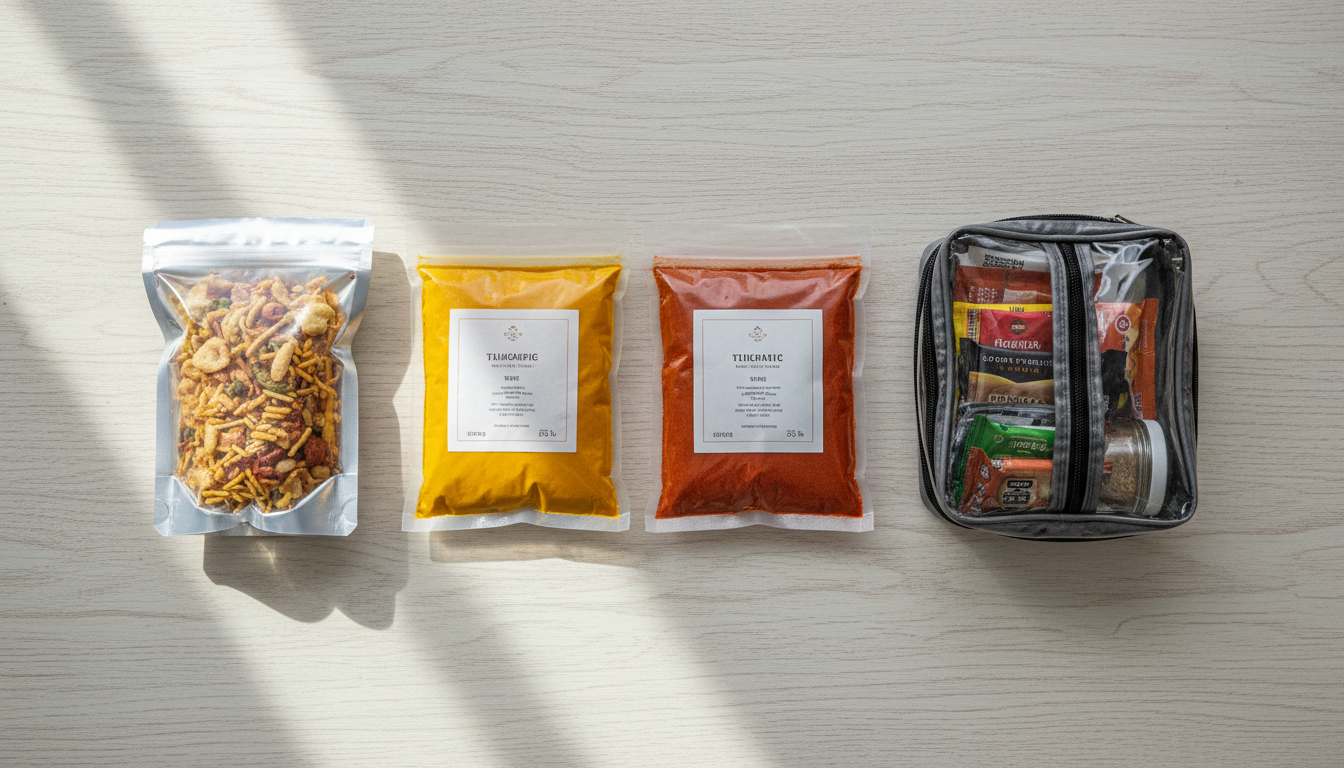
| United Kingdom | Sealed, factory-packaged ground dry spices, ready-to-eat vegetarian meals (MTR), dry snacks (namkeen, khakhra), vacuum-packed parathas. | ALL meat products, poultry, milk, paneer, ghee, fresh fruits, vegetables, and butter. | Declare food via the Red Channel. Undeclared banned biosecurity items carry fines up to **£5,000**. If you are preparing for a UK study trip, review our guide on planning your UK journey. |
| Australia | Commercially ground, factory-sealed, clearly labelled spices (turmeric, chili powder). | Whole raw seeds (cumin, coriander, fennel seeds), dried chillies, dairy-based sweets (burfi, peda, rasgulla), fresh fruits, homemade unlabelled loose items. | Strictest rules globally. ALL food MUST be declared on the Incoming Passenger Card. Undeclared food risks instant fines up to **AUD 2,664+** or visa cancellation. |
| Germany / EU | Factory-sealed ground spices, dried lentils/dal (up to 2 kg for personal use), sealed tea/coffee bags. | Fresh produce, live plants, raw seeds, meat products, poultry, paneer, unpasteurized dairy. | EU biosecurity rules apply. Prohibited items are confiscated and destroyed; undeclared imports trigger administrative fines. |
| USA & Canada | Commercial packaged dry snacks, sealed spice packets, processed tea, roasted coffee. | Fresh fruits, vegetables, raw meat, poultry, unsealed raw seeds, raw milk products/cheeses. | Declare all agricultural goods on the primary customs declaration form or automated kiosk. Check details on US flights and customs rules before flying. |
Airline Student Baggage Allowances & Booking Perks
Standard economy class tickets generally limit passengers to 23 kg to 30 kg of checked luggage. However, major international carriers offer significant free baggage upgrades specifically for verified international students flying out of India.
- Air India: Standard routes allow 2 pieces (23 kg each) for North America. Under verified Student Fares, students receive an additional +10 kg on weight-concept routes or 1 extra checked bag (23 kg) on piece-concept routes (yielding up to 56 kg total allowance on US routes).
- Qatar Airways (Student Club): Joining the free Qatar Airways Student Club unlocks an additional +10 kg allowance or 1 extra checked bag, free onboard Wi-Fi passes, flexible date change privileges, and tier status upgrades upon graduation.
- Emirates: Student Fare bookings offer an extra +10 kg or 1 extra piece on selected international routes, alongside discounted fares and flexible rebooking options.
- Singapore Airlines: Verified Krisflyer Student members receive 40 kg total checked baggage on weight-concept flights (UK, Europe, Australia) or 3 pieces x 23 kg (69 kg total) on US/Canada routes.
- Lufthansa & British Airways: Offer a free 2nd or 3rd checked bag (up to 23 kg) for students holding valid ISIC (International Student Identity Cards) or student ticket codes.
How to Claim: To access these extra weight benefits, select the “Student Fare” category while searching for flights online, and present your university admission offer letter, valid student visa, or ISIC card at the airport check-in counter.
Frequently Asked Questions About Packing List for Indian Students Going Abroad
Can I carry homemade ghee, pickles, or sweets abroad?
Ghee and milk-based traditional sweets (peda, burfi, rasgulla) are strictly prohibited in the UK, EU, and Australia due to dairy biosecurity regulations. Homemade pickles containing liquid or oil cannot be carried in cabin baggage under the 100ml liquid security rule. Commercial, factory-sealed non-dairy pickles can be packed in checked luggage for the US or UK, provided they are declared at customs upon arrival.
Should I buy a winter jacket in India before leaving?
No. Pack 2–3 pairs of high-quality thermal innerwear (merino wool) and warm thermal socks from India. Buy heavy sub-zero winter coats (-10°C to -20°C rated) and waterproof snow boots after landing at your destination. Local jackets are designed for the specific climate and are easily available during student arrival sales.
What happens if I forget to declare food at customs in Australia or the UK?
In Australia, failure to declare restricted food on your Incoming Passenger Card can result in instant infringement fines of up to AUD 2,664, civil court prosecution, or immediate visa cancellation and deportation. In the UK, undeclared food carrying biosecurity risks can attract fines up to £5,000. The golden rule for any international airport is simple: When in doubt, declare it on your customs form.
Can I carry my Indian mixie (mixer grinder) to the US or Canada?
No. India operates on a 230V electrical standard, whereas the US and Canada run on 110V. An Indian mixer grinder will not operate at full power and will quickly burn out or fail without a heavy 1500W+ voltage step-up transformer. It is far more practical to buy a 110V blender (like a Magic Bullet, NutriBullet, or Preethi US-spec model) locally or order one online after arriving.
How many kilograms of luggage am I allowed as a student?
Standard economy tickets allow 23 kg to 30 kg. However, by booking a verified Student Fare with airlines like Air India, Qatar Airways, Emirates, or Singapore Airlines, students can get an extra 10 kg to 23 kg free (total checked allowance of 40 kg to 56 kg).