The Ultimate Guide to Monsoon Cloud Chasing Tourism Circuits in India: Immersive Journeys into Nature’s Rains

The pursuit of leisure travel has shifted from static sightseeing to active environmental participation. Instead of avoiding seasonal downpours, a growing number of travelers now actively pursue the path of the monsoon. In this context, the rising interest in monsoon cloud chasing tourism circuits in india represents a major change in how the subcontinental rainy season is experienced. This specialized travel involves tracking low-hanging cloud formations, fog-laden valleys, and active precipitation zones across varied geographic terrains. It is a pursuit that demands local meteorological understanding and a willingness to embrace wet conditions. This article provides a comprehensive, professional analysis of these circuits, mapping out the scientific, logistical, and safety aspects of chasing the Indian monsoon. By understanding the core mechanics of these systems, travelers can experience nature in its most raw, unaltered form.
Key Takeaways for Cloud Chasers
- Unique Geographic Focus: Monsoon cloud chasing targets active meteorological phenomena, low-hanging clouds, and orographic lift zones across India.
- Four Major Circuits: The premier routes span the Meghalaya Highlands, Western Ghats Crestline, Nilgiri Mist, and the Eastern Ghats’ Araku Valley.
- Safety & Planning: Real-time weather monitoring (via IMD) and specialized preparation are crucial to navigate landslides and low visibility.
- Eco-Tourism Priorities: Travelers must focus on leaving zero footprint, supporting local homestays, and minimizing impact on highly sensitive ecosystems.
Understanding the Concept of Cloud Chasing Tourism
To comprehend the growth of this travel sector, one must understand that cloud chasing is not merely about observing rainfall from a hotel window. It is an active, outdoor-focused endeavor. Understanding the layout of monsoon cloud chasing tourism circuits in india requires an appreciation of how geographic features interact with seasonal wind patterns. It is basically a dynamic play of wind and rock. Travelers who participate in this style of tourism actively track atmospheric changes. They position themselves at high-elevation viewpoints and deep valleys where the contact between clouds and terrain is most dramatic. Interest in the specialized monsoon cloud chasing tourism circuits in india has surged because travelers now seek highly immersive, sensory encounters with nature. Many travelers seek dry, sun-drenched beaches during their holidays. But still, the raw energy of a wet mountain ridge holds an undeniable draw.
The Science Behind Monsoon Cloud Formation in India
The scientific appeal of monsoon cloud chasing tourism circuits in india lies in the predictability of seasonal winds. This process of orographic lift unfolds in distinct stages:
- Landmass Heating: During summer, the Indian subcontinental landmass heats up rapidly, creating a powerful low-pressure zone over the northern plains.
- Moisture Influx: This low pressure draws vast, moisture-laden south-westerly winds from the Indian Ocean and Arabian Sea.
- Orographic Uplift: When these wet winds collide with high coastal mountain ranges, they are forced aggressively upward.
- Condensation & Cooling: As the warm, moist air rises, it cools rapidly and condenses, forming the dense, low-flying clouds characteristic of the Indian monsoon.
This meteorological phenomenon turns the monsoon cloud chasing tourism circuits in india into a theater of shifting visibility. In the Western Ghats, steep cliffs force Arabian Sea winds upward, creating a continuous blanket of fog. Roughly speaking, the cloud base can drop to 300 meters above sea level (depending on local humidity profiles), allowing travelers to walk through clouds.
Why Monsoon Tourism is Shifting Toward Active Cloud Chasing
The shift from passive observation to active engagement is redefining the tourism market. By developing organized monsoon cloud chasing tourism circuits in india, state authorities are finding ways to extend the travel calendar into the traditional off-season, supporting local economies. Homestays and regional guides now find steady work during months previously considered quiet.
The infrastructure supporting monsoon cloud chasing tourism circuits in india has improved significantly. Roads once prone to washouts are now built with efficient drainage systems, allowing safer access to viewpoints. Furthermore, real-time weather tracking applications allow independent travelers (frequently referred to as FITs, or Free Independent Travelers) to monitor satellite radar images and position themselves accordingly. This combination of clean air and dramatic skies has made monsoon travel a major segment of the premium domestic travel market.

The Premier Monsoon Cloud Chasing Tourism Circuits in India
When exploring the premier monsoon cloud chasing tourism circuits in india, one must begin in the regions where the seasonal winds make their first and most powerful impact. The geographic spread of monsoon cloud chasing tourism circuits in india ensures that different regions offer entirely different atmospheric experiences. From the vertical cliffs of the Northeast to the rolling hills of the southern peninsula, each circuit presents a unique combination of terrain and rainfall intensity. Cloud behavior comes later. These circuits have been mapped out to maximize exposure to the most scenic rain-bearing systems.
The Meghalaya Highlands Circuit: Cherrapunji and Mawsynram
The north-eastern leg of monsoon cloud chasing tourism circuits in india offers an unparalleled atmospheric experience. Meghalaya, which translates directly to the “Abode of Clouds,” is the definitive destination for serious cloud chasers. This circuit centers around the Shillong-Cherrapunji highway (a route that has seen significant widening in recent years), winding through deep gorges that receive some of the highest rainfall on Earth. To explore this region in depth, travelers can select specialized Assam and Meghalaya tour packages designed to handle the logistical demands of monsoon travel.
The unique geography of the Khasi Hills creates a funnel for moist winds from the Bay of Bengal. As these winds meet the near-vertical cliffs of the plateau, rapid air ascent causes intense condensation. Enthusiasts of monsoon cloud chasing tourism circuits in india often rate Meghalaya as arguably the most intense experience due to the sheer volume of water and the speed of cloud movement.
As travelers move through these monsoon cloud chasing tourism circuits in india, the dramatic contrast between the high plateau and the deep gorges below becomes clear. According to the regional developmental filings of the Meghalaya Tourism Development Corporation, Cherrapunji sits at an altitude of roughly 1,400 meters (depending on the specific measurement benchmark), placing it directly within the cloud condensation zone.
The Western Ghats Crestline Circuit: Amboli to Mahabaleshwar
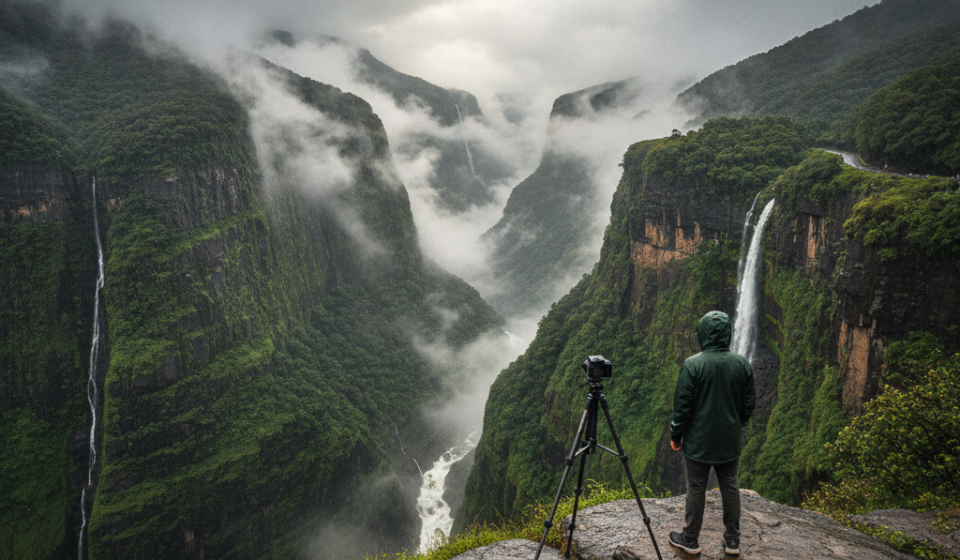
The western stretch of monsoon cloud chasing tourism circuits in india is characterized by the rugged cliffs of the Sahyadri range. This circuit spans from Amboli up through the high plateaus of Panchgani and Mahabaleshwar. The Western Ghats act as a massive wall that intercepts the Arabian Sea branch of the monsoon, resulting in heavy, consistent rainfall and dense cloud caps over the peaks.
Amboli, a quiet hill station in southern Maharashtra, receives roughly 7,500 millimeters of rain annually. As recorded in the historical datasets of the India Meteorological Department, this precipitation falls almost entirely between June and September. Here, the dense forest canopy traps moisture, creating a persistent ground fog. For photographers documenting the monsoon cloud chasing tourism circuits in india, the Western Ghats provide a unique opportunity to capture the contrast between basalt cliffs and soft cloud formations.
Further north, the Mahabaleshwar plateau offers wide vistas for watching cloud movements. Viewpoints like Arthur’s Seat look down into deep river valleys. During active monsoon phases, these valleys fill with dense clouds, creating a vast sea of mist. This makes the Western Ghats one of the most accessible monsoon cloud chasing tourism circuits in india for urban residents of Mumbai and Pune.
The Nilgiri Mist Circuit: Ooty, Coonoor, and Wayanad
The southern segment of monsoon cloud chasing tourism circuits in india winds through the Nilgiri hills and neighboring Kerala. This circuit includes Ooty, Coonoor, and Wayanad. The Nilgiris, or “Blue Mountains,” offer a softer, pastoral aesthetic compared to the rugged cliffs of the Western Ghats or the sheer gorges of Meghalaya.
In this region, monsoon clouds drift gently through extensive tea estates, wrapping the manicured green bushes in thin layers of mist. The quiet allure of southern monsoon cloud chasing tourism circuits in india lies in the slow pace of atmospheric shifts. In Wayanad, which sits on the windward side of the Western Ghats, rain-bearing clouds gather over peak formations like Chembra. The clouds here are accompanied by gentle, persistent drizzle rather than violent downpours, making it ideal for walking through mist.
The Nilgiri Mountain Railway becomes an extraordinary cloud chasing platform during the monsoon, passing directly through thick banks of cloud.
The Araku Valley and Eastern Ghats Circuit
Among the diverse monsoon cloud chasing tourism circuits in india, the Eastern Ghats route offers a distinct and often overlooked experience. This circuit focuses on the Araku Valley, located in Andhra Pradesh near the Odisha border. Unlike the Western Ghats, the Eastern Ghats are discontinuous and lower in elevation, which results in a different pattern of cloud formation and rainfall.
During the monsoon, the Araku Valley benefits from both the Arabian Sea and the Bay of Bengal currents, which converge over Visakhapatnam district. The valley, situated at approximately 911 meters above sea level, becomes a sanctuary of low-flying clouds settling over coffee plantations. The cloud formations here are less dense than those on the western coast, allowing for better visibility and creating a beautiful play of light across the hills.
Travelers on this circuit typically start their journey from Visakhapatnam, taking the winding road climbing through the Ananthagiri hills. Along the way, the road passes through several cloud-prone zones where the forest canopy is frequently enveloped in mist.
Comparative Analysis of Key Cloud Chasing Circuits
Each of these distinct monsoon cloud chasing tourism circuits in india caters to different travel styles, physical capabilities, and seasonal preferences. To compare the primary monsoon cloud chasing tourism circuits in india, the following matrix analyzes the routes based on key logistical and environmental criteria. For those looking to explore a wide range of domestic destinations, reviewing the broader selection of domestic tour packages in India can provide additional ideas for combining cloud chasing with other regional attractions.
| Circuit Name | Primary Region | Average Rainfall | Peak Months | Key Atmospheric Feature |
|---|---|---|---|---|
| Meghalaya Highlands | North-East (Khasi Hills) | Over 11,000 mm | June to September | Rapidly moving, dense orographic fog over deep canyons |
| Western Ghats Crestline | West Coast (Maharashtra) | 3,000 mm to 7,500 mm | July to August | Heavy clouds rising from coastal plains over basalt cliffs |
| Nilgiri Mist | Southern Peninsula (Tamil Nadu) | 2,000 mm to 4,000 mm | June to September | Soft, slow-drifting mist over high-altitude tea plantations |
| Araku Valley | East Coast (Andhra Pradesh) | 1,500 mm to 2,500 mm | August to October | Low-hanging valley clouds with high ambient light play |
Choosing among these monsoon cloud chasing tourism circuits in india depends on regional accessibility and the traveler’s tolerance for wet weather. For instance, the Meghalaya circuit requires flying into Guwahati followed by a four-hour mountain drive, whereas the Western Ghats can be reached easily by road from major industrial hubs.
Essential Gear and Travel Safety Guidelines for Monsoon Expeditions
Any journey along the monsoon cloud chasing tourism circuits in india demands meticulous preparation and specialized equipment. The very factors that make these destinations so appealing (the intense moisture, high winds, and rapid temperature changes) also present significant challenges to physical comfort and electronic devices. Standard holiday packing lists are entirely inadequate for the high-saturation environments encountered on these high-altitude routes. Preparation begins with choosing the correct personal gear and understanding safety protocols.
| Gear Category | Essential Items | Primary Function |
|---|---|---|
| Personal Wear | Gore-Tex rain jacket, quick-dry pants, waterproof hiking boots | Keeps body dry and maintains traction on wet, slippery mountain trails. |
| Gear Protection | Dry bags (10L/20L), silicone camera covers, silica gel packs | Prevents high humidity and direct water ingress from damaging electronics. |
| Safety & Navigation | Offline GPS maps, high-intensity headlamp, personal first-aid kit | Ensures safe navigation through zero-visibility fog and remote landslide zones. |
| Health & Hygiene | Insect repellent (leech protection), anti-fungal powder, water purifier | Protects against heavy monsoon pests and ensures access to safe drinking water. |
Specialized Equipment for Wet-Weather Photography
Wet-weather photography within the monsoon cloud chasing tourism circuits in india presents unique challenges for both amateur and professional creators. Equipment survival is a key topic of discussion among guides working the monsoon cloud chasing tourism circuits in india, who often see expensive cameras ruined by moisture ingress. High humidity can cause condensation inside lens elements, leading to temporary fogging or fungal growth.
To prevent these issues, photographers must employ a multi-layered protection strategy:
- Silicone Rain Covers: Utilize dedicated silicone or waterproof sleeves specifically designed for camera bodies.
- Airtight Storage: Keep all offline electronics and spare lenses in heavy-duty dry-bags packed with large silica gel packets to absorb ambient moisture.
- Weather-Sealed Optics: Rely primarily on high-grade weather-sealed lenses to prevent interior moisture ingress.
- Stable Support: Carry a sturdy, weighted carbon-fiber tripod to withstand high winds and manage the long exposures required to capture moving mist.
- Front-Element Protection: Keep lens hoods attached at all times to ward off stray raindrops, and maintain quick access to clean microfiber cloths in a dry, sealed pocket.
Physical Preparation and On-Ground Safety Protocols
Safety is the primary concern when traversing the monsoon cloud chasing tourism circuits in india during heavy downpours. The heavy rainfall that feeds spectacular waterfalls also increases the risk of natural hazards such as landslides, flash floods, and rockfalls. This risk is particularly high in the Western Ghats and Himalayan foothills, where steep slopes can become unstable after prolonged saturation.
Critics say traveling during peak downpours is reckless. They are not entirely wrong – but they underestimate the level of infrastructure currently in place to support these travelers. Travelers must stay informed by monitoring local weather bulletins issued by the India Meteorological Department (IMD) and regional offices. It is critical to avoid driving during periods of extreme warnings when roads are highly vulnerable to blockage. When driving in mountainous terrain, maintaining a low speed and keeping a safe distance from the vehicle ahead is essential, as visibility can drop to under five meters in dense cloud banks.
Sustainable Practices in Monsoon Tourism
The rapid growth of seasonal travel has placed significant pressure on the delicate ecosystems that host these cloud-prone regions. Responsible exploration of the monsoon cloud chasing tourism circuits in india is critical for preserving these natural spaces for future generations of travelers. Many of these high-altitude circuits are located in ecologically sensitive areas (such as the Western Ghats, which is recognized as a global biodiversity hotspot) where human disruption can have severe, long-lasting consequences.
Minimizing Environmental Footprint in Fragile Eco-Systems
By preserving the ecological integrity of these monsoon cloud chasing tourism circuits in india, travelers ensure that these unique atmospheric phenomena remain viable attractions. Local communities surrounding the monsoon cloud chasing tourism circuits in india play a vital role in this preservation effort. Supporting community homestays and hiring local guides ensures that economic benefits are distributed fairly, and guarantees that travelers are guided by individuals who possess deep knowledge of local safety limits.
To minimize personal impact, travelers should follow key guidelines:
- Carry Out All Waste: Wet weather makes waste management extremely difficult; plastic waste must be carried back.
- Stay on Designated Trails: Venturing off-trail damages fragile topsoil and accelerates erosion, contributing to mudslides.
- Respect Wildlife Activity: The monsoon is breeding season for amphibians and reptiles; do not disturb their habitats.
- Avoid Single-Use Plastics: Bring reusable bottles and durable dry bags rather than thin plastic sheets that tear easily.

Conclusion
Ultimately, the rise of monsoon cloud chasing tourism circuits in india showcases a deep appreciation for the natural rhythms of the subcontinent. This style of travel transforms what was once considered an off-season into a highly sought-after window of environmental discovery. Whether standing on the high, wind-swept plateaus of Meghalaya or watching the quiet mist drift through the tea gardens of the Nilgiris, travelers are provided with an intimate view of the earth being renewed by water.
But still, the beauty of these wet journeys comes with a clear responsibility. Choosing to travel along the monsoon cloud chasing tourism circuits in india is not merely about sightseeing. It requires an active commitment to safety, preparation, and ecological preservation. By planning carefully, utilizing local expertise, and respecting the raw power of the monsoon, travelers can participate in some of the most extraordinary atmospheric journeys on Earth, returning with a profound understanding of how water shapes both the terrain and the cultures that depend on it.