
The Ultimate Guide to Psycho-acoustic Heritage Tourism Circuits in India: Exploring Ancient Sites Where History Meets Resonant Healing Soundscapes

Ancient architectural marvels in India have long been admired for their visual grandeur, historical significance, and intricate stone carvings. Yet, an invisible dimension exists within these monolithic structures, one that speaks directly to the human nervous system through the medium of sound. This acoustic design is not accidental, but rather a deliberate integration of structural engineering and spiritual science. The development of psycho-acoustic heritage tourism circuits in india marks a significant shift in how heritage travel is conceived and experienced. By focusing on how spatial dimensions, materials, and carvings alter sound, these circuits offer visitors a chance to experience history not just visually, but aurally. It is basically an immersive encounter with the past where stone structures act as giant, tuned instruments. Historically, builders of temples, forts, and stepwells understood that sound could influence consciousness. Today, modern travelers are beginning to appreciate this sonic legacy.
- Ancient Sonic Science: India’s heritage sites integrate precise mathematical engineering and materials like granite and basalt to manipulate sound waves intentionally.
- Healing Frequencies: Many rock-cut sanctuaries and inner sanctums (garbhagrihas) resonate at around 110 Hz, a frequency known to induce deep relaxation and alpha/theta brainwave states.
- Diverse Acoustic Phenomena: The subcontinent offers diverse experiences, ranging from the percussive “musical pillars” of Hampi to the multi-echo whispering gallery of Gol Gumbaz.
- Structured Travel Circuits: Grouping sites into Southern, Western, and Northern itineraries allows tourists to efficiently experience specialized ancient acoustic technologies.
- Mindful Conservation: Protecting these fragile structures and their surrounding soundscapes is vital for preserving India’s unique psycho-acoustic heritage.
Understanding Psycho-Acoustics in Ancient Architecture
When mapping out psycho-acoustic heritage tourism circuits in india, scholars often look at how ancient builders manipulated sound to evoke deep psychological states. Psycho-acoustics study how humans perceive sound, including the cognitive and physiological responses triggered by different frequencies. In the context of ancient Indian architecture, this concept was applied with mathematical precision. Temples and monuments were not constructed merely as assembly halls. Instead, they were designed as physical amplifiers of vocal chanting and instrumental music.
The materials chosen for these sites played a critical role. Basalt, granite, and sandstone were selected not only for their durability but also for their sound-reflecting properties. When acoustic energy interacts with these dense stones, it creates distinct patterns of resonance. This design choice turned enclosed spaces into acoustic chambers that could sustain sound for extended periods. For those studying psycho-acoustic heritage tourism circuits in india, these mathematical frequencies reveal a profound understanding of wave mechanics that pre-dates modern acoustic science.
| Material Type | Acoustic Properties | Acoustic Behavior | Primary Application |
|---|---|---|---|
| Granite | Extremely dense & non-porous | Reflects high-intensity sound waves; creates bright, sustained reverberation. | Pillars, halls, and heavy structural beams |
| Basalt | Dense, fine-grained volcanic rock | Sustains deep, rich, low-frequency standing waves. | Rock-cut sanctuaries and monolithic caves |
| Marble | Polished, metamorphic rock | Selectively absorbs high frequencies while projecting warm, clear vocal resonance. | Intricately carved domes and open pavilions |
| Sandstone | Porous sedimentary rock | Diffuses sound, reducing harsh flutter echoes while maintaining general amplification. | Enclosed stepwells and perimeter fortress walls |
The Science Behind Resonant Frequencies
Every enclosed space has a natural resonant frequency. This is the frequency at which the air inside the chamber naturally vibrates. In many ancient Indian shrines, the inner sanctum (known as the garbhagriha) was designed as a small, high-ceilinged room. This shape naturally enhances low-frequency sound. When a priest or practitioner chants inside this space, the sound waves bounce off the hard, polished stone walls, creating a dense sound field.
Research indicates that many rock-cut cave sanctuaries exhibit a primary resonance at roughly 110 Hz, a performance metric documented in acoustic surveys by the Acoustical Society of India. This specific frequency has a notable effect on the human brain. It matches the lower end of the human male vocal range and corresponds to specific brainwave states associated with deep relaxation and meditation. The architectural dimensions were thus carefully calibrated to maximize this physical response, transforming spoken sound into a visceral physical experience.
Sound as a Medium for Spiritual and Physical Healing
The healing dimensions of sound form the spiritual core of psycho-acoustic heritage tourism circuits in india. In ancient Indian wellness systems, sound, or Shabda, was considered the primary element from which the physical universe emerged. Chanting specific syllables, known as mantras, was believed to clear blockages in the human body’s subtle energy channels. This belief was supported by structural designs that allowed these vibrations to penetrate the soft tissues and nervous systems of practitioners.
As sound waves travel through a tuned stone chamber, they create standing waves. These are static patterns of acoustic pressure that can be felt physically as a gentle vibration in the chest and skull. This physical resonance helps trigger the parasympathetic nervous system, reducing the heart rate and lowering blood pressure. By routing travel itineraries through these acoustically active spaces, modern wellness seekers can experience the therapeutic benefits of sound therapy in its most ancient, unamplified form.

The Geography of Sound: Key Psycho-Acoustic Sites in India
To understand the sheer variety of psycho-acoustic heritage tourism circuits in india, one must analyze the geographic distribution of these ancient sonic marvels. From the granite temples of the south to the monolithic caves of the west, the subcontinent is dotted with structures that manipulate sound in diverse ways. These sites can be categorized by their specific acoustic phenomena, which range from percussive rock formations to complex echoing chambers.
The following table provides a comparison of the primary psycho-acoustic heritage sites across India, detailing their locations, structural characteristics, and acoustic signatures:
| Site Name | State / Region | Primary Acoustic Phenomenon | Acoustic Mechanism |
|---|---|---|---|
| Vittala Temple | Hampi, Karnataka | Percussive Lithophones | Solid granite pillars carved to vibrate at distinct musical notes when tapped. |
| Gol Gumbaz | Vijayapura, Karnataka | Multi-Echo Whispering Gallery | Massive hemispherical dome that bounces sound across its circular balcony up to ten times. |
| Ranpur Jain Temple | Pali, Rajasthan | Hollow Pillar Acoustic Amplification | Intricately carved marble pillars arranged to direct vocal chants to the central hall. |
| Great Stupa | Sanchi, Madhya Pradesh | Low-Frequency Dome Resonance | Solid brick and stone hemispherical structure that focuses ambient sound toward its base. |
| Kailash Temple | Ellora, Maharashtra | Monolithic Chamber Echo | Carved out of a single rock face to create deep, dark, and highly reverberant soundscapes. |
The Musical Pillars of Vittala Temple in Hampi
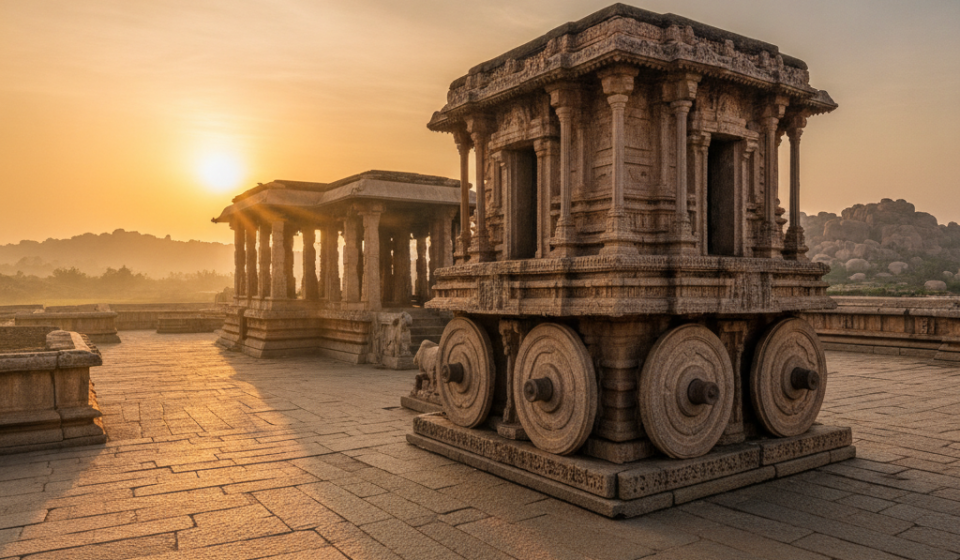
As a cornerstone of many psycho-acoustic heritage tourism circuits in india, Hampi represents the peak of medieval stone architecture. The 16th-century Vittala Temple is famous for its assembly hall, which contains 56 musical pillars. These pillars, also known as sa-re-ga-ma pillars, are carved out of solid blocks of granite. When gently tapped with the fingers, they emit clear musical notes, each corresponding to a different traditional Indian instrument.
Visitors traveling along psycho-acoustic heritage tourism circuits in india are often mesmerized by how these stone columns produce distinct sounds. An inventory compiled by the UNESCO World Heritage Centre details the 56 musical pillars of the Vittala temple complex, highlighting their unique physical structure. Key characteristics include:
- Central Shaft & Minor Resonators: Each main pillar is surrounded by seven minor shafts, which act as resonators.
- Density & Composition: The high density and mineral composition of the granite allow the stone to vibrate cleanly.
- Dimensional Variation: The varying diameters, lengths, and shapes of the shafts enable them to vibrate at specific, tuned frequencies.
The Whispering Gallery of Gol Gumbaz in Vijayapura
Another spectacular highlight of psycho-acoustic heritage tourism circuits in india is the Gol Gumbaz, the mausoleum of Muhammad Adil Shah. Built in the 17th century, this structure features one of the largest domes in the world. Structural measurements compiled by the Archaeological Survey of India confirm the Gol Gumbaz dome spans 44 meters in diameter, which allows it to catch and amplify the softest sounds. Directly below the dome is a circular balcony known as the Whispering Gallery.
For curators of psycho-acoustic heritage tourism circuits in india, this acoustic feature is a prime example of structural reflection. A whisper at one end of the gallery travels along the curved wall and can be heard clearly on the exact opposite side, nearly 40 meters away. Even more impressive is the multiple-echo phenomenon. A single clap in this gallery is repeated up to ten times as the sound waves bounce repeatedly between the parallel surfaces of the dome. This complex acoustic interaction creates a cascading soundscape that is both disorienting and fascinating to experience.
The Acoustic Sanctum of Ranpur Jain Temple
Western India contributes unique structures to psycho-acoustic heritage tourism circuits in india, particularly the Ranpur Jain Temple in Rajasthan. Built in the 15th century, this temple is supported by over 1,400 uniquely carved marble pillars. The layout of the temple is designed to allow natural light and sound to flow freely through its open-plan courtyards. The central dome is supported by hollowed and carved pillars that function as natural megaphones.
When rituals are performed in the central sanctum, the unique acoustic system works through the following mechanisms:
- Capture: The chanting of prayers is instantly captured by the curved, reflective surfaces of the central marble dome.
- Projection: These sound waves are projected outward through the open-plan pillared halls without losing clarity.
- Selective Absorption: The marble surfaces absorb high-frequency noise while reflecting lower, warm vocal tones.
- Unified Experience: This prevents the sound from becoming muddy, ensuring clear auditory participation for the entire congregation.
The Resonance of the Great Stupa at Sanchi
Buddhist architecture also plays a key role in psycho-acoustic heritage tourism circuits in india. The Great Stupa at Sanchi, dating back to the 3rd century BCE, is primarily known as a visual symbol of peace. However, its solid, hemispherical shape also possesses remarkable acoustic properties. The circular path around the stupa, used for ritual circumambulation, is enclosed by a high stone railing.
Acoustic mapping within psycho-acoustic heritage tourism circuits in india has revealed that this circular walkway acts as a sound guide. When pilgrims chant as they walk around the stupa, the sound waves are trapped between the curved wall of the dome and the outer railing. This physical setup prevents the sound from dissipating into the open air. Instead, it creates a continuous, low-frequency hum that envelops the practitioner. This ambient sound field helps focus the mind during long periods of walking meditation.
Designing Psycho-Acoustic Heritage Tourism Circuits in India
Creating structural and logical psycho-acoustic heritage tourism circuits in india involves grouping these ancient sites into cohesive travel itineraries. These itineraries must balance travel distances with the theme of acoustic exploration. By organizing tours around regional clusters, travelers can experience a wide variety of soundscapes without spending too much time in transit. This systematic approach is ideal for specialized educational groups and wellness tourists alike.
When selecting your next journey, exploring these stunning regions is made simple through curated domestic tour packages that cover ancient soundscapes. These routes are designed to offer a complete sensory journey, pairing historical education with deep acoustic experiences. Depending on the traveler’s interest, several regional circuits can be customized to focus on specific architectural periods or acoustic technologies.
The Southern Resonance Circuit (Hampi, Madurai, and Thanjavur)
The Southern path of psycho-acoustic heritage tourism circuits in india links together some of the most advanced stone temples on the subcontinent. Starting in Hampi, travelers explore the percussive properties of the Vittala Temple. From there, the route moves south to Madurai, where the Meenakshi Amman Temple features long, echoing corridors and musical stone steps. The journey concludes at the Brihadeeswarar Temple in Thanjavur, a colossal structure whose main shrine generates a powerful, low-frequency resonance during vocal chants.
This specific segment of psycho-acoustic heritage tourism circuits in india focuses on the use of granite as a resonant medium. Granite is exceptionally hard, which means it absorbs very little sound energy. Instead, it reflects almost all the acoustic waves that strike it. This physical property makes southern temples ideal for studying how high-intensity vocal chanting can be sustained within stone structures to create an immersive spiritual environment.
The Western Acoustic Echo Circuit (Ranpur, Ellora, and Gol Gumbaz)
The Western path of psycho-acoustic heritage tourism circuits in india presents a very different acoustic experience. This route begins in Rajasthan at the Ranpur Jain Temple, highlighting how marble alters sound reflection. Next, the circuit travels south to Maharashtra, where the monolithic caves of Ellora, particularly the Kailash Temple, offer a chance to study rock-cut acoustics. The final stop is Gol Gumbaz in Karnataka, where travelers can experience the multi-echo whispering gallery.
Architectural acoustic enthusiasts booking psycho-acoustic heritage tourism circuits in india often prefer this route because of the sheer variety of sound phenomena. It contrasts the soft, diffuse soundscapes of marble temples with the sharp, repeating echoes of granite domes and deep rock caves. This comparison helps travelers understand how different structural shapes and materials can be used to control sound waves in enclosed environments.
The Northern Spiritual Resonance Circuit (Varanasi, Sanchi, and Rishikesh)
Moving north, psycho-acoustic heritage tourism circuits in india encompass a mixture of open-air riverfronts and ancient brick structures. This circuit starts in the ancient city of Varanasi, where the stone steps of the ghats reflect the sound of evening prayers across the wide surface of the Ganges River. The route then moves to the Great Stupa at Sanchi to study the low-frequency sound guiding properties of Buddhist architecture. It concludes in Rishikesh, where the natural acoustics of the Himalayan foothills and the flowing river create a constant background of white noise.
This northern circuit emphasizes the relationship between natural soundscapes and man-made structures. It shows that psycho-acoustics is not just about closed stone rooms. It is also about how open-air monuments can be positioned to interact with the sounds of wind, water, and forests. This makes it a popular choice for travelers who want to combine historical exploration with nature-based meditation practices.

Health, Wellness, and the Cognitive Benefits of Acoustic Pilgrimages
The value of psycho-acoustic heritage tourism circuits in india extends beyond mere history and architectural appreciation. It is increasingly clear that visiting these acoustically active sites offers significant wellness benefits. In a fast-paced world filled with digital noise, stepping into an ancient temple designed for sonic harmony provides a rare chance to reset the human nervous system. This therapeutic aspect is drawing a new demographic of travelers to these ancient heritage sites.
Many of these travelers find that spending time in these spaces helps them manage modern stressors. By engaging with the soundscapes of these monuments, visitors can experience a form of acoustic meditation that is difficult to replicate in modern wellness centers. This unique offering positions India at the forefront of the global wellness tourism industry.
Neurological Impacts of Steady Rhythmic Frequencies
Cognitive science research supports the underlying ideas behind psycho-acoustic heritage tourism circuits in india. When a person is exposed to steady, low-frequency sounds, the brain naturally begins to synchronize its electrical activity with the frequency of the sound. This process is known as brainwave entrainment (a biological mechanism where brainwaves align to external acoustic rhythms). In many ancient stone sanctuaries, the resonant frequency matches the alpha and theta brainwave states, which are associated with deep relaxation and creative thinking.
Exposure to these frequencies can lead to several positive physiological shifts, including:
- Decreased Cortisol Levels: Lowering the body’s primary stress hormone to promote physical recovery and reduce tension.
- Enhanced Cognitive Focus: Calming the internal chatter of the mind, making it easier to enter a deep meditative state.
- Improved Heart Rate Variability: Signaling to the heart that the body is in a safe, non-threatening environment.
- Physical Vibration Sensing: Stimulating deep somatic receptors through low-frequency standing waves.
Therapeutic Soundscapes and Stress Reduction
For modern wellness travelers, psycho-acoustic heritage tourism circuits in india offer a quiet escape from the constant bombardment of urban noise pollution. City environments are filled with high-frequency, unpredictable sounds like traffic, sirens, and machinery. These sounds trigger a mild, chronic stress response in the human body. In contrast, the soundscapes of ancient temples are structured, predictable, and harmonious.
When travelers sit quietly inside an acoustic chamber like the garbhagriha, the surrounding stone walls filter out external city noise. The only remaining sounds are the low-frequency hum of ambient resonance and the steady rhythm of their own breathing. This physical isolation, combined with the therapeutic acoustic environment, allows the mind to enter a state of deep rest, helping to alleviate symptoms of chronic anxiety and mental fatigue.
Practical Guide for Travelers and Preservation Challenges
Embarking on psycho-acoustic heritage tourism circuits in india requires practical planning to get the most out of the experience. Unlike visual tourism, which can be enjoyed even in crowded conditions, acoustic tourism requires a quiet environment. Travelers must plan their visits carefully to avoid the loud crowds that often gather at these popular historical sites.
Furthermore, for those traveling with like-minded enthusiasts, booking specialized group tours offers a structured way to experience these delicate acoustic structures. These specialized tours are designed to grant access to the sites during quiet hours, ensuring that you can experience the soundscapes in their purest form.
Planning Your Acoustic Heritage Itinerary
When organizing travel for psycho-acoustic heritage tourism circuits in india, timing is crucial. To truly appreciate the subtle echoes and musical pillars of these ancient sites, you need to visit when ambient noise is at its lowest. This means arriving early in the morning, immediately after the sites open to the public, or during the late afternoon when the crowds begin to thin out.
Here is a step-by-step process for planning a successful acoustic heritage trip:
- Identify Your Core Sites: Choose a regional circuit that matches your interest, whether it is the percussive stones of the south or the echoing domes of the west.
- Research Peak Visiting Hours: Contact local guides to find out when the sites are least crowded. Avoid major religious festivals if you want a quiet experience.
- Hire an Acoustic Guide: Look for guides who understand the structural physics of the monuments, rather than those who only repeat standard historical legends.
- Pack Minimalist Audio Gear: If you want to record the sounds, bring high-quality, directional microphones and over-ear headphones to capture the subtle frequencies.
Preserving the Delicate Soundscapes of Ancient Monolithic Ruins
A critical aspect of promoting psycho-acoustic heritage tourism circuits in india is conservation. These ancient structures are incredibly delicate, and their acoustic properties can be easily damaged. For instance, repeatedly striking the musical pillars of Hampi with hard objects can cause micro-fissures in the granite, destroying their resonance forever. Consequently, the Archaeological Survey of India has placed restrictions on physically touching many of these pillars.
Preservation is not just about protecting the physical stone. It is also about protecting the sonic environment. As urban development expands around these historical sites, traffic noise and industrial activity threaten to drown out the subtle acoustic features of the monuments. Protecting these soundscapes requires establishing noise-free buffer zones around the heritage sites, ensuring that future generations can continue to experience these ancient sonic marvels in their intended environments.
FAQs
What are the most popular psycho-acoustic heritage tourism circuits in india?
The most popular routes include the Southern Resonance Circuit, which connects Hampi, Madurai, and Thanjavur, and the Western Acoustic Echo Circuit, which covers Ranpur, Ellora, and Gol Gumbaz. These routes are designed to offer a balanced mix of percussive stones, whispering galleries, and monolithic cave acoustics, providing a comprehensive introduction to India’s ancient acoustic engineering.
How do psycho-acoustic heritage tourism circuits in india help with wellness?
These circuits promote wellness by exposing travelers to low-frequency soundscapes that trigger brainwave entrainment. When visitors spend time in tuned stone chambers, their brainwaves naturally synchronize with the calming, low-frequency vibrations of the space. This physical resonance helps lower heart rates, reduce cortisol levels, and calm the nervous system, offering a natural and deep form of stress relief.
Are travelers allowed to touch the musical pillars in Hampi?
Due to the risk of structural damage, physical contact with the musical pillars of the Vittala Temple is highly restricted. Visitors are no longer allowed to strike the pillars with stones or sticks, as this can cause permanent cracks in the granite. Instead, travelers are encouraged to listen to demonstrations by authorized guides or enjoy the natural acoustic properties of the surrounding temple halls.
Do I need specialized equipment to experience these acoustic phenomena?
No specialized equipment is necessary to enjoy these sites. The human ear is fully capable of perceiving the distinct echoes, resonances, and musical notes produced by these ancient structures. However, wellness travelers and researchers often bring high-quality audio recorders and headphones to document the specific frequencies for personal meditation and study at home.
Which is the best time of year to visit these acoustic heritage sites?
The best time to visit most of these sites is during the cooler winter months, from October to March. During this period, the weather is pleasant for walking through open-plan temple complexes. Additionally, planning your daily visits for the early morning hours, around 6:00 AM, is highly recommended to experience the acoustic features before the arrival of large tourist groups.