
Planning an Italy trip from India in 2026?
A comfortable 10-day Italy trip costs between ₹1.6 lakh and ₹2.5 lakh per person including return flights, Schengen visa, hotels, inter-city trains, food, and sightseeing. Air India now operates direct flights to Rome from Delhi – one of the few non-stop connections to Italy from India. The Schengen visa requires 6 to 8 weeks lead time and a specific document set (apply at VFS Global for Italy). The classic first-time Italy circuit: Rome (3 nights), Florence (2 nights), Venice (2 nights) – connected by Frecciarossa high-speed trains that run like clockwork. And the most important booking tip: pre-book Vatican Museums and the Colosseum weeks in advance – walk-up queues in peak season can cost you 2 to 3 hours of a precious Italy day.
Italy has a way of ruining other European holidays. Once you have sipped an espresso standing at a Roman counter at 7 AM, wandered into a centuries-old Florentine bookshop, or watched Venice wake up before the cruise-ship crowds arrive, every other city starts to feel a little louder, a little less alive. Italy’s national tourism agency ENIT recorded more than 64 million international arrivals in 2023, and Indian visitors were among the fastest-growing visitor cohorts. The country offers more UNESCO World Heritage Sites than any other nation (58 at last count), a cuisine that the world has imitated without ever quite replicating, and a physical beauty – from the Amalfi coast to the Dolomites to Tuscany’s rolling vineyards – that makes the photographs feel like understatements.
This guide covers the visa process, verified cost breakdown, an 8-day first-timer itinerary, the best places to visit, Italy’s train network explained, the food guide for Indian travellers, and the practical tips that separate a smooth Italy trip from a stressful one.
Italy Visa for Indians in 2026: Schengen Applies
Italy is a Schengen Area member — Indian passport holders need a Schengen Tourist Visa. Italy has no visa on arrival and no e-Visa option. The application must be submitted in person at a VFS Global centre in India.
| Detail | Information |
|---|---|
| Visa type | Schengen Type C Tourist Visa |
| Embassy fee | €90 (~₹9,400 at current rates) |
| VFS service charge | ₹1,933 to ₹3,111 |
| Total per person (all-in) | ₹11,500 to ₹15,000 |
| Travel insurance (mandatory) | Minimum €30,000 coverage, valid across all Schengen states |
| Processing time (2026) | 15 to 30 working days — apply 6 to 8 weeks before travel |
| Apply at | VFS Global Italy centres — Delhi, Mumbai, Bangalore, Chennai, Hyderabad, Kolkata |
| Applications can open | Up to 180 days before travel |
💡 Critical 2026 tip: In 2026, spring and summer VFS Italy appointment slots fill up fast — 6 to 8 weeks before your travel date. For April to June travel, book your VFS appointment in February or March. Do not start the visa process after booking non-refundable flights without first checking VFS appointment availability.
For the complete Schengen visa documents checklist, step-by-step process, and approval tips — refer to our detailed Schengen Visa from India 2026 guide. If Italy is your sole Schengen destination, apply through VFS Italy. If combining Italy with France, Switzerland, or Greece, apply to the embassy of the country where you spend the most days.
Best Time to Visit Italy from India
| Season | Months | Weather | Crowds | Prices | Verdict |
|---|---|---|---|---|---|
| Spring | April to mid-June | 18–25°C, sunny, wildflowers in Tuscany | Building but manageable | Moderate to high | ✅ TravelDham’s top pick — best overall Italy experience |
| Peak Summer | Mid-June to August | 28–36°C, very hot and humid in Rome and Florence | Very high — Venice and Rome at capacity | Highest of year | ⚠️ Beautiful light and long days. Extremely crowded and hot. Avoid if possible. |
| Autumn | September to October | 18–26°C, warm, harvest season, beautiful light | Thinning from September | 20–30% lower than peak | ✅ Excellent — warm sea, fewer crowds, harvest season food and wine |
| Winter | November to March | 8–14°C, rain possible, shorter days | Very low | Lowest fares and hotels | ⚠️ Good for art and culture focus. Christmas markets in December. Cold but no queues at major sites. |
April to May and September to October are the two windows that consistently deliver the best Italy experience — pleasant temperatures (18 to 25°C), the major sites at manageable crowd levels before and after the summer peak, and prices 20 to 30% below August. October specifically is extraordinary — Tuscany’s harvest season, the Italian light at its most golden, and Venetian canals before winter fog without the summer crush.
For Indian school holiday windows: April–May is perfect for Italy. October is equally good. December offers the Christmas market atmosphere in cities like Bolzano and Verona, but expect cold weather and shorter sightseeing days.
Italy Trip Cost from India 2026: Verified Breakdown
| Expense | Budget (per person, 8 nights) | Mid-Range (per person, 8 nights) | Premium (per person, 8 nights) |
|---|---|---|---|
| Return flights from India (Delhi/Mumbai to Rome or Milan) | ₹45,000–₹65,000 | ₹65,000–₹90,000 | ₹95,000–₹1,80,000 |
| Schengen visa (all charges) | ₹11,500–₹15,000 | ₹11,500–₹15,000 | ₹11,500–₹15,000 |
| Accommodation (8 nights) | ₹20,000–₹36,000 (₹2,500–₹4,500/night) | ₹40,000–₹72,000 (₹5,000–₹9,000/night) | ₹80,000–₹1,60,000 (₹10,000–₹20,000/night) |
| Inter-city trains (Rome-Florence-Venice) | ₹3,000–₹5,000 (booked well ahead) | ₹5,000–₹9,000 | ₹9,000–₹16,000 |
| Meals (8 days — local trattorias + cafes) | ₹9,000–₹14,000 | ₹14,000–₹24,000 | ₹28,000–₹60,000 |
| Sightseeing — Colosseum, Vatican, Uffizi, Doge’s Palace | ₹8,000–₹12,000 | ₹12,000–₹18,000 | ₹18,000–₹35,000 |
| Local transport (Rome Metro, Venice vaporetti, taxis) | ₹4,000–₹6,000 | ₹6,000–₹10,000 | ₹10,000–₹20,000 |
| Travel insurance | ₹2,000–₹3,500 | ₹3,500–₹6,000 | ₹6,000–₹12,000 |
| Miscellaneous (shopping, gelato, tips) | ₹3,000–₹6,000 | ₹8,000–₹15,000 | ₹20,000–₹60,000 |
| Total per person (8 nights) | ₹1,05,500–₹1,62,500 | ₹1,65,000–₹2,59,000 | ₹2,77,500–₹5,58,000 |
Italy is moderately priced by European standards – more affordable than Switzerland or Scandinavia, but more expensive than Eastern Europe or Southeast Asia. The biggest cost driver is the long-haul return flight from India, which accounts for approximately 35 to 40% of the total Italy trip budget. Once in Italy, day-to-day expenses are very manageable: a coffee at a Roman bar costs ₹100 to ₹160 (stand at the counter – sitting doubles the price), a pizza margherita at a local pizzeria costs ₹700 to ₹1,200, a pasta lunch at a trattoria costs ₹800 to ₹1,500.
💡 The open-jaw flight strategy: Fly into Rome and out of Milan, or vice versa. This eliminates backtracking on a Rome-Florence-Venice-Milan itinerary and open-jaw tickets on this combination are frequently priced comparably to a round trip to one city. TravelDham builds all Italy itineraries with this open-jaw option assessed first.
Italy’s Train Network: The Best Way to Travel Between Cities
Italy’s high-speed train network is one of Europe’s finest — clean, reliable, comfortable, and significantly cheaper than flying once airport time is factored in. Understanding how to use it is one of the most important Italy planning decisions.
| Route | Train | Duration | Fare (booked early) | Fare (same day) |
|---|---|---|---|---|
| Rome to Florence | Frecciarossa / Frecciargento | 1 hour 30 minutes | ₹1,500–₹2,500 | ₹5,000–₹8,000 |
| Florence to Venice | Frecciarossa | 2 hours 10 minutes | ₹2,500–₹4,000 | ₹6,000–₹9,000 |
| Rome to Naples (for Pompeii / Amalfi) | Frecciarossa / Italo | 1 hour 10 minutes | ₹1,200–₹2,500 | ₹4,000–₹6,000 |
| Milan to Venice | Frecciarossa | 2 hours 30 minutes | ₹1,800–₹3,200 | ₹5,000–₹7,500 |
| Florence to Cinque Terre (La Spezia) | Intercity / Regional | 2 hours 30 minutes | ₹1,500–₹2,500 | ₹2,500–₹4,000 |
💡 Second class vs first class on Italian trains: Second class (standard) on the Frecciarossa is very comfortable — wide seats, air conditioning, power outlets, and plenty of space. First class adds a bit more width and complimentary snacks but is not necessary for the journey times involved. Second class is always the right choice for price-to-comfort ratio on Italian high-speed trains.
Best Places to Visit in Italy for Indians in 2026
Rome – The Eternal City
Rome is an overwhelming city in the best possible sense. Two and a half thousand years of civilisation are layered on top of each other in an area you can walk in a day — a 2nd-century Pantheon beside a 16th-century fountain beside a medieval church beside a 21st-century espresso bar, all functioning simultaneously and none of it seeming to find this unusual. Plan at least 3 full days here — and plan those days around what you are booking in advance versus what you are walking into.
Must-do in Rome:
- Colosseum and Roman Forum — the most important Roman structure in the world, operational from 80 AD. The Colosseum held 50,000 to 80,000 spectators. The Roman Forum complex adjacent was the centre of Roman public life. Pre-book online at the official site (coopculture.it) — walk-up tickets in peak season can mean a 2 to 3-hour queue. Combined Colosseum + Forum + Palatine Hill entry: approximately ₹2,100 for Indians. Allow 3 to 4 hours for the full complex.
- Vatican Museums and Sistine Chapel — the world’s largest art collection, housed in the papal state within Rome. The Sistine Chapel ceiling — Michelangelo’s nine scenes from Genesis, painted lying on scaffolding between 1508 and 1512 — is genuinely more extraordinary in person than any photograph suggests. Book online at museivaticani.va weeks in advance. Entry: approximately ₹2,200 (skip-the-line included online). The Vatican Gallery of Maps and the Gallery of Tapestries before the Sistine Chapel are among the most beautiful rooms in the world — do not rush through them.
- St. Peter’s Basilica — adjacent to the Vatican Museums and free to enter. Michelangelo’s Pietà is in the first chapel on the right upon entering. Climb the dome for extraordinary views over Rome (₹840 by stairs, ₹1,260 by elevator). Dress modestly — shoulders and knees covered mandatory.
- Trevi Fountain — the world’s most famous fountain. The tradition of throwing a coin (over your left shoulder with your right hand) has reportedly generated millions of euros collected by the city annually. Best visited very early morning (6 to 7 AM) when it is almost empty. By 10 AM it is surrounded by crowds. Free.
- Pantheon — a perfectly preserved 2nd-century Roman temple with the world’s largest unreinforced concrete dome. The oculus (opening in the dome) is 8.7 metres wide and the source of all the building’s light. Entry: approximately ₹420 with pre-booking.
- Piazza Navona — a beautiful baroque piazza built on the site of an ancient Roman stadium, containing Bernini’s Fountain of the Four Rivers. Excellent for evening dining in the surrounding restaurants. Free to enter.
- Trastevere — Rome’s most charming neighbourhood — cobblestone lanes, medieval churches, ivy-covered walls, and the best local restaurants in the city. Best experienced in the evening when the neighbourhood comes alive for aperitivo and dinner.
Florence – The Heart of the Renaissance
Florence is the most perfectly proportioned city in Italy — small enough to walk entirely, rich enough in art and architecture to absorb a week without exhausting, and surrounded by the Tuscan hills that have been painting the background of Italian art for 500 years. The city is the birthplace of the Italian Renaissance — Botticelli, Michelangelo, Brunelleschi, Dante, and Leonardo da Vinci all worked here. A morning in the Uffizi Gallery alone justifies the Italy trip.
Must-do in Florence:
- Uffizi Gallery — one of the world’s great art museums, housing the most important collection of Italian Renaissance painting anywhere. Botticelli’s Birth of Venus and Primavera, Caravaggio, Raphael, Leonardo da Vinci, Michelangelo — all in one building. Pre-book at uffizi.it — skip-the-line is essential in peak season. Entry approximately ₹2,100. Allow 3 to 4 hours minimum.
- Accademia Gallery — Michelangelo’s David — a 5.17-metre marble statue carved between 1501 and 1504 and considered the most perfect depiction of the male form ever created. Seeing it in person is humbling — the scale, the detail of the veins and muscles, and the expression of concentrated tension on David’s face are impossible to convey in photographs. Pre-book at galleriaaccademiafirenze.it. Entry approximately ₹1,680.
- Florence Cathedral (Duomo) — Brunelleschi’s Dome — the most distinctive skyline in Italy. Filippo Brunelleschi’s dome (completed 1436) was an engineering impossibility by contemporary standards and remains the largest brick dome ever constructed. Climb to the top (463 steps, no lift) for extraordinary views over Florence’s terracotta rooftops to the Tuscan hills beyond. Entry to the dome: approximately ₹1,680 (combined ticket with other Duomo sites).
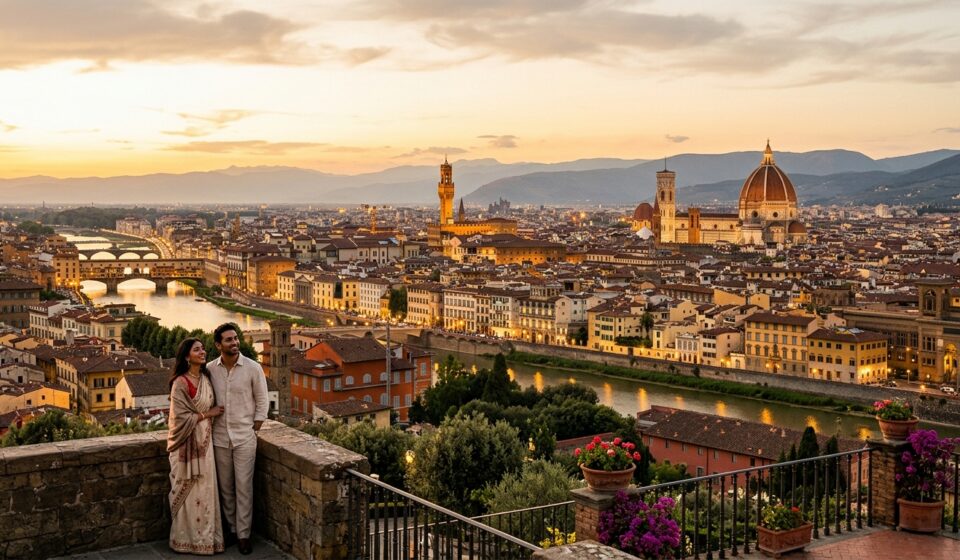
- Ponte Vecchio — the only Florentine bridge not destroyed during WWII, lined with the goldsmiths and jewellers who have occupied its shops since the 16th century. The view of the Arno from Ponte Vecchio at golden hour — the water turning copper, the buildings lining the banks, the hills beyond the city — is one of Italy’s most beautiful moments. Free to walk across.
- Piazzale Michelangelo — a hilltop piazza 15 minutes walk (or taxi) above the city with a 360-degree panoramic view of Florence, the Arno, and the surrounding Tuscan hills. Best visited at sunset. Free. Take the stairs from the Ponte San Niccolò area for the scenic route up.
- Oltrarno neighbourhood — the neighbourhood south of the Arno, less touristy than the historic centre, with artisan workshops, small restaurants, and the Boboli Gardens behind the Pitti Palace. The most genuinely Florentine part of the city for a morning walk.
Venice – The Floating City
Venice is unlike any other city in the world — 118 small islands connected by 400 bridges and separated by 150 canals, with no roads and no cars. The only way to navigate is on foot or by boat. Everything that would be ordinary in another city becomes extraordinary here — going to the supermarket involves crossing three bridges, the postman travels by boat, and the streets flood twice a day at high tide (acqua alta). Venice is slowly sinking (approximately 2mm per year) and there is an urgency to seeing it that other cities do not have. Go now, while it still looks exactly like this.
Must-do in Venice:
- St. Mark’s Square and Basilica — the ceremonial heart of the Venetian Republic. The Basilica di San Marco is a 9th-century Byzantine masterpiece covered in 8,000 square metres of golden mosaics. Entry to the Basilica is free — the museum sections and terrace have a fee (approximately ₹840). Arrive early morning (Basilica opens at 9 AM) before the cruise-ship crowds arrive around 10 AM. St. Mark’s Square itself is free and worth sitting in (expensive cafe prices — stand at the counter or sit elsewhere).
- Gondola ride — the most iconic Venice experience and the most expensive for what it is. A standard 30-minute gondola ride costs approximately €80 to €100 per gondola (seats 6 people) during daytime — approximately ₹8,400 to ₹10,500 — going up to €120 at night. Shared gondola rides with strangers reduce the per-person cost. The experience is genuinely unique — being propelled silently through narrow canals too small for any other boat, with the gondolier navigating by skill and occasional shout to other gondoliers at blind corners — it is worth doing once. Negotiate the price and agree the route before boarding.
- Doge’s Palace (Palazzo Ducale) — the Gothic palace that was the centre of Venetian government for 1,000 years. The Council Chamber ceiling — Tintoretto’s Paradise, the largest oil painting in the world — is extraordinary. The Bridge of Sighs (the enclosed bridge over the canal connecting the palace to the prison, where prisoners took their last look at Venice before incarceration) is one of Venice’s most photographed features, best seen from the bridge on the Riva degli Schiavoni. Entry approximately ₹1,680.
- Rialto Bridge and Market — the most famous bridge in Venice and historically its commercial heart. The Rialto Market adjacent (fish market and produce market) is one of Italy’s most vibrant and best visited at 7 to 8 AM before the tourist crowds arrive. Free to walk across the bridge.
- Murano Island glass-blowing — a 10-minute vaporetto (water bus) from Venice, Murano is where Venetian glassmakers have worked since 1291. Watching a master glassblower create a vase in 60 seconds from a molten blob of glass is genuinely fascinating. Most studios offer free demonstrations. Vaporetto: approximately ₹840 for a 24-hour pass covering all lines.
- Getting lost — the best Venice experience requires no booking and no money. Leave the main tourist routes (the route from the station to St. Mark’s Square is by far the most crowded path) and walk without purpose into the narrower lanes (calli). You will find neighbourhood squares (campi) with children playing, local bakeries (pasticcerie) selling pastries no tourist has photographed, and the particular silence of a city with no traffic that is Venice’s most distinctive quality.
Amalfi Coast – Italy’s Most Beautiful Drive
The Amalfi Coast — a 50-km stretch of cliffside towns between Salerno and Sorrento on the Bay of Naples — is Italy’s most dramatic coastal scenery. Coloured houses clinging to vertical cliffs above a turquoise sea, terraced lemon groves, and narrow roads carved into the rock that feel genuinely implausible. The key towns are Positano (the most picturesque and most photographed), Amalfi (the main town with a beautiful 9th-century cathedral), and Ravello (a hilltop village above the coast with extraordinary views).
The Amalfi Coast is best accessed from Naples (45 minutes to Sorrento by train, then ferry or bus along the coast) and works as a 2 to 3-day addition to a Rome-focused itinerary. It is significantly easier to do as a day trip or with a private driver than by attempting to drive the coast road yourself in peak season — the road is genuinely narrow, traffic is heavy, and parking is nearly impossible.
Tuscany – Vineyards, Hill Towns, and Cypress Trees
The Tuscany countryside between Florence and Siena — rolling hills covered in vineyards, olive groves, and cypress trees, punctuated by medieval hill towns (Siena, San Gimignano, Montepulciano, Pienza) — is the Italy that all the other Italys are quietly trying to be. A day trip from Florence to Siena and San Gimignano by bus or private car is one of the most rewarding Italy experiences, particularly in October during the grape harvest when the vineyards are at their most colourful and the local wineries are most welcoming.
Cinque Terre – Italy’s Famous Coastal Villages
Five brightly coloured coastal villages (Monterosso, Vernazza, Corniglia, Manarola, and Riomaggiore) connected by coastal walking trails on the Italian Riviera, 3 hours from Florence by train. The Cinque Terre card (daily or multi-day) covers the hiking trails and the train between villages. Best visited as a day trip from Florence or with an overnight stay in one of the villages (book 3 to 4 months ahead in peak season — accommodation is very limited and in high demand).
8-Day Italy Itinerary for Indians 2026: The Classic Rome-Florence-Venice Circuit
Day 1 – Arrive Rome + Trastevere Evening
- Arrive at Rome Fiumicino Airport (FCO). Take the Leonardo Express train to Roma Termini (32 minutes, ₹1,500). Alternatively, the cheaper FL1 regional train to Trastevere station (60 minutes, ₹350) if your hotel is in Trastevere or near the centre.
- Check in — stay in the historic centre (near Termini, Colosseum, Pantheon, or Trastevere) for best walking access to everything.
- Evening: first walk through the Trastevere neighbourhood — dinner at a local trattoria. This is where Romans eat, not tourists. Budget ₹800 to ₹1,500 for a full dinner with wine per person.
Day 2 – Rome: Colosseum + Roman Forum + Palatine Hill
- Early morning (9 AM entry): Colosseum and Roman Forum. Pre-booked tickets, arrive at opening. Allow the full morning — 3 to 4 hours for the complete complex.
- Afternoon: Capitoline Museums (the world’s oldest public museums, containing Marcus Aurelius’ original equestrian statue and extraordinary Roman sculptures). Entry approximately ₹1,300.
- Evening: walk to Circus Maximus, then along the Tiber, arriving at Castel Sant’Angelo (the cylindrical mausoleum converted to a fortress and then a museum — extraordinary view of St. Peter’s from the top). Entry approximately ₹1,050.
- Dinner in Prati neighbourhood (across the Tiber from the Vatican) — excellent traditional Roman restaurants, less touristy than Trastevere.
Day 3 – Rome: Vatican + Trevi + Pantheon
- Early morning (8 AM entry, booked online): Vatican Museums and Sistine Chapel. Allow 3 to 4 hours — go slowly through the Raphael Rooms and the Gallery of Maps before the Sistine Chapel.
- St. Peter’s Basilica immediately after Vatican Museums (same complex, different entrance) — Pietà, the dome climb.
- Afternoon: walk from Piazza del Popolo down the Via del Corso to the Pantheon and Piazza della Rotonda. Coffee inside the square.
- Trevi Fountain — late afternoon (4 to 5 PM is better than midday — still crowded but the light is better for photographs).
- Evening: Spanish Steps at sunset, dinner in the Campo de’ Fiori area.
Day 4 – Rome to Florence by Frecciarossa
- Morning: take the Frecciarossa high-speed train from Roma Termini to Firenze Santa Maria Novella — 1 hour 30 minutes. Book this before leaving India for best fares.
- Check in at Florence hotel — stay in the Oltrarno or near the Duomo for best walking access.
- Afternoon: first walk around Florence — Piazza della Signoria (the outdoor sculpture gallery that is the heart of Florence, free), Ponte Vecchio, the exterior of the Duomo at golden hour.
- Piazzale Michelangelo at sunset — the definitive Florence view. Walk up (15 minutes from the city centre, longer from the Duomo area) or take a taxi.
- Dinner in Oltrarno — Florence’s most authentic neighbourhood for traditional Tuscan food. Ribollita (bread and vegetable soup), pappa al pomodoro, bistecca alla Fiorentina (the famous T-bone steak for meat eaters — approximately ₹4,000 to ₹8,000 per kg, sold by weight).
Day 5 – Florence: Uffizi + David + Duomo
- Morning (8:15 AM entry, pre-booked): Uffizi Gallery. Allow 3 to 4 hours. Do not try to see everything — find the Botticelli room, then the Michelangelo rooms, then wander as interest dictates.
- Accademia Gallery (Michelangelo’s David) — book separately. Allow 1 to 1.5 hours.
- Afternoon: Brunelleschi’s Dome climb (pre-book — timed entry slots fill up fast). The view from the top is one of Italy’s finest.
- Boboli Gardens behind the Pitti Palace — a large formal garden on the hill behind the palace with excellent city views. Entry approximately ₹1,680 combined with the palace.
Day 6 – Tuscany Day Trip (Siena + San Gimignano)
- Morning bus from Florence to Siena (1.5 hours, approximately ₹600 each way — book at Sena or Flixbus). Siena’s historic centre is one of the best preserved medieval cities in Europe — the Piazza del Campo (the scallop-shell shaped central square where the Palio horse race has been run since 1283) and the Siena Cathedral are the highlights.
- Afternoon: bus from Siena to San Gimignano (45 minutes) — a medieval hill town famous for its 14 surviving medieval towers (originally there were 72 — towers were status symbols, each representing a wealthy family’s power). Walk the walls, eat Vernaccia wine and wild boar pasta, look at the view from the walls over Tuscany.
- Bus back to Florence by evening.
Day 7 – Florence to Venice by Frecciarossa
- Morning: Frecciarossa from Firenze Santa Maria Novella to Venezia Santa Lucia — 2 hours 10 minutes. Book in advance.
- Arrive Venice — exit the station onto the Grand Canal. The shock of the first view of Venice — water where there should be road, palaces where there should be shops — is one of the great travel moments.
- Water bus (vaporetto) from the station to your hotel — buy a 24-hour pass (approximately ₹1,800) which covers all vaporetto lines including Murano and Burano.
- Afternoon: get lost in Venice. Start walking away from the tourist route (away from the station, away from St. Mark’s) and let the city reveal itself.
- Evening: Rialto Bridge at sunset, dinner in a local osteria near the Rialto Market.
Day 8 – Venice: St Mark’s + Gondola + Murano + Departure
- Early morning (9 AM): St. Mark’s Basilica — arrive at opening to beat the crowds. Spend 45 minutes.
- Doge’s Palace — immediately adjacent. Allow 2 hours for the full palace including the Bridge of Sighs passage.
- Mid-morning: Gondola ride (30 minutes through the back canals — avoid the Grand Canal routes which are busier and less atmospheric).
- Late morning: vaporetto to Murano Island — watch a glass-blowing demonstration, browse the glass shops.
- Afternoon: return to Venice main island. Final espresso standing at a bar counter (the correct Italian way).
- Departure by train or water taxi to Marco Polo Airport for flight home. Book the vaporetto to the airport (Alilaguna line, approximately ₹1,400 per person) or water taxi (approximately ₹8,400 per boat — shares possible at the dock for a lower per-person cost).
Italian Food: What Indian Travellers Should Know
Italian food is one of the world’s great culinary traditions — and significantly more accessible for Indian palates than most other European cuisines. The emphasis on fresh ingredients, olive oil, garlic, tomatoes, and herbs creates a flavour profile that Indian travellers find simultaneously familiar and exciting.
For vegetarian Indian travellers: Italy is remarkably vegetarian-friendly. Pizza margherita (the original — tomato, mozzarella, basil — invented in Naples in 1889) is vegetarian. Pasta al pomodoro, pasta al pesto, spaghetti aglio e olio (olive oil and garlic), cacio e pepe (cheese and black pepper — a Roman specialty), pasta arrabiata — all vegetarian. Risotto (in mushroom or saffron versions), caprese salad (tomato, mozzarella, basil), bruschetta, panzanella — all vegetarian. Italy may be the most vegetarian-friendly country in Western Europe for travellers accustomed to a plant-based diet.
One caveat for strict vegetarians: some Italian cheeses (including Parmesan/Parmigiano-Reggiano and Pecorino Romano) are made with animal rennet and are technically not vegetarian. Pesto traditionally contains Parmesan. Ask specifically if this matters to you — Italian restaurant staff in tourist areas are accustomed to the question.
Must-eat Italian food experiences:
- Gelato — real gelato (artigianale) is made fresh daily and has a smooth, dense texture completely unlike supermarket ice cream. Look for gelaterias where the gelato is stored in covered metal containers (not piled up in bright mounds in plastic tubs — the latter is industrially produced). Flavours to try: pistachio (pistacchio), hazelnut (nocciola), Sicilian almond, and stracciatella. Cost: ₹250 to ₹500 for a small cup or cone.
- Pizza Napoletana in Naples — the original pizza, eaten in its city of birth. Soft, slightly charred crust, simple high-quality tomato sauce, fresh buffalo mozzarella. At Pizzeria da Michele or Sorbillo in Naples — the two institutions. Dinner for two with two pizzas: ₹800 to ₹1,500.
- Espresso at the bar — Italy’s coffee culture is specific and wonderful. Stand at the bar (barlettiere position) rather than sitting at a table — prices are significantly lower standing. Order “un caffè” for an espresso (the default), “un cappuccino” (only at breakfast — ordering a cappuccino after midday marks you as a tourist), or “un macchiato” (espresso with a spot of milk). Cost standing: ₹100 to ₹180.
- Aperitivo — between 6 and 8 PM, Italians drink Aperol Spritz (prosecco, Aperol, and soda) or Negroni with free bar snacks at most bars — in Milan and Turin, the aperitivo spread can amount to a light meal. Cost: ₹600 to ₹1,200 for a drink including the snack spread.
- Truffle experiences in Tuscany — Tuscany’s white and black truffles are among the world’s most prized. A truffle pasta (tagliolini al tartufo) in a good Tuscan restaurant is an extraordinary experience. Cost: ₹2,000 to ₹5,000 per dish depending on the quantity and quality of truffle.
Practical Tips for Indians Visiting Italy in 2026
Pre-book Vatican Museums and the Colosseum before anything else. These two sites see the longest queues in Italy — 2 to 3 hours in peak season is not unusual for walk-up entry. Online booking gives you skip-the-line access and specific entry time slots. Book at museivaticani.va for the Vatican and coopculture.it for the Colosseum. Do this before booking your flights — know your Rome dates first, then book attraction slots.
Book Italian inter-city trains on trenitalia.com or italotreno.it at least 60 days in advance. The cheapest early-bird fares (called Super Economy on Trenitalia) sell out and are priced at 40 to 60% below the same-day price. The Rome-Florence and Florence-Venice Frecciarossa routes have many departures daily — there is no need to be rigid on your departure time, but buy tickets as soon as your hotel dates are confirmed.
Stay in centrally located hotels. Italy’s most valuable accommodation investment is location — a mid-range hotel within walking distance of the historic centre saves on transport costs and saves the time of commuting to sights. In Rome, the Trastevere and Navona/Pantheon areas are ideal. In Florence, staying near the Duomo or Oltrarno puts everything within a 15-minute walk. In Venice, staying on the main island (rather than Mestre on the mainland) is non-negotiable for the full experience.
The euro is the currency – carry some cash. Italy uses the euro. Most restaurants, hotels, and large shops accept international cards. However, smaller trattorias, local markets, gelaterias, and taxis sometimes prefer cash. Keep €50 to €100 in cash for any given day. Withdraw from ATMs (Unicredit and Intesa Sanpaolo ATMs give better rates than the orange Euronet machines).
Venice flooding (acqua alta) – plan for it between October and January. Venice experiences regular tidal flooding, particularly between October and January. The city provides rubber boots for rent and elevated walkways (passerelle) during flooding events. It is genuinely part of the Venice experience and rarely prevents sightseeing — but carry waterproof shoes or be prepared to buy disposable rubber overshoes from street vendors (approximately €5). Check the tidal forecast on the Venice municipality website when arriving in October or November.
Dress codes are enforced at Italian churches. All Italian churches — including St. Peter’s Basilica and St. Mark’s in Venice — require covered shoulders and knees. Wearing shorts and a sleeveless top without a scarf will result in being turned away at the entrance. Carry a light scarf or shawl in your bag throughout Italy. Many major churches provide paper coverings at the entrance, but having your own is cleaner and more comfortable.
Italian restaurants have a cover charge (coperto). Most Italian restaurants charge a coperto — a fixed cover charge of €1 to €3 per person that appears automatically on the bill and is separate from the service charge. This is entirely legal and normal — it is not a scam. Factor it into your meal budget.
Frequently Asked Questions – Italy Trip from India 2026
How much does an Italy trip from India cost in 2026?
A comfortable 10-day Italy trip from India costs between ₹1.6 lakh and ₹2.5 lakh per person including return flights (₹45,000 to ₹90,000), Schengen visa (₹11,500 to ₹15,000), 9 nights in 3-star hotels (₹40,000 to ₹70,000), inter-city trains, food, and sightseeing. Budget travellers using hostels and cooking some meals can do 10 days for ₹1.2 to ₹1.5 lakh. Luxury travellers with 4 to 5-star hotels and fine dining should budget ₹3.5 to ₹5 lakh per person.
Do Indians need a visa for Italy in 2026?
Yes. Indian passport holders need a Schengen tourist visa for Italy. The embassy fee is €90 (~₹9,400) plus VFS service charges of ₹1,933 to ₹3,111. Mandatory travel insurance with minimum €30,000 coverage is required. Processing takes 15 to 30 working days in 2026 — apply 6 to 8 weeks before travel. Apply through VFS Italy if Italy is your sole Schengen destination. There is no e-Visa or visa-on-arrival option for India-Italy travel.
How many days are enough for Italy?
8 to 10 days is ideal for a first Italy trip covering Rome (3 nights), Florence (2 nights), and Venice (2 nights) with travel days. 10 to 12 days allows you to add the Amalfi Coast (accessed from Naples, 1.5 hours from Rome by Frecciarossa) or a Tuscany countryside day trip from Florence. 7 days is the absolute minimum for the Rome-Florence-Venice circuit and requires careful pacing. Two weeks gives you the freedom to add Cinque Terre, the Italian lakes (Como, Maggiore), or Sicily.
Are there direct flights from India to Italy?
Yes — Air India operates direct (non-stop) flights from Delhi to Rome Fiumicino (FCO). This is one of very few non-stop connections to Italy from India and significantly reduces total journey time compared to connecting options via Gulf or other European hubs. Most Indian travellers flying from Mumbai, Bangalore, Chennai, Hyderabad, or Kolkata connect through Istanbul (Turkish Airlines — often the most competitively priced), Dubai (Emirates), Doha (Qatar Airways), or Frankfurt (Lufthansa). Milan Malpensa (MXP) is an alternative entry airport for northern Italy circuits.
What is the best Italian city for a first-time visitor?
Rome is the essential starting point for any first Italy trip — it has the highest concentration of extraordinary ancient, medieval, and Renaissance history of any city in the world and could reasonably absorb a week on its own. Florence is the best city for art lovers — the Uffizi alone justifies the trip. Venice is the most immediately distinctive and visually extraordinary — there is nowhere else like it on earth. All three are necessary components of a complete Italy first trip. If forced to choose only one: Rome.
Is Italy vegetarian-friendly for Indian travellers?
Yes — Italy is one of the most vegetarian-friendly countries in Europe. Pizza, pasta, risotto, and traditional vegetable dishes provide extensive options. Pizza margherita, pasta al pomodoro, spaghetti aglio e olio, pasta al pesto, caprese salad, bruschetta, and numerous antipasti are all vegetarian. Strict vegans and Jains will need to navigate more carefully — some Italian cheeses use animal rennet (Parmesan, Pecorino) and pesto traditionally contains Parmesan. Indian restaurants exist in Rome, Milan, and Florence for those who need a familiar meal.
Plan Your Italy Trip with TravelDham
Italy looks straightforward to plan and reveals its complexity only once you start — the Vatican booking system that confuses even experienced travellers, the Frecciarossa train network where booking 90 days ahead saves ₹5,000 per person per leg, the VFS Italy appointment slot scarcity in spring 2026, and the Florence hotel market where anything worth staying in within walking distance of the Duomo books out months ahead in April and May.
TravelDham builds fully customised Italy FIT trips for Indian travellers – handling the Schengen visa documentation and VFS timing, booking Vatican Museums and Colosseum in advance, procuring the best Frecciarossa fares, selecting centrally located hotels in Rome, Florence, and Venice matched to your budget and preferences, building the open-jaw flight option to eliminate backtracking, and arranging Schengen-compliant travel insurance. We also coordinate add-ons — the Amalfi Coast, Tuscany countryside days, Cinque Terre, and the Italian lakes — for travellers who want more than the standard circuit.
Whether you are planning a first 8-day Rome-Florence-Venice trip, a 12-day Italy circuit with Amalfi and Tuscany, a honeymoon combining Venice and Positano, or a 14-day grand Italy tour including Sicily — TravelDham builds it from scratch around your group, travel dates, and the Italy experiences that matter most to you.
Contact TravelDham today for a free Italy itinerary and quote. We respond within 24 hours with a detailed plan, transparent pricing, and Vatican booking availability for your specific travel dates.