
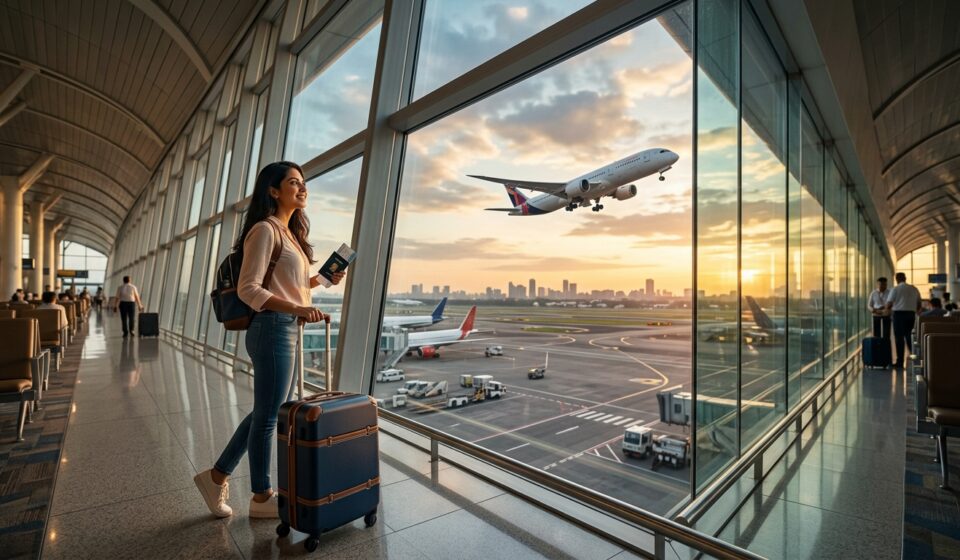
First International Trip from India 2026: Complete Checklist, Documents, Money & Airport Guide | TravelDham

Planning your first international trip from India in 2026?
The four most common first-timer mistakes are: not checking passport validity (most countries require at least 6 months from your date of entry — strictly enforced at check-in), not buying travel insurance (a single medical emergency abroad without insurance can cost ₹5 to ₹50 lakh), not carrying any local currency (UPI and Indian debit cards do not work in most international destinations without advance preparation), and arriving too late for international check-in (arrive at least 3 hours before your international departure — immigration, security, and boarding procedures are significantly more involved than domestic flights). Get these four things right and the rest of the trip is significantly more manageable.
87% of Indian Gen Z travellers report finding the process of booking an international trip overwhelming — compared to 52% globally. The anxiety is entirely understandable. The paperwork feels like a lot. The airport processes feel unfamiliar. The currency is different. The phone might not work. The food might not be what you expect. These are all real concerns, and this guide addresses every single one of them — not with generic reassurance but with specific, actionable information that makes the first international trip from India a confident, enjoyable experience rather than a stressful one.
Step 1 – Passport: Check This Before Anything Else
Your passport is the foundation of every international trip. Before you book flights, before you research destinations, before you do anything else — check your passport.
| Check | Why It Matters | What to Do |
|---|---|---|
| 6-month validity rule | Most countries (and almost all airlines at check-in) require your passport to be valid for at least 6 months beyond your intended date of entry. If your passport expires in less than 6 months from your travel date, you may be denied boarding — even if your visa is valid. | Calculate 6 months forward from your travel date. If your passport expires before that date — apply for renewal immediately. Standard renewal takes 30 to 45 days; Tatkaal takes 7 to 14 days. |
| Blank pages | Most countries require a minimum of 2 blank pages in your passport for stamps. Some require more. | Count your blank pages. If you have fewer than 4 to 5, consider renewal — especially if you plan to travel regularly. |
| Physical condition | A damaged, torn, or water-stained passport can be rejected by immigration even if all the information is readable. | If your passport has any physical damage, apply for a replacement before travel. |
| Name consistency | Your name on your passport must exactly match your name on your flight ticket and visa application. Even a single name mismatch (Priya vs Priyaa) can cause problems at check-in. | Check your passport name against your PAN card and Aadhaar. If inconsistent, contact the Passport Seva Kendra before applying for a visa. |
💡 The new Indian e-Passport (2026): India began issuing chip-enabled biometric e-passports from 2025 with the rollout continuing through 2026. If you are applying for a new or renewed passport in 2026, you may receive an e-passport depending on your Passport Office’s rollout status. The e-passport has your biometric data on a microchip embedded in the back cover — this enables faster clearance at e-gates in many international airports.
Step 2 – Visa: Understand What You Need Before You Book Flights
This is where most first-time travellers get the order wrong — they book flights first, then start researching the visa, and then discover the processing time is longer than expected. The correct order is: research visa requirements → confirm eligibility and processing time → book flights around the visa timeline → start the visa application.
Categories of Entry for Indian Passport Holders
| Category | Countries (Examples) | Process | Cost |
|---|---|---|---|
| Visa-Free | Maldives, Nepal, Bhutan (Aadhaar sufficient for Bhutan) | Just arrive — no advance application | Free |
| Visa on Arrival (VOA) | Sri Lanka, Mauritius, Seychelles, some African countries | Get visa at the airport immigration counter on arrival. Have required documents ready. | Varies by country |
| e-Visa (online, advance) | Thailand (60-day visa-free + TDAC form), Malaysia (visa-free + MDAC form), Vietnam (e-Visa $25), Turkey (e-Visa $50 if eligible), Kenya, Australia | Apply online before departure. Receive digital approval by email. Show on phone on arrival. | Varies — typically USD 15 to USD 100 |
| Embassy / Consulate Visa | Schengen countries (Europe), UK, USA, Canada, China, Japan | Physical application at embassy or VFS centre. In-person appointment. Passport submitted. Processing: 10 to 90 days depending on country. | Varies — €90 for Schengen, $435 for USA |
Key visa processing timelines in 2026:
- UAE (Dubai): e-Visa in 3 to 5 working days
- Singapore: e-Visa in 3 to 5 working days
- Schengen (Europe): 15 to 30 working days — apply 6 to 8 weeks before travel
- UK: 15 to 20 working days
- USA (B1/B2): Interview appointment wait 1 to 15 months depending on consulate (Chennai is fastest at 1 to 2 months in 2026)
- Japan: 5 to 10 working days
- Australia: 15 to 25 working days
💡 Never book non-refundable flights before your visa is approved. Use tentative or refundable bookings for visa applications. Book confirmed non-refundable tickets only after your passport with the visa stamp (or your e-Visa approval email) is in your hands.
Step 3 – Travel Insurance: Not Optional
Travel insurance is the single most undervalued preparation item for Indian international travellers — and the one that causes the most serious financial damage when skipped. Here is what you need to know:
What Travel Insurance Covers
- Medical emergencies abroad — hospitalisation, surgery, ICU, ambulance
- Emergency medical evacuation back to India
- Trip cancellation for covered reasons
- Flight delay and missed connection expenses
- Baggage loss or delay
- Loss of passport abroad
- Personal liability (accidental damage to property or injury to a third party)
What It Costs
- Asia (Dubai, Thailand, Bali, Singapore): ₹600 to ₹1,200 for a 14-day trip per person
- Europe (Schengen mandatory, min €30,000 coverage): ₹900 to ₹1,800 for 14 days per person
- USA / Canada / Australia: ₹1,500 to ₹3,500 for 14 days per person — highest medical costs in the world, never travel here without insurance
When It Is Mandatory
Travel insurance is legally mandatory for every Schengen visa application — minimum €30,000 coverage valid across all Schengen states. Applications without it are automatically rejected. For all other destinations it is not legally required but deeply advisable.
Best Indian insurers for international travel: Tata AIG, ICICI Lombard, Bajaj Allianz, HDFC Ergo. Buy directly from their websites — cheaper than through travel agents or VFS add-on services. Buy as soon as your trip is confirmed — trip cancellation cover starts from purchase date, not travel date.
Step 4 – Money Abroad: Cards, Cash, and Forex
This is the area that causes the most confusion and the most avoidable on-trip stress. Here is how money actually works when you travel internationally from India:
UPI Abroad: The Reality
UPI currently works in a limited number of countries (Nepal, Bhutan, Singapore, UAE, Mauritius, Sri Lanka, France, and a few others in 2026). For the majority of international destinations — including Thailand, Bali, Vietnam, Japan, Malaysia, Greece, Italy, Turkey, and the USA — UPI does not work. Do not plan to rely on UPI for anything outside India without first confirming it works at your specific destination.
Your Options for Spending Money Abroad
| Option | How It Works | Best For | Caution |
|---|---|---|---|
| Forex card (multi-currency) | Pre-load foreign currency at a known exchange rate before travel. Use like a debit card internationally. | Most destinations — best combination of safety and exchange rate | Load currency before departure. Some cards charge ATM withdrawal fees. |
| International debit / credit card | Your existing Indian bank card with international access enabled. Works at most international ATMs and shops. | Backup option — widely accepted | Forex markup fees (2.5 to 5%) on every transaction. Enable international transactions before travel. |
| Foreign currency cash | Exchange INR to local currency (USD, EUR, AED, THB, etc.) at a forex counter in India before departure. | Markets, street food, taxis, small vendors, tips | Better rates in India than at foreign airports. Carry USD or EUR as backup anywhere in the world. |
| ATM abroad | Withdraw local currency using your Indian debit card at foreign ATMs. | Anywhere you need cash quickly | Use bank ATMs (Visa/Mastercard network) not independent ATMs. Check for international withdrawal fees. |
How Much Currency to Carry
- Always carry some local currency cash before landing — especially for the taxi, bus, or train from the airport to your hotel
- Airport forex counters give worse rates than city money changers or your forex card rate — exchange the minimum needed at the airport
- Carry USD 100 to 200 in cash as an emergency backup regardless of your primary payment method — USD is accepted almost everywhere in the world as a backup currency
- In many Southeast Asian destinations (Thailand, Vietnam, Bali), US Dollars exchanged locally give better rates than pre-loading forex cards — research your specific destination before departure
The Duty-Free Allowance on Return
When returning to India from any international destination, you are allowed to bring goods worth up to ₹75,000 (the updated duty-free allowance for 2026) without paying customs duty. Goods above this value are subject to customs duty. Declare honestly at the red channel if you are above the limit — attempting to conceal dutiable goods is a customs offence with significant penalties.
Step 5 – Documents Checklist: What to Carry
Carry both physical copies and digital backups of every document. A folder or document wallet for the physical copies and a secure cloud folder (Google Drive, iCloud) or email to yourself for digital backups.
Essential Documents — Every International Trip
- ✅ Original passport (6+ months validity, 2+ blank pages)
- ✅ Visa — physical sticker in passport, printed e-Visa approval, or Visa Issuance Notice on phone (depends on country and visa type)
- ✅ Return flight ticket — printed or saved on phone (offline)
- ✅ Hotel booking confirmation for at least the first night (some immigration officers ask for this)
- ✅ Travel insurance certificate — with the insurer’s 24/7 international helpline number written separately and saved on your phone
- ✅ Emergency contact list — your family’s phone numbers, your hotel addresses, your travel agent’s contact
- ✅ Photocopies of all the above — kept separately from the originals (in checked luggage while originals travel in hand luggage)
Country-Specific Documents to Carry
- For Thailand: TDAC QR code (completed within 72 hours before arrival at tdac.immigration.go.th)
- For Malaysia: MDAC QR code (completed 3 days before arrival at imigresen-online.imi.gov.my)
- For Maldives: IMUGA Travel Declaration QR code (completed within 96 hours before arrival at imuga.immigration.gov.mv)
- For Bali: e-VOA approval email + Bali Tourist Levy QR code (lovebali.baliprov.go.id) + All Indonesia Arrival Card QR code
- For Japan: Visa Issuance Notice saved on your phone (NOT a printed PDF — Japan’s new system requires digital display)
- For USA: DS-160 confirmation + visa stamp in passport + ESTA if applicable
- For Schengen countries: Visa sticker in passport + travel insurance certificate
Additional Documents Worth Having
- Aadhaar card or any second government ID
- Foreign exchange receipts (some countries’ customs may ask how much foreign currency you are carrying)
- Credit/debit card international PIN (test it before departure — some ATMs abroad require a 4-digit PIN)
- Your doctor’s prescription for any medications you are carrying (essential for controlled medications internationally)
Step 6 – Flight: Before, During, and Arriving
Before Your Flight
- Arrive at the airport 3 hours before departure for international flights — not 2 hours. International check-in, immigration, security, and boarding procedures are significantly more time-consuming than domestic travel. Even if check-in “opens” 3 hours before, be at the terminal by the 3-hour mark.
- Online check-in opens 24 to 48 hours before most international flights — use it. It saves time at the airport and often allows seat selection.
- Know your baggage allowance before packing. Most economy international tickets allow 23 kg of checked baggage and 7 to 8 kg of hand baggage. Excess baggage at the airport is expensive — ₹500 to ₹2,000 per kg depending on the airline and route.
- Download offline maps for your destination before you leave India — Google Maps downloaded offline works without data connection and is invaluable on arrival before you have a local SIM or working data.
- Notify your bank that you are travelling internationally — many Indian bank cards get blocked on first international transaction without prior notification. Do this 2 to 3 days before departure via your bank’s app or customer service.
What Not to Pack in Hand Luggage
- Liquids, gels, and aerosols above 100ml — must go in checked baggage or be discarded at security. Pack toothpaste, sunscreen, shampoo in checked luggage or buy miniatures.
- Sharp objects — scissors, nail files, razors
- Any item that could be mistaken for a weapon in X-ray
- Valuables worth significant amounts in a bag that will be stored in the overhead locker — keep valuables on your person or in a secure inner bag within your hand luggage
At Immigration on Arrival
This is the part that most first-time international travellers feel most anxious about — and it is considerably more straightforward than the anxiety suggests. Here is exactly what happens and what to do:
- Follow the immigration signs (usually “Arrivals” then “Passport Control” or “Immigration”)
- Join the queue for the appropriate channel — “Visitors” or “Foreign Nationals” (not the channel for residents or citizens of that country)
- When you reach the counter: hand over your passport (open to the photo page), visa document, and return ticket if asked
- Answer questions simply and directly — “Purpose of visit?” → “Tourism / Holiday.” “How long will you stay?” → State your actual planned duration. “Where are you staying?” → Name of your first hotel is sufficient.
- Do not volunteer additional information beyond what is asked. Be honest, be direct, be calm.
- Your fingerprints and/or photograph will be taken at immigration in most countries — this is standard procedure, not a cause for concern
- The officer may ask to see your return ticket, hotel booking, or proof of funds. Have these accessible on your phone or in paper form.
💡 The most common reason for being pulled into secondary screening: Vague or inconsistent answers, no return ticket accessible, no hotel booking, or very large amounts of cash. Have your documents organised before you approach the counter — not after.
Step 7 – Mobile Phone and Connectivity Abroad
Your phone abroad is your map, your translator, your booking platform, your emergency contact, and your camera. Setting it up correctly before you leave India is important.
Your Options for Data Abroad
| Option | Cost | Best For | How to Set Up |
|---|---|---|---|
| International roaming on your Indian SIM | ₹500 to ₹3,000 for 7 to 30 days depending on carrier and destination | Short trips, primarily for calls and light data | Activate before departure via Airtel/Jio/BSNL app or customer care. Check if your destination is covered. |
| Local SIM at destination | ₹300 to ₹1,500 for a tourist SIM with 15 to 30 days data | Longer trips, best data value | Buy at the destination airport. AIS/DTAC in Thailand, SingTel in Singapore, du/Etisalat in UAE. Bring passport for SIM registration. |
| eSIM (digital SIM) | ₹500 to ₹2,500 for international data plans | Those with eSIM-compatible phones who want connectivity before landing | Buy online before departure (Airalo, Holafly, Airtel International eSIM). Activates immediately on arrival. |
| Pocket WiFi rental | ₹400 to ₹800 per day | Groups or families sharing one device | Rent online and collect at airport, or rent at destination airport. |
Before You Leave India
- Download Google Maps offline for your destination — essential
- Download Google Translate offline for the local language — invaluable in Japan, Vietnam, Turkey, Greece
- Download your airline app, hotel app, and any transport apps you will use (Grab for Southeast Asia, metro apps for each city)
- Save your hotel address in the local script (Japanese, Thai, Arabic) for showing to taxi drivers
- Screenshot all your booking confirmations — offline access to these is essential if you land with no data
- Set up international transactions on your card via your bank’s app
Step 8 – Health and Medications
Before Your Trip
- Visit your doctor 4 to 6 weeks before travel to any destination with specific health considerations — particularly Southeast Asia (dengue fever risk areas), Africa (malaria prophylaxis), or high-altitude destinations like Ladakh (altitude medication)
- Check if any vaccinations are recommended or required for your destination — typhoid and hepatitis A are commonly recommended for travel from India to certain destinations. Yellow fever vaccination certificate is required for entry to several African and South American countries.
- Get a dental check-up before long international trips — dental costs abroad are very high, and a preventable tooth problem in the middle of a trip is miserable and expensive
Personal Medications
- Carry a full supply plus 7 extra days’ buffer of all regular medications — supply disruption abroad is a genuine risk
- Keep medications in original labelled packaging — particularly important for controlled medications at international customs
- Carry a written prescription and doctor’s letter for all medications in English — essential for customs in any country
- Know the generic (chemical) name of your medications — brand names vary by country and a pharmacist abroad may not recognise your Indian brand name
Basic Medical Kit for International Travel
- Paracetamol (for fever, headache, general pain)
- Ibuprofen or diclofenac (anti-inflammatory)
- ORS sachets (oral rehydration — essential for traveller’s diarrhoea which is extremely common)
- Loperamide / Lopamide (for diarrhoea management on the go)
- Antacids (India to abroad food transition upsets digestion regularly)
- Motion sickness tablets (if prone — ferry rides, winding mountain roads)
- Small first aid kit — bandages, antiseptic cream, adhesive plasters
- Insect repellent (essential for Southeast Asia and Africa)
- Sunscreen SPF 50+ (high-UV destinations — everywhere outdoor-focused)
Step 9 – Packing: Smart, Not Heavy
The Single Most Important Packing Rule
Pack your bag. Then remove 30% of what you packed. You will not use it, you will carry it everywhere, and you will wish you had packed less. This rule applies universally to first-time international travellers.
Hand Luggage – Always Carry These
- Passport and all travel documents (originals)
- Phone, power bank, charging cables, universal travel adapter
- All medications (never check these in)
- A change of clothes and basic toiletries — in case checked luggage is delayed
- Snacks for the flight (Indian flights rarely have vegetarian-appropriate food on all sectors)
- Neck pillow for long-haul flights
- Headphones or earbuds
- Empty water bottle (fill after security)
What to Pack Based on Destination
| Destination Type | Essential Additions |
|---|---|
| Beach destinations (Maldives, Bali, Thailand, Goa) | Swimwear (2 sets), reef-safe sunscreen, flip flops, sarong/cover-up, after-sun lotion |
| European cities (Italy, France, Greece) | Comfortable walking shoes (crucial — cobblestones), light jacket for evenings, modest clothing for churches |
| Cold destinations (Switzerland, Japan winter, Kashmir) | Thermal base layer, down jacket, gloves, warm hat, merino wool socks |
| Religious sites (Southeast Asia, Middle East, India) | Modest clothing, light scarf for women, closed-toe shoes for temple entry |
| High altitude (Ladakh, Swiss Alps, Andes) | Warm layers, wind-resistant jacket, altitude medication if prescribed, sunscreen and UV sunglasses |
💡 Universal adapter: India uses Type D plugs (large round 3-pin). Europe uses Type C and F, UK uses Type G, USA uses Type A, Southeast Asia varies. A universal travel adapter (₹500 to ₹1,200 from any electronics shop or Amazon) is one purchase worth making before your first international trip.
Step 10 – Cultural Etiquette: The Rules That Matter
Understanding basic cultural etiquette prevents the most common tourist mistakes that cause offence, embarrassment, or legal problems abroad. Here are the highest-priority etiquette rules for the countries Indians most commonly visit:
| Country / Region | Most Important Rules |
|---|---|
| Japan | Do not eat while walking. Do not talk on the phone on trains. Remove shoes when entering homes and some restaurants. Never tip (considered rude). Queue discipline is absolute. |
| Dubai and UAE | Public displays of affection are illegal. Dress modestly in public areas (not just at mosques). Never photograph military, government buildings, or people without permission. Alcohol only at licensed venues. |
| Thailand | Never touch or point at religious images. Remove shoes at temple entrances. Never touch monks. Royal family criticism is illegal (lèse-majesté). Dress modestly at temples. |
| Bali / Indonesia | Do not step on or over flower offerings (canang sari) placed on the ground. Dress modestly at temples — sarong and sash provided. Left hand is traditionally unclean — use right hand for passing items. |
| Europe (general) | Queue discipline strictly observed. Keep noise levels down on public transport. Tipping is expected (10 to 15% at restaurants). Do not photograph individuals without permission. Separate waste into correct bins. |
| Turkey | Remove shoes at mosque entrances. Dress modestly at religious sites. Never comment disrespectfully about the Turkish state or military. |
| Greece | Dress modestly at churches. Do not photograph inside Orthodox churches without permission. Pushing queues is not acceptable — respect the line. |
| Southeast Asia (general) | Never point feet at people or religious objects (feet are considered the lowest, most impure part of the body). Smile — it resolves most minor misunderstandings. Bargaining is appropriate in markets but not shops or restaurants. |
Common Mistakes First-Time International Travellers Make (and How to Avoid Them)
1. Booking non-refundable flights before the visa is approved. This is the single most expensive mistake — and the most common. Book flexible or refundable fares until the visa stamp is in your passport. The small price premium for a flexible ticket is minimal compared to the cost of losing a non-refundable flight booking to a rejected visa.
2. Relying on UPI abroad. UPI works in a limited number of countries. For most international destinations, carry a forex card and some local currency cash from the moment you land. Test your international card before departure.
3. Not carrying any local currency for arrival. The journey from the airport to your hotel requires money — for the taxi, the bus, the metro ticket. Carry at least USD 50 to 100 (or the equivalent in local currency) in cash before landing anywhere. Airport exchange is expensive but functional for this initial need.
4. Overpacking checked luggage. Airlines enforce international baggage weight limits at check-in. 23 kg is the standard economy allowance — be under it before you leave home. Overweight baggage fees at the airport are designed to be painful.
5. Not saving documents offline. Your phone is your travel hub — and phones sometimes lose internet access, run out of battery, or malfunction at exactly the wrong moment. Screenshot your hotel address, flight details, visa copy, and insurance certificate. Email them to yourself. Download them. Do not rely entirely on real-time internet access for essential documents.
6. Arriving 90 minutes before an international flight. International check-in closes significantly earlier than domestic. Most airlines close international check-in 60 minutes before departure. With immigration, security, and the walk to the gate — 3 hours at the airport is the correct target for any international departure.
7. Exchanging all currency at the airport. Airport forex counters globally offer the worst exchange rates. Exchange only what you need for immediate arrival expenses at the airport. Change the rest at city money changers, ATMs using your card, or your pre-loaded forex card once you are settled.
8. Not telling your bank about your travel plans. Many Indian bank cards block international transactions as a fraud prevention measure. Inform your bank 2 to 3 days before departure. Do this via the bank app, internet banking, or customer care — take note of your bank’s international helpline number in case your card is blocked abroad.
The First International Trip Checklist: Summary
12 Weeks Before Travel
- Check passport validity (6+ months from travel date)
- Apply for passport renewal if needed (allow 30 to 45 days)
- Research visa requirements for your destination
- For Schengen/UK/Japan/USA — start the visa process before booking non-refundable flights
8 Weeks Before Travel
- Book flights (refundable until visa is confirmed)
- Submit visa application at VFS or embassy
- Book hotels — confirm hotel addresses in local language and save offline
- Buy travel insurance — do this the same day as hotel booking
4 Weeks Before Travel
- Visa confirmed — convert flights to non-refundable if cheaper
- Order forex card or arrange foreign currency
- Inform your bank of travel dates and destination
- Enable international transactions on your debit/credit card
- Book must-do activities in advance (Vatican, Colosseum, Cappadocia balloon, etc.)
- Doctor consultation if needed (altitude medication, vaccinations, prescription refills)
1 Week Before Travel
- Complete any mandatory digital arrival cards (TDAC, MDAC, IMUGA, e-CD depending on destination)
- Download offline maps and Google Translate for destination
- Screenshot all booking confirmations and documents
- Check in online (opens 24 to 48 hours before most flights)
- Pack — then remove 30% of what you packed
- Arrange pet care, house keys, plant watering — the non-travel logistics
Day of Travel
- Arrive at airport 3 hours before international departure
- Carry passport + visa + return ticket + hotel booking + travel insurance certificate in accessible hand luggage
- Have local currency or USD 100 accessible for arrival expenses
- Insurer’s 24/7 international helpline saved in your phone
- Phone charged, power bank charged, travel adapter packed
Frequently Asked Questions – First International Trip from India 2026
What documents do I need for my first international trip from India?
The essential documents for any international trip from India are: valid passport (minimum 6 months validity from your intended entry date, with 2 blank pages), visa for your destination (or evidence of visa on arrival / e-Visa eligibility), confirmed return flight tickets, hotel booking confirmation for at least your first night, and travel insurance certificate. For specific destinations, additional documents are required — TDAC card for Thailand, MDAC for Malaysia, IMUGA for Maldives, e-VOA and Tourist Levy receipt for Bali.
How much money should I carry for my first international trip?
This depends entirely on your destination and trip duration. As a general rule for a 7-day international trip from India: carry USD 100 to 200 in cash as a universal emergency fund (USD is accepted as a backup currency almost everywhere), plus local currency for the first day’s expenses (taxi, meal, small purchases before you find an ATM), plus your forex card or international debit card for larger purchases. For Southeast Asia (Thailand, Bali, Vietnam), USD 50 to 70 per day covers accommodation, food, and activities at a comfortable level. For Europe, budget €80 to €150 per day excluding accommodation.
Does UPI work internationally?
UPI works in a limited and growing number of countries in 2026 — currently including Nepal, Bhutan, Singapore, UAE, Mauritius, Sri Lanka, and France. For the majority of popular Indian international travel destinations — Thailand, Bali, Vietnam, Japan, Malaysia, Greece, Italy, Turkey, and the USA — UPI does not currently work. Carry a forex card, an international debit/credit card, and local currency cash for any destination where UPI support has not been confirmed.
How early should I arrive at the airport for an international flight?
Arrive at the airport 3 hours before your international departure time. International check-in involves queue waiting, check-in itself, document verification, baggage drop, immigration clearance (departure), security screening, and then the walk to your gate. Most international airlines close check-in counters 60 to 75 minutes before departure and the gate 20 to 30 minutes before. Arriving 90 minutes before an international flight is genuinely risky — 3 hours is the correct buffer.
What is the duty-free allowance when returning to India from abroad?
The updated 2026 duty-free allowance for Indian residents returning from international travel is ₹75,000 per person. Goods brought back that exceed this value are subject to customs duty. Alcohol allowance: 2 litres. Tobacco: 100 cigarettes or 25 cigars. Currency: you may bring back up to USD 5,000 equivalent in foreign currency without declaration. Amounts above USD 5,000 in cash must be declared at customs. Declare honestly at the red channel if your goods exceed the allowance.
Is travel insurance really necessary for international travel?
Yes — unconditionally. A single medical emergency abroad without insurance can cost between ₹5 lakh (a minor hospitalisation in Southeast Asia) and ₹50 lakh or more (any serious event in the USA or Europe). Travel insurance for a 14-day trip costs ₹600 to ₹3,500 depending on destination — a tiny fraction of any trip budget. Additionally, travel insurance is legally mandatory for every Schengen visa application. Buy insurance the same day you book your hotels — trip cancellation cover applies from the date of purchase.
What are the easiest international destinations for first-time Indian travellers?
The most accessible first international destinations for Indian passport holders, combining ease of visa, familiarity, and good infrastructure for Indian tourists: Thailand (60-day visa-free, excellent infrastructure for Indians, Hindi and English widely understood in tourist areas), Dubai (e-Visa in 3 to 5 days, large Indian community, Hindi spoken everywhere, familiar food), Singapore (e-Visa in 3 to 5 days, English spoken, very safe and orderly), Bali (e-VOA on arrival, beautiful, good value, increasingly popular with Indians), and Malaysia (visa-free until December 2026). Maldives is also excellent for a first trip — visa-free, completely English-speaking resort environment, no language or cultural navigation required.
Plan Your First International Trip with TravelDham
The difference between a first international trip that is joyful and one that is stressful almost always comes down to the preparation — specifically, knowing the right order to do things in, having someone to ask when a document requirement is unclear, and having a contact you can call when something unexpected happens at the airport at 2 AM.
TravelDham plans first international trips for individuals, couples, families, and groups — handling the visa documentation and VFS appointment timing, booking flights and hotels in the right sequence, arranging travel insurance, providing destination-specific document checklists, and remaining available throughout your trip for any support needed on the ground.
Whether you are planning your first Dubai trip, your first Bali honeymoon, your first Europe adventure, or any other international destination — TravelDham walks you through the process step by step so that by the time you board the plane, everything is in order and the only thing left to do is enjoy the journey.
Contact TravelDham for a free first international trip consultation. Tell us where you want to go and when — we handle the planning from passport check to landing, so your first international trip is the beginning of a lifelong love of travel, not a source of stress.