


A passport serves as the primary instrument for international travel, establishing both nationality and legal identity across global jurisdictions. But still, the administrative protocols governing the maintenance and renewal of this document often present a source of complexity for travelers. A common question arises among frequent travelers: is police verification required for passport renewal? Given the continuous integration of digital databases and risk-based filtering by the consular authorities, the rules for renewal applications diverge significantly from those of fresh passports. Understanding these distinctions is critical for timely planning. For travelers seeking comprehensive assistance with international travel permissions, exploring the TravelDham visa services can simplify the administrative burden. To answer if is police verification required for passport renewal, the Ministry of External Affairs relies on specific criteria.
Key Takeaways
- Default Waiver: If your personal and address details remain unchanged, physical police verification is typically waived (No PV).
- Address Changes Trigger Checks: Changing your residential address during renewal will almost always require active police verification.
- Three-Year Rule: If your passport has been expired for more than three years, a Pre-Police Verification check is mandatory.
- Tatkaal Benefits: Urgent renewals under the Tatkaal scheme usually follow the Post-Police Verification route for faster dispatch.
- Exemptions: Minors (with verified parents) and Government Employees (with Identity Certificates/NOCs) enjoy significant verification relaxations.
Understanding the Legal Framework of Passport Renewal in India
The issuance of passports and travel documents within the Indian territory is regulated exclusively under the Passports Act of 1967. This legislation empowers consular authorities to establish mechanisms for verifying the identity, residential history, and legal standing of every applicant. Over the past decade, the Ministry of External Affairs has significantly modernized these verification protocols. Its basically a shift toward an integrated digital infrastructure where the passport database connects with national judicial databases and state police registries.
Historically, the administration mandated physical police verification for every passport transaction, including renewals. But still, modern administrative reforms have prioritized citizen convenience without compromising national security interests. The goal is to establish a system where law-abiding citizens face minimal disruption, while individuals with pending judicial proceedings or criminal records are flagged systematically. This balanced approach ensures that state resources are utilized efficiently.
Under the current legal framework, the regional passport offices utilize automated assessment tools to categorize renewal applications. To determine if is police verification required for passport renewal under modern statutes, the authorities rely on computerized records rather than manual assessments. Based on the regulatory reforms enacted by the Ministry of External Affairs in 2015, physical verification norms were relaxed for certain low-risk categories of applicants. This policy change recognizes that redundant physical checks impose an unnecessary administrative load on local police forces (a long-overdue priority for busy citizens) and delay the document issuance process for legitimate travelers.
Is Police Verification Required for Passport Renewal?
To address the primary concern, the passport office does not apply a single, uniform rule to all applicants. The exact guidelines concerning whether is police verification required for passport renewal depend heavily on the applicant’s record. In most standard applications, the fundamental query remains: is police verification required for passport renewal?
The Direct Answer and Core Rules
The default protocol of the consular department is to waive the physical check during a renewal, provided there are no changes to the demographic details. Many people wonder, is police verification required for passport renewal if there are no changes in the personal details? Under normal circumstances, if the applicant’s name, parentage, and address remain identical, the renewal is processed under the No Verification (No PV) category. The system relies on the initial verification report compiled during the previous issuance.
However, specific legal triggers can alter this default waiver. If the previous passport has expired, the duration of the expiration plays a critical role. The definitive manual specifies that is police verification required for passport renewal if the previous passport expired more than three years ago. In such scenarios, the long gap in holding an active passport necessitates a fresh validation of the citizen’s residency and legal status to confirm they have not acquired foreign citizenship or committed domestic offenses in the interim.
When Verification is Waived Completely
Certain demographics enjoy institutional exemptions, though not without exceptions. For government employees, the determination of is police verification required for passport renewal relies on the Identity Certificate. When public servants submit a standardized Identity Certificate (Annexure ‘A’) or a formal No Objection Certificate (NOC), physical checks are waived because their departments perform regular background assessments.
Additionally, specific age groups receive distinct considerations. When evaluating the issue, is police verification required for passport renewal for senior citizens, different relaxations apply. Senior citizens over 65 years are granted a waiver if their previous record is clear. Similarly, minors are typically exempt if at least one parent holds a valid passport with a matching address. Applicants frequently query the helpdesk regarding whether is police verification required for passport renewal for minors. The parent’s verified record acts as a sufficient guarantee, eliminating the need for independent field visits. Arguably, this is one of the most efficient features of the updated system.
The table below illustrates the typical outcomes based on the applicant’s profile and requested modifications during the renewal process.
| Applicant Profile and Condition | Verification Category Status | Primary Administrative Rationale |
|---|---|---|
| No changes in details, renewal within validity period | No Verification (No PV) | The system relies on the historical verified records on file |
| Change in residential address or personal details | Required (Pre-PV or Post-PV) | Validation of the newly declared local residence and legal status |
| Passport expired for a period exceeding 3 years | Required (Pre-PV) | Re-establishment of identity and character check after a significant gap |
| Government employees with an authorized NOC | No Verification (No PV) | Prior security clearance completed by the employing department |
| Minor applicants with parents holding valid passports | No Verification (No PV) | The child’s identity is anchored to the parent’s verified status |
The Two Main Modes of Police Verification
When the consular system determines that a check is necessary, the verification is routed through one of two distinct operational channels. These channels are known as Pre-Police Verification (Pre-PV) and Post-Police Verification (Post-PV). The distinction between them directly affects when the physical passport booklet is dispatched.
| Feature | Pre-Police Verification (Pre-PV) | Post-Police Verification (Post-PV) |
|---|---|---|
| Dispatch Timing | Passport is printed and dispatched after verification is complete. | Passport is printed and dispatched before verification is complete. |
| Standard Timelines | Typically completed within 15 days of the appointment. | Dispatched quickly (often within 1–3 days); check happens later. |
| Common Use Cases | Lost/damaged passports, long expirations (>3 years), major profile flags. | Urgent processing (Tatkaal), standard renewals with minor changes. |
| Risk Outcome | Low risk; document is only issued after full validation. | High accountability; passport can be impounded if the report returns adverse. |
Pre-Police Verification Explained
Under the Pre-PV system, the passport is printed and dispatched only after the local police department completes its field checks. While some cases are exempt, the general rule regarding whether is police verification required for passport renewal points to yes if there are major address changes or profile flags. As documented in the official Passport Seva service metrics, standard applications requiring pre-verification are targeted for completion within roughly 15 days of the appointment. This mode is the default for complex cases like lost, damaged, or long-expired passports, guaranteeing that the document is issued only after complete verification.
Post-Police Verification Explained
Post-PV represents an accelerated path designed to prevent administrative delays from disrupting travel plans. Under this mechanism, the regional passport office prints and dispatches the new booklet before the physical verification takes place. This mode is frequently utilized under urgent processing tracks. Although the passport is received quickly, the local police department will still conduct a physical check afterward. If the final report returned by the police contains adverse findings, the passport office is legally authorized to suspend or impound the issued document. This post-issuance check ensures that the urgency of travel is respected without compromising long-term national security.
The Passport Renewal Process and Police Checks
The process of applying for a renewal requires a thorough understanding of the differences between standard and expedited services. This choice directly determines how the administrative verification is managed.
Ordinary Passport Applications vs. Tatkaal Scheme
Applications on the ordinary track are processed sequentially. If the system flags a requirement for a check, the applicant undergoes Pre-PV or Post-PV. A major point of discussion is: is police verification required for passport renewal when applying under the Tatkaal scheme? Under Tatkaal, the process defaults to Post-PV to ensure rapid delivery. The passport is issued swiftly, and verification is completed later. Government records clarify whether is police verification required for passport renewal based on system-generated risk parameters. If the risk score is high due to incomplete historical data, the application returns to the Pre-PV queue regardless of the Tatkaal fee.
Verification Scenarios: Address Change vs. Same Details
An address change is the most common reason why a renewal triggers a check. When an applicant changes their permanent address, the answer to is police verification required for passport renewal is almost always yes. The local police must visit the newly declared residence to verify the applicant’s presence (depending on how the local records are classified).
Conversely, maintaining the identical address from the previous passport booklet significantly reduces the likelihood of an active check. To understand if is police verification required for passport renewal, one must look at the physical verification history of the applicant:
- Clear Previous History: If a clear police report was submitted during the previous issuance cycle and no details changed, renewal is typically approved immediately.
- Resource Allocation: This streamlined approach allows the consular department to focus administrative resources on high-risk profiles.
- Lost or Damaged Passports: Such cases always demand a complete, fresh vetting process due to the potential risks of identity theft.
Required Documentation for Seamless Passport Renewal
Securing a fast and successful renewal depends heavily on the accuracy and completeness of the documents submitted during the appointment at the Passport Seva Kendra. Missing or mismatched documents are the leading cause of application delays and subsequent adverse police reports.
The following list outlines the essential documents required for a standard passport renewal:
- Original Passport: The physical booklet of the current passport, accompanied by self-attested photocopies of the first two and last two pages, including the ECR/Non-ECR page.
- Proof of Present Address: Required if the current residence is different from the address printed on the old passport. Acceptable proofs include:
- An Aadhar Card with the updated address
- Recent utility bills (not older than three months)
- A registered rent agreement or land deed
- An active bank passbook from a scheduled public or private sector bank, containing the applicant’s photograph
- Proof of Date of Birth: Necessary only if there is a modification in the birth details. Standard proofs include a birth certificate or a school leaving certificate.
- Non-ECR Status Proof: For eligible applicants, document proof such as a matriculation certificate or higher educational degrees is required.
Understanding whether is police verification required for passport renewal helps applicants prepare their documents in advance. Having these documents ready ensures that the physical verification process goes smoothly. When the local police officer visits the residence, presenting the exact documents that were uploaded during the online application prevents inconsistencies that could flag the report as incomplete.
Step-by-Step Procedure of a Police Verification Visit
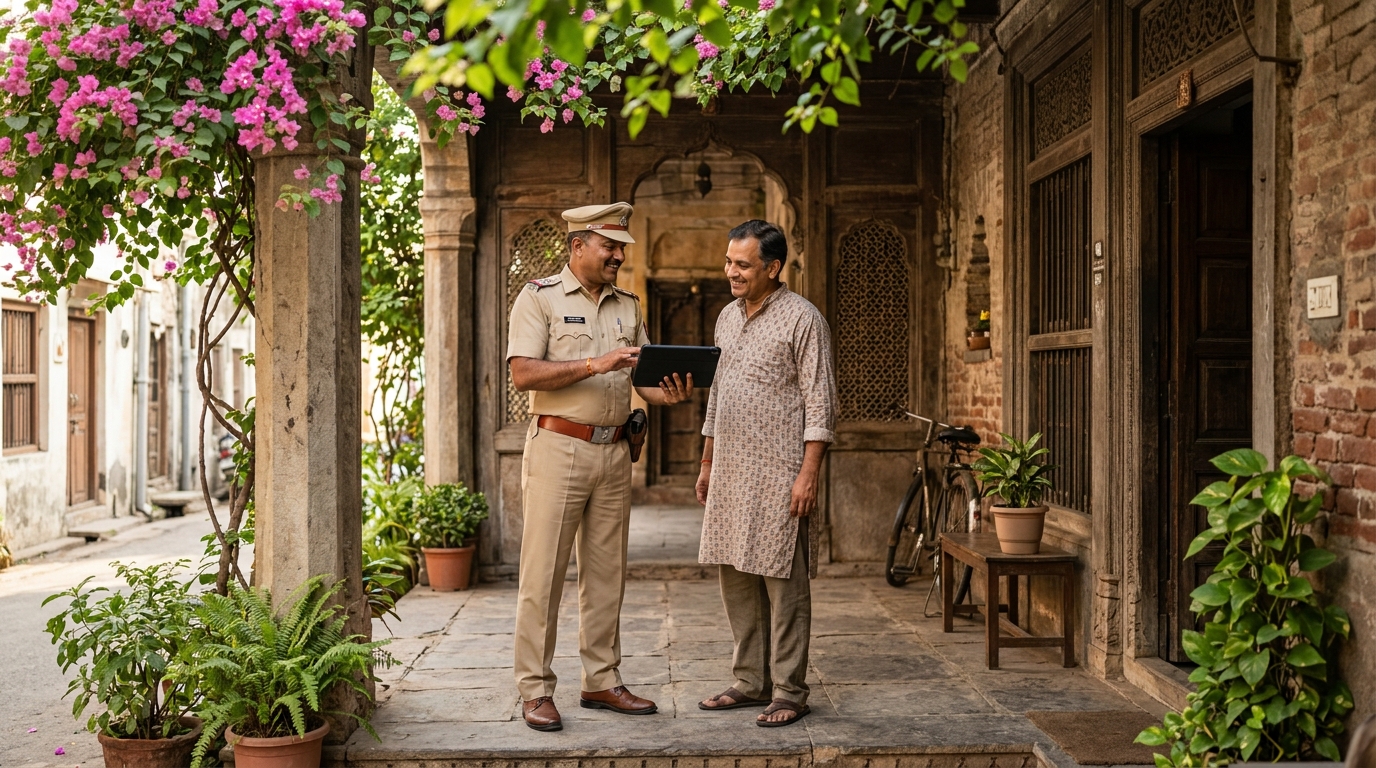
For many applicants, the prospect of a police officer visiting their home can cause unnecessary stress. However, the procedure is highly standardized and operates under clear administrative guidelines.
What to Expect During the Physical Visit
- Data Transmission: The Passport Seva Kendra transmits your application details electronically to the local police station in your residential jurisdiction.
- Officer Assignment: A designated verification officer is assigned to verify your residential address and credentials.
- Scheduling: The officer will typically contact you via your registered mobile number to schedule a convenient time (though unannounced visits are legally permitted).
- Physical Check: The officer visits your physical address to confirm that you reside at the declared location.
Key Questions Asked by the Verifying Officer
During the brief visit, the officer is tasked with establishing residency and basic character credentials. The primary questions asked are straightforward:
- How long have you lived at this specific residence?
- Do you have any ongoing criminal cases, active litigations, or police complaints registered against you?
- What is your profession or current source of livelihood?
The officer will also inspect the physical copies of the uploaded documents and require two local neighbors to sign the verification form as witnesses. These signatures serve as local testimony to the applicant’s residency and character. A systematic review of whether is police verification required for passport renewal shows that clean records and cooperative behavior facilitate faster processing, leading to a quick approval.
Tracking Verification Status and Resolving Issues
Once the physical field visit is complete, the local police station compiles the findings and transmits the Police Verification Report (PVR) back to the regional passport office. Applicants must monitor this transition to ensure no complications arise.
How to Check Status Online
Applicants can track the progress of their verification using the official Passport Seva portal or the mPassport Seva mobile application. The official portal clarifies when is police verification required for passport renewal during the online registration process. The system will display specific status messages such as “Police Verification Report is under review at the Regional Passport Office” or “Police Verification is clear”.
Handling ‘Adverse’ or ‘Incomplete’ Reports
In some instances, the PVR may be marked with an “Adverse” or “Incomplete” status. This typically occurs if the applicant was absent during the officer’s visit, failed to produce the required documents, or if there is a discrepancy in the address details.
To resolve issues around an adverse or incomplete status, applicants should follow this structured pathway:
- Check Notification: The passport office will issue an official notification explaining the reasons for the adverse or incomplete report.
- Schedule an RPO Appointment: Book an appointment with your local Regional Passport Office (RPO) to clarify the discrepancy in person.
- Present Supporting Evidence: Bring all original documents, residential proofs, and explanation letters to satisfy the queries raised.
- Request Re-verification: If the initial visit failed due to your absence, request a fresh police verification through the RPO.
Also, the consular services outline exactly when is police verification required for passport renewal for non-resident Indians.

Conclusion
In conclusion, understanding if is police verification required for passport renewal ensures a smooth application experience. The entire system is structured logically to balance national security with administrative convenience. By carefully preparing the necessary documents, understanding when a verification is likely to be triggered, and cooperating with the local police department during field visits, applicants can navigate the renewal process with complete confidence. This thorough preparation allows travelers to secure their renewed passport quickly, enabling them to focus fully on their future international journeys.