
History is usually recorded in towering monuments, grand palaces, and written manuscripts. But still, some of the most compelling stories of human civilization are preserved in absolute silence. Across the vast geography of the Indian subcontinent, dozens of settlements that once buzzed with trade, laughter, and daily commerce now stand completely vacant. These locations, collectively known as ghost towns in india, represent a quiet intersection of archaeological mystery, geological shifts, and human tragedy. From the windswept sands of the Thar Desert to the storm-battered tips of the southern peninsula, these sites represent the most compelling ghost towns in india, offering a stark look at how quickly a thriving community can vanish. Exploring these silent landscapes reveals not just abandoned brick and mortar, but the fragile relationship between human societies and their environment.
Key Takeaways
- Diverse Triggers: Ghost towns in India were abandoned due to varied factors, including natural disasters, resource depletion, and socio-political tyranny.
- Kuldhara’s Mystical Exit: The mass migration of Paliwal Brahmins from Kuldhara remains one of the world’s most organized secret exoduses.
- Nature’s Reclamation: Locations like Ross Island (now Netaji Subhash Chandra Bose Island) demonstrate the rapid power of tropical vegetation in reclaiming colonial stone ruins.
- Seismic Shifts: Lakhpat showcases how a single earthquake (1819) can permanently reroute a river and collapse a thriving maritime port.
- Visitor Safety: Many sites have strict visit timings enforced by the Archaeological Survey of India (ASI) due to remote locations and safety concerns.
Historical Enigmas: The Phenomenon of Ghost Towns in India
The academic study of deserted settlements (often categorized under the umbrella of dark tourism or urban exploration, abbreviated as urbex) provides immense insight into historical crises. When examining the historical trajectory of ghost towns in india, one discovers that these abandonments are rarely accidental. Instead, they are the direct consequences of severe environmental stress, political upheavals, or sudden economic collapses.
Historically, resource security and environmental shifts have been the primary drivers of demographic shifts among the historical ghost towns in india. These abandonments can be classified into several primary categories:
- Hydrological Failures: Entire cities emptied within weeks when primary water sources dried up, directly linking these phenomena to monsoon patterns.
- Tectonic Disruptions: Sudden physical activity, such as tectonic movements in the Rann of Kutch, disrupted vital river pathways overnight.
- Socio-Economic Escape: Oppressive administrative taxation and feudal tyranny drove entire populations to orchestrate midnight evacuations, abandoning intact stone shells.
While popular legends often attribute these desertions to paranormal curses, the underlying reality is almost always grounded in socio-economic changes. But still, the myths remain powerful. They serve as cultural preservation mechanisms, keeping the memory of these abandoned spaces alive.
Kuldhara: The Haunted Deserted Village of Rajasthan
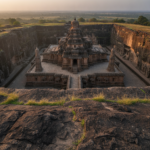
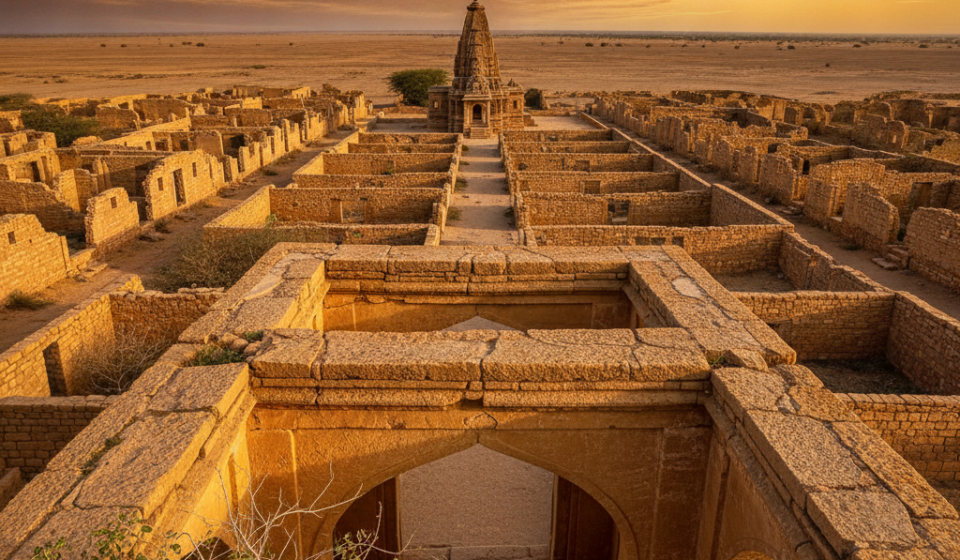
Located roughly 18 kilometers west of the golden fort city of Jaisalmer, the ruins of Kuldhara present one of the most enigmatic archaeological landscapes in Rajasthan. Established in the late 13th century, Kuldhara was once a prosperous township inhabited by the Paliwal Brahmins, a community renowned for agricultural ingenuity. Today, the site consists of hundreds of roofless stone houses, dry wells, and a solitary temple that stands as a silent sentinel over the barren plains. For those interested in exploring this region, booking tailored Jaisalmer travel packages provides a structured way to access this remote archaeological site.
The Sudden Flight of the Paliwal Brahmins
The collapse of Kuldhara occurred overnight in 1825, marking one of the most sudden desertions among all ghost towns in india, when the entire population of the village, along with 84 neighboring settlements, vanished. Historical records and local narratives point toward the tyrannical administration of Salim Singh, the powerful prime minister of the Jaisalmer state. Salim Singh levied exorbitant taxes on the Paliwal community, pushing them to financial ruin.
The final straw was Salim Singh’s demand to marry the village chief’s daughter, threatening the community with dire consequences if they refused. Faced with an existential threat to their honor, the village elders made a collective decision to abandon their ancestral homes. The logistics of this silent mass exodus remains a marvel of community organization that has baffled researchers for decades.
The Undying Curse of Kuldhara
Before embarking on their migration, the Paliwal Brahmins reportedly cast a powerful curse on Kuldhara, decreeing that no one would ever be able to resettle the land. Anyone attempting to inhabit the vacant stone dwellings would face misfortune and death. While skeptics dismiss this curse as a convenient deterrent to keep thieves away from buried ancestral wealth, the curse has successfully preserved the integrity of Kuldhara.
Among the various ghost towns in india, Kuldhara remains uniquely intact because no modern development has encroached upon its borders. The dry desert air has preserved the yellow sandstone facades, leaving a beautifully preserved grid pattern of streets that showcases advanced medieval town planning.

Dhanushkodi: The Sunken City of Tamil Nadu
At the southeastern tip of Pamban Island in Tamil Nadu lies Dhanushkodi, flanked by the Bay of Bengal and the Indian Ocean. This geographical positioning made it a thriving port during the late 19th and early 20th centuries, facilitating trade with Ceylon. Today, Dhanushkodi is a stark, windswept sand spit, punctuated by the skeletal remains of a railway station, a church, and a post office. It stands as a prominent example among the ghost towns in india.
The Tragic Cyclone of 1964
The fate of Dhanushkodi was sealed on the night of December 22, 1964, when a catastrophic category 5 tropical cyclone struck the coast with wind speeds exceeding 280 kilometers per hour. A massive tidal wave, estimated to be over 20 feet high, swept across the narrow island, completely submerging the town.
The disaster’s most tragic aspect was the destruction of the passenger train. The train, carrying 115 passengers and crew members, was engulfed by the storm surge just as it approached the Dhanushkodi station, resulting in zero survivors. The entire town was flattened, and over 1,800 people lost their lives in a matter of hours. Recognizing the extreme vulnerability of the terrain, the Government of Madras declared Dhanushkodi unfit for human habitation, formally sealing its status as one of the permanent ghost towns in india.
A Landscape Frozen in Time
In the decades following the disaster, Dhanushkodi has transformed into a haunting memorial to the power of nature. Visitors are greeted by the ruins of the Portuguese-style church, whose crumbling brick arches frame the open sky. Nearby, the rusted iron tracks of the old railway line emerge from the shifting sands, leading to nowhere.
Despite its desolate nature, Dhanushkodi attracts thousands of travelers who are drawn to its unique atmosphere of isolation. The contrasts are striking: the roaring waves of the Bay of Bengal clash violently with the calm waters of the Indian Ocean, separated only by a thin ribbon of sand. This dramatic past makes Dhanushkodi one of the most visited ghost towns in india.
Bhangarh: The Cursed Fort in the Aravali Range
Situated in the Alwar district of Rajasthan, at the edge of the Sariska Tiger Reserve, Bhangarh is widely recognized as one of the most famous ghost towns in india. The site features a 17th-century fort, ancient temples, market ruins, and the royal palace, all nestled within a scenic valley surrounded by the Aravali hills. To explore this fascinating region and understand its deep historical roots, arranging professional Jaipur tours provides an excellent itinerary choice for cultural travelers.
The Legend of the Wizard and the Princess
Unlike some other ghost towns in india, the abandonment of Bhangarh is shrouded in a legendary narrative involving Princess Ratnavati, famed for her extraordinary beauty, and a dark magician named Singhia. Singhia, infatuated with the princess, attempted to use a love potion disguised as cosmetic oil to win her favor. The princess, sensing the deception, threw the potion onto a nearby boulder.
The oil turned the boulder into a stone that rolled down the hill, crushing the magician. Before dying, Singhia cursed the palace and its residents to perish, decreeing their souls would remain trapped within the fort. Shortly after, a military conflict between Bhangarh and neighboring Ajabgarh led to the massacre of the fort’s population, leaving the city permanently deserted by 1783.
The Archeological Survey of India Mandate
Beyond the folklore, Bhangarh represents a highly significant archaeological site managed by the Archaeological Survey of India (ASI). The scientific explanation for its desertion points to a combination of severe famine and a devastating military siege that crippled the local economy, forcing the survivors to migrate.
Interestingly, the ASI has installed a prominent signboard near the entrance of the fort prohibiting entry between sunset and sunrise. This legal mandate has fueled the fort’s reputation as a paranormal hotspot. Local authorities enforce this rule strictly, citing wild animals from the adjacent reserve and the hazards of navigating the unlit, crumbling stone structures after dark. It is this unique blend of legal caution and myth that distinguishes Bhangarh from other ghost towns in india.
Lakhpat: The Abandoned Port of Gujarat
Lakhpat, located at the extreme northwestern tip of the Kutch district in Gujarat, stands as a monument to geological impermanence. Encircled by seven kilometers of massive stone fortifications, this silent outpost was once a bustling port city that generated immense revenue from maritime trade. This rich mercantile history makes Lakhpat highly unique among the ghost towns in india.
The Earthquake of 1819 and the Shift of the Indus
The dramatic decline of Lakhpat was caused not by war or disease, but by a massive earthquake that struck the region in 1819. This seismic activity shifted the entire landscape, showing how environmental disasters create ghost towns in india, with a tectonic event that measured roughly 7.7 on the Richter scale.
The 1819 earthquake triggered a cascade of environmental changes that decimated Lakhpat’s economy:
- Tectonic Uplift: A major land barrier (the Allah Bund) was formed, blocking the eastern branch of the Indus River.
- River Redirection: The Indus shifted its course westward, depriving the local port of deepwater access.
- Desertification: The fertile agricultural plains surrounding Lakhpat were transformed into hyper-saline salt flats.
- Mass Migration: Left with no maritime trade or agricultural resources, the merchants and citizens abandoned the city.
The Silent Ruins of a Once-Vibrant Outpost
Today, Lakhpat is inhabited by only a handful of families who live within the vast, crumbling fortress walls. The site houses a mixture of religious monuments that reflect its multicultural heritage, including a historic Gurdwara visited by Guru Nanak, and the beautiful tomb of Ghaus Muhammad, a Sufi saint.
The silence in Lakhpat is profound, broken only by the whistling desert winds. For historians studying the impact of natural disasters on human settlements, Lakhpat serves as an invaluable case study, showing how geological forces can dismantle a thriving trade hub overnight. It is arguably one of the most underrated ghost towns in india.
Netaji Subhash Chandra Bose Island: The Relic of British Penal Settlements
In the Andaman and Nicobar archipelago, Netaji Subhash Chandra Bose Island (formerly known as Ross Island) presents an entirely different category of abandonment. Located a short boat ride from Port Blair, this island served as the administrative headquarters of the British penal settlement established in 1858 following the Indian Rebellion of 1857. It was once referred to as the “Paris of the East” due to its lavish lifestyle, but it is now one of the most intriguing ghost towns in india.
The Ruins of Luxury in the Andaman Jungle
During its prime, the British administrative class built an elaborate, self-contained colony on this tiny island. The settlement featured a grand ballroom, a swimming pool, a printing press, a bakery, a water distillation plant, and a magnificent Presbyterian church. The officers lived in luxury, isolated from the mainland’s grim reality where thousands of Indian freedom fighters were subjected to brutal labor.
The decline of this island colony followed a swift, tragic progression:
- 1941 Earthquake: A severe seismic event damaged several structures and led to an initial evacuation.
- Japanese Occupation (World War II): Japanese forces seized the island, dismantling iconic British structures to build defensive shoreline bunkers.
- Post-War Abandonment: Following the Allied reclaim, the British administration decided against rebuilding, permanently transferring the regional headquarters to Port Blair.
The Silent Reclaiming of Stone by Nature
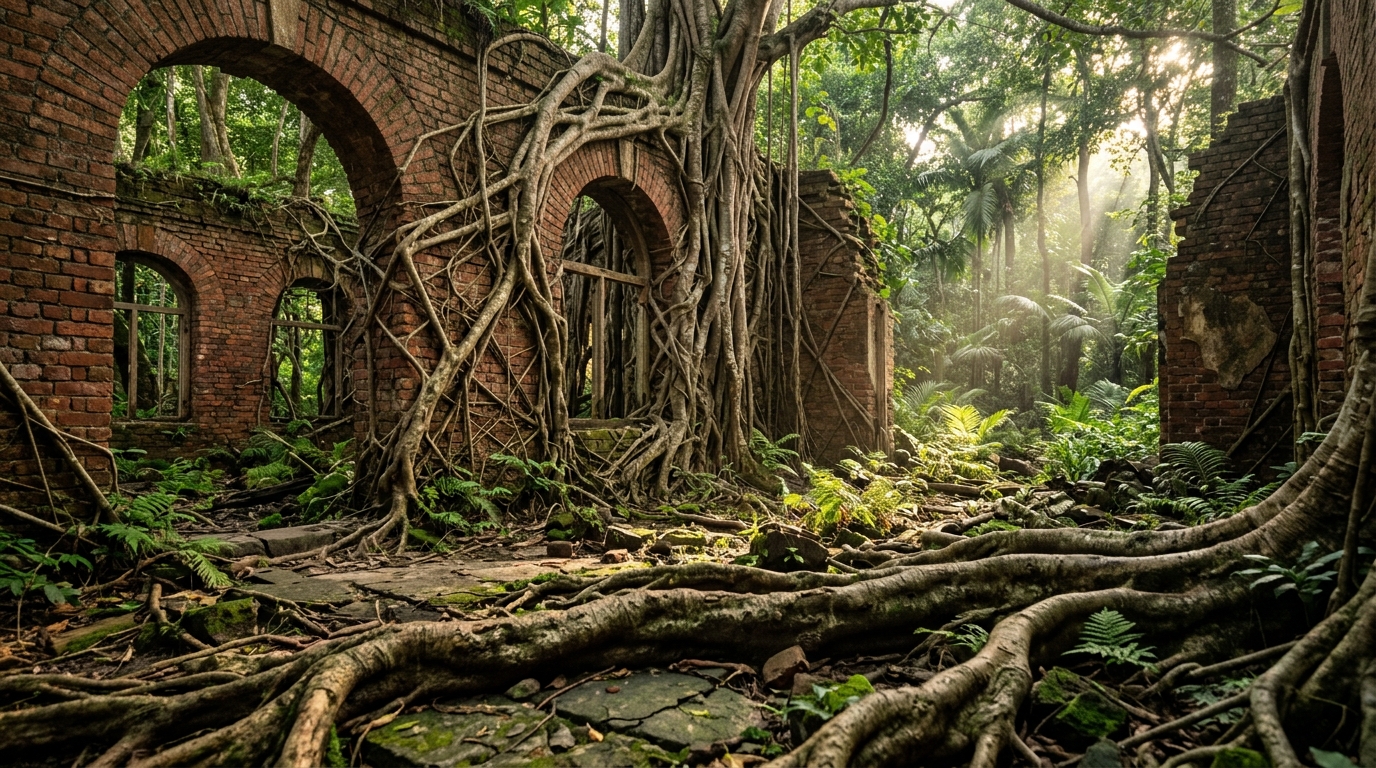
What makes this island unique among the various ghost towns in india is the dramatic way nature has reclaimed the colonial architecture. Massive Ficus and Peepal trees have grown over the ruins, their powerful roots wrapping around the brick walls like giant claws, holding the crumbling structures together.
The juxtaposition of colonial grandeur, wartime bunker defense, and aggressive tropical vegetation creates an eerie, cinematic environment. It serves as a vivid reminder that no matter how heavily fortified a human outpost might be, the natural world will eventually reclaim it.
Comparative Analysis of India’s Major Deserted Settlements
Analyzing the historical trajectories of these abandoned sites reveals distinct patterns of human settlement and abandonment. The differences in geography, primary causes of desertion, and current preservation states highlight the diverse factors that contribute to the creation of ghost towns in india.
To help travelers and historians understand these differences, the table below provides a structured comparison of the five most famous abandoned settlements in the country.
| Ghost Town | State / Territory | Primary Cause of Abandonment | Approximate Era of Desertion | Key Architectural Remains |
|---|---|---|---|---|
| Kuldhara | Rajasthan | Feudal Oppression & Taxation | Early 19th Century (1825) | Sandstone residential quarters, temples |
| Dhanushkodi | Tamil Nadu | Severe Tropical Cyclone | Mid-20th Century (1964) | Railway station, church, post office |
| Bhangarh | Rajasthan | Military Siege & Famine | Late 18th Century (1783) | Royal palace, temples, city ramparts |
| Lakhpat | Gujarat | Geological Tectonic Shift | Early 19th Century (Post-1819) | Massive fort walls, tombs, Gurdwara |
| Ross Island | Andaman & Nicobar | Military Occupation & Relocation | Mid-20th Century (Post-1945) | Colonial bungalows, church, bunkers |
This comparative perspective emphasizes that the history of ghost towns in india is not monolithic. Each location offers a unique archaeological narrative, requiring specialized conservation strategies to protect what remains. Comparing these sites shows that while some are preserved by arid desert climates, others are slowly consumed by tropical vegetation.
Practical Travel Guidelines for Dark Tourism in India
Exploring ghost towns in india requires a higher degree of planning and caution compared to standard holiday destinations. Because many of these sites are located in remote, environmentally harsh, or ecologically sensitive areas, travelers must prioritize safety and logistical preparedness.
| Preparation Category | Key Action / Item Required | Why It Matters |
|---|---|---|
| Permit Requirements | Check ASI guidelines and local police borders | Some sites like Lakhpat lie near international borders; Bhangarh restricts entry after dark. |
| Hydration & Food | Carry at least 2 liters of water and energy snacks | Arid climates of Rajasthan and Gujarat ghost towns have no commercial vendors. |
| Footwear & Safety | Sturdy, closed-toe hiking shoes | Crumbling masonry, snake hazards in overgrown areas, and hot sand terrains. |
| Time Management | Plan arrivals between 9:00 AM and 3:00 PM | Ensures exit before sunset to avoid hazardous navigation or wild animal encounters. |
Safety Standards and Travel Advisory
To ensure personal safety when visiting these historic ruins, travelers should observe several key precautions:
- Daylight Navigation: Always ensure you visit these locations during daylight hours, as many sites lack modern lighting or cellular connectivity.
- Hydration and Supplies: Carrying sufficient water, a comprehensive first aid kit, and appropriate footwear is essential when navigating these arid ghost towns in india.
- Wildlife Awareness: Be cautious of wild animals, especially when navigating unlit, crumbling stone structures after dark.
Permits and Access Restrictions
Administrative guidelines and legal mandates must be strictly adhered to during exploration:
- Respect Legal Signage: Many significant ghost towns in india are protected by federal agencies such as the Archaeological Survey of India (ASI).
- Observe Timings: Strict entry and exit times are enforced, especially near border zones or protected heritage ecosystems.
- Hire Local Guides: Engaging the services of authorized local guides is highly recommended for providing valuable historical context.
Frequently Asked Questions about Ghost Towns in India
Why were these villages abandoned overnight?
The rapid abandonment of settlements was typically driven by immediate threats, such as severe resource depletion, political or feudal tyranny, or sudden natural disasters. In the case of Kuldhara, the extreme taxation and administrative high-handedness of the local diwan forced the villagers to flee. For Dhanushkodi, a devastating cyclone destroyed the entire civic infrastructure in a single night, rendering the region uninhabitable.
Are ghost towns in india safe to visit for tourists?
Yes, visiting ghost towns in india is generally safe during daylight hours, provided tourists adhere to safety guidelines. Travelers should avoid entering structurally compromised buildings and respect local regulations, such as the ASI sunset restriction at Bhangarh. Hiring a local guide ensures a safe exploration of these historical ruins.
What is the best time of year to visit these abandoned sites?
The ideal period to visit these unique ghost towns in india is during the cooler winter months, specifically from October to March. This period offers pleasant weather, which is particularly crucial when exploring open-air ruins located in arid regions like Rajasthan and Gujarat, or humid coastal zones like Tamil Nadu and the Andaman Islands.