

DigiYatra for International Flights: A Complete Step-by-Step Guide for Indian Travelers

International departures often involve long queues and manual checks. For travelers flying from major Indian airports, the process requires substantial patience. However, the introduction of digiyatra for international flights marks a major shift in how departures are managed. By linking biometric systems with immigration databases, authorities are working to remove paper bottlenecks. This technology lets passengers complete crucial steps on their phones before reaching the terminal. This guide details the operational steps and security rules of the biometric system. Understanding these details helps any traveler avoid airport delays.
Key Takeaways
- e-Passport Requirement: Unlike domestic travel, international DigiYatra requires an e-passport with an active microprocessor chip.
- NFC Registration: Users must register by scanning their physical e-passport chip using a smartphone’s NFC reader.
- Immigration Checks Still Apply: Biometrics speed up terminal entry, but travelers must still clear manual immigration desks.
- Data Deletion Policy: To ensure passenger privacy, biometric databases delete passenger credentials 24 hours after departure.
The Evolution of Biometric Boarding in India
The digitization of Indian airports commenced with domestic trial runs, which successfully achieved the following:
- Replacement of manual paper checks with automated facial recognition.
- Effective management of growing passenger crowds under the direction of the Ministry of Civil Aviation.
- Immediate reduction of check-in and security gate waiting times to under ten seconds per passenger.
- Establishment of a scalable foundation for expanding the biometric framework nationwide.
According to operational data, the platform successfully processed over 30 million passengers (Press Information Bureau, 2025) across domestic terminals before expanding the infrastructure to international gates. Expanding this infrastructure to international departures presents a different set of challenges. Unlike domestic travel, which requires only an Aadhaar card and a boarding pass, international departures involve multiple security layers. Consequently, implementing digiyatra for international flights has required complex integration between airport operator systems, airline databases, and the central immigration network. This shift represents a major milestone in Indian aviation, aligning domestic hubs with world-class smart airports that utilize advanced biometric frameworks.
How DigiYatra Works for International Travel
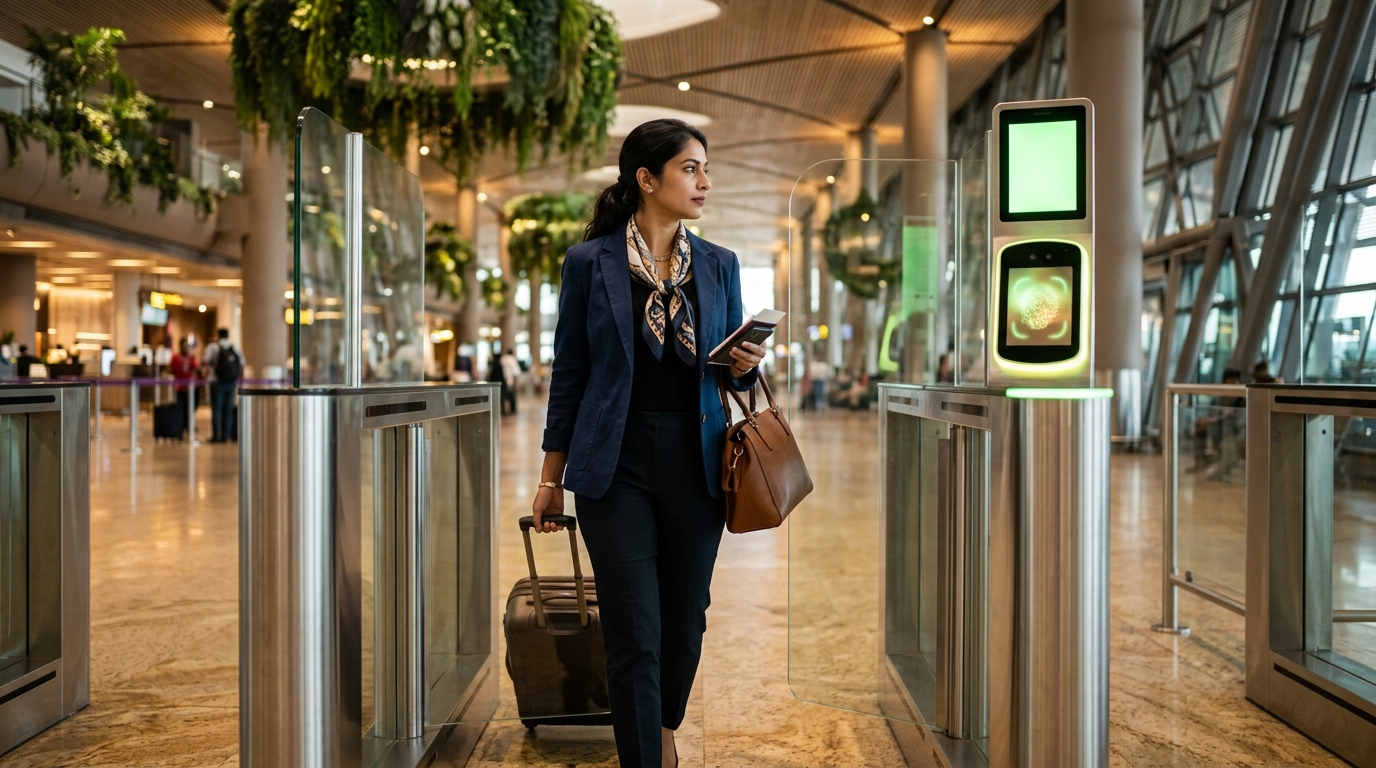
The technical architecture of the program relies on facial recognition technology to map unique facial features, converting them into a secure digital signature. This signature acts as a primary token for identification throughout the airport journey. For international departures, the process integrates directly with the passenger’s electronic passport (e-passport) rather than relying solely on Aadhaar data. The e-passport contains a secure microprocessor chip storing biographical and biometric data, which can be read via Near Field Communication (NFC) protocols.
When a traveler initiates registration, the DigiYatra app reads the secure data chip embedded within the physical passport. This action verifies the authenticity of the travel document through cryptographic keys. Once verified, the passenger’s identity is linked to their biometric facial template. This link allows the facial recognition technology to match the passenger’s real-time face at the airport with the validated passport data.
The physical terminal entry process is streamlined through these automated actions:
- Biometric Scanning: Specialized gates scan the passenger’s face as they approach.
- Token Matching: The system instantly compares the live image with the secure digital token created during registration.
- Automated Entry: Once a match is confirmed, the gate opens immediately, granting terminal access without manual document presentation to security.
- Immigration Integration: The automated gate does not bypass immigration, but instead speeds up preparatory checks so border officers can focus on primary evaluations.
Step-by-Step Registration Guide for International Passengers
Completing the setup for international biometric boarding requires systematic preparation before arriving at the departure terminal. Passengers must ensure they possess an updated smartphone equipped with NFC capabilities and an active, chip-enabled e-passport. Below is the comprehensive sequence for registering and utilizing digiyatra for international flights.
Step 1: Application Installation and Account Setup
Passengers must first download the official DigiYatra app from the authorized Google Play Store or Apple App Store. It is critical to verify the publisher to avoid unofficial applications. Once installed, the registration process begins by entering an active mobile number. After entering the OTP sent via SMS, the basic profile setup is complete.
Step 2: Identity Verification via Aadhaar
To establish a verified identity, the application requires linking with the passenger’s Aadhaar credentials. Passengers must input their Aadhaar number or use their DigiLocker account to fetch the necessary identity details. This step utilizes a secure authentication process to retrieve the passenger’s official name, date of birth, and gender. The database matching must be precise; any discrepancies between the Aadhaar name and the passport name may require manual corrections or lead to registration failure.
Step 3: Passport Verification via NFC
For international journeys, a standard Aadhaar linkage is insufficient. The application must verify the e-passport. Passengers must select the passport verification option within the app. The process requires placing the physical passport close to the smartphone’s NFC reader. The application scans the embedded microchip to verify the cryptographic authenticity of the passport. This process automatically imports the verified passport photograph and passport number into the local profile.
Step 4: Ticket Upload and Token Generation
Once the profile is verified, passengers can link their upcoming international flight details. This is done by scanning the barcode or QR code on the boarding pass, or by uploading the PDF ticket directly into the application. This step must be performed within twenty-four hours of the scheduled departure time. The system will process the flight details, cross-reference them with the airline departure control system, and generate a dynamic, biometric boarding token.
Step 5: Terminal Entry and Security Processing
At the airport, passengers must locate the dedicated biometric entry gates marked for automated clearance. The passenger stands before the biometric camera, which performs a real-time scan. Once the system matches the face with the pre-generated token, the gate opens. The passenger then proceeds to the airline check-in counter to drop baggage, followed by the immigration counters and security checkpoints.
Participating Airports and Airline Compatibility
The expansion of digiyatra for international flights is being executed in phased sequences across select international gateways in India. Not all airports or terminals are equipped with the necessary biometric gates and database integrations required to process international flights. Currently, metropolitan hubs with high international traffic are leading the pilot programs and full integrations.
The following table outlines the current operational status of the biometric boarding system for international departures across major Indian airports as of mid-2026:
| Airport Name | Terminal Status | Compatible Airline Carriers | Operational Status |
|---|---|---|---|
| Indira Gandhi International Airport (DEL), New Delhi | Terminal 3 | Air India, IndiGo, Singapore Airlines | Active Pilot Phase |
| Chhatrapati Shivaji Maharaj Airport (BOM), Mumbai | Terminal 2 | Air India, IndiGo, Emirates | Active Pilot Phase |
| Kempegowda International Airport (BLR), Bengaluru | Terminal 2 | Singapore Airlines, IndiGo, British Airways | Full Integration |
| Rajiv Gandhi International Airport (HYD), Hyderabad | Main Terminal | Air India, IndiGo | Trial Phase |
Airline participation remains a key variable. For the biometric boarding token to function correctly, the airline’s departure control system must communicate with the DigiYatra central server. Major domestic carriers like Air India and IndiGo have integrated their international schedules into the platform. Foreign airlines are progressively adopting the system, with several Asian and European carriers initiating trials to support paperless departures.
Integrating foreign airline databases involves several technical layers:
- Diverse Legacy Systems: Each international carrier runs proprietary departure control systems that must bridge securely with the Indian framework.
- Varying Clearance Experiences: Passengers on early-adopter carriers will experience fully automated entry, while others may temporarily require traditional manual verification.
- Pre-travel Verification: Travelers are strongly advised to check airline eligibility directly within the DigiYatra application before heading to the airport.
- Future Standardization: Airport authorities are actively standardizing integrations to cover the majority of international departures.
Essential Differences: Domestic vs. International DigiYatra
While the basic objective remains the reduction of manual verification, the operational frameworks for domestic and international biometric processing diverge in several key areas. Understanding these distinctions is crucial for passengers who are accustomed to domestic paperless travel.
| Feature / Parameter | Domestic DigiYatra Setup | International DigiYatra Setup |
|---|---|---|
| Primary Identification | Aadhaar Card / DigiLocker verification | Validated e-Passport with physical chip |
| Verification Method | Face matching against Aadhaar database | Face matching against cryptographic passport chip via NFC |
| Immigration Process | Completely absent (Direct security lane entry) | Mandatory physical desk check and passport stamp |
| Visa Validation | Not required | Required (Manual airline counter check may be needed) |
| Token Expiry | Long-term profile active on app | Generated specifically per international flight segment |
Below are the primary differences that distinguish domestic and international biometric boarding:
- Document Requirement: Domestic travel relies exclusively on Aadhaar-based credentials paired with a standard boarding pass. In contrast, digiyatra for international flights necessitates a secure e-passport containing an active microprocessor chip. Standard passport copies or non-chip passports cannot be used to generate the biometric token.
- Immigration Counter Processing: Domestic passengers proceed directly from security checks to their departure gates. International passengers, however, must undergo mandatory immigration clearance. The biometric gate speeds up terminal entry, but the physical passport must still be presented to immigration officers.
- Visa and Destination Documentation: Before generating an international boarding token, airlines must verify the passenger’s visa eligibility for the destination country. This requirement means that while terminal entry is automated, passengers may still need to visit physical check-in desks for manual visa checks depending on airline policies.
- Profile Lifespan: A domestic DigiYatra profile is valid for long-term use. For international travel, the verification of the passport chip is linked to the passport’s expiration date. The biometric boarding token itself must be generated fresh for every specific international flight segment.
For those planning their next holiday, exploring curated international tour packages can simplify the logistical journey even further, providing a well-structured travel experience from booking to departure. While the system facilitates terminal entry, travelers must understand that the digital token is a tool to expedite movement through the terminal, not a legal replacement for physical travel credentials.
Privacy, Data Security, and Passenger Concerns
The collection and processing of facial biometrics and passport data naturally raise questions regarding user privacy and data security. The DigiYatra Foundation, which oversees the platform’s architectural design, has implemented a decentralized storage model to address these concerns. This security design ensures that passengers maintain control over their personal information.
The key security protocols protecting passenger data include:
- Decentralized Local Storage: The personally identifiable information (PII), including biometric templates and passport details, is stored exclusively on the user’s personal smartphone. There is no centralized database that retains the passenger’s biometric data.
- Encrypted Transmission: When a boarding token is created, the data is encrypted and transmitted directly to the departing airport’s local server. This communication uses secure cryptographic protocols to prevent interception during transit.
- The 24-Hour Deletion Mandate: According to official system guidelines, the local airport servers must purge all passenger biometric data within 24 hours (DigiYatra Foundation, 2025) of the flight’s departure. This ensures that personal information is not retained permanently.
- Consent-Driven Usage: The system operates on a strictly voluntary basis. Passengers who prefer manual document verification can always choose to use the traditional entry and check-in queues.
Securing comprehensive travel insurance remains a vital pre-departure step alongside setting up digital credentials, ensuring protection against any unexpected travel disruptions. The adoption of digiyatra for international flights offers convenience, but travelers should still carry physical travel documents. Physical passports, visas, and paper boarding passes remain legally mandatory for entry into the destination country, regardless of how advanced the departure airport’s biometric system is.
FAQs
Can passengers use DigiYatra for international flights with a normal passport?
No. The system requires an e-passport (a passport equipped with an electronic chip containing biometric data). Standard non-chip passports do not support the NFC scanning required to verify identity through the application.
Is immigration physical verification completely bypassed?
No. Biometric boarding speeds up terminal entry and security checkpoint lines. However, passengers must still clear physical immigration counters and present their physical passport to immigration officers for final clearance and passport stamping.
What happens if the app fails to scan the passport chip?
If the smartphone’s NFC reader fails to scan the passport chip, passengers must proceed through the traditional manual verification queues at the airport entrance. Ensure that the phone case is removed and the passport is held flat against the back of the device.
Does the system store passenger data permanently?
No. The passenger’s biometric data and passport details are stored locally on their mobile device. The airport servers receive an encrypted package that is permanently deleted within 24 hours of flight departure.
Can children register for the international biometric system?
Currently, the system is designed for adult passengers holding individual e-passports. Children below a certain age, particularly those traveling on parental passports or without an Aadhaar link, must use the manual immigration and security lanes accompanied by their guardians.

Conclusion
Integrating biometric verification into international departures is a significant progression in Indian aviation. The deployment of digiyatra for international flights marks a transition toward modern, efficient, and secure airport transits. By combining facial recognition technology with e-passport verification, the platform significantly reduces the manual administrative burdens historically associated with cross-border departures.
While the system is currently in a phased rollout across primary metropolitan terminals, its expansion promises to establish a standardized travel experience. Passengers can minimize airport waiting times by setting up their profiles prior to arrival. However, travelers must remember that digital tokens do not replace physical credentials. Carrying physical passports, visas, and backup documents remains an essential practice for international travel. Adopting these digital protocols allows modern passengers to focus on the journey ahead, transforming the departure experience from a series of queues into a streamlined and predictable transition.