
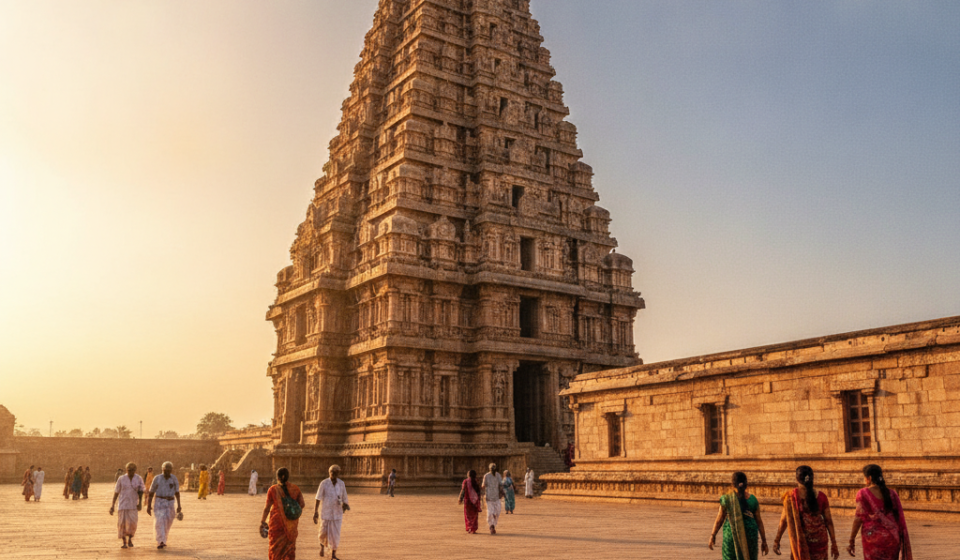

The silent granite sanctuaries of the Indian subcontinent hold architectural secrets that modern engineering is still trying to decode. For millennia, master craftsmen worked with nothing more than basic hammers, chisels, and complex mathematical calculations to sculpt vast monuments out of solid mountain cliffs. These sacred structures represent far more than mere places of worship. They are historical archives, repositories of structural genius, and stone-bound testaments to civilizational endurance. Exploring the historic trail of ancient temples in india reveals a sophisticated world where art, science, and spiritual philosophy converged to create lasting architectural wonders. Visitors who walk through these massive entryways are not merely stepping into stone chambers. They are entering living monuments that have survived wars, climate shifts, and the slow passage of centuries. Understanding this heritage requires looking beyond the religious surface to examine the sophisticated design philosophies, regional variations, and remarkable engineering feats that allowed these structures to stand tall across generations.
Key Takeaways
- Architectural Evolution: Temple architecture transitioned over centuries from simple timber and rock-cut caves to highly complex, free-standing structural stone designs.
- Regional Typologies: North India developed the curvilinear Nagara style, South India perfected the monumental Dravidian style, and the Deccan region bridged them with the hybrid Vesara style.
- Engineering Sophistication: Master builders leveraged advanced mineralogy, interlocking gravity-based masonry, and acoustical engineering to create timeless stone monuments.
- Astronomical Alignments: Ancient builders aligned temple sanctums precisely with solar and celestial cycles, showing a deep grasp of mathematics and astronomy.
- Practical Exploration: Traveling during cooler months (October to March) and respecting local guidelines, such as removing footwear, ensures a respectful and rewarding journey.
The Evolution of Temple Architecture in India
The architectural evolution of ancient temples in india represents a journey from humble clay and timber structures to monumental stone edifices. This progression occurred over centuries, guided by sacred geometric texts known as the Vastu Shastras. These manuals were not merely spiritual guides but comprehensive textbooks on civil engineering, town planning, and materials science. Early builders began by utilizing natural caves, carving shrines directly into mountain rock to ensure durability. As dynasties stabilized and wealth accumulated, structural architecture emerged, leading to the creation of free-standing stone buildings. This transition allowed for greater spatial freedom, enabling architects to design multi-chambered complexes that mirrored the cosmos. By the sixth century AD, distinct regional styles had crystallized across the subcontinent, shaped by geography, available materials, and imperial patronage.
The Nagara Style of Northern India
The soaring towers and geometric layouts of north indian temple architecture developed primarily in the regions between the Himalayas and the Vindhya mountain range. This style is defined by several distinctive architectural elements:
- Curvilinear Shikharas: Spires that rise gradually to a point, symbolizing the sacred Mount Meru.
- Raised Platforms (Jagati): Stone bases that elevate the entire temple structure above the surrounding landscape.
- Central Sanctum (Garbha Griha): Located directly beneath the tallest tower, establishing a vertical spiritual axis.
- Ratha Plan Projections: Offset vertical projections on the sanctum walls that create intricate, multi-faceted stone exteriors playing with light and shadow.
This structural complexity is prominently featured in the ancient temples in india of the northern plains, where sandstone and granite were meticulously carved without the use of mortar. The intricate geometric symmetry of these structures remains a key feature that distinguishes them from other ancient temples in india.
The Dravidian Style of Southern India
In the southern regions of the subcontinent, a radically different architectural philosophy emerged under the patronage of the Pallava, Chola, and Pandya dynasties. The Dravidian style is defined by several key components:
- Towering Gopurams: Monumental, highly decorated gateway towers set into massive enclosing boundary walls.
- Pyramidal Vimanas: Central towers rising in structured, stepped pyramidal storeys rather than curvilinear forms.
- Kalyanis: Deep, stone-lined temple tanks utilized for ritual purification and sophisticated rainwater harvesting.
- Communal Integration: Massive layouts that served as administrative offices, schools, and local treasuries.
For travelers wishing to immerse themselves in this unique architectural tradition, securing specialized travel arrangements through curated tour options is highly recommended. For instance, exploring the grand temples of Madurai and Thanjavur is made simple with custom regional packages, such as the Tamil Nadu Tour Packages offered by TravelDham, which provide comprehensive itineraries to these architectural wonders. The deep integration of civic life and spiritual devotion is a unique cultural phenomenon found in the southern ancient temples in india. These vast structural complexes served as the spiritual and civic centers of the ancient temples in india.
The Vesara Style and Transitional Epochs
In the Deccan region, particularly under the Chalukya and Hoysala dynasties, architects experimented with a hybrid style that bridged the northern and southern traditions. This transitional form is known as the Vesara style. It ingeniously combined the circular plan and decorative elements of the Nagara style with the stepped spires and pillared halls of the Dravidian school. The result was a highly ornate, star-shaped ground plan (a brilliant layout design) that allowed for an unprecedented density of sculptural detail. The Hoysala builders utilized soapstone, a relatively soft mineral that hardens upon exposure to the air, allowing artisans to carve extremely intricate jewelry, garments, and battle scenes with microscopic precision. The Vesara style represents a conscious effort to harmonize diverse regional design philosophies, creating a distinct hybrid character among the ancient temples in india. This synthesis demonstrates that ancient craftsmen were not isolated by geography but actively exchanged ideas, engineering techniques, and aesthetic philosophies across regional boundaries.
| Style Name | Geographical Focus | Signature Tower Design | Primary Construction Material |
|---|---|---|---|
| Nagara Style | Northern India | Curvilinear Shikhara | Sandstone and Granite |
| Dravidian Style | Southern India | Stepped Pyramidal Vimana | Hard Granite and Mortarless Masonry |
| Vesara Style | Deccan Region | Hybrid Stepped/Circular Spire | Soft Soapstone (Chloritic Schist) |
Iconic Ancient Temples in India: Regional Masterpieces
The vast geographical spread of the Indian subcontinent fostered localized pockets of artistic and structural excellence. These regional masterpieces illustrate how different dynasties mobilized resources, craftsmen, and engineering principles to create unique physical structures. Examining these sites individually reveals the true depth and regional diversity of ancient temples in india.
The Structural Marvels of Tamil Nadu
The southern state of Tamil Nadu contains some of the most structurally ambitious masonry projects of the ancient world. Foremost among these is the Brihadeeswarar Temple in Thanjavur. Completed in 1010 AD according to data from the Archaeological Survey of India, this temple stands as a testament to Chola engineering. The central vimana rises to a height of 66 meters, crowned by a massive monolithic stone dome, or kumbam, weighing an estimated 80 tons. Legend states that a ramp several kilometers long was constructed to hoist this single stone block to the top of the tower. What makes this feat even more remarkable is that the entire temple is built of interlocking granite blocks without any binding mortar or cement, relying entirely on gravity and precise joinery. This unparalleled craftsmanship makes Tamil Nadu a premier region for studying ancient temples in india. Farther north along the coast, the Shore Temple of Mahabalipuram showcases the early transition from rock-cut shrines to structural stone temples, engineered to withstand the corrosive effects of sea salt and coastal winds for over twelve centuries. The meticulous placement of heavy granite blocks ensured the long-term structural integrity of these ancient temples in india.
The Rock-Cut Wonders of Maharashtra
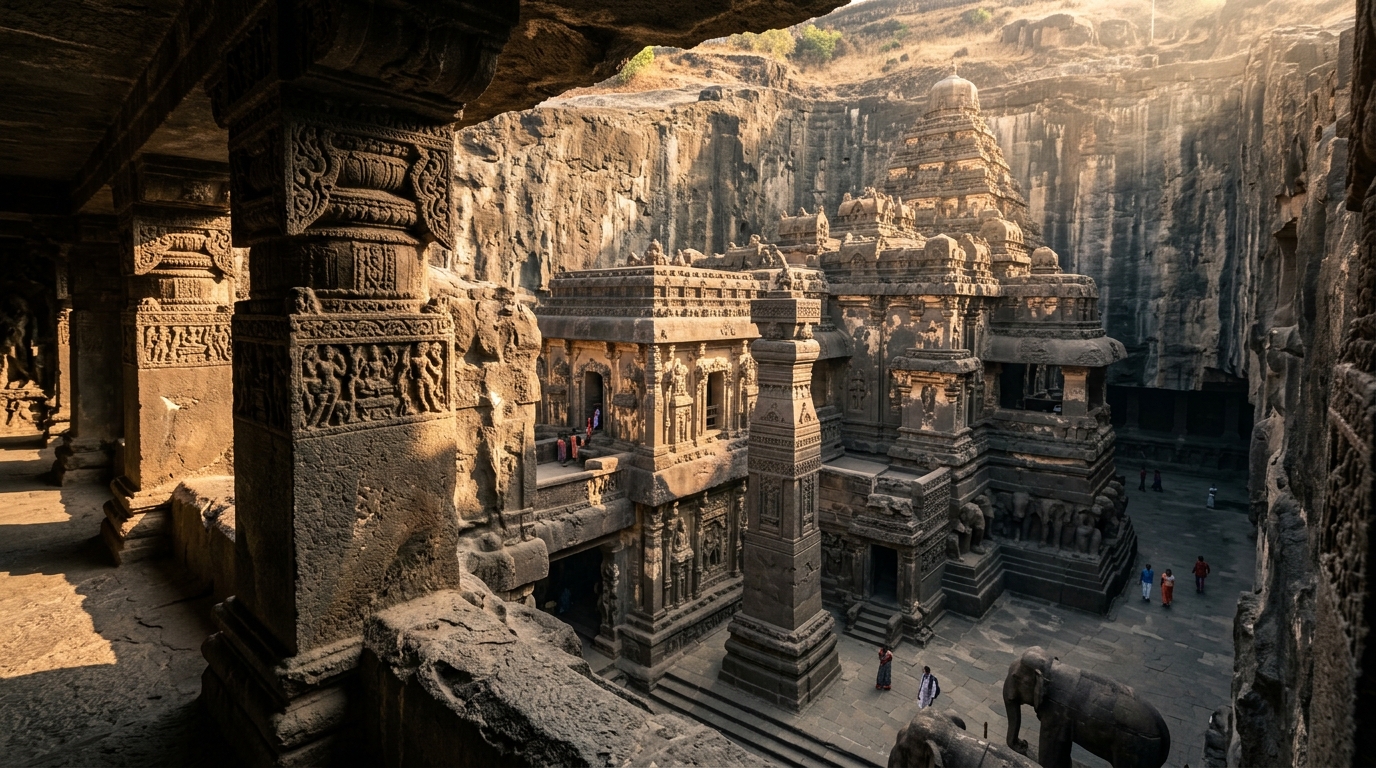
Moving inland to the Deccan plateau, the architectural paradigm shifts from structural masonry to the subtractive process of rock-cut excavation. The Kailash Temple (Cave 16) at the Ellora complex in Maharashtra remains the pinnacle of rock cut architecture in the ancient world. Unlike traditional structural temples built from the ground up, the Kailash Temple was carved out of a single volcanic basalt cliff from the top down. This required monumental planning, as any error made by the sculptors would have been irreversible. Artists removed over 200,000 tons of solid rock over several decades, leaving behind a fully realized, multi-storey temple complete with courtyards, bridges, galleries, and life-sized elephant sculptures. The temple was excavated in the 8th century AD, as documented by the Archaeological Survey of India, during the reign of Krishna I of the Rashtrakuta dynasty. It stands as one of the most extraordinary specimens among the ancient temples in india, demonstrating a perfect grasp of three-dimensional spatial planning. The transition from rock cut architecture to structural brick and stone is beautifully preserved in these caves, showing how ancient engineers mastered the physical properties of basalt to execute the complex, monolithic carvings that define several ancient temples in india.
The Ornate Sandstone Creations of Odisha and Madhya Pradesh
In eastern and central India, sandstone became the medium of choice, allowing for highly expressive and structurally complex designs. The Sun Temple at Konark, Odisha, built in the shape of a colossal chariot, represents the aesthetic zenith of ancient temples in india. The temple was designed with twelve pairs of intricately carved stone wheels, which also functioned as highly accurate sundials, and was pulled by seven stone horses representing the days of the week. The structure was designated as a World Heritage site in 1984 by UNESCO due to its unique artistic and engineering values. Similarly, the Khajuraho group of temples in Madhya Pradesh represents the peak of the Nagara style. Built by the Chandela dynasty between the tenth and eleventh centuries, these temples are famous for their elegant, soaring shikharas and deeply detailed external carvings that depict every aspect of human life, from daily chores and musical performances to spiritual aspirations and eroticism. The use of fine-grained local sandstone allowed sculptors to achieve a level of fluid, lifelike movement in stone that remains a key distinguishing feature of these ancient temples in india.
Engineering and Architectural Sophistication of Ancient Builders
To view these structures merely as relics of religious devotion is to overlook the profound scientific and engineering principles that governed their construction. The builders of these monuments possessed an advanced understanding of material science, geology, acoustics, and astronomy. This intellectual sophistication ensured that the structural and functional layout of ancient temples in india served both spiritual and physical purposes. Let us examine two specific areas where this advanced engineering is most visible to modern observers.
Acoustic Engineering and Musical Pillars
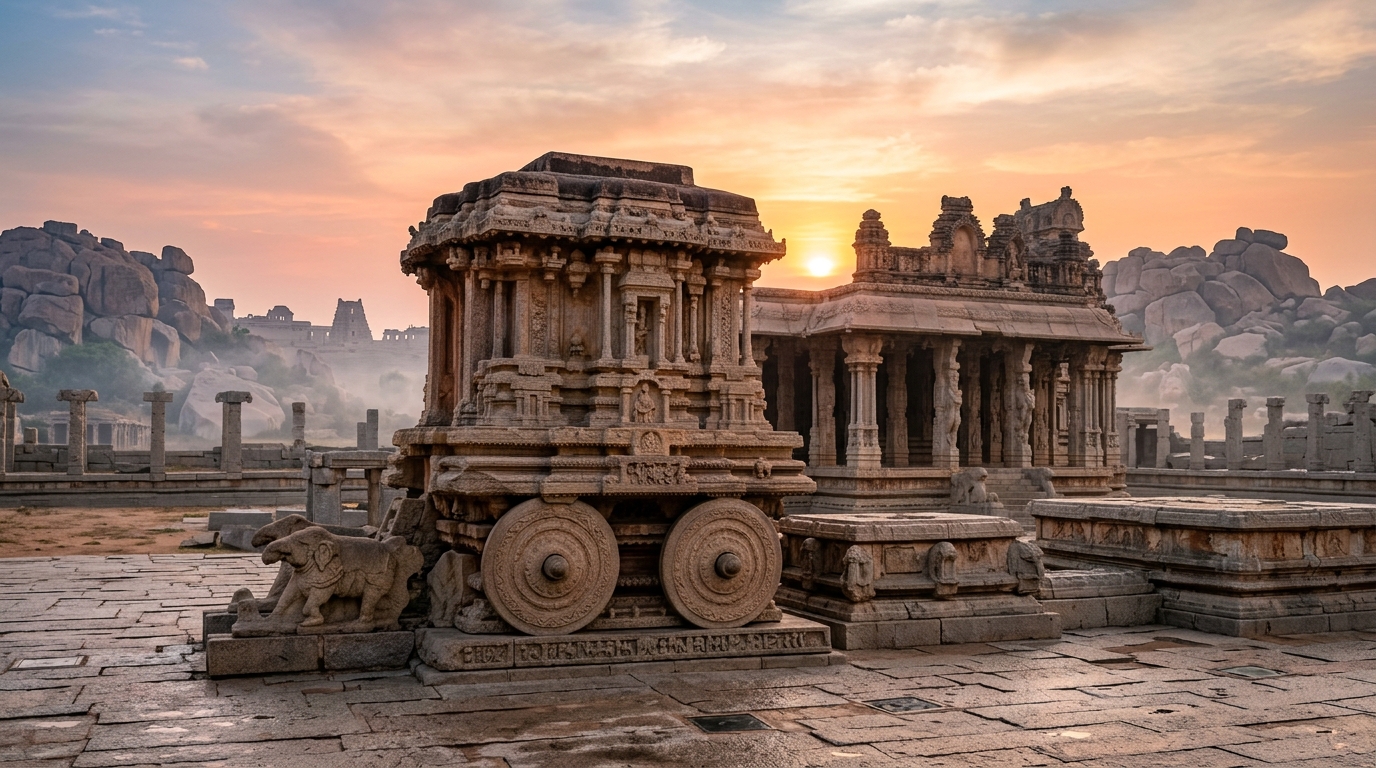
Ancient builders frequently designed temple interiors to manipulate and amplify sound, creating specific acoustic environments that enhanced spiritual chanting and musical performances. At the Vittala Temple in Hampi, Karnataka, the open assembly hall features 56 slender granite pillars known as the musical pillars. When gently tapped with a wooden mallet or hand, these solid stone pillars emit distinct musical notes that resonate with surprising clarity. Modern mineralogical studies have revealed that the builders selected granite blocks with specific silica and metallic impurities, carving them to precise thicknesses and heights to generate varying frequencies. Furthermore, the structural design of the garbha griha in many temples was calculated to act as a natural amplifier, focusing the sound waves of low-frequency Vedic chants to create a deep, resonant hum that physically vibrates through the stone floors, altering the sensory experience of those within. This deliberate engineering of sonic properties within the ancient temples in india shows that ancient builders possessed a sophisticated grasp of physics and resonance.
Astronomical Alignments and Solar Precision
The alignment of temple structures with celestial bodies was a critical component of ancient design, reflecting the belief that earthly structures should mirror the cosmic order. The solar orientation of ancient temples in india was calculated with remarkable precision. At the Sun Temple of Modhera in Gujarat, the temple is designed such that on the mornings of the equinoxes, the first rays of the rising sun pass directly through the main entrance, pierce the dark assembly halls, and illuminate the golden deity inside the inner sanctum. Similarly, at the Virupaksha Temple in Hampi, a tiny opening in the eastern wall acts as a natural pinhole camera, projecting an inverted shadow of the towering main gopuram onto the western wall of the inner sanctum, even though the tower is located dozens of meters away. This precise astronomical alignment across other ancient temples in india shows that the builders were not just skilled stonemasons but accomplished astronomers and mathematicians who successfully integrated timekeeping directly into the physical structure of their monuments.
Practical Travel Guide for Visiting Indian Temples
Embarking on a journey to explore the ancient temples in india requires careful planning to appreciate their historical context, artistic detail, and structural beauty. To make the most of this cultural expedition, travelers should plan their routes, prepare for local customs, and utilize professional travel platforms to secure hassle-free transport, lodging, and guided tours. For those planning a comprehensive domestic itinerary, checking the diverse options available on the TravelDham Domestic Holiday Packages page can greatly assist in organizing an efficient and memorable travel route. Understanding the operational rules of ancient temples in india is key to enjoying a respectful and deeply rewarding travel experience.
Best Time to Visit and Cultural Etiquette
Given the vast geographic spread of India, weather conditions vary significantly between the northern plains and the southern peninsula. Generally, the ideal window for temple exploration is between October and March, when the cooler winter temperatures make walking across expansive stone courtyards comfortable. Visiting during the extreme heat of summer (April to June) can be physically taxing, as stone floors can absorb heat and make barefoot walking difficult. When visiting these active ancient temples in india, adhering to local cultural etiquette is of paramount importance:
- Footwear Removal: Shoes, sandals, and leather items must be left at designated shoe-keeping stands outside the temple premises.
- Modest Attire: Both men and women should dress conservatively. Shoulders and knees should be covered; some traditional temples in the south may require men to wear a traditional dhotis and women to wear saris or salwar suits.
- Photography Regulations: While photography is permitted in outer courtyards, taking photos inside the garbha griha (inner sanctum) is strictly prohibited at almost all active sites.
- Circumambulation: When walking around shrines, always move in a clockwise direction, keeping the deity to your right.
Respecting these simple rules ensures a peaceful visit and contributes to the preservation of the ancient temples in india.
Key UNESCO World Heritage Sites to Prioritize
For travelers seeking a curated itinerary of the finest architectural marvels, prioritizing designated UNESCO sites ensures exposure to the absolute peaks of historical engineering and artistic design. The database of unesco world heritage sites india includes several key locations that represent distinct epochs, building materials, and design philosophies. Visiting these unesco world heritage sites india offers an unparalleled look into the sheer diversity of the country’s ancient architecture.
Below is a comparison of key sites to help organize your itinerary:
| Temple Site & Location | Primary Builder Dynasty | Architectural Style | Key Structural Highlight |
|---|---|---|---|
| Brihadeeswarar Temple (Thanjavur, Tamil Nadu) | Chola Dynasty (Raja Raja Chola I) | Dravidian | 66-meter high vimana built of interlocking granite blocks without mortar. |
| Kailash Temple (Ellora, Maharashtra) | Rashtrakuta Dynasty (Krishna I) | Rock-Cut Monolithic | Entire multi-storey complex carved out of a single volcanic basalt cliff face. |
| Sun Temple (Konark, Odisha) | Eastern Ganga Dynasty (Narasimhadeva I) | Kalinga (Nagara variant) | Colossal stone chariot design featuring 24 highly accurate sundial wheels. |
| Kandariya Mahadeva (Khajuraho, Madhya Pradesh) | Chandela Dynasty | Nagara (Panchayatana) | Complex, elevated sandstone platform with interlocking curvilinear spires. |
FAQs
What is the oldest functioning ancient temple in India?
The Mundeshwari Devi Temple in the Kaimur district of Bihar is widely recognized as the oldest continuously functioning temple in India. Archaeological inscriptions indicate that religious services have been performed at this octagonal stone temple since at least 625 AD, and some structural elements may date even earlier to the Kushan period. Built of stone, its unique octagonal plan is a rare architectural design that has survived centuries of earthquakes and political upheavals, offering invaluable insights into the structural stability of ancient temples in india.
What are the primary differences between Nagara and Dravidian architecture?
The differences lie primarily in their towers, entryways, and layouts. Northern Nagara temples feature curvilinear, beehive-shaped spires called shikharas and are built on raised stone platforms without high boundary walls. In contrast, southern Dravidian temples feature stepped, pyramidal towers called vimanas and are enclosed by massive stone walls with monumental, multi-storey gateway towers called gopurams. Additionally, Dravidian temples almost always incorporate large, stone-lined ritual water reservoirs within the complex, whereas northern temples rarely do. These structural hallmarks of ancient temples in india highlight the distinct environmental and political contexts in which northern and southern architects worked.
Do Indian temples have dress codes for visitors?
Yes, many active ancient temples in india enforce traditional dress codes, particularly in the southern states like Tamil Nadu and Kerala. Generally, visitors must wear modest clothing that fully covers the shoulders and knees. In certain orthodox shrines, men are required to remove their shirts and wear a traditional dhoti or mundu, while women must wear saris, dhotis, or modest Indian suits. Standard western wear like shorts, sleeveless tops, and short skirts are strictly forbidden at these sacred sites. It is always advisable to research the specific guidelines of each monument before visiting the prominent ancient temples in india.