
A tiny margin of error can disrupt travel planning. Many international visa rejections stem not from financial shortfalls, but from a simple, flawed piece of paper: the visa photograph. Consulates enforce rigid biometric rules, meaning even a subtle shadow, an incorrect head angle, or an off-center crop can lead to immediate denial. For anyone planning an international trip, understanding the visa photo requirements india applications must comply with is the first step toward a successful submission. Getting these parameters right avoids unnecessary delays and ensures travel documents proceed smoothly through automated screening systems. For those seeking professional assistance to manage the entire application process, securing a visa through specialized services like TravelDham Visa Services ensures all travel documents, including biometric photo submissions, are perfectly aligned with official international regulations.
Key Takeaways
- Strict Biometric Rules: Minor flaws like shadows, head tilt, or poor cropping lead directly to automated application rejections.
- Recency is Vital: Photos must be taken within the last 6 months to match actual biometric databases.
- Strict Dressing Guidelines: Wear solid, dark colors to create a strong contrast against standard white or grey backgrounds.
- No Eyeglasses Allowed: Almost all major consulates now completely prohibit wearing glasses in visa photos to prevent scanner glare.
Why Visa Photo Accuracy Matters
Consulates do not reject photographs out of pedantry. Rather, modern border control systems rely on facial recognition technology. These systems scan key physical features such as the distance between the eyes, the bridge of the nose, and the shape of the jawline. When a photo fails to meet these rigid biometric standards, the automated system flags the application, resulting in manual reviews or outright rejection.
Historically, roughly 15% of visa application delays are linked directly to non-compliant photographs. For an Indian traveler, these photo failures can lead to several major consequences:
- Immediate visa processing delays or outright rejection.
- Missed flights and non-refundable hotel bookings.
- A compromised travel history with foreign consulates.
Adhering to the visa photo requirements india portals publish is crucial to avoiding these logistical setbacks.
But still, many travelers treat the visa photo as an afterthought, using leftover passport photos from years prior. This is arguably one of the most expensive errors a traveler can make. Biometric databases are updated regularly, and most countries require photos taken within the last six months to ensure an accurate representation.
General Specifications and Technical Standards
While each country maintains its own specific criteria, certain universal parameters standardize the baseline visa photo requirements india applicants encounter. Most international consulates utilize the standards set by the International Civil Aviation Organization (ICAO), a global agency that establishes travel document security. Knowing these baseline criteria helps applicants identify sub-standard work.
First, the physical print must be on high-quality photographic paper. Matte or semi-matte finishes are universally preferred, as high-gloss prints often cause glare under scanner lights.
Lighting must be uniform across the face. Shadows on the face or background are a leading cause of rejection, as they obscure the natural contours that biometric systems need to analyze. It is essential to verify the general visa photo requirements india consulates share to ensure that the lighting setup matches these digital standards.
Here is a summary of the baseline specifications that apply to almost all international visas:
| Parameter | Standard Requirement |
|---|---|
| Image Quality | Sharp focus, no blur, high resolution |
| Background Color | Plain white or light grey (no patterns) |
| Face Coverage | 70% to 80% of the total frame area |
| Recency | Taken within the last 6 months |
| Paper Finish | Matte or semi-matte (never glossy) |
Additionally, the subject must look directly at the camera with eyes open. The head must not be tilted, and the shoulders must be straight. A neutral expression is mandatory; wide smiles or frowning will result in immediate rejection because they distort biometric markers.
Detailed Country-Wise Visa Photo Specifications
Different parts of the world operate under distinct visa regimes, meaning there is no single photo size that fits every application. This diversity explains the specific differences in the visa photo requirements india outbound tourists face. For example, while European nations prefer a rectangular format, North American destinations require a square template.
| Region / Country | Required Photo Size | Background Color | Key Unique Standard |
|---|---|---|---|
| Schengen Area | 35mm x 45mm | Light grey or off-white | Face must occupy 70%-80% of the frame height |
| United States | 2 x 2 inches (51mm x 51mm) | Plain white | Digital size between 10 KB and 240 KB |
| United Kingdom | 35mm x 45mm | Light cream or light grey | Strictly zero digital retouching or editing allowed |
| UAE | 4.3cm x 5.5cm | White | Standard 3.5cm x 4.5cm accepted online |
| Saudi Arabia | 2 x 2 inches (51mm x 51mm) | White | Dark clothing highly recommended for shoulder contrast |
| Thailand / Vietnam | 4cm x 6cm | White | Mainly used for Visa on Arrival physical forms |
Schengen Area Visa Photo Requirements
The Schengen Zone comprises 29 European countries operating under a unified visa policy. Schengen countries maintain strict visa photo requirements india travelers must follow, requiring a photograph size of 35mm x 45mm.
The face must occupy between 70% and 80% of the frame, measuring between 32mm and 36mm from the chin to the top of the head. The background must be a solid, light grey or off-white, as pure white backgrounds can sometimes cause overexposure on the edges of the hair. As documented by Schengen Visa Info in their compliance guidelines, any photograph that does not show both ears clearly or features hair covering the eyebrows may be flagged for manual review.
United States (US) Visa Photo Requirements
The United States maintains some of the most technologically advanced visa processing systems in the world. For this reason, US authorities set up unique visa photo requirements india applicants should review before booking appointments.
The US visa photo must be a perfect square, measuring 2 inches by 2 inches (51mm x 51mm). The face coverage should be between 50% and 69% of the photo’s total height, measured from the bottom of the chin to the top of the head. The background must be plain white, and the photo must be printed on high-quality paper. If uploading a digital photo for the DS-160 form, the image must be at least 600 x 600 pixels and no larger than 240 KB, as specified on the US Department of State portal. The system will automatically scan the photo for head size and centering, rejecting files that do not align.
United Kingdom (UK) Visa Photo Requirements
The United Kingdom operates outside the Schengen visa framework, maintaining its own independent visa process. Consequently, the UK government maintains distinct visa photo requirements india citizens must meet to secure entry.
The required dimensions are 35mm wide by 45mm high, which matches the physical size of the Schengen photo. But still, the internal composition is slightly different. The face must measure between 29mm and 34mm from the chin to the crown of the head. Crucially, the UK visa guidelines do not permit any digital enhancement or editing of the image. Even basic color correction or background removal can result in a rejection if the software detects alterations. The background must be a light cream or light grey, not pure white.
United Arab Emirates (UAE) and Saudi Arabia Visa Photo Requirements
For travelers heading to the Middle East, particularly the Gulf Cooperation Council (GCC) nations, photo specifications are highly standardized. Gulf countries enforce specific visa photo requirements india travelers must provide, particularly for online visa-on-arrival portals and e-visas.
For the UAE, the standard photo size is 4.3cm x 5.5cm, although standard 3.5cm x 4.5cm photos are frequently accepted for online e-visa portals. The background must be white, and the expression must be completely neutral.
Saudi Arabia has recently updated its online tourist visa portal. The required photo size is 2 inches by 2 inches (similar to the US format) with a white background. It is worth noting that for Saudi Arabia, the contrast between the clothing and the background is strictly monitored; dark-colored clothing is recommended to ensure the shoulders do not blend into the backdrop.
Southeastern Asian Destinations (Thailand, Singapore, Malaysia, Vietnam)
Southeast Asia remains one of the most popular travel regions for Indian citizens, driven by convenient flight connections and simplified e-visa options. Even with these streamlined processes, Asian countries have streamlined the visa photo requirements india tourists should understand to avoid airport immigration delays.
Let us look at the distinct sizes required across these popular destinations:
- Thailand: Requires a 4cm x 6cm photograph for Visa on Arrival (VoA) applications.
- Singapore: Requires a 35mm x 45mm photo with a matte finish and white background.
- Malaysia: Utilizes a 35mm x 50mm size for its e-visa applications.
- Vietnam: Demands a 4cm x 6cm photo for physical applications.
Matching the precise visa photo requirements india documentation requires is critical here, especially since many of these countries process visas electronically, and automated systems reject non-compliant files before human officials ever see them.
Dress Code and Grooming Standards
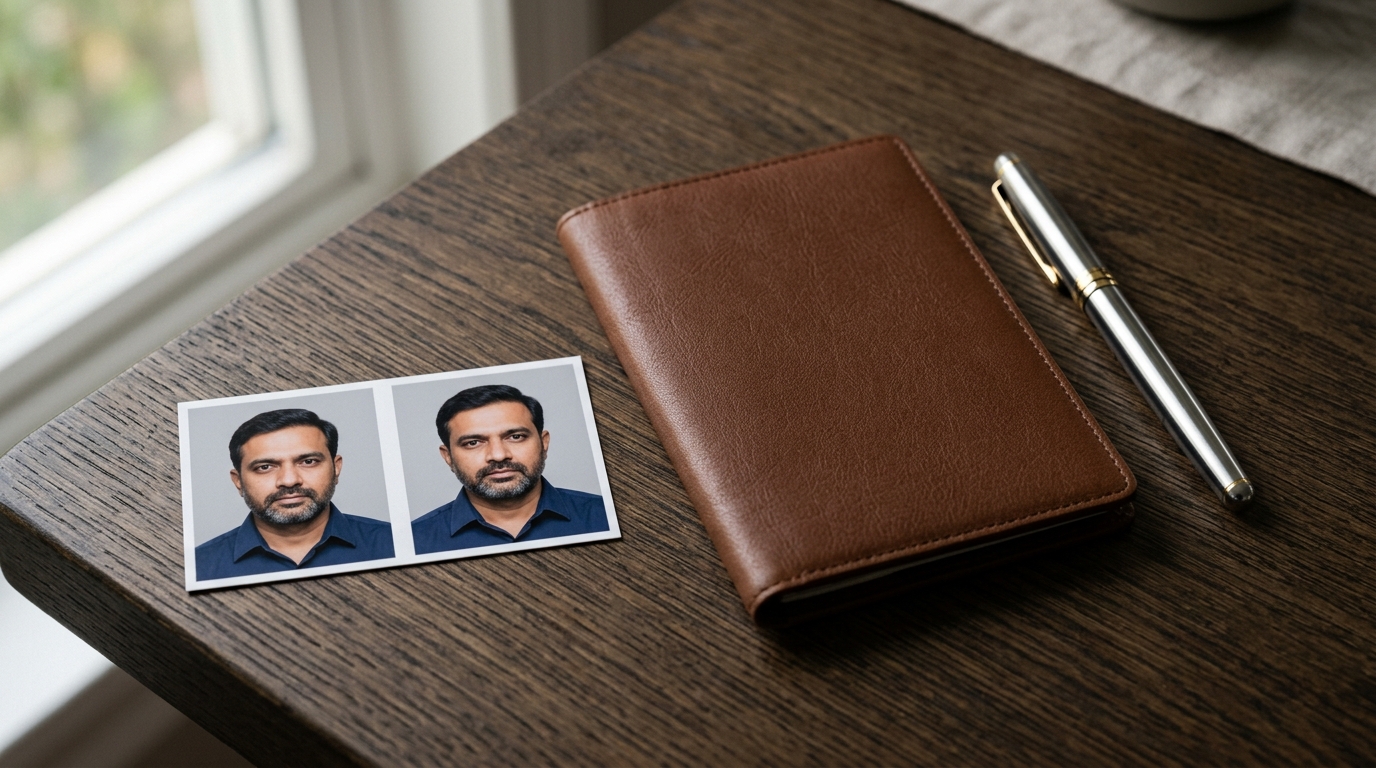
What you wear is just as important as the size of the photograph. Appropriate clothing is central to the visa photo requirements india consulates enforce. The primary rule is contrast. Since most backgrounds are white or light grey, wearing light-colored clothing can make your shoulders disappear, giving the photo a floating-head effect. This visual defect is a common trigger for rejection.
To prevent avoidable delays, make sure your grooming and apparel comply with the following standards:
- Wear Highly Contrasting Colors: Opt for solid, dark clothing like deep navy, black, or dark green to ensure a sharp contrast against standard light backdrops.
- Avoid Reflective Ornaments: Minimize jewelry, glittery makeup, or glossy cosmetics that might reflect light and disturb facial recognition sensors.
- Ensure Full Facial Visibility: Keep hair tied back or styled so that it does not drape over your eyes, eyebrows, or cover your ears.
Head coverings must comply with the visa photo requirements india centers accept. Generally, headwear is prohibited unless worn for religious reasons. In such cases, the head covering must not obscure any facial features. The entire face, from the bottom of the chin to the top of the forehead, must be completely visible. Shadows cast by the headwear onto the face are strictly unacceptable. Additionally, professional grooming is advised; excessive makeup that alters skin tone should be avoided.
Digital Visa Photo Requirements for Online Applications
The shift toward electronic visas has changed how travelers submit documents. Online portals have updated the visa photo requirements india e-visa systems apply to ensure automated facial matching software works efficiently. When uploading an image, the physical dimensions are translated into digital pixels, which requires careful attention.
Most digital uploads require observing the visa photo requirements india platforms specify. The image format must be JPEG or PNG, and the file size must be kept within a strict range, usually between 10 KB and 300 KB. High-resolution files from modern smartphone cameras often exceed these sizes, requiring compression. But still, compression must be done using high-quality tools to avoid pixelation. If the digital image is blurry or shows compression artifacts, the automated portal will reject the upload immediately. A standard resolution of 600 x 600 pixels is the safest baseline for most digital systems.
| Digital Parameter | Recommended Specification |
|---|---|
| File Format | JPEG (.jpg) or PNG (.png) |
| File Size Range | 10 KB to 240 KB |
| Minimum Resolution | 600 x 600 pixels |
| Color Space | sRGB |
Additionally, digital photos must be captured in color; black and white images are never accepted for modern e-visas. The photo must be taken under professional studio lighting to prevent red-eye or uneven skin tones, which are difficult for software systems to read accurately.
Common Mistakes Leading to Visa Photo Rejections
Understanding what not to do is often the best way to ensure compliance. Many travelers make mistakes that violate the visa photo requirements india agencies publish, resulting in avoidable delays. The most common errors involve accessories, lighting, and printing quality.
Here is a quick reference guide to the most frequent errors and how to avoid them:
- Wearing Prescription Glasses: While some countries allowed glasses in the past, almost all major consulates now prohibit them entirely. Glare on the lenses or thick frames that obscure the eyes will cause immediate rejection.
- Inappropriate Expressions: Smiling broadly, showing teeth, or frowning will lead to rejection. A neutral, closed-mouth expression is mandatory.
- Poor Cropping: Taking a standard passport photo and cropping it manually with scissors often damages the edges or alters the aspect ratio.
- Selfies and Filtered Photos: Photos taken using front-facing cameras or modified with smartphone filters are easily detected by biometric scanners and rejected instantly.
Avoiding errors that clash with the visa photo requirements india authorities maintain is straightforward when utilizing professional photography services instead of home-based setups.
Frequently Asked Questions
Clarifying the precise visa photo requirements india travelers ask about helps resolve common anxieties before submitting applications.
Can I wear my glasses in a visa photo?
No, most major consulates do not allow glasses of any kind, even if they are prescription lenses. This rule is designed to prevent lens glare and frame shadows, which interfere with biometric scanning systems. It is best to remove your glasses for the photo, which aligns with the visa photo requirements india consulates mandate.
Can I take my visa photo at home with a smartphone?
While high-end smartphone cameras have the necessary resolution, capturing the correct lighting and background at home is incredibly difficult. Critics say that home-made digital photos are good enough. They are not entirely wrong, but still, home environments rarely offer shadow-free backdrops or glare-free lighting. To satisfy the visa photo requirements india applications demand, using a professional studio is highly recommended.
How old can my visa photo be?
The photo must be taken within the last six months. Consulates compare your visa photo to your current appearance and previous passport stamps. If they notice that you are using an old photo, your application will be delayed or rejected. Keeping your photo current is a standard part of the visa photo requirements india travelers need to follow.
Conclusion
Securing an international visa requires meticulous attention to detail, and the photograph is arguably the most sensitive component of the dossier. From the square formats of North American destinations to the rectangular standards of Europe, each destination enforces guidelines designed to feed automated biometric systems. Ensuring full compliance with the visa photo requirements india consulates set is not merely about aesthetic appeal; it is about protecting your travel investment. Partnering with professional visa services can help eliminate these risks, allowing travelers to focus on their itineraries rather than administrative hurdles. While securing your biometric photos and visa is paramount, ensuring you have robust Travel Insurance is another essential step to protect against unexpected travel delays or medical emergencies.