
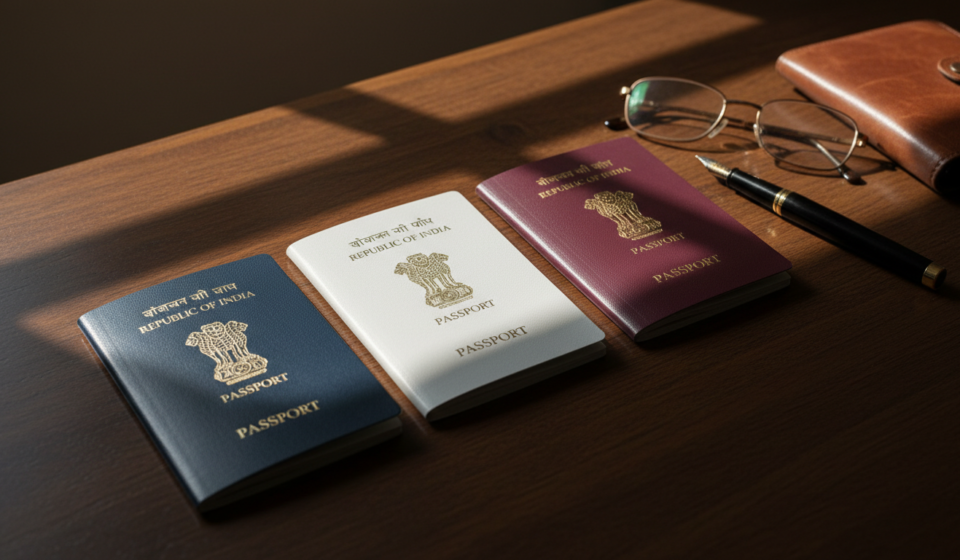

Indian travellers heading through airport immigration often notice passports of different colors carried by fellow passengers. The Government of India issues three active official types of indian passports: Navy Blue, White, and Maroon. A fourth color—the widely discussed Orange passport—is a persistent myth that was scrapped before a single booklet was printed. Each color defines the holder’s official capacity, immigration privilege levels, and travel status under Indian law.
Understanding which passport you hold, how to read the information printed inside, and whether you require government emigration clearance before flying can save you from unexpected delays at the departure gate. Here is a practical, complete breakdown of every Indian passport category, their official codes, fees, and rules.
The Official Types of Indian Passports: Blue, White, and Maroon
The Ministry of External Affairs (MEA) categorizes travel documents using specific legal designations under the Passports Act, 1967. Below is an overview of all standard and official categories currently issued by the Government of India.
| Cover Color | Type Code | Official Designation | Target Holder Group | Available Booklet Size | Primary Function |
|---|---|---|---|---|---|
| Navy Blue | Type P (Personal) | Ordinary Passport | General Indian citizens (tourists, students, business travelers, migrant workers) | 36 Pages or 60 Pages | Standard international identification; issued under ECR or Non-ECR status. |
| White | Type S (Service) | Official Passport | Non-diplomatic government officials (IAS, IPS, defense officers, government deputations) | 36 Pages or 60 Pages | Identifies representatives traveling on official government business; expedites immigration processing. |
| Maroon / Red | Type D (Diplomatic) | Diplomatic Passport | High-ranking diplomats (IFS), Union Cabinet Ministers, MPs, Constitutional authorities | 28 Pages or 36 Pages | Grants diplomatic immunity under international law and select diplomatic visa waivers. |
| Orange | N/A | ECR Passport (Scrapped) | NEVER ISSUED (Proposed in early 2018; permanently cancelled) | N/A | Myth: Orange passports do not exist. All ECR and Non-ECR citizens carry Navy Blue booklets. |
1. Navy Blue Passport (Type P – Personal)
The Navy Blue passport is the standard travel document issued to ordinary Indian citizens. The letter P stands for Personal. Whether you are traveling overseas for a family holiday, pursuing foreign university studies, attending an international business conference, or taking up employment abroad, this is the passport cover you will carry.
It acts as primary proof of Indian citizenship and identity across all foreign borders. Depending on your travel frequency, you can choose between a standard 36-page booklet or a 60-page “Jumbo” booklet when applying or renewing.
2. White Passport (Type S – Service)
The White passport is an Official Passport designated by the letter S, which stands for Service. It is issued exclusively to non-diplomatic government officers and official representatives traveling abroad on state duty.
Eligible recipients include members of the Indian Administrative Service (IAS), Indian Police Service (IPS), Armed Forces officers, civil servants, and technical experts assigned to represent the Republic of India at international summits or official delegations.
The plain white cover immediately alerts foreign border authorities that the holder is traveling as an authorized representative of the Indian state. This often grants access to dedicated government immigration counters and streamlined processing. However, White passports cannot be used for personal vacations; government officers must use their personal Navy Blue passport when taking personal trips abroad.
3. Maroon Passport (Type D – Diplomatic)
The Maroon (or deep red) passport carries the letter D for Diplomatic. It is the highest-tier international travel document issued by India, reserved for top-ranking dignitaries, members of the Indian Foreign Service (IFS), Cabinet Ministers, Members of Parliament (MPs), Supreme Court Judges, and key constitutional officeholders.
Holders of Maroon passports enjoy diplomatic immunity and legal protections under the Vienna Convention on Diplomatic Relations. In many countries, diplomatic passport holders are exempt from standard entry visa requirements, allowing visa-free travel based on reciprocal bilateral agreements between India and host nations. Like Official passports, diplomatic passports are restricted to official duties unless specifically authorized for official diplomatic postings abroad.
Debunking the Orange Passport Myth
A widespread misconception across travel forums and financial websites claims that the Indian government issues a fourth cover—an Orange Passport—to citizens who have not completed 10th-grade education. This is completely incorrect.
Here is what actually happened:
- In early January 2018, the Ministry of External Affairs considered a proposal to introduce an orange cover specifically for passport holders who required Emigration Check Required (ECR) status. The intention was to streamline immigration processing for overseas workers.
- The announcement faced strong public opposition and criticism regarding social discrimination and privacy concerns, as an orange cover would visually label low-skilled or uneducated migrant workers at international terminals.
- Recognizing these concerns, the MEA officially **revoked and cancelled the decision on January 30, 2018**.
No Orange passports were ever printed or distributed to the public. Today, every single ordinary Indian citizen—regardless of their educational qualifications, income, or employment background—receives the exact same Navy Blue passport booklet.
ECR vs Non-ECR: What Your Blue Passport Details Mean
While all ordinary Indian citizens carry the same Navy Blue booklet, their passports fall under one of two internal administrative categories: ECR (Emigration Check Required) or Non-ECR (formerly known as ECNR – Emigration Check Not Required).
This distinction was established under the Passports Act of 1967 to protect vulnerable, uneducated Indian workers from fraudulent overseas recruitment agencies and labor exploitation in specific foreign jurisdictions.
How to Check Your Passport Status
You can verify your category in less than ten seconds by checking your physical booklet:
- ECR Passport: Has an explicit text endorsement printed on the observation page (Page 2 or Page 35/last page) reading “Emigration Check Required”.
- Non-ECR Passport: Has NO ECR STAMP anywhere in the booklet. (The MEA discontinued printing an explicit “ECNR” stamp years ago. The total absence of an ECR stamp automatically signifies Non-ECR status).
Who Automatically Qualifies for Non-ECR Status?
You automatically qualify for a Non-ECR (ECNR) status passport if you meet any one of the following official conditions:
- Educational Qualification: Anyone who has passed 10th standard (Matriculation) or holds higher educational qualifications (Degrees, Diplomas, ITI certificates).
- Taxpayers: Income tax payers who filed individual ITR returns for the previous financial year, as well as their spouses.
- Age Demographics: All citizens aged 50 years and above, and minors aged under **18 years**.
- Professionals: Doctors, Engineers, Chartered Accountants, Lawyers, certified Teachers, and registered Seafarers with a Continuous Discharge Certificate (CDC).
- Government Employees: Civil servants, gazetted officers, their spouses, and dependent children.
- Long-Term Overseas Residents: Persons who have resided abroad for three or more consecutive years, alongside their spouses.
The 18 ECR Designated Countries
If you hold an ECR passport, emigration clearance from the Protector General of Emigrants (PGE) is mandatory **ONLY when traveling on an Employment/Work Visa** to the following 18 countries:
| # | Country | # | Country |
|---|---|---|---|
| 1 | United Arab Emirates (UAE) | 10 | Yemen |
| 2 | Kingdom of Saudi Arabia (KSA) | 11 | Sudan |
| 3 | Qatar | 12 | South Sudan |
| 4 | Oman | 13 | Afghanistan |
| 5 | Kuwait | 14 | Indonesia |
| 6 | Bahrain | 15 | Syria |
| 7 | Malaysia | 16 | Lebanon |
| 8 | Jordan | 17 | Thailand |
| 9 | Libya | 18 | Iraq |
Crucial Rule for Holiday Travelers: If you hold an ECR passport but are traveling to Dubai, Thailand, Malaysia, or any other country on a Tourist Visa, Business Visa, Visit Visa, or Student Visa, you do NOT need emigration clearance. ECR clearance applies strictly to work and employment visas.
India’s Biometric E-Passport Rollout (PSP V2.0)
India transitioned its official travel documents into the digital era with the rollout of Next-Gen Biometric E-Passports under the Passport Seva Programme (PSP) Version 2.0.
The domestic nationwide rollout was completed across all 37 Regional Passport Offices (RPOs) and over 543 Passport Seva Kendras (PSKs) and Post Office Passport Seva Kendras (POPSKs). The global rollout across Indian Embassies and Consulates worldwide was executed shortly after.
How to Identify an Indian E-Passport
An e-passport looks almost identical to a conventional paper booklet, with one defining distinction: a small, rectangular metallic gold RFID chip symbol printed on the bottom center of the front cover.
Inside the back cover, the passport contains an embedded contactless Radio Frequency Identification (RFID) chip paired with an antenna. This architecture complies with ICAO (International Civil Aviation Organization) Document 9303 guidelines.
Key Features of the E-Passport
- Data Security: Encrypts the holder’s demographic details, high-resolution facial biometrics, and electronic signatures directly onto the silicon chip.
- Tamper Prevention: Secured using Public Key Infrastructure (PKI). Any unauthorized physical attempt to modify the paper pages or tamper with the chip invalidates the cryptographic signature, instantly alerting immigration scanners.
- Faster Border Checks: Enables automated e-gates at major international airports worldwide, drastically reducing passport queue times.
Do You Need to Replace Your Existing Passport?
No. Existing physical, non-chip passports remain fully valid until their printed expiration date. The Ministry of External Affairs is transitioning the population gradually. Whenever you apply for a fresh passport, a renewal, or a re-issue, you will automatically receive the new biometric e-passport booklet at no additional cost.
Comparing Types of Indian Passports: Fees, Timelines, and Pages
When applying for an ordinary Navy Blue passport, you must make two practical choices: booklet size (36 pages vs. 60 pages) and processing scheme (Normal vs. Tatkaal).
36-Page vs 60-Page Booklet: Which Should You Choose?
- 36-Page Standard Booklet: Ideal for leisure travelers, tourists taking 1–2 trips a year, or students. Provides ample room for visa stamps over a standard 10-year validity window.
- 60-Page “Jumbo” Booklet: Recommended for frequent corporate travelers, international consultants, and digital nomads. If you exhaust your passport pages before the 10-year validity expires, you must pay full fees to apply for a re-issued booklet. Choosing the Jumbo option avoids early replacement hassles.
Official Processing Fees and Timelines
| Applicant Type | Booklet Size | Processing Mode | Official Fee (INR) | Police Verification Requirement | Average Delivery Time |
|---|---|---|---|---|---|
| Adult (18+) | 36 Pages | Normal | ₹1,500 | Pre-Issuance | 15 – 30 Working Days |
| Adult (18+) | 60 Pages (Jumbo) | Normal | ₹2,000 | Pre-Issuance | 15 – 30 Working Days |
| Adult (18+) | 36 Pages | Tatkaal | ₹3,500 (₹1,500 + ₹2,000) | Post-Issuance | 1 – 3 Working Days |
| Adult (18+) | 60 Pages (Jumbo) | Tatkaal | ₹4,000 (₹2,000 + ₹2,000) | Post-Issuance | 1 – 3 Working Days |
| Minor (<18) | 36 Pages | Normal | ₹1,000 | Exempt / Post-Issuance | 7 – 15 Working Days |
| Minor (<18) | 36 Pages | Tatkaal | ₹3,000 (₹1,000 + ₹2,000) | Exempt / Post-Issuance | 1 – 3 Working Days |
| Lost / Damaged | 36 Pages | Normal | ₹3,000 | Pre / Post-Issuance | 15 – 25 Working Days |
| Lost / Damaged | 36 Pages | Tatkaal | ₹5,000 | Post-Issuance | 1 – 3 Working Days |
Note: Most international destinations require your Indian passport to have **at least 6 months of remaining validity** from your planned arrival date. If your passport is expiring within 6 to 12 months, renew it before booking long-haul international flights. If you are renewing a passport that contains valid long-term visas, review our guide on carrying a valid visa on an expired passport to keep your travel credentials intact.

How to Upgrade from ECR to Non-ECR Status
If your current Navy Blue passport was issued with an ECR endorsement (for instance, if it was issued when you were a minor or before you passed Class 10), you can convert it to Non-ECR status once you meet the eligibility criteria. Upgrading removes the need for emigration checks when moving abroad for work.
Follow these steps to update your status on the Passport Seva system:
- Register/Log In: Visit the official Passport Seva Portal (
passportindia.gov.in) and log into your account. - Select Service: Choose “Apply for Re-issue of Passport”.
- Specify Reason: Under the reason for re-issue, select “Change in Personal Particulars” and check the box for “Change in ECR/Non-ECR Status”.
- Upload Proof of Eligibility: Attach self-attested copies of your supporting eligibility documents:
- Class 10th (Matriculation) passing certificate or higher degree certificate.
- Assessment order/acknowledgement receipt of your Income Tax Return (ITR) for the preceding financial year.
- Proof of age showing 50+ years (Aadhaar card, birth certificate).
- Book PSK Appointment: Pay the standard re-issue fee of ₹1,500 and select your appointment slot at the nearest Passport Seva Kendra.
- Document Verification: Present your original certificates during your interview appointment. A fresh Navy Blue e-passport will be printed and dispatched without the ECR stamp.
If you are planning long-term foreign travel or family visits after updating your passport, ensure you have gathered all necessary visa documentation. For example, if you are organizing trips for elderly family members who qualify for Non-ECR status, review our US B1/B2 visa checklist for Indian parents to streamline their application process.
Additionally, having a Non-ECR Indian passport opens up simpler entry pathways globally. Several countries grant entry waivers or visas-on-arrival if you hold a valid visa from a major jurisdiction; check our detailed breakdown on visa-free travel destinations with a US visa to expand your holiday itineraries.
Frequently Asked Questions About Types of Indian Passports
Q1: Can I get an Orange passport in India today?
No. The decision to introduce an Orange passport cover for ECR category citizens was permanently scrapped by the Ministry of External Affairs in January 2018. All ordinary Indian citizens receive the Navy Blue passport cover regardless of education or tax filing status.
Q2: Does an e-passport cost more than a traditional passport?
No. The Indian government fee structure for biometric e-passports remains identical to traditional passports: ₹1,500 for normal processing (36 pages) and ₹3,500 under the Tatkaal scheme.
Q3: My current passport doesn’t have a microchip. Do I need to replace it immediately?
No. Non-chip passports remain fully valid until their printed expiration date. When your current passport expires or runs out of pages, your replacement passport will automatically be issued as a chip-enabled e-passport.
Q4: Can I travel to Dubai for a holiday on an ECR passport without government clearance?
Yes. Emigration clearance is required only if you are traveling to one of the 18 designated ECR countries on an Employment or Work Visa. If you are traveling to Dubai, Thailand, or Malaysia on a Tourist or Visit visa, no emigration clearance is required.
Q5: Can ordinary citizens apply for a White or Red passport?
No. White (Official) passports are reserved for government officials traveling on authorized state business. Maroon (Diplomatic) passports are restricted to diplomats, Union ministers, MPs, and top constitutional authorities. Private citizens traveling for tourism, personal work, or education are eligible only for the Navy Blue passport.