
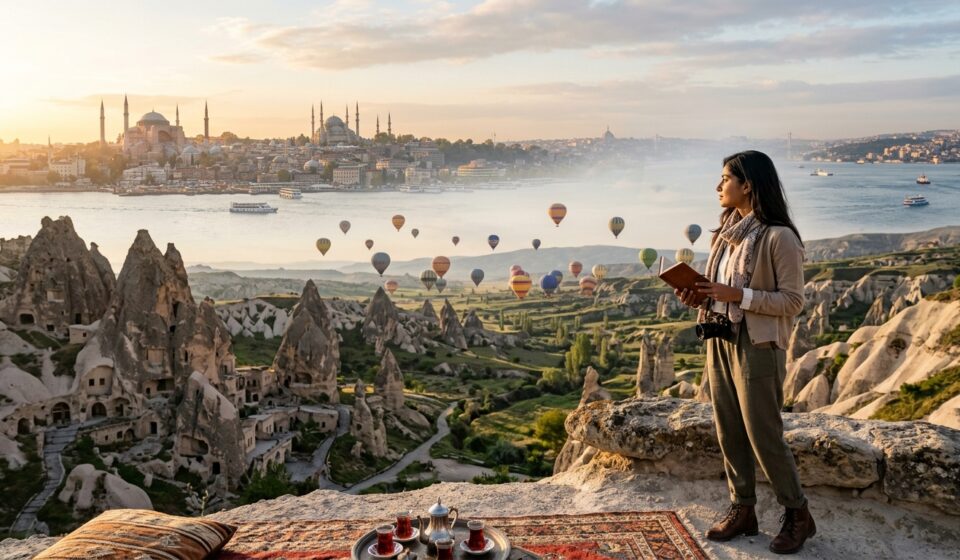

Planning a Turkey trip from India in 2026?
Turkey is one of the best value international destinations for Indians right now — the Turkish lira is at a historically favourable rate (approximately ₹2.08 per lira as of May 2026), making mid-range and luxury experiences remarkably affordable. A 7-night Turkey package from India including flights costs approximately ₹85,000 to ₹1,10,000 per person mid-range. The e-Visa costs USD 50 (~₹4,200) and is processed online in 24 to 48 hours — but there is an important condition for Indians that this guide covers clearly. The hot air balloon ride over Cappadocia at sunrise is the single non-negotiable experience, book it before everything else. And the best time to visit is April to June and September to October – perfect weather without the July–August heat and peak crowds.
Turkey is the destination that most Indian first-time international travellers did not know was this good. It sits at the crossroads of Europe and Asia — literally, in Istanbul, where you can stand on a bridge and look at Europe on one bank and Asia on the other. It has the architectural grandeur of an empire that once covered three continents (the Hagia Sophia, the Topkapi Palace, the Blue Mosque). It has a landscape in Cappadocia — fairy chimneys, cave hotels, and 150 hot air balloons rising at dawn — that exists nowhere else on earth. It has Mediterranean beaches. Ancient Roman cities. The white travertine terraces of Pamukkale that look like snow frozen in time. And all of it, in 2026, is extraordinarily affordable for Indian visitors.
This guide covers the visa process clearly (including the condition for Indians), verified costs, an 8-day itinerary, the Cappadocia balloon experience explained honestly, the best places to visit, and the practical tips that make a Turkey trip genuinely smooth for Indian travellers.
Turkey Visa for Indians in 2026: The Conditional e-Visa Explained
This is the most important section for Indian travellers — and the most frequently misunderstood. Turkey’s visa policy for Indian passport holders has a specific condition that catches many travellers off guard.
| Condition | Visa Option | Fee | Processing Time |
|---|---|---|---|
| If you hold a valid US, UK, Ireland, or Schengen visa / residence permit | Turkish e-Visa online (evisa.gov.tr) — simple, instant online process | USD 50 (~₹4,200) | 24 to 48 hours (usually faster) |
| If you do NOT hold any of the above | Apply through the Turkish Embassy or Turkish Visa Application Centre in India | Varies — contact Embassy | 2 to 4 weeks |
In plain language: if you have a valid Schengen visa, US visa, UK visa, or any of these countries’ residence permits — even if you are not currently travelling to those countries — you can get a Turkish e-Visa online in 24 to 48 hours. Millions of Indian business travellers and frequent international travellers qualify under this condition.
If you do not hold any of these visas, you must apply through the Turkish Embassy in India, which takes longer. The processing time and fee vary — contact the Turkish Embassy in New Delhi for current requirements.
How to Apply for the Turkish e-Visa
- Step 1: Go to evisa.gov.tr — the only official Turkish government e-Visa portal. Avoid third-party websites that charge more for the same service.
- Step 2: Select “Indian” passport and confirm your eligibility (Schengen/US/UK visa requirement)
- Step 3: Fill in personal details — name as on passport, passport number, travel dates
- Step 4: Upload a scan of the valid Schengen/US/UK visa or residence permit
- Step 5: Pay USD 50 by international debit or credit card
- Step 6: Receive e-Visa by email — typically within 24 to 48 hours. Save and print. Show at Turkish border control.
The e-Visa is a single-entry visa valid for 30 days from the date of first entry. Apply at least 5 to 7 days before travel for buffer – processing is usually faster but allow time for any correction of details if needed.
💡 Important for people planning a trip combining Turkey and Europe: Turkey is NOT a Schengen member — it requires a separate visa. The Turkish e-Visa does not count as a Schengen visa and vice versa. If you plan a trip covering Turkey and a Schengen country (like Greece or Italy), you need both visas. The good news: the Schengen visa you obtain for Europe also makes you eligible for the Turkish e-Visa.
Best Time to Visit Turkey from India
| Season | Months | Istanbul Weather | Cappadocia Weather | Prices | Verdict |
|---|---|---|---|---|---|
| Spring | April to June | 16–26°C, tulips in bloom, pleasant | 10–22°C, wildflowers, excellent for ballooning | Moderate to high | ✅ TravelDham’s top pick — perfect weather, tulips in Istanbul (April), excellent visibility for balloons |
| Peak Summer | July to August | 27–33°C, warm and humid | 25–35°C, very hot, crowded | Highest | ⚠️ Hot, crowded, expensive — Istanbul bearable, south coast excellent for beach but Cappadocia uncomfortable |
| Autumn | September to November | 18–27°C in September, cooling to 12–16°C by November | 10–22°C in September, cooler by October | 20–30% lower than peak | ✅ Excellent — warm weather, lower prices, thinning crowds, beautiful light |
| Winter | December to March | 5–10°C, some rain, occasional snow in Cappadocia | -5 to 8°C, snow possible — beautiful cave hotel experience | Lowest fares and hotels | ⚠️ Cold but magical — Cappadocia in snow is extraordinary. Balloon flights weather-dependent and more likely to cancel. |
April to June is the best window for most Indian travellers — Istanbul is at its most beautiful during tulip season (April), Cappadocia has wildflowers and excellent balloon weather, and the south coast beaches are opening up. September and October offer a similar quality of experience with meaningfully lower prices and reduced crowds — excellent value and TravelDham’s recommended alternative.
For Indian school holiday windows: April–May aligns perfectly with spring Turkey. October also works well — September and October are ideal for Cappadocia balloon rides with clear autumn skies.
Turkey Trip Cost from India 2026: Complete Breakdown
| Expense | Budget (per person, 7 nights) | Mid-Range (per person, 7 nights) | Premium (per person, 7 nights) |
|---|---|---|---|
| Return flights from India to Istanbul | ₹28,000–₹42,000 | ₹42,000–₹65,000 | ₹70,000–₹1,50,000 |
| Turkish e-Visa | ₹4,200 (USD 50) | ₹4,200 | ₹4,200 |
| Istanbul hotel (3 nights) | ₹6,000–₹12,000 | ₹14,000–₹28,000 | ₹30,000–₹80,000 |
| Cappadocia cave hotel (2 nights) | ₹9,000–₹15,000 | ₹16,000–₹35,000 | ₹40,000–₹1,00,000 |
| Antalya / coast hotel (2 nights) | ₹6,000–₹12,000 | ₹14,000–₹28,000 | ₹30,000–₹80,000 |
| Domestic flights (Istanbul → Cappadocia → Antalya) | ₹5,000–₹8,000 | ₹8,000–₹14,000 | ₹14,000–₹25,000 |
| Hot air balloon Cappadocia | ₹12,600–₹17,000 (group, €150–€200) | ₹17,000–₹21,000 (premium group) | ₹25,000–₹45,000 (private) |
| Meals (7 days — local restaurants + Turkish cuisine) | ₹5,000–₹9,000 | ₹10,000–₹18,000 | ₹20,000–₹45,000 |
| Tours and sightseeing (Hagia Sophia, Topkapi, Cappadocia tour, Pamukkale) | ₹5,000–₹9,000 | ₹9,000–₹18,000 | ₹18,000–₹40,000 |
| Local transport (Istanbul Metro, taxis, transfers) | ₹2,000–₹4,000 | ₹4,000–₹8,000 | ₹8,000–₹15,000 |
| Travel insurance | ₹1,500–₹2,500 | ₹2,500–₹4,500 | ₹4,500–₹9,000 |
| Total per person (7 nights) | ₹84,300–₹1,40,700 | ₹1,40,700–₹2,43,700 | ₹2,64,200–₹6,94,200 |
Turkey’s biggest value advantage for Indian travellers in 2026 is the Turkish lira exchange rate — at approximately ₹2.08 per lira, experiences that cost TRY 500 cost approximately ₹1,040. Restaurant meals that would cost ₹1,500 to ₹2,000 in an equivalent European setting cost ₹400 to ₹700 in Turkey. Cave hotels in Cappadocia that would command a substantial premium in any comparable European destination are available at ₹4,500 to ₹9,000 per night for mid-range properties. Turkey offers genuine Mediterranean luxury at a fraction of Greece, Italy, or France pricing.
💡 January–February and November offer the cheapest flights to Turkey from India — often 30 to 40% lower than peak season fares. Budget ₹28,000 to ₹38,000 for round-trip economy tickets during these windows versus ₹42,000 to ₹65,000 in peak season.
Best Places to Visit in Turkey for Indians in 2026
Istanbul – The City of Two Continents
Istanbul is the only city in the world that spans two continents — Europe and Asia, separated by the Bosphorus Strait. It is also one of the world’s great historic cities, the capital of three successive empires (Roman, Byzantine, Ottoman), and a modern metropolis of 15 million people that somehow makes it all work simultaneously. For Indian travellers specifically, Istanbul has a particular resonance — the Ottoman Empire’s connections to Mughal India, the shared Persian cultural influences, and the flavours of the food (kebabs, rice dishes, spiced sweets) that feel both exotic and familiar.
Must-do in Istanbul:
- Hagia Sophia (Ayasofya) — one of the world’s great architectural achievements. Built in 537 AD as a Byzantine cathedral, converted to a mosque in 1453, turned into a museum in 1935, and reconverted to a mosque in 2020. The interior — with its massive dome, golden mosaics, and the strange coexistence of Christian and Islamic elements — is extraordinary. Free entry for prayer times; non-Muslim tourists may visit at designated hours. Check current visiting hours before going as they are subject to prayer schedule.
- Blue Mosque (Sultanahmet Camii) — built between 1609 and 1616, named for the 20,000 blue Iznik tiles that cover the interior. Active mosque — open to tourists outside prayer times. Free entry. Dress modestly — women require a headscarf (provided at the entrance). The exterior silhouette with its six minarets against the Istanbul skyline is the most recognisable image of the city.
- Topkapi Palace — the administrative centre of the Ottoman Empire for 400 years, containing the Imperial Treasury (with Topkapi Dagger and Spoonmaker’s Diamond), the Harem complex, and extraordinary views over the Bosphorus and the confluence of three waterways. Entry: approximately ₹1,200 for palace, ₹700 additional for Harem. Book online to skip queues.
- Grand Bazaar (Kapalıçarşı) — one of the world’s oldest and largest covered markets. 61 covered streets, 4,000 shops, and everything from Turkish carpets to spices to gold jewellery to evil eye ceramics. Open Monday to Saturday. Bargain for everything — initial prices are always significantly above the selling price. Do not feel obligated to buy when you enter a shop — looking around without buying is completely normal.
- Bosphorus Cruise — a ferry cruise along the Bosphorus strait, passing palaces, fortresses, and the most expensive waterfront real estate in Turkey on both the European and Asian banks. Public ferries (₹50 to ₹100) do the same route as tourist boats (₹600 to ₹1,500) — use the public Bosphorus ferry for a genuine Istanbul experience at a fraction of the tourist boat price.
- Spice Bazaar (Mısır Çarşısı) — smaller and more concentrated than the Grand Bazaar, the Spice Bazaar is the place for Turkish saffron, dried fruits, lokum (Turkish delight), and spice mixes. 15 minutes walk from the Grand Bazaar.
- Galata Tower and Beyoğlu — the medieval Genoese tower in the Beyoğlu district offers 360-degree city views. The surrounding neighbourhood — Istiklal Avenue, Çiçek Pasajı, and the maze of side streets — is Istanbul’s most cosmopolitan area with excellent cafes, restaurants, and nightlife.
Cappadocia – The World’s Most Extraordinary Landscape
Cappadocia in central Turkey is, quite simply, unlike anything else on earth. Over millions of years, volcanic eruptions deposited thick layers of ash that hardened into soft rock (tuff), which water and wind then sculpted into thousands of “fairy chimney” formations — tall cones of rock, often with harder stone “caps” balanced on top. Humans then carved homes, churches, and entire underground cities into this rock — creating one of the most complex and strange inhabited landscapes in history. And every morning between April and November, up to 150 hot air balloons rise above this landscape at dawn, and it is one of the most photographed scenes on earth for very good reason.
Must-do in Cappadocia:
- Hot Air Balloon Ride at Sunrise — the defining Cappadocia experience. Depart from Göreme or Ürgüp at approximately 5 to 5:30 AM, ascend with the first light, and float for 45 to 90 minutes over the fairy chimney landscape as the sun rises. Standard group balloon: approximately €150 to €200 per person (~₹12,600 to ₹16,800). Premium balloon with smaller group and higher altitude: €250 to €350 per person (~₹21,000 to ₹29,400). Private balloon: significantly more. Book well in advance — balloons sell out weeks ahead in April–June and September–October. Flights are weather-dependent and may be cancelled — the reputable operators refund in full or reschedule if weather forces cancellation. Do not book with operators who do not offer full refund for weather cancellation.
- Cave hotel stay — sleeping in a carved-out cave room in Cappadocia is a bucket-list accommodation experience. The stone walls maintain a natural 18 to 20°C temperature year-round, and many cave hotels have private terraces with fairy chimney views. Mid-range cave hotels: ₹4,500 to ₹9,000 per night. Luxury cave hotels (Museum Hotel, Argos in Cappadocia): ₹25,000 to ₹60,000+ per night.
- Göreme Open Air Museum — a UNESCO World Heritage Site containing a remarkable collection of Byzantine-era rock-cut churches decorated with 10th to 13th century frescoes. The Dark Church (Karanlık Kilise) has the best-preserved frescoes — a small additional entry fee (approximately ₹350) is worth paying. Entry to the main complex: approximately ₹1,000.
- Valley walks — Rose Valley, Pigeon Valley, Love Valley — Cappadocia’s landscape is best experienced on foot. The Rose Valley walk (2 to 3 hours, moderate difficulty) takes you through rock formations that turn pink and gold at sunset. Pigeon Valley has ancient pigeon houses carved into the cliffs. Love Valley has the most distinctive phallic fairy chimney formations. All are free to walk — hire a local guide for ₹2,500 to ₹4,000 for a half-day to understand the geology and history you are walking through.
- Underground Cities — Derinkuyu — an 8-level underground city carved into the rock that housed approximately 20,000 people (and their livestock) during Byzantine Christian persecution. The city extends 85 metres below the surface and includes ventilation shafts, wells, wine cellars, and stables. Genuinely extraordinary engineering from 2,000 years ago. Entry: approximately ₹500.
- Sunset at Uçhisar Castle — the highest natural rock formation in Cappadocia, carved into a castle that is now a viewpoint. The 360-degree view of the valley at golden hour, with the balloon-dotted sky of the morning replaced by the warm tones of evening light on the fairy chimneys, is beautiful.
Pamukkale – The Cotton Castle
Pamukkale (“Cotton Castle” in Turkish) is one of Turkey’s most unique natural wonders — a hillside of brilliant white travertine terraces formed over millennia by calcium-rich thermal waters flowing down the slope and depositing calcium carbonate in a series of pools and cascades. The result looks exactly like snow that has been frozen in place — strikingly unreal. At the summit, the ancient Roman city of Hierapolis contains a beautifully preserved theatre, a necropolis (city of the dead), and the Antique Pool where you can swim among ancient Roman columns submerged when the city was destroyed by earthquakes.
Pamukkale is 200 km south of Istanbul — accessible as a day trip from coastal Antalya (3 hours) or as a stop on the inland route between Istanbul and Antalya. Entry: approximately ₹840. The Antique Pool swimming: approximately ₹1,200 additional.
💡 Walking on Pamukkale: You must remove shoes to walk on the white terraces — bags and cameras are allowed. The thermal water pools at the top are warm (35°C) and you can sit in them. The terraces are slippery — walk carefully. The travertine is white and pristine at the top sections and darker lower down (where more visitors walk) — aim for the upper sections for the best photographs.
Antalya – Turkey’s Mediterranean Coast
Antalya is Turkey’s most popular beach destination — a modern city on the Mediterranean coast surrounded by the Taurus Mountains, with a beautifully preserved Roman and Ottoman old town (Kaleiçi), and easy access to some of Turkey’s best beaches and ancient ruins. Perge (a well-preserved Roman city), Side (ancient ruins on a beach peninsula), and the stunning Düden Waterfalls that plunge directly into the sea are all within a day trip distance.
The Antalya coast is at its best between April and October — warm Mediterranean sea, excellent hotel infrastructure, and a more relaxed pace than Istanbul. All-inclusive resorts along the Antalya coast offer extraordinary value for Indian families — world-class facilities at prices that are substantially lower than comparable Mediterranean resorts in Greece or Spain.
Ephesus – The Ancient Roman City
Ephesus, 70 km from Izmir, is one of the best-preserved ancient Roman cities in the world — walking its marble-paved streets past the Library of Celsus, the Grand Theatre (capacity 25,000), the Terrace Houses (showing how wealthy Romans lived), and the Temple of Hadrian gives a genuinely visceral sense of what a functioning Roman city of 250,000 people looked like. Adjacent is the Basilica of St John and the House of Virgin Mary — making Ephesus a significant Christian pilgrimage site as well. Entry: approximately ₹1,100.
8-Day Turkey Itinerary for Indians 2026
Day 1 – Arrive Istanbul + Sultanahmet Evening
- Arrive at Istanbul Airport (IST — the new Istanbul Airport, 45 to 60 minutes from the city) or Istanbul Sabiha Gökçen Airport (SAW — on the Asian side, 60 to 90 minutes from the European side)
- Transfer to hotel in Sultanahmet (the historical peninsula — best location for first-time Istanbul visitors)
- Evening: first walk around Sultanahmet Square — Hagia Sophia and Blue Mosque illuminated at night is one of Istanbul’s most beautiful scenes
- Dinner at a Sultanahmet restaurant: kebabs, mezes, and baklava. Turkish dinner for two costs approximately ₹800 to ₹1,500 at a good local restaurant.
Day 2 – Istanbul: Historical Peninsula
- Early morning (8 AM): Hagia Sophia — arrive early for cooler temperatures and fewer crowds. Check current prayer schedule for non-Muslim visitor access times.
- Blue Mosque (outside prayer times — usually accessible mid-morning)
- Topkapi Palace — morning through midday. Pre-book tickets online. Include Harem.
- Grand Bazaar — afternoon. Budget 2 hours for browsing, bargaining, and tea invitations from shop owners.
- Spice Bazaar — 15 minutes from the Grand Bazaar
- Evening: Galata Tower sunset views, dinner in Beyoğlu neighbourhood
Day 3 – Istanbul: Bosphorus + Asian Side
- Morning: Bosphorus public ferry from Eminönü — take the 10 AM departure, ride to Anadolu Kavağı (the furthest point, with a medieval castle), have fresh fish at the harbour, return by 4 PM
- Alternative: cross to the Asian side of Istanbul by ferry (15 minutes, ₹50) — explore Kadıköy market and Moda neighbourhood for a completely different Istanbul atmosphere
- Late afternoon: Dolmabahçe Palace on the European Bosphorus waterfront — the opulent 19th-century palace where the last Ottoman sultans lived and Atatürk died. Guided tours only. Entry approximately ₹1,500.
- Evening: dinner near the Bosphorus with water views
Day 4 – Fly Istanbul to Cappadocia + Afternoon Valley Walk
- Morning: domestic flight Istanbul to Kayseri or Nevşehir (1.5 hours — Turkish Airlines or Pegasus operate multiple daily flights from approximately USD 40 to 80 one-way)
- Transfer from airport to Göreme (30 to 45 minutes) — the main Cappadocia tourist village
- Check in at cave hotel
- Afternoon: Pigeon Valley walk or sunset at Uçhisar Castle
- Evening: Turkish pottery class in Avanos (45 minutes from Göreme) — optional but highly recommended. The town of Avanos has been making red clay pottery for thousands of years.
Day 5 – Cappadocia: Hot Air Balloon + Göreme Museum
- Pre-dawn: pick-up from hotel (approximately 4:30 to 5 AM), transfer to launch site, balloon ride at sunrise (45 to 90 minutes). This is the highlight of the entire Turkey trip.
- Post-balloon: champagne toast (traditional for balloon ride completion), breakfast at hotel
- Mid-morning: Göreme Open Air Museum — the Byzantine cave churches with frescoes
- Afternoon: Derinkuyu or Kaymaklı Underground City
- Sunset: Rose Valley walk for the golden hour light on the fairy chimneys
Day 6 – Cappadocia: Valleys + Drive to Pamukkale (or fly to Antalya)
- Morning: Love Valley and Red Valley walks — the best morning light for fairy chimney photography
- Option A: Transfer to Pamukkale (4 to 5 hours by road or short flight via Denizli). Afternoon at Pamukkale terraces and Antique Pool. Overnight Pamukkale.
- Option B: Fly from Kayseri to Antalya (Turkish Airlines, 1.5 hours). Arrive Antalya afternoon. Evening in Kaleiçi old town.
Day 7 – Pamukkale (if chosen) or Antalya/Coast
- If Pamukkale: morning at the travertine terraces and Hierapolis ruins. Afternoon drive to Antalya (3 hours).
- If Antalya: Perge ancient ruins day trip (20 km from Antalya, entry approximately ₹700), afternoon beach at Lara or Konyaaltı
- Antalya Kaleiçi (old town) evening — Roman harbour, Ottoman mansions, street cafes
Day 8 – Final Day + Depart
- Morning: Düden Waterfalls (5 km from Antalya centre) — the upper and lower falls are both beautiful, the lower waterfall plunging directly into the sea is the more dramatic of the two
- Turkish hamam (bath) experience — Antalya has several historic hamams. A 45-minute traditional hamam with scrub and foam massage costs approximately ₹1,500 to ₹2,500. An excellent final morning activity.
- Transfer to Antalya Airport (AYT) for international departure (direct flights to India or via Istanbul/Dubai)
Turkish Food: What Indian Travellers Should Know
Turkish cuisine is one of the world’s great food traditions — and it is significantly more accessible for Indian travellers than most other European destinations. The food culture is meaty (lamb, chicken, and beef dominate), but vegetarian options are available and genuinely excellent. The overlap with Indian food culture in ingredients (lentils, rice, eggplant, chickpeas, yogurt) and cooking techniques means the flavour profile is familiar enough to be comfortable but different enough to be exciting.
- Kebabs — Turkey is the home of the kebab in all its forms. Adana kebab (spiced minced lamb on a skewer, named for the southern city), İskender kebab (döner meat over bread with tomato sauce and yogurt butter), and şiş kebab (cubed marinated meat on a skewer) are the most important. A full kebab meal at a local lokanta costs ₹400 to ₹800.
- Mezze — small dishes served as starters or a full meal. Hummus, cacık (yogurt with cucumber and garlic — the Turkish tzatziki), patlıcan salatası (smoky roasted eggplant), tabbouleh, dolma (stuffed grape leaves — often vegetarian), and sigara böreği (cheese-filled fried pastry). A mezze spread for two with bread costs ₹600 to ₹1,200.
- Lahmacun — a thin crispy flatbread topped with spiced minced meat and vegetables, rolled up and eaten like a wrap. Often called “Turkish pizza.” One of Turkey’s greatest street foods. ₹80 to ₹150 at a local bakery.
- Simit — a circular sesame-covered bread sold from street carts throughout Turkey. The Istanbul morning commuter’s breakfast. ₹20 to ₹40 per ring. Eat with cheese and tea.
- Lokum (Turkish Delight) — the original Turkish delight. The real thing — made from starch and sugar with rose water, pistachios, and various flavourings — is completely different from the sugar-coated versions exported abroad. Try at the Spice Bazaar in Istanbul.
- Baklava — layers of filo pastry, chopped pistachios or walnuts, and honey or syrup. The finest baklava in Turkey is made in the southeastern city of Gaziantep, but excellent versions are available throughout the country. ₹150 to ₹400 for a small box at a good baklava shop.
- Turkish tea (çay) and coffee — Turkey runs on tea. Small tulip-shaped glasses of black çay are served everywhere, constantly, and usually for free. Turkish coffee (strong, unfiltered, served in a small cup with grounds settling at the bottom) is an experience — drink it slowly and don’t drain the last sip.
For vegetarian Indian travellers: Turkey is more vegetarian-friendly than it first appears. Mezze culture means dozens of vegetable and cheese dishes are available as complete meals. Gözleme (filled flatbreads with cheese, spinach, or potato) are excellent vegetarian street food. Lentil soup (mercimek çorbası) is ubiquitous and genuinely good. Vegetarian pide (Turkish flatbread with various toppings) is available at most pide restaurants. Indian restaurants exist in Istanbul (particularly Taksim and Sultanahmet) for those who need a familiar meal.
Practical Tips for Indians Visiting Turkey in 2026
Verify your e-Visa eligibility before booking anything. Check whether you hold a valid US, UK, Irish, or Schengen visa before assuming you can get the e-Visa. If you don’t have any of these, contact the Turkish Embassy in New Delhi to understand the alternative process and timeline. Do not book non-refundable flights before confirming your visa eligibility.
Book the Cappadocia balloon ride before you book anything else. The balloon ride is the single most sought-after activity in Turkey and sells out weeks ahead during peak season. Reputable operators who offer a full refund for weather cancellations are essential — Butterfly Balloons, Royal Balloon, and Voyager Balloons are consistently well-regarded. Book directly with operators rather than through hotel desks that add commission.
Use the Turkish lira advantage intelligently. At ₹2.08 per lira (May 2026), Turkey offers extraordinary value for Indian visitors. Withdraw Turkish lira from ATMs for the best exchange rate — carry some cash for markets, local restaurants, and smaller vendors. International Visa and Mastercard are accepted widely at hotels, larger restaurants, and tourist sites. UPI does not work in Turkey.
Book domestic flights within Turkey in advance. The Istanbul to Cappadocia and Istanbul to Antalya domestic routes are busy and popular — book 3 to 4 weeks ahead for the best fares. Turkish Airlines and Pegasus Airlines both operate frequent services. A one-way Istanbul to Kayseri (Cappadocia) flight typically costs USD 40 to 80 (~₹3,360 to ₹6,720) when booked in advance.
Haggling is expected in bazaars — not in shops. In the Grand Bazaar and Spice Bazaar, bargaining is part of the experience. Start at 50 to 60% of the quoted price and meet somewhere in between. In regular shops, supermarkets, and restaurants, prices are fixed. The tea invitation from bazaar shopkeepers (“please come in, just looking, no obligation”) is genuine hospitality but also a sales strategy — you are not obligated to buy anything but they will be disappointed if you look for 20 minutes, drink their tea, and leave without purchasing. Be gracious either way.
Respect religious customs. Turkey is a predominantly Muslim country. During Ramadan (check dates — moves each year), many local restaurants may be closed during daylight hours and the atmosphere changes significantly. Remove shoes when entering mosques. Dress modestly — cover shoulders and knees for mosque visits. Women should carry a headscarf for mosque entry (provided at most major mosques if you forget).
Istanbul’s public transport is excellent. The Istanbul Metro, tram (T1 line from Kabataş to Bağcılar covers most tourist sites), and ferries are connected by a rechargeable Istanbulkart (approximately ₹420 deposit, load credit as needed). Far cheaper than taxis and very reliable. Download the Istanbul Metro app for route planning.
Frequently Asked Questions – Turkey Trip from India 2026
Do Indians need a visa for Turkey in 2026?
Yes. Indian passport holders need a visa for Turkey. If you hold a valid US, UK, Ireland, or Schengen visa or residence permit, you can apply for a Turkish e-Visa online at evisa.gov.tr — it costs USD 50 (~₹4,200) and is processed in 24 to 48 hours. If you do not hold any of these visas, you must apply through the Turkish Embassy in India, which takes longer. Apply at least 5 to 7 days before travel for the e-Visa; allow 3 to 4 weeks for embassy applications.
How much does a Turkey trip from India cost in 2026?
A 7-night Turkey trip from India costs approximately ₹84,000 to ₹1,41,000 per person at a budget level, ₹1,41,000 to ₹2,44,000 per person mid-range, and ₹2,64,000+ per person premium — including return flights, visa, accommodation, domestic Turkey flights, hot air balloon, food, and sightseeing. The favourable Turkish lira exchange rate (₹2.08 per lira as of May 2026) makes Turkey one of the best-value international destinations for Indian travellers currently.
How much does the Cappadocia hot air balloon cost in 2026?
A standard group hot air balloon ride in Cappadocia costs €150 to €200 per person (~₹12,600 to ₹16,800) in 2026. Premium smaller-group balloons cost €250 to €350 per person (~₹21,000 to ₹29,400). Private balloons cost significantly more. Book with reputable operators who offer full refund or free reschedule for weather cancellations — balloon flights are weather-dependent and cancellations do occur. Book weeks in advance for peak season (April to June, September to October).
What is the best time to visit Turkey from India?
April to June and September to October are the best times to visit Turkey from India. Spring (April to June) offers pleasant weather across all regions, Istanbul’s famous tulip season in April, and excellent balloon weather in Cappadocia. Autumn (September to October) is equally good with lower prices and thinning crowds. July and August are the hottest and most crowded months — Istanbul is manageable but Cappadocia can be uncomfortably hot, and prices are at their peak. Winter (December to March) offers the lowest prices and Cappadocia in snow, which is magical but balloon flights are more frequently cancelled.
How many days are enough for Turkey?
7 to 9 days is ideal for a first Turkey trip covering Istanbul (2 to 3 nights), Cappadocia (2 nights), and one coastal or cultural addition (Pamukkale, Antalya, or Ephesus). Istanbul alone can absorb 3 full days without repetition. Cappadocia needs a minimum of 2 nights to include the balloon ride, underground city, and valley walks. Adding Antalya or Pamukkale requires 1 to 2 additional days. A 5-day trip covering only Istanbul and Cappadocia is the minimum meaningful Turkey trip.
Is Turkey safe for Indian tourists in 2026?
Yes — Istanbul, Cappadocia, Antalya, and Pamukkale are safe, well-touristed areas with good tourist infrastructure and low crime rates against visitors. The tourism industry is extremely well-developed and English is widely spoken in tourist areas. Standard travel precautions apply — petty theft in crowded areas (carry bags in front), taxi fare agreements before departure (insist on meter or agree price), and awareness of tourist-targeting scams near the Grand Bazaar and Hagia Sophia. The overwhelming majority of Indian tourists visit Turkey without any incident.
Are there direct flights from India to Turkey?
Turkish Airlines operates direct (non-stop) flights from Istanbul to Mumbai and Delhi. The flight time is approximately 7 to 8 hours. Turkish Airlines is also frequently the cheapest option for Istanbul-bound travel from India due to the Istanbul hub’s geographic position between South Asia and Europe. Indirect options via Dubai (Emirates), Doha (Qatar Airways), and Abu Dhabi (Etihad) are available from most Indian cities. Book 2 to 3 months in advance for peak season; January–February and November offer the cheapest fares.
Plan Your Turkey Trip with TravelDham
Turkey has more planning complexity than it first appears — the conditional e-Visa requirement that catches Indian travellers off guard, the advance balloon booking that sells out in peak season, the domestic flight coordination between Istanbul, Cappadocia, and Antalya, and the decision between Pamukkale, Ephesus, and the Aegean coast as the third leg of the itinerary. Getting these decisions right before you book makes the difference between a seamlessly enjoyable Turkey trip and one that involves last-minute scrambling.
TravelDham builds fully customised Turkey FIT packages for Indian travellers — verifying your visa eligibility and guiding the e-Visa or embassy application process, booking hot air balloon rides with verified Cappadocia operators that offer weather cancellation protection, coordinating domestic Turkey flights, selecting cave hotels and Istanbul properties matched to your budget and location preferences, and building an itinerary around your travel dates and the specific Turkey experiences that matter most to you.
Whether you are planning a first-time 7-day Istanbul and Cappadocia trip, a honeymoon combining Cappadocia’s cave hotels with Antalya’s beachfront resorts, a family trip with the coastal add-on, or a 10-day extended circuit including Ephesus and the Aegean coast — TravelDham builds it around your group and budget.
Contact TravelDham today for a free Turkey itinerary and quote. We confirm your e-Visa eligibility, balloon availability, and cave hotel options for your specific travel dates — all within 24 hours.