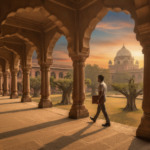

The rapid acceleration of urban development has left many seeking destinations that remain untouched by modern uniformity. For travelers seeking deep historical connections, exploring the ancient tribal villages in india offers an unparalleled perspective on human heritage. These settlements are not merely geographic locations. They are living museums where ancient customs, oral histories, and sustainable ecological practices continue to exist in their purest forms. To wander through these villages is to step back in time. It is basically a journey into the ancestral heart of the subcontinent. As far as current data suggests, these communities maintain a complex relationship with the natural world, preserving craft forms and belief systems that have vanished elsewhere. This guide provides an analytical and comprehensive exploration of these unique destinations, outlining the cultural significance, geographic distribution, and ethical considerations necessary for travelers planning a respectful visit.
- Rich Cultural Heritage: India’s tribal villages represent ancient customs, traditional crafts, and unique social structures preserved over centuries.
- Eco-Friendly Living: Villages like Khonoma in Nagaland are pioneers in sustainable development, environmental conservation, and local governance.
- Diverse Artistic Expressions: From Gond paintings in Bastar to Lippan mud-mirror art in Kutch, indigenous art forms reflect deep ecological connections.
- Responsible Tourism: Cultivating respectful travel habits, such as hiring local guides and purchasing crafts directly from artisans, supports community livelihoods.
- Regulatory Requirements: Many tribal areas, particularly in Northeast India, require special entry permits like Inner Line Permits (ILP) for domestic and international travelers.
The Cultural Significance of Indigenous Communities in India
The demographic makeup of the Indian subcontinent is characterized by an extraordinary variety of communities. India is home to hundreds of distinct ethnic groups, collectively referred to as Scheduled Tribes or Adivasis. Within this broad classification, the government identifies certain groups as PVTGs (Particularly Vulnerable Tribal Groups). This is an administrative designation for communities experiencing low literacy, stagnant populations, and unique historical technologies that predate modern agriculture. Understanding this categorization is essential before visiting any tribal villages in india. These indigenous communities have spent centuries perfecting agricultural techniques, architectural styles, and handloom arts that are perfectly adapted to their local environments.
But still, modern economic pressures present a significant challenge to the survival of these traditions. The preservation of cultural knowledge in the tribal villages in india depends heavily on community-led heritage initiatives. When managed with care, tourism can offer these communities a viable livelihood, reducing the need for migration to congested urban centers. Travelers who choose to explore the tribal villages in india play a direct role in this economic system. However, this interaction must be approached with academic curiosity rather than voyeuristic sentimentality. The distinct social structures and communal decision-making processes found within these settlements represent highly sophisticated social systems.
As reported by the Ministry of Tribal Affairs based on the 2011 Census of India, tribal communities constitute roughly 8.6 percent of the country’s total population.
Geographic Hubs of Tribal Tourism in India
The distribution of tribal populations in India is highly regional, with distinct cultural clusters in the Northeast, Central, Eastern, and Western zones. Engaging in tribal tourism requires an understanding of these distinct regions, as each offers completely different cultural expressions, dialects, and artistic outputs. The tribal villages in india are not uniform. A traveler will find vast differences between the high-altitude wooden longhouses of Nagaland and the circular mud huts of the Gujarat deserts.
In the northeastern states, the mountainous terrain has allowed communities to maintain high degrees of autonomy and cultural preservation. Here, the tribal villages in india are often organized around clan structures, with complex systems of community governance. In Central India, Chhattisgarh settlements are famous for intricate wood carvings and metalwork. Meanwhile, the Eastern Ghats of Odisha host communities that have preserved ancient agrarian lifestyles with minimal external interference. Finally, the arid zones of Gujarat and Rajasthan contain pastoral nomadic communities whose livelihoods revolve around livestock and highly sophisticated embroidery. Exploring these diverse hubs reveals how the tribal villages in india have adapted to diverse ecological niches, from dense tropical forests to parched salt plains.
Northeast India: Ziro Valley and the Apatani Heritage
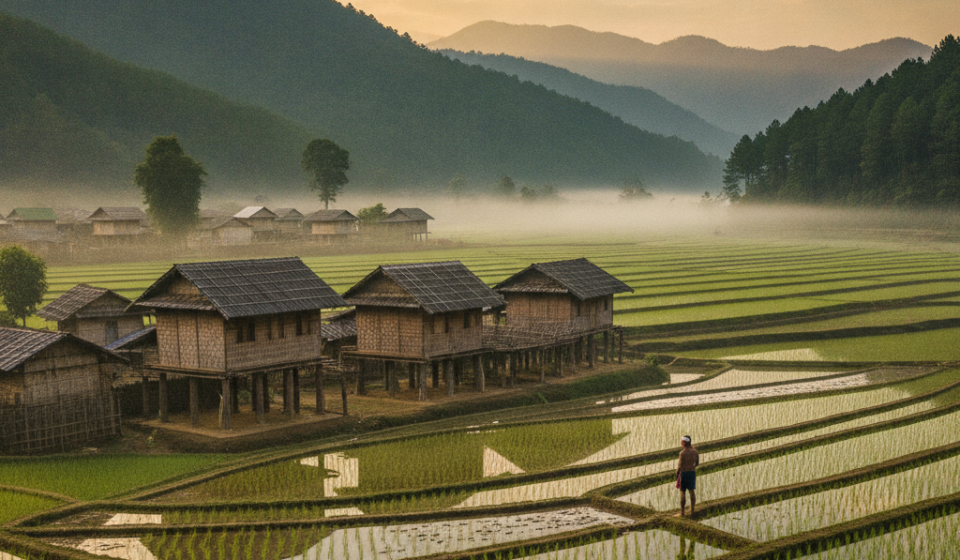
Arunachal Pradesh is arguably one of the most culturally diverse regions in Asia, containing more than two dozen major tribes and numerous sub-tribes. For those interested in studying the architectural and agricultural systems of these communities, a visit to the Ziro Valley is essential. Travelers can easily book curated tours to Arunachal Pradesh to experience these ancient lifestyles firsthand. The valley is the home of the Apatani tribe, who are widely recognized for several remarkable adaptations:
- Wet Rice Cultivation: Unlike many other tribal villages in india that practice shifting cultivation, the Apatani have developed a permanent, sustainable farming model that integrates fish farming directly into the paddy fields.
- Traditional Markings: The traditional nose plugs and facial tattoos of older Apatani women remain a powerful historical marker (though this practice is no longer common among the younger generation).
- Bamboo Architecture: The tribal villages in india situated in the Ziro Valley, such as Hong and Hari, are constructed primarily of bamboo and timber, raised on stilts to prevent damage during the monsoon season.
- Community Assembly (Lapang): Walking through these settlements, one observes the central role of the lapang, a large wooden platform that serves as a community assembly point for judicial and social discussions. These structures demonstrate the sophisticated level of communal self-governance that characterizes the tribal villages in india in the far northeast.
Nagaland: Khonoma and the Angami Conservation Model
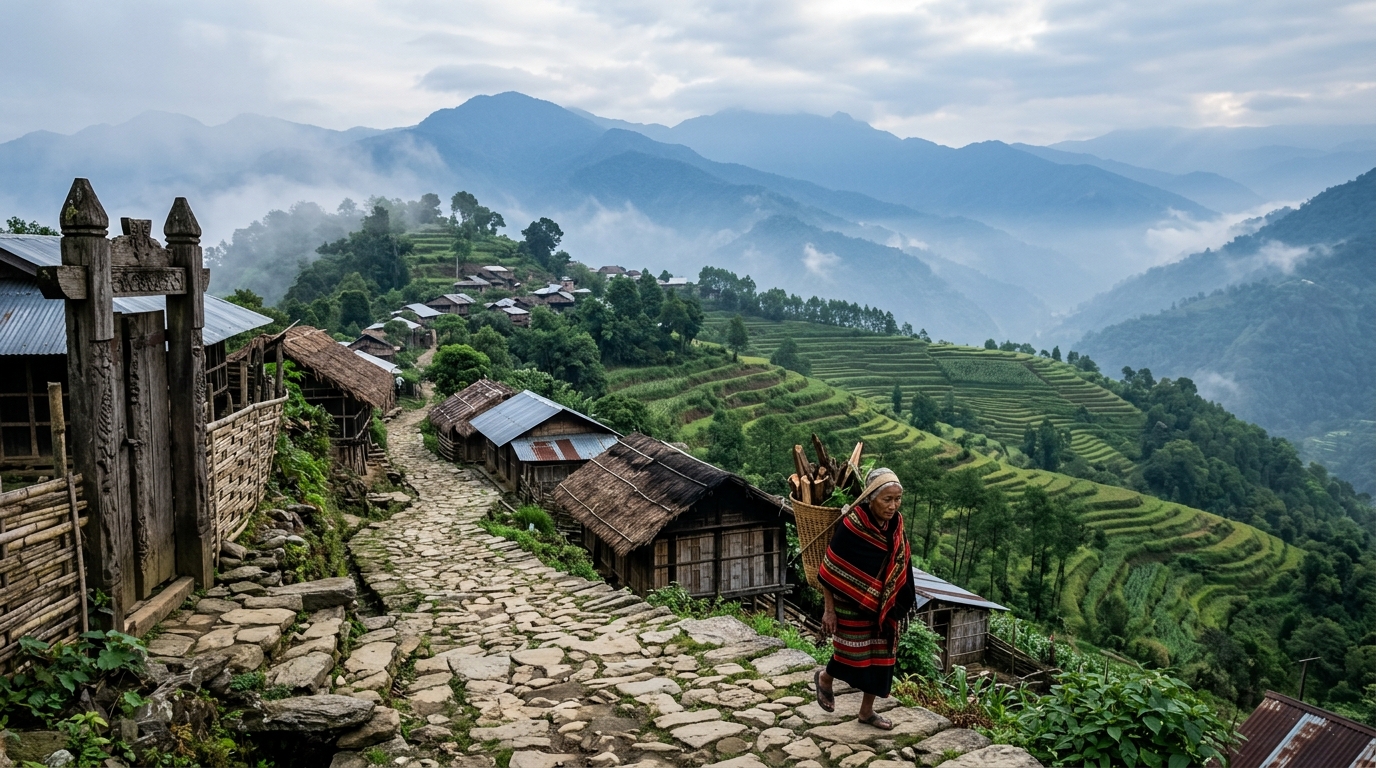
Further south in the Naga hills lies Nagaland, a state composed of sixteen major tribes, each distinguished by unique attire, dialects, and customs. Khonoma, an Angami Naga settlement, represents a fascinating evolution in how the tribal villages in india interact with their natural surroundings. Historically known for their fierce resistance to British colonial expansion, the people of Khonoma have transitioned into pioneers of ecological conservation. The village is widely celebrated as India’s first green village, a status achieved through a community-mandated ban on logging and hunting within their ancestral forests.
As documented by the Nagaland Tourism Department in their historical archives, the Hornbill Festival was established in the year 2000 to encourage structured interaction among the diverse tribes. Travelers looking to explore the broader region can easily integrate a visit to Khonoma with customized itineraries to Assam and Meghalaya to witness the incredible diversity of the region. The Angami community in Khonoma is distinguished by several unique socio-ecological practices:
- Alder Tree Cultivation: The Angami cultivate nitrogen-fixing alder trees to maintain soil fertility across terraced plots, a technique unique among the tribal villages in india showing a deep understanding of forest ecology.
- Eco-Conservation Leadership: As India’s first green village, Khonoma enforces a strict community-mandated ban on logging and hunting within ancestral forests.
- Architectural Heritage: The village is famous for its stone-paved pathways, traditional fort gates, and morungs (youth dormitories serving as educational spaces where young Nagas learned folklore and crafts).
The preservation of these structures within the tribal villages in india highlights the successful integration of heritage conservation with modern ecological standards.
Central India: Bastar and the Gond Art Tradition
The forested plateau of Bastar in Chhattisgarh is synonymous with some of the most artistic tribal villages in india. The region is predominantly inhabited by the Gond, Maria, and Muria tribes, who have maintained an rich oral tradition and a highly distinctive aesthetic style. The Gond are particularly famous for their vibrant painting style, which uses repetitive lines, dots, and vibrant colors to depict sacred flora, fauna, and local deities. Initially painted on mud walls, this art has gained international recognition, showing how the creative output of the tribal villages in india connects rural heritage with global markets.
In addition to painting, the tribal villages in india in the Bastar region are characterized by distinctive artistic and social systems:
- Dhokra Metal Casting: A non-ferrous metal casting technique utilizing the lost-wax casting method, practiced in the subcontinent for over four thousand years. Artisans create exquisite brass figurines of deities, musicians, and animals with unique, non-symmetrical details.
- Gond Paintings: An internationally recognized style using repetitive lines, dots, and vibrant colors to depict sacred flora, fauna, and local deities.
- The Ghotul Institution: A traditional institution where young men and women live communally to learn social responsibilities, music, and dance, highlighting the progressive social frameworks preserved in these ancient tribal villages in india.
Odisha: Rayagada and the Isolated Communities of the Eastern Ghats
Odisha possesses one of the largest concentrations of diverse indigenous groups, with sixty-two distinct tribes residing in its forested hills and valleys. The district of Rayagada is the gateway to some of the most isolated tribal villages in india, particularly those inhabited by the Lanjia Saora and Dongria Kondh tribes. The Dongria Kondh, who reside in the Niyamgiri hills, worship the hills as sacred entities, a belief system that has historically put them at the forefront of environmental preservation battles against industrial mining.
The tribal villages in india in this region are characterized by their simple, linear arrangements of clay-walled houses, often decorated with geometric wall paintings known as Idital. These geometric paintings serve as visual prayers for health, fertile crops, and protection. The weekly markets, or haats, held near these tribal villages in india are crucial centers of commerce and social interaction. Here, the tribes gather to barter forest produce, hand-woven shawls, and traditional brass ornaments. These weekly gatherings offer visitors a rare glimpse into a non-monetized barter economy that has largely disappeared from the rest of the country. It is basically a living economic system where the value of goods is determined by mutual need rather than global market indices, making these tribal villages in india essential research sites for anthropologists and cultural enthusiasts alike.
Western India: Hodka and the Artisans of the Rann of Kutch
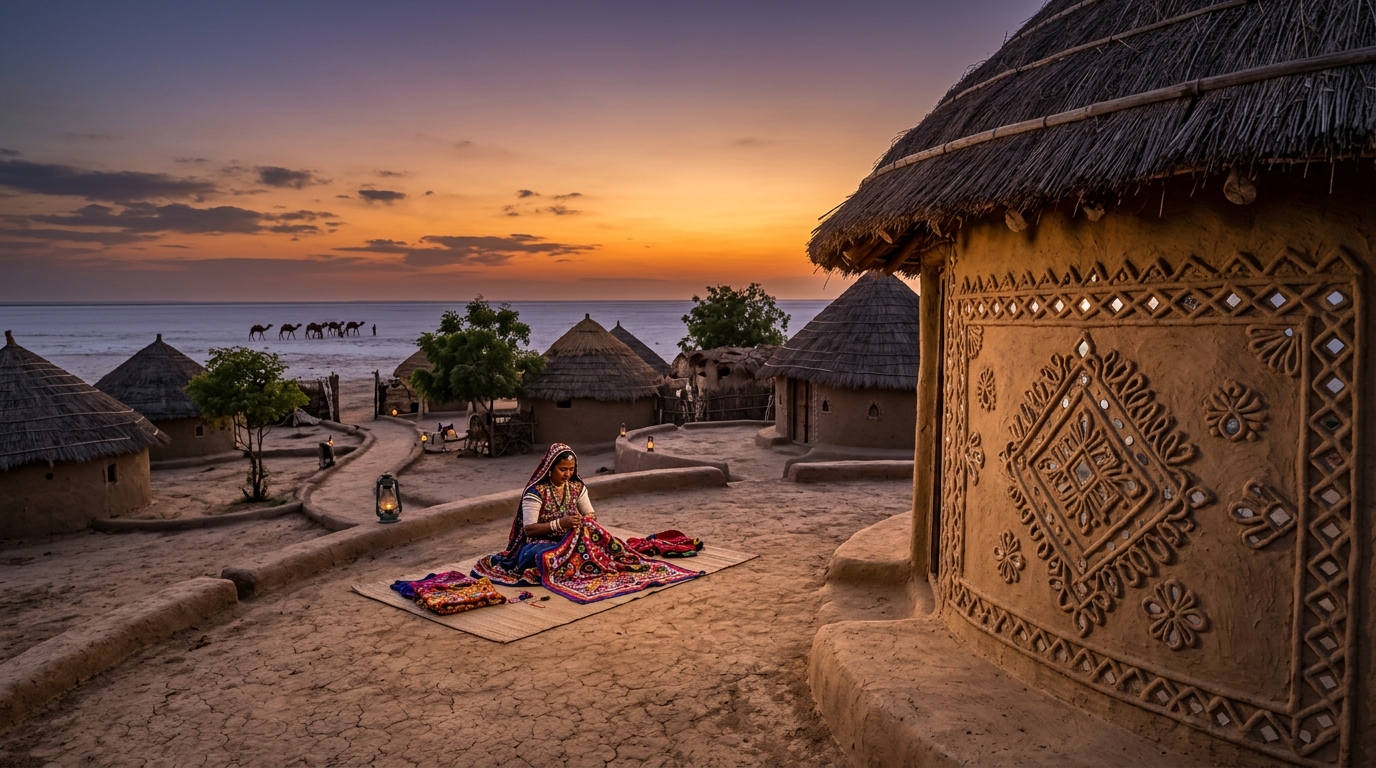
The arid plains of the Rann of Kutch in Gujarat present a stark contrast to the forested hills of the East and Northeast. In this dry environment, the tribal villages in india have developed around pastoralism and exquisite textile arts. The village of Hodka, inhabited by the Halepotra and Meghwal clans, is a premier example of these desert settlements. The residents are renowned for their master craftsmanship, particularly in Bharat embroidery, leatherwork, and mud-mirror art known as Lippan Kaam.
The architecture of these western tribal villages in india is uniquely adapted to the harsh desert climate. The houses, called bhungas, are circular mud structures with conical thatch roofs. This circular design protects homes from desert winds, while thick mud walls insulate against extreme summer heat and winter cold. The interior walls of these bhungas are intricately decorated with Lippan Kaam, creating reflective patterns that maximize the light from a single oil lamp. The survival of these architectural techniques in the tribal villages in india of Kutch highlights a profound, ancestral understanding of sustainable building practices. Visiting Hodka allows travelers to see how these communities have turned the challenges of an arid environment into a source of stunning artistic and architectural innovation.
A Comparative Analysis of Key Tribal Communities
To help travelers plan their itineraries, it is useful to compare the distinctive features of the various tribal villages in india. The table below outlines five key communities, their geographic locations, primary artistic practices, and traditional architectural styles. This structured comparison demonstrates the immense diversity found across these settlements, showing that each region requires a different approach to travel and cultural engagement.
The table illustrates that the tribal villages in india are shaped by their local geographies. For instance, the high rainfall of the Northeast necessitates stilted timber houses, while the extreme heat of the Western deserts requires the thermal mass of circular mud bhungas. Similarly, artistic traditions reflect local ecosystems, using native materials like bamboo in Nagaland, clay in Gujarat, and wild grass in Odisha. Understanding these regional variations is crucial for anyone wishing to visit these tribal villages in india in a meaningful and supportive manner.
| Tribe / Community | Primary Region | Key Artistic / Cultural Practice | Traditional Housing Style |
|---|---|---|---|
| Apatani | Ziro Valley, Arunachal Pradesh | Wet Rice and Fish Cultivation | Stilted Bamboo and Timber Houses |
| Angami Naga | Khonoma, Nagaland | Alder Wood Terrace Farming | Stone-Walled Timber Longhouses |
| Gond | Bastar, Chhattisgarh | Dhokra Metal Casting and Gond Painting | Clay-Walled Mud Houses with Thatch |
| Dongria Kondh | Niyamgiri Hills, Odisha | Kapdaganda Embroidery (Shawls) | Linear Mud Houses with Sacred Wall Art |
| Meghwal | Kutch, Gujarat | Lippan Kaam (Mud-Mirror Art) | Circular Mud Bhungas with Conical Roofs |
Ethics and Best Practices for Visiting Tribal Villages
The growing popularity of tribal tourism has brought much-needed economic opportunities to remote areas. However, it also poses significant risks to the social fabric and privacy of indigenous communities. Unlike resorts, the tribal villages in india are active residential spaces where daily chores and community governance happen in public view. Travelers must behave with the same decorum they would show when entering a private home in a modern city. Ethical engagement is not just a moral obligation. It is essential for ensuring that these fragile cultural ecosystems are not degraded by unregulated tourism.
To ensure a mutually beneficial interaction, travelers should adhere to the following best practices when visiting tribal villages in india:
- Engage Local Guides: Always hire local, community-approved guides. They understand the complex social taboos, can translate local dialects, and ensure that your presence does not disrupt daily routines.
- Obtain Explicit Consent: Never photograph individuals, religious shrines, or private homes without asking for permission first. In many tribal villages in india, certain rituals and spaces are highly sacred and closed to outsiders.
- Support the Economy Directly: Purchase handlooms, metal crafts, and agricultural products directly from the artisans. This ensures that the economic benefits of tribal tourism stay entirely within the host community.
- Minimize Waste: Remote tribal villages in india often lack modern waste-disposal systems. Travelers must pack out all non-biodegradable waste, particularly plastic bottles and packaging, to prevent environmental contamination.
- Dress Modestly: Most indigenous communities maintain conservative dress standards. Wearing modest clothing is a simple but powerful sign of respect for local social norms.
Planning Your Respectful Journey
Venturing into the historic tribal villages in india requires meticulous logistical planning and a highly respectful mindset. Because many of these communities reside in sensitive border regions or protected forest zones, travelers must secure the necessary Inner Line Permits (ILPs) or state government clearances before arrival. It is advisable to consult with specialized travel professionals who maintain direct, ethical relationships with the local village councils. (This ensures that your trip is both legally compliant and socially responsible). A well-planned visit to these ancestral lands does more than expand a traveler’s horizons. It helps preserve the profound cultural diversity that defines the nation.
| State / Region | Permit Type Required | Processing Time | Required Documents & Guidelines | Best Time to Visit |
|---|---|---|---|---|
| Arunachal Pradesh | Inner Line Permit (ILP) for domestic; Protected Area Permit (PAP) for foreigners | 1–3 Business Days | Passport/Aadhaar, passport photos, and local sponsor details | October to April |
| Nagaland | Inner Line Permit (ILP) for domestic; FRRO Registration for foreigners | 2–5 Business Days | Government-issued ID, photographs, and local address declaration | November to February |
| Chhattisgarh (Bastar) | No special permits required for most areas | N/A (Open Entry) | Standard government ID for hotel check-ins; local guide recommended | October to March |
| Odisha (Rayagada) | Prior permission from District Magistrate for sensitive tribal areas | 5–7 Business Days | Detailed itinerary, passport copies, and authorized tour operator invite | November to March |
| Gujarat (Kutch) | Rann Permit required for border areas (Hodka/Dhordo) | Instant (Online/At Checkpost) | Self-attested copy of ID proof (Aadhaar, Passport, or DL) | November to March |