
p>Artificial light has systematically compromised the nighttime environment of major global cities, leaving millions of urban dwellers unable to view even the basic contours of the Milky Way. Yet, far from the light-polluted corridors of expanding metropolitan hubs, the subcontinent holds pockets of pristine darkness that offer some of the most spectacular cosmic views on the Earth. The rise of stargazing in india represents a profound shift in modern travel preferences, moving away from hyper-commercialized resorts toward locations where high altitudes, clean air, and minimal light pollution converge. Exploring these remote sanctuaries allows travelers to reconnect with the universe, offering a rare glimpse of cosmic phenomena that remain hidden from modern civilization. Indeed, the geographically diverse terrain of the subcontinent offers unique meteorological conditions, paving the way for high-quality stargazing in india that rivals established global dark-sky sites. For the dedicated astrophile, these remote locations provide a theater of cosmic clarity.
Key Takeaways
- Hanle is India’s Premier Dark Sky Reserve: Located in Ladakh at 4,500 meters, it offers unparalleled astronomical clarity and a protected nocturnal ecosystem.
- Bortle Scale Matters: Traveling to low Bortle Class areas (Class 1-3) is essential for viewing deep-sky objects and the Milky Way core with the naked eye.
- Timing is Crucial: Optimal stargazing in India requires planning trips around the New Moon cycle in cloudless, dry winter months.
- Preparation and Gear: Pack essential items like red LED headlamps, 10×50 binoculars, offline star charts, and heavy winter layers for high altitudes.
- Diverse Terrains: From high-altitude cold deserts (Spiti, Ladakh) to warm arid dunes (Jaisalmer), India has varied, world-class observation sites.
The Scientific Appeal of Indian Skies
The scientific potential of the subcontinent’s atmosphere stems from its geographical diversity, which spans over thirty degrees of latitude. High-altitude deserts, vast plains, and isolated mountain ranges provide distinct atmospheric properties that appeal to both amateur astronomers and professional astrophysicists. For those pursuing stargazing in india, understanding these atmospheric conditions is critical. The primary metric of concern for astronomical observations is atmospheric “seeing” (the measure of turbulence in the air). High-altitude regions like the Trans-Himalayas feature exceptionally thin air and low precipitable water vapor, which minimizes light scattering and atmospheric distortion. This lack of moisture prevents the “twinkling” effect that, while romanticized in literature, literally represents distorted starlight passing through turbulent air layers.
Furthermore, the geographical position of the country allows observers to view both northern constellations and parts of the southern celestial hemisphere. While northern latitudes dominate the nocturnal view, southern objects like the Carina Nebula remain visible during specific seasons from southern viewpoints. Thus, stargazing in india is not merely a leisure activity but an opportunity to observe a wide spectrum of the cosmos under optimal atmospheric conditions that are recognized by global scientific agencies.
India’s Premier Stargazing Destinations
Selecting the correct observation site requires balancing physical accessibility with sky quality. While many remote locations offer pitch-black conditions, the practicalities of travel, lodging, and personal safety must be carefully evaluated. Fortunately, several specialized regions have emerged as prominent hubs for stargazing in india, each offering unique vantage points, varying elevations, and distinct atmospheric conditions for cosmic exploration. From the high-altitude deserts of Ladakh to the arid expanses of Rajasthan and the elevated tea plantations of Southern India, the geographic diversity of the country ensures that there is a suitable location for every level of astrophile.
Hanle, Ladakh: The Pinnacle of Indian Astrotourism
Situated at an altitude of roughly 4,500 meters above sea level, Hanle is the crown jewel of astronomical observation in Asia. This remote village is home to the Indian Astronomical Observatory (operated by the Indian Institute of Astrophysics), which selected the site due to its high percentage of cloudless nights and exceptionally dry air. In late 2022, Hanle was officially designated as India’s first Dark Sky Reserve, a crucial regulatory step in preserving its nocturnal ecosystem. This designation restricts artificial lighting within a specific radius, ensuring the preservation of pristine night skies for scientific research and tourism.
For travelers seeking the ultimate experience of stargazing in india, this high-altitude sanctuary offers an unparalleled view of the Milky Way core (a sight that appears almost three-dimensional due to the lack of dust and water vapor). To observe these celestial wonders comfortably, booking comprehensive Leh Ladakh travel packages is highly recommended, as these structured itineraries handle the complex inner line permits and high-altitude logistics required for the journey. Visitors must acclimatize in Leh for at least forty-eight hours before ascending to Hanle, as rapid ascent to such altitudes carries significant health risks. But still, the reward of seeing the cosmic dust lanes of our galaxy makes every logistical hurdle worthwhile. The presence of professional astronomers and world-class instrumentation makes Hanle a legendary spot for stargazing in india.
Spiti Valley, Himachal Pradesh: High-Altitude Clarity
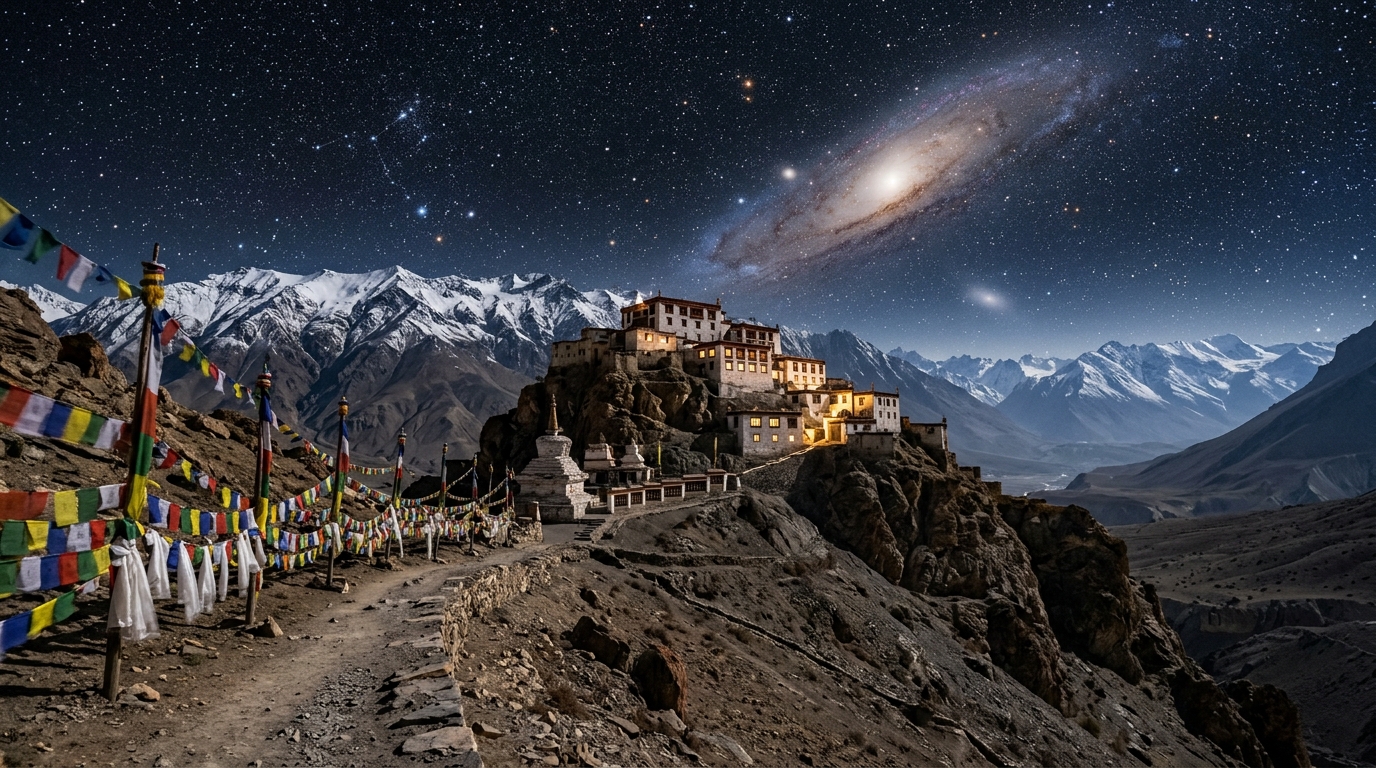
Spiti Valley offers another high-altitude alternative for those pursuing stargazing in india. The valley is characterized by dry alpine weather and a sparse population, which translates to minimal light pollution. Kibber, one of the highest inhabited villages in the world, and Kaza serve as excellent base camps for astronomical observation. These settlements sit well above the atmospheric boundary layer, which means the air is exceptionally stable and clear of low-level pollutants.
The primary challenge of stargazing in india from Spiti is the demanding road journey, which is often subject to landslides and seasonal closures. However, the reward is a Bortle Class 1 or 2 sky, where the Andromeda Galaxy is easily visible to the naked eye. Observers can spend hours tracking satellites, meteor showers, and deep-sky objects without the need for complex telescopic equipment. The local monasteries, such as Key and Dhankar, provide dramatic backdrops for wide-angle astrophotography, combining cultural heritage with cosmic beauty. The cold, crisp air of the Spiti nights stabilizes the atmosphere, allowing stars to shine with a steady, untroubled brilliance.
Jaisalmer, Rajasthan: The Cosmic Desert
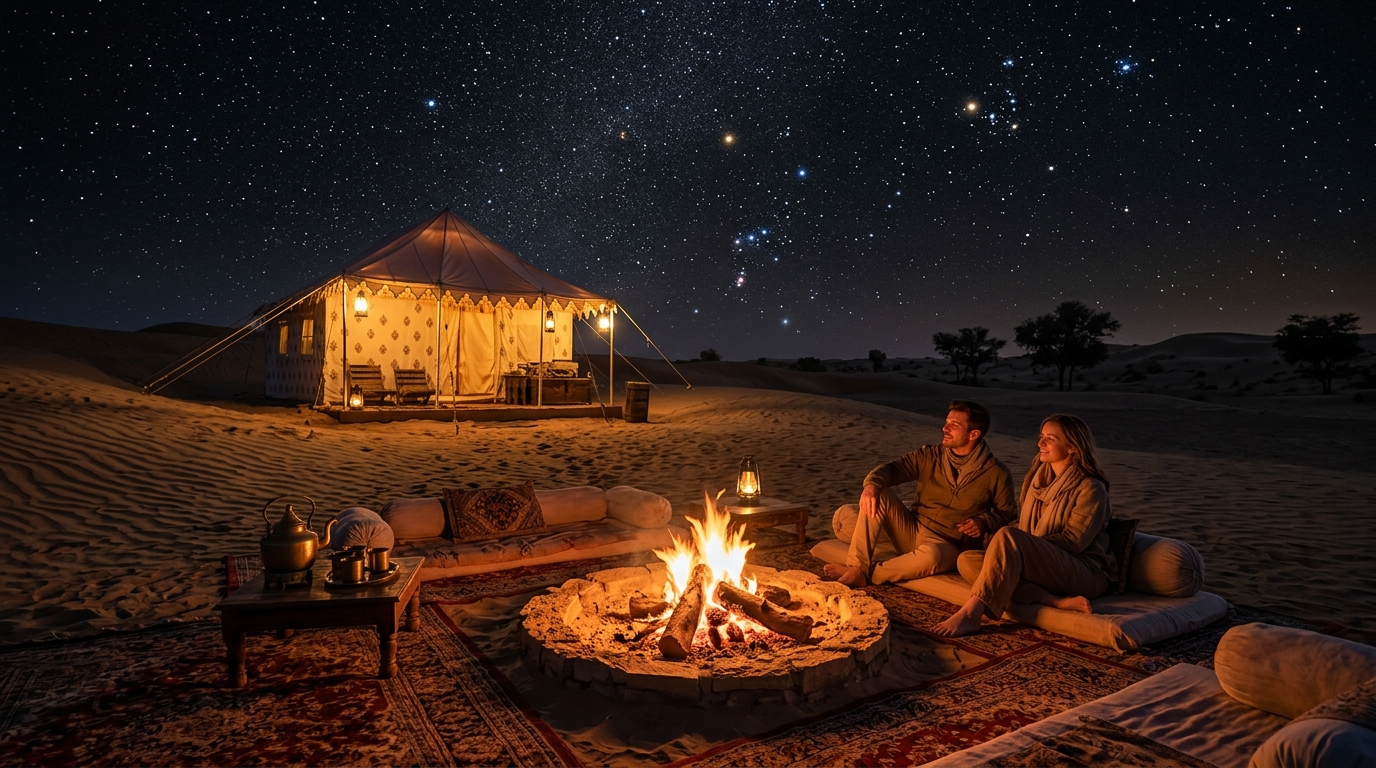
For those who prefer to avoid extreme cold and thin mountain air, the Thar Desert offers an exceptional alternative. The arid climate of Rajasthan ensures clear skies for a major portion of the year (particularly during the winter months from October to March). The shifting sand dunes outside the main town provide a naturally isolated environment where light pollution drops to negligible levels. The vast, flat horizons of the desert allow for unprecedented views of low-horizon celestial objects that are typically blocked by mountainous terrain.
When planning a trip focused on stargazing in india, Jaisalmer presents a unique combination of cultural richness and dark skies. Opting for specialized Jaisalmer tour packages allows travelers to camp deep within the desert dunes, far from the city’s halogen lights. The dry desert air provides excellent transparency, making it easy to observe seasonal constellations like Orion and Taurus in vivid detail. The silence of the desert floor, combined with a glittering dome of stars, creates a deeply meditative environment that mountain destinations cannot replicate. This climate is particularly conducive for casual observers who want to try stargazing in india without confronting high-altitude physiological stress.
Pangong Tso, Ladakh: Reflection of the Cosmos
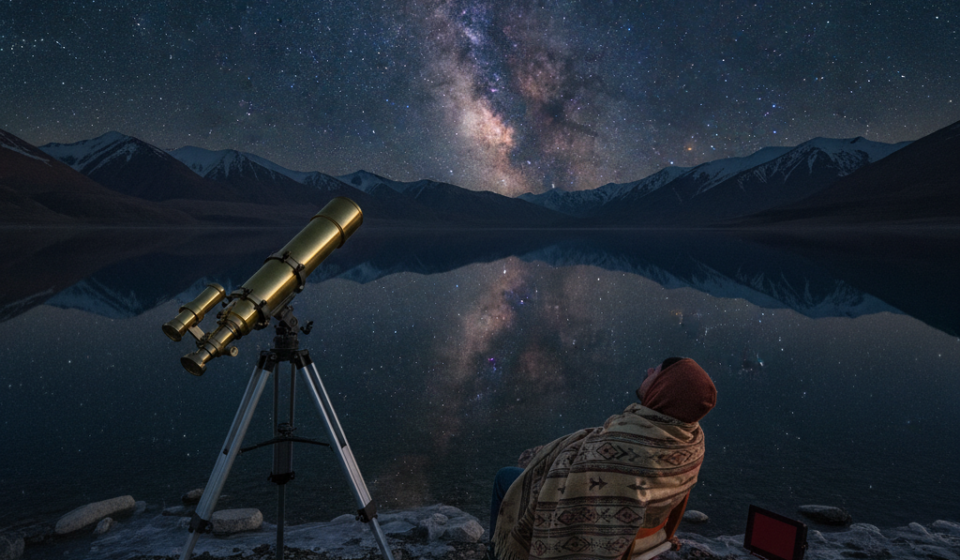
Pangong Tso, the high-altitude lake spanning the border between India and China, provides a highly dramatic vantage point for stargazing in india. At an elevation of approximately 4,225 meters, the lake’s sheer distance from major municipal infrastructure guarantees exceptionally dark skies. The stillness of the water on windless nights creates a perfect mirror image of the celestial sphere, duplicating the stars across the dark water. The absolute silence of the lake shores enhances the sensory experience of stargazing, making it feel as though one is floating in the vacuum of space itself.
The experience of stargazing in india from the shores of Pangong Tso is visual poetry. However, travelers must prepare for sub-zero temperatures, even during the peak summer months. The extreme cold requires specialized thermal gear and careful battery management for electronic devices, as lithium-ion batteries lose charge rapidly in low temperatures. Staying in nearby eco-cottages or homestays in Tangtse or Spangmik allows visitors to step directly into a celestial theater where the stars seem close enough to touch, far removed from the modern world.
Coorg, Karnataka: Southern Sky Observations
While northern destinations dominate the discussion, southern India offers excellent seasonal opportunities for celestial observation. Coorg, nestled in the Western Ghats, is highly regarded for its periodic dark skies during the post-monsoon and winter months. Though light pollution is higher here than in Ladakh, the region’s elevated coffee estates provide private pockets of darkness, shielded by thick forest canopies and mountainous ridges that block city lights from nearby towns.
For travelers in southern India, Coorg serves as an accessible gateway for stargazing in india. The southern sky offers a different perspective, allowing observers to view constellations like the Southern Cross and Alpha Centauri during early summer, which are difficult or impossible to see from higher northern latitudes. The lush vegetation also helps trap ground dust, leading to surprisingly clean local atmospheric conditions and stable micro-climates suitable for stargazing in india during dry spells. Combining a nature retreat with night sky observation makes Coorg an ideal spot for families and beginner astrophiles who are just beginning their cosmic journey.
Destination Comparison: Accessibility & Best Seasons
| Destination | Elevation (Approx.) | Best Travel Season | Access Difficulty |
|---|---|---|---|
| Hanle, Ladakh | 4,500 meters | May to October | High (Requires acclimatization & permits) |
| Spiti Valley, Himachal | 3,800 – 4,200 meters | June to September | High (Demanding road journeys) |
| Jaisalmer, Rajasthan | 220 meters | October to March | Easy (Well-connected by rail/road) |
| Pangong Tso, Ladakh | 4,225 meters | May to September | High (Extreme cold and remote) |
| Coorg, Karnataka | 1,100 meters | October to March | Easy (Perfect for weekend getaways) |
Understanding Sky Quality: The Bortle Scale in India
To systematically measure the darkness of a location, astronomers rely on the Bortle Dark-Sky Scale. This nine-level numeric scale measures the observational limit of naked-eye stars and the visibility of celestial phenomena like the zodiacal light. Understanding this classification is crucial for anyone organizing a trip dedicated to stargazing in india, as it directly impacts what celestial structures will be visible.
A Class 1 sky represents pristine, untouched darkness where the Milky Way casts distinct shadows on the ground. Class 9, by contrast, represents inner-city skies where only the moon and a few bright planets are visible. Most major Indian metropolitan areas fall into Class 8 or 9, whereas the remote spots listed above offer Class 1 to Class 3 conditions.
Below is a comparative reference to help plan your observation strategy based on sky quality parameters across different regions:
| Destination | Bortle Class | Sky Quality Meter (SQM) Value | Visible Celestial Phenomena |
|---|---|---|---|
| Hanle, Ladakh | Class 1 | 21.8 – 22.0 | Milky Way casts shadows, zodiacal light, airglow |
| Spiti Valley, Himachal | Class 2 | 21.5 – 21.7 | Andromeda Galaxy naked-eye, highly detailed Milky Way |
| Thar Desert, Jaisalmer | Class 3 | 21.2 – 21.4 | Good horizon detail, some light domes at edge |
| Coorg, Karnataka | Class 4 | 20.4 – 21.1 | Milky Way visible but washed out near horizon |
| Typical Indian Suburb | Class 7 – 8 | 18.0 – 19.5 | Only major constellations and bright planets visible |
This differentiation explains why traveling to remote regions is essential for high-fidelity stargazing in india. A higher SQM value indicates a darker sky, with 22.0 representing absolute natural darkness. For deep-sky observation, targeting locations with a Bortle Class of 3 or lower is highly recommended.
Practical Tips for Astrophiles and Star Travellers
A successful observation trip requires meticulous planning and a basic understanding of observational astronomy. Unlike traditional tourism, astronomical travel is heavily dependent on natural cycles and environmental variables. To maximize the chances of a successful expedition for stargazing in india, travelers must pay close attention to scheduling, weather forecasts, and equipment preparation. A single cloudy night or a poorly timed trip during a full moon can completely derail an otherwise well-planned itinerary, making preparation key to a rewarding experience.
Timing Your Trip: The Lunar Cycle
The single most common mistake made by amateur observers is failing to account for the lunar cycle. A brilliant full moon will completely wash out the faint light of distant nebulae and galaxies, turning a Bortle Class 1 sky into the equivalent of a suburban environment. Therefore, scheduling a trip for stargazing in india must center around the New Moon phase.
To maximize your observation window, keep these critical timing factors in mind:
- The Lunar Window: The ideal observation period begins five days before the New Moon and extends to three days after, ensuring the sky remains in deep, natural darkness.
- Seasonal Weather: Winter months are highly preferred across India, as cold air holds less moisture, leading to clearer atmospheric conditions and stable seeing.
- The Galactic Core: The bright core of the Milky Way is best visible from March to October, while winter skies offer brilliant views of the constellation-rich Orion arm.
- Astronomical Calendars: Always monitor local astronomical almanacs, meteor shower schedules, and celestial events when planning your trip.
Equipment Essentials for Celestial Observation
While the naked eye is sufficient for viewing major constellations and the core of our galaxy, specialized equipment significantly enhances the experience of stargazing in india. Depending on the level of interest and expertise, observers should consider packing the following essentials:
- Binoculars (7×50 or 10×50): An excellent, highly portable tool for sweeping the Milky Way, resolving star clusters like the Pleiades, and observing the moons of Jupiter without the setup time of a telescope.
- Red LED Headlamps: Red light does not disrupt human night vision, which takes roughly twenty minutes to fully adjust to the dark. White light, even from a smartphone, instantly resets this adaptation.
- Star Chart or Astronomy Mobile Application: Offline digital maps (such as Stellarium or SkySafari) are vital for identifying celestial bodies in remote areas with zero cellular reception. Be sure to enable the red night-mode setting.
- Warm Layers and Windcheaters: Night temperatures in high-altitude dark sky regions drop rapidly below freezing, requiring layered thermal protection to ensure physical comfort during long observation sessions.
When selecting gear for stargazing in india, prioritizing portability is crucial, especially when traveling to remote Himalayan sectors where luggage weight limits apply on domestic flights. Investing in a sturdy, lightweight tripod is also recommended if you plan to use larger binoculars or cameras.
Astrophotography in India: Capturing the Cosmos
Capturing the night sky requires a shift from standard photography techniques. For those interested in documenting their journey of stargazing in india, a digital camera with manual exposure controls and a sturdy tripod are the minimum requirements. The goal is to collect as much light as possible over a prolonged exposure period without causing star trailing.
For high-quality astrophotography results, implement these proven techniques:
- Fast Wide-Angle Lenses: Use lenses with wide apertures (ideally f/2.8 or wider) to maximize the amount of light hitting the camera sensor.
- Apply the Rule of 500: Divide 500 by your lens’s focal length to determine the maximum exposure time in seconds before star trails begin to form.
- Advanced Processing: Use star stacking software and dark frame calibration techniques to minimize digital sensor noise during long exposures.
- Equipment Capabilities: Utilize modern mirrorless cameras with high ISO capabilities to easily capture the delicate hues of the Orion Nebula and the Milky Way’s dust lanes.
The Growing Infrastructure of Astrotourism in India
The domestic travel industry is rapidly adapting to the growing demand for dark-sky experiences. Across various states, specialized observatories, private astronomical camps, and home-stays equipped with telescopes are appearing. This specialized focus on stargazing in india is not only promoting scientific curiosity but also providing sustainable livelihoods for remote rural communities. This shift is turning what was once a highly niche hobby into a mainstream travel segment.
Local youths in Ladakh and Spiti are being trained as certified astrotourists guides, capable of operating telescopes and explaining sky mythology alongside modern astrophysics. This community-led conservation of dark skies ensures that local economic growth does not result in excessive light pollution, setting a new standard for sustainable stargazing in india. As national interest grows, several state tourism boards are working to establish dedicated dark sky parks, ensuring that future generations can continue to enjoy the brilliance of the night sky without traveling to the absolute extremes of the subcontinent.
Conclusion
The search for dark skies offers a profound reminder of our place in the universe. From the frozen heights of Hanle to the sweeping sands of the Thar Desert, stargazing in india provides a rare opportunity to escape the frenetic pace of modern life and gaze into the deep past of our cosmos. By choosing the right destinations, planning around lunar phases, and respecting the delicate night environment, travelers can experience the night sky in its truest, most majestic form. Protecting these dark sky sanctuaries remains a collective responsibility, ensuring that the ancient human tradition of staring up at the stars in wonder is preserved for centuries to come. Ultimately, dedicated efforts to limit light pollution and preserve the night sky for stargazing in india will allow this ancient human tradition of looking up at the stars in wonder to endure for generations to come.