
The wind howling through the crumbling arches of India’s ruined bastions often carries more than just dust. Across the plains of Rajasthan and the old corridors of Delhi, historic stone structures stand as silent witnesses to centuries of bloody battles, royal betrayals, and unexplained phenomena. It is here, where history and legend blur, that travellers seek out the most haunted fort in india. While modern science attributes the eerie sensations felt in these ruins to drafty corridors and shifting shadows, local communities maintain a different perspective. These ancient sites, built to withstand mortal armies, now host legends of spirits that refuse to leave. This guide explores the historical truths and chilling lore behind these legendary fortresses, offering a detailed roadmap for those daring to explore these active paranormal locations.
Key Takeaways
- Bhangarh Fort: Recognized as the most haunted fort in India, entry is strictly prohibited after sunset by the Archaeological Survey of India (ASI).
- Kuldhara Village: A cursed, abandoned ghost town near Jaisalmer left completely vacant overnight by Paliwal Brahmins in 1825.
- Feroz Shah Kotla: A unique 14th-century Delhi fortress believed to be home to Djinns, where visitors write letters to the entities.
- Shaniwar Wada: A majestic Pune fortress haunted by the tragic cries of the young Peshwa Narayanrao, assassinated in 1773.
- Fort Madhogarh: A historic royal battlefield and fort converted into a heritage hotel, where guests report phantom battle sounds.
The Allure of the Supernatural: Exploring India’s Haunted Heritage
The fascination with paranormal travel has grown into a major segment of global tourism, with India serving as a primary hub. The subcontinent is home to thousands of medieval structures, each with a unique narrative of rise and fall. Often, these grand historical accounts end in sudden tragedy, leaving behind a residual energy that locals and paranormal investigators find impossible to ignore. Identifying the most haunted fort in india is not merely a matter of listing ghost stories; it is an investigation into how historical trauma shapes modern spaces. When an entire palace is abandoned overnight, the silence left behind becomes fertile ground for the supernatural. For the curious historian, these sites provide a dual experience, offering an architectural marvel by day and a chilling encounter by night. Whether through ancient curses or violent assassinations, these historical locations have earned their place in global folklore, drawing thousands of brave souls each year who wish to see the most haunted fort in india for themselves.
Bhangarh Fort: The Undisputed Epicentre of Paranormal Lore
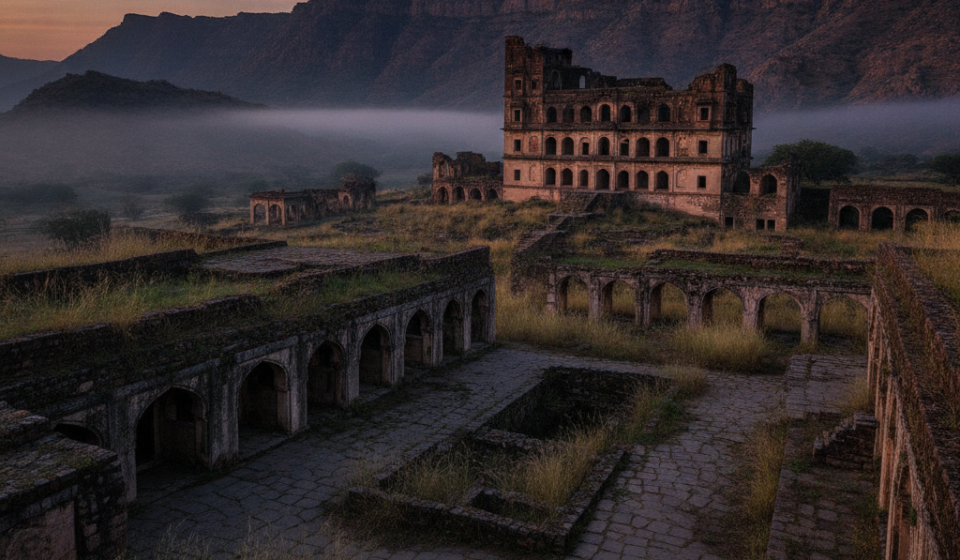
Located on the border of the Sariska Tiger Reserve in Alwar, Rajasthan, Bhangarh Fort is widely acknowledged as the most haunted fort in india. Built in 1613 (a period of significant architectural expansion in Rajasthan) by King Madho Singh, the fort complex was once a thriving settlement complete with grand palaces and bustling marketplaces. But still, the prosperity did not last, and today the entire area lies in ruin, wrapped in an oppressive silence. Visitors frequently report an overwhelming sense of paranoia, as if unseen eyes are monitoring their every step. The heavy air inside the ruined pavilions seems to vibrate with a strange energy, making this site the definitive most haunted fort in india. For travellers planning a journey to this destination, booking customized Jaipur tour packages provides the perfect balance of historical context and reliable transport.
The Legend of the Curse: Guru Balu Nath and Princess Ratnavati
Two distinct legends attempt to explain why Bhangarh remains the most haunted fort in india. The first involves an ascetic named Guru Balu Nath, who meditated on the site before construction. The holy man granted permission on one strict condition: the shadow of the palace must never touch his meditation retreat. However, an ambitious descendant added columns, casting a dark shadow over the ascetic’s sanctuary. True to his word, the angry sage cursed the city to fall into ruins. The second, more theatrical tale features Princess Ratnavati, a woman of extraordinary beauty, and a black magician named Singhia who attempted to enchant her with a love potion. Ratnavati, sensing the deceit, threw the potion onto a massive boulder, which then rolled down the hill and crushed the magician. In his dying breaths, Singhia cursed the fort, declaring that no one would survive within its walls. These tales have cemented Bhangarh’s status as the most haunted fort in india, with locals believing that the spirits are still locked in a spectral struggle.
The Archeological Survey of India Mandate: No Entry After Sunset
The most compelling evidence of the paranormal nature of Bhangarh is not found in local folklore, but in an official government mandate. The Archaeological Survey of India (ASI) has placed a prominent signboard near the main entrance of the fort. This notice strictly prohibits entry into the fort premises between sunset and sunrise. While skeptics argue this rule exists simply to protect tourists from wild animals, locals claim that anyone who stays inside after dark never returns. They are not entirely wrong, but they underestimate the deep atmospheric dread that settles over the fort at twilight. This legal restriction adds official credibility to the claim that this is the most haunted fort in india. It remains the only historical site in the nation where the government acknowledges the potential danger of nocturnal spirits, solidifying its reputation as the most haunted fort in india.
Kuldhara: The Abandoned Village Safeguarding Its Secrets
Though technically an abandoned village rather than a single fortress, the ruins of Kuldhara are intimately connected to the defensive forts of Jaisalmer. Located roughly 18 kilometres west of Jaisalmer, Kuldhara is often studied alongside the most haunted fort in india due to its shared paranormal characteristics. Established in the thirteenth century (or earlier, depending on the source), this once-prosperous settlement was home to the wealthy Paliwal Brahmins. Today, it stands as a ghost town, an eerie collection of roofless stone houses crumbling under the desert sun. Paranormal researchers who visit the site report sudden drops in temperature, disembodied whispers, and the distinct feeling of being watched. The silence here is not peaceful; it is a heavy, expectant silence. For anyone searching for paranormal activity, Kuldhara offers an experience that is just as intense as exploring the most haunted fort in india.
The Sudden Evacuation of the Paliwal Brahmins
The mystery of Kuldhara lies in the suddenness of its abandonment. In 1825, the villagers of Kuldhara and 84 neighboring villages vanished overnight, leaving behind their homes and possessions. According to historical records, the migration was driven by the tyranny of Salim Singh, the powerful and cruel prime minister of the state. Salim Singh had set his eyes on the beautiful daughter of the village chief and threatened the community with dire consequences. Rather than submit to this dishonour, the Paliwal Brahmins chose to abandon their ancestral lands. Before they departed, they cast a powerful curse on the village, declaring that anyone who tried to inhabit Kuldhara would meet with death. This curse has kept the village uninhabited for nearly two centuries, drawing parallels to the legends that surround the most haunted fort in india.
What Remains Today: Exploring the Haunted Ruins
Today, Kuldhara is managed by the government as a heritage site, but its ghostly reputation remains fully intact. Members of the Paranormal Society of India have spent nights at the village, using advanced electronic equipment to detect anomalies. Their instruments have recorded unexplained electromagnetic field (EMF) fluctuations and electronic voice phenomena (EVP, which refers to the auditory capture of unexplained spirit voices on digital recorders) in the ruins. Visitors can explore the preserved temple and a few restored houses, but the vast majority of the settlement lies in decay. The sense of desolation is absolute, making it a critical stop for anyone investigating the most haunted fort in india. It is basically an open-air museum of the supernatural, where the dry desert wind blows through the hollow doorways, creating a low whistling sound.
Feroz Shah Kotla: The Delhi Fort Governed by Djinns
In the heart of India’s capital city lies Feroz Shah Kotla, a fourteenth-century fortress built by Sultan Feroz Shah Tughlaq. While Rajasthan is home to many haunted ruins, this historic site is uniquely recognized as the most haunted fort in india due to its unique inhabitants. Unlike other haunted locations where ghosts of the deceased are said to linger, Feroz Shah Kotla is believed to be inhabited by Djinns. In Islamic theology, Djinns are powerful, invisible beings created from smokeless fire, possessing free will and the ability to influence human lives. The fortress, with its dark, subterranean chambers and ruined mosque, has become a major center of worship for those seeking the assistance of these spirits. This unique theological aspect distinguishes Feroz Shah Kotla from any other most haunted fort in india.
The Tradition of Writing Letters to Unseen Entities
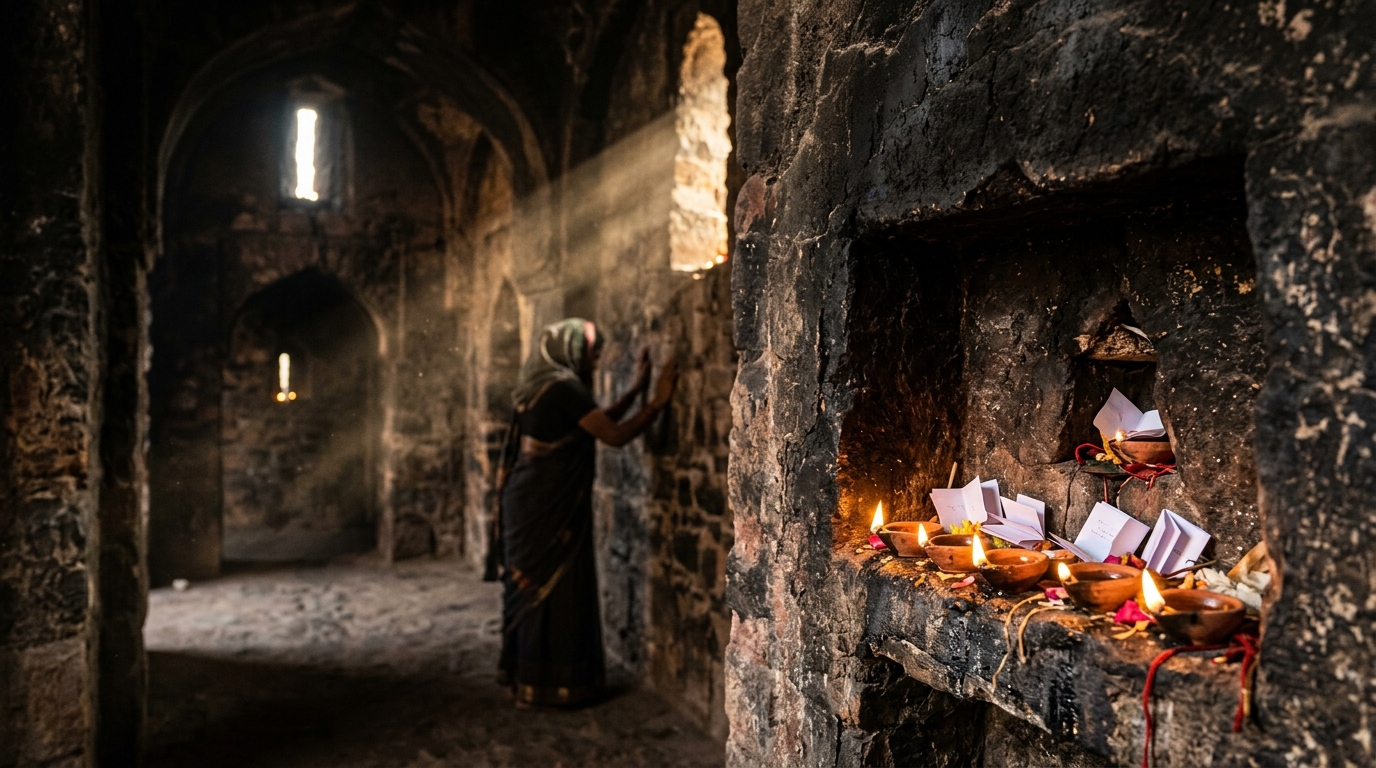
Every Thursday, hundreds of devotees and thrill-seekers gather at Feroz Shah Kotla to participate in a highly unusual ritual. They write letters detailing their personal problems, family disputes, or financial struggles, and leave them in the dark alcoves of the fort. These letters are addressed to specific Djinns, whom the devotees believe hold court in the ruins. Along with the letters, people leave offerings of milk, grain, and coins, hoping to earn the favor of these supernatural entities. The practice is a living tradition, a fascinating blend of faith and paranormal belief that one will not find at any other most haunted fort in india (a practice that continues to baffle secular historians). It shows that the most haunted fort in india does not always evoke fear; sometimes, it evokes hope and devotion.
Paranormal Encounters: Darkness and Disembodied Voices
Beyond the religious devotion, the dark chambers of Feroz Shah Kotla have a reputation for intense paranormal activity. Visitors who wander into the underground passages frequently report several unexplained occurrences:
- Sudden feelings of extreme cold and drops in temperature.
- The strong smell of sweet fragrances, which are traditionally associated with the presence of Djinns.
- Being pushed or touched by invisible forces in the narrow corridors.
- Hearing disembodied voices whispering in their ears.
After dark, the fort takes on a sinister atmosphere, leading many to consider it the most haunted fort in india. The contrast between the busy streets of Delhi just outside the walls and the eerie quiet within the ruins is sharp and unsettling, making Feroz Shah Kotla a must-visit for any paranormal enthusiast.
Shaniwar Wada: The Tragic Echoes of a Young Peshwa
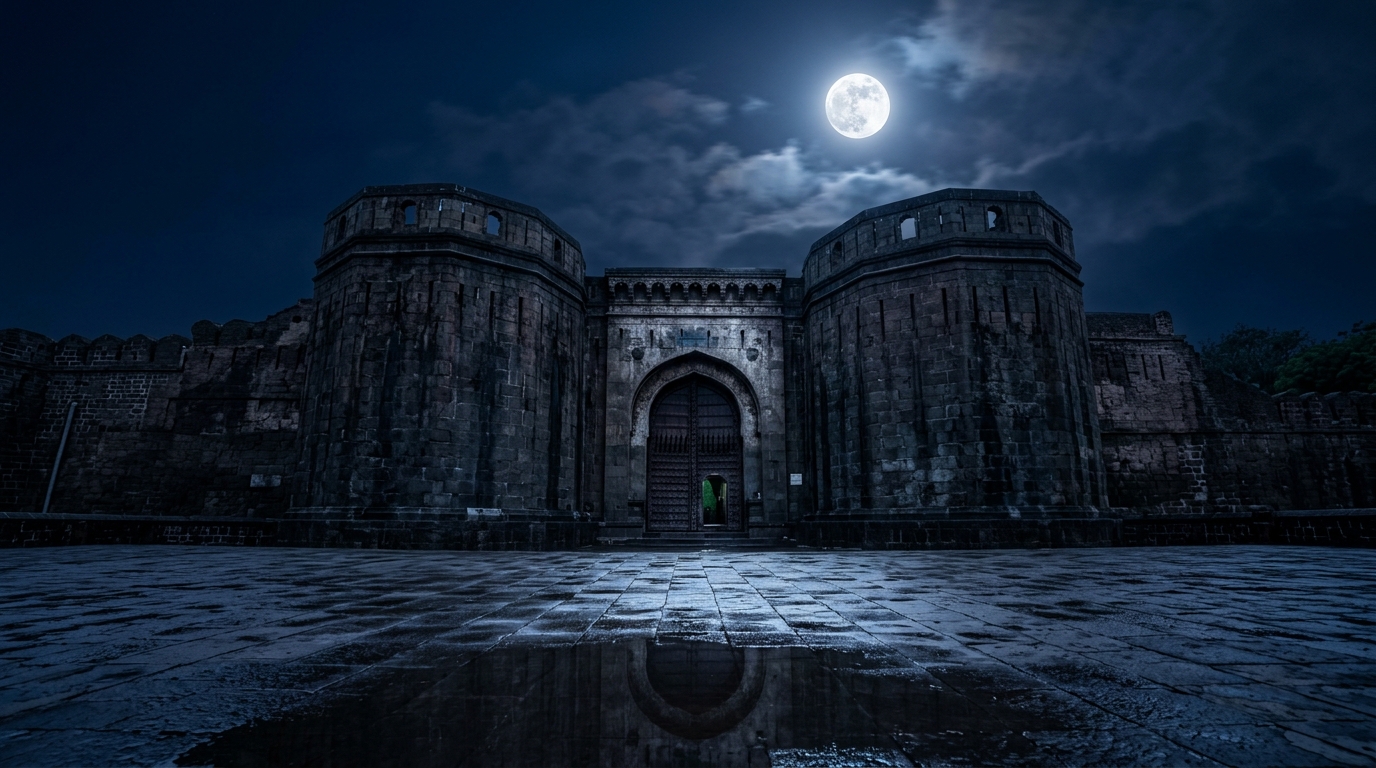
Shaniwar Wada, located in Pune, Maharashtra, is a majestic fortification that served as the seat of the Peshwas of the Maratha Empire. Built in 1732, this grand fort was once a seven-storey palace of unparalleled luxury. However, a series of mysterious fires and political assassinations reduced the fort to its stone foundations, leaving behind a legacy of sorrow. Today, Shaniwar Wada is widely regarded, arguably with good reason, as the most haunted fort in india, particularly on full moon nights. Visitors to the fort report hearing agonizing cries coming from the ruins after sunset. The grand stone walls, which once protected the empire’s leaders, now seem to trap the restless spirits of those who died violently within them. For anyone tracking the most haunted fort in india, the Pune fortress represents a dark chapter of Maratha history.
The Brutal Assassination of Narayanrao
The root of the haunting at Shaniwar Wada lies in a brutal family betrayal. In 1773, the young Peshwa, Narayanrao, who was only sixteen years old, was brutally assassinated within the palace walls on the orders of his own uncle, Raghunathrao, and aunt, Anandibai. Narayanrao was chased through the corridors by armed guards sent to murder him. As he ran, he cried out for his uncle, screaming “Kaka, Mala Vachva” (Uncle, save me!). His cries went unanswered, and he was hacked to pieces by conspirators acting under the instructions of Anandibai. This horrific act of violence left a permanent scar on the fortress, initiating its transition into the most haunted fort in india.
The Haunting Cry of “Kaka, Mala Vachva”
Local residents living near Shaniwar Wada claim that the agonizing screams of the young prince can still be heard on specific nights. During full moon nights, the wind carrying through the ruins allegedly echoes with the words “Kaka, Mala Vachva,” sending chills down the spines of those nearby. The persistent nature of this haunting has solidified Shaniwar Wada’s position as the most haunted fort in india. While the government has closed the inner ruins to the public at night, the auditory phenomena continue to be reported from the perimeter. It is a haunting that is deeply embedded in Pune’s local history.
Fort Madhogarh: Where the Past Refuses to Sleep
Situated approximately 40 kilometres from Jaipur, Fort Madhogarh stands as a stunning example of Rajput architecture. Built by King Madho Singh, this historic fort was the site of numerous fierce battles. Today, part of the fort has been converted into a heritage hotel, allowing visitors to experience the luxury of royal Rajasthan. But still, the conversion has not erased the fort’s dark history, with many guests claiming it is the most haunted fort in india.
The battlefield surrounding the fort was once soaked in the blood of thousands of soldiers, and many believe their restless spirits still roam the ramparts. Guests staying at the heritage hotel have reported the following eerie occurrences during the night:
- The heavy sound of marching boots along the old corridors.
- Clashing swords echoing from the dark ramparts.
- Faint, disembodied cries of long-dead soldiers.
(It is worth noting that hotel staff often downplay these stories to avoid alarming visitors, though the stories continue to spread among travel communities.) It remains a unique destination for those seeking the most haunted fort in india.
Comparing the Eeriness: India’s Haunted Forts at a Glance
To help travellers plan their paranormal explorations, it is useful to compare these historic sites across several key parameters. The following comparative analysis outlines the primary characteristics of each most haunted fort in india, helping adventurers choose their next destination based on historical context, safety rules, and the nature of reported phenomena.
| Fort Name | Location | Key Paranormal Phenomenon | Historical Context | Night Entry Allowed? |
|---|---|---|---|---|
| Bhangarh Fort | Alwar, Rajasthan | Unexplained shadows, extreme paranoia, cold spots | Cursed by a magician and an ascetic in the 17th century | No (Strictly Prohibited) |
| Kuldhara Ruins | Jaisalmer, Rajasthan | Sudden temperature drops, disembodied whispers | Abandoned overnight by Paliwal Brahmins in 1825 | No (Restricted after dusk) |
| Feroz Shah Kotla | Delhi | Presence of Djinns, letters from devotees, incense aroma | Fourteenth-century fortress built by Feroz Shah Tughlaq | No (Closes at sunset) |
| Shaniwar Wada | Pune, Maharashtra | Auditory screams of “Kaka, Mala Vachva” on full moons | Assassination of 16-year-old Narayanrao in 1773 | No (Gates locked at night) |
| Fort Madhogarh | Jaipur, Rajasthan | Sounds of battle, phantom marching, heavy atmosphere | Historic royal battlefield converted into a heritage hotel | Yes (For hotel guests) |
Determining the most haunted fort in india ultimately depends on what kind of encounter one seeks, whether it is the auditory tragedy of Shaniwar Wada or the spiritual energy of Delhi’s ancient Djinn temple.
Practical Travel Advice: Preparing for Your Paranormal Expedition
Exploring a haunted historical site requires careful preparation, respect for local customs, and strict adherence to safety guidelines. The rough terrain, and how remote the site is, can pose physical challenges. To ensure a safe and successful journey to the most haunted fort in india, travellers should implement the following professional recommendations:
- Adhere strictly to official timings: Never attempt to bypass security gates or trespass into restricted areas after dark, especially at Bhangarh Fort. Doing so violates federal laws.
- Hire licensed local guides: Engaging a knowledgeable guide who understands the history and local lore of the area will enrich your experience and ensure safety.
- Carry essential equipment: Ensure you have reliable flashlights, backup power sources, plenty of water, and basic medical supplies when visiting remote sites like Kuldhara.
- Respect local customs and beliefs: When visiting active spiritual sites like Feroz Shah Kotla, dress modestly and avoid disturbing religious items or letters left by devotees.
Taking these precautions will allow you to focus on the historical marvels and paranormal intrigue. For a seamless travel experience across India’s domestic destinations, exploring comprehensive domestic tour packages can simplify your logistics. Planning ahead ensures that your quest to find the most haunted fort in india remains a thrilling adventure rather than a hazardous ordeal.
Conclusion
The historic ruins of India hold a unique fascination, serving as physical monuments to the country’s complex history. From the cursed ruins of Bhangarh to the tragic, echo-filled corridors of Shaniwar Wada, these locations offer more than mere ghost stories. They provide a direct window into the past, showing how historical trauma and human emotion can leave an enduring mark on stone and soil. Exploring the most haunted fort in india is an exercise in historical curiosity and respect for the unknown. While science may continue to seek rational explanations for these anomalies, the legends persist. Whether one travels as a skeptic, a historian, or an active seeker of the paranormal, these ancient fortresses promise an unforgettable journey into the heart of India’s supernatural heritage.