


Global mobility in 2026 demands absolute administrative clarity, especially when dealing with official travel credentials. For Indian citizens planning international journeys, the passport remains the primary gateway to the world. However, the process of updating an expiring document often introduces procedural uncertainties. One of the most common points of confusion for applicants centers around a specific security protocol: is police verification required for passport renewal. While the Ministry of External Affairs has updated its framework to expedite applications, the rules governing physical background checks remain highly nuanced. Understanding these specific regulatory triggers ensures a smooth, uninterrupted application process. Determining whether is police verification required for passport renewal helps applicants set realistic travel timelines.
Key Takeaways
- Exemption Criteria: Police verification is typically waived if you renew within 3 years of expiry with zero changes to your personal details and have a clean previous PVR.
- Automatic Triggers: Major modifications (such as legal name changes), lost/stolen booklets, or an expiry exceeding 3 years will mandate physical verification.
- Tatkaal Advantage: Urgent applications under Tatkaal defer the physical police verification to a “post-verification” stage, facilitating dispatch in 1–3 days.
- Digital Integration: Thanks to the mPassport Police App, verification times have plummeted from weeks to under 6 days nationwide.
Understanding Passport Renewal in India
The administrative machinery behind the Indian Passport Seva Project (PSP) has undergone significant updates. It is basically a digital-first initiative designed to minimize manual delays while maintaining strict national security standards. In the past, every single application for a fresh document or a renewal necessitated a physical visit from the local police department. Today, the system relies on a central database connected to crime records, allowing for more targeted security checks.
The legal framework for this system was established by the Passport Act of 1967 (as established by the Passport Act of 1967). This historical legislation dictates how travel documents are issued, restricted, or renewed. To understand when is police verification required for passport renewal, one must first examine how the system categorizes applicants. The Regional Passport Office (RPO) processes renewals under two primary paths: standard renewal and urgent Tatkaal renewal. The level of background check applied depends directly on the integrity of your existing record and any updates you request during the process.
Applicants must understand that a renewal is technically an application for a “reissue” of a passport. A reissue typically occurs under the following circumstances:
- The current passport booklet is about to expire or has already expired.
- The booklet has run out of blank pages for visas and stamps.
- There are planned changes to the passport holder’s personal details (e.g., name, address, or spouse info).
- The passport has been lost, stolen, or damaged.
This distinction is important because the security systems handle renewals differently than fresh applications. For a fresh passport, a background check is almost always mandatory. For renewals, the system uses a risk-based evaluation to decide if a check is necessary. This evaluation relies on your existing Police Verification Report (PVR), which is stored in the national database.
When Is Police Verification Required for Passport Renewal?
The short answer to the question, is police verification required for passport renewal, is that it is not always mandatory. If your current passport has not expired, or expired less than three years ago, and there are no changes in your personal details, the physical check is usually waived. Indeed, the query of whether is police verification required for passport renewal is answered by checking the previous passport database. If your previous PVR is marked as “Clear” and no red flags exist, the system bypasses the physical verification step. This allows the RPO to print and dispatch your new booklet in a matter of days.
However, this waiver is not an absolute right. The passport issuing authority reserves the right to order a police check on any application. This decision can be made even if you meet all the criteria for an exemption. Several factors can trigger a manual check, such as inconsistencies in your digital profile, random security sampling, or an incomplete address history. In the next section, we will analyze the different types of verification and how they affect your application timeline.
Pre-Verification vs Post-Verification Explained
When analyzing is police verification required for passport renewal, the timing of the verification represents a key distinction. The system uses two main types of physical verification: pre-verification and post-verification. These categories determine whether you receive your new booklet before or after the local police department verifies your details.
Pre-verification means the physical background check must be completed before the RPO prints and dispatches your passport. This process is triggered when the system finds significant discrepancies in your application or when you request major changes. While this ensures high security, it can add several weeks to your overall processing time. Post-verification, on the other hand, allows the RPO to print and dispatch your passport first. The police verification is then conducted after you receive the booklet, usually within a few weeks. This classification is central to understanding how and when is police verification required for passport renewal.
The table below provides a side-by-side comparison of these verification modes to clarify how they affect your application.
| Verification Type | Processing Priority | Dispatch Timeline | Typical Triggers |
|---|---|---|---|
| Pre-Verification | Standard | After police report is marked “Clear” | Major changes, lost passport, or long expiry |
| Post-Verification | Accelerated / Tatkaal | Before police report is generated | Urgent travel needs with verified identity documents |
| No Verification | Fast Track | Direct dispatch within 3-5 working days | No changes in details, clear previous PVR record |
Renewals Without Police Verification
For many law-abiding citizens, the ideal scenario is obtaining a passport without any police involvement. So, is police verification required for passport renewal if nothing has changed? Roughly speaking, if your booklet has not expired and your personal details match your old document exactly, you will likely bypass physical verification. This streamlined process is designed to reward consistent, documented residency and clean legal records.
To qualify for this exemption, your previous passport must have been issued with a clear police report. Additionally, the application for renewal must be submitted within a specific timeframe: either before the current passport expires or within three years of its expiration date. If you meet these conditions, the Passport Seva system fast-tracks your file. Your new booklet is printed directly, avoiding the need for a local police officer to visit your home or verify your documents.
Crucial Scenarios Triggering Police Verification
Let us look at specific instances where the automatic exemption is bypassed. Generally, is police verification required for passport renewal if the previous verification report is missing? Yes, if the RPO cannot find a clean, digital PVR from your last application, a physical check is ordered. This is common for older passports issued before the digital Passport Seva system was fully implemented.
To help clarify when is police verification required for passport renewal, let us list the critical transition events. These events automatically change your application status from “No Verification” to either “Pre-Verification” or “Post-Verification”:
- Applying for renewal after more than three years have passed since your passport expired.
- Major changes to your personal details, such as a complete name change or changes to your parents’ names.
- Reporting a passport as lost, stolen, or damaged beyond recognition.
- A negative, incomplete, or adverse report on your previous passport application.
- Discrepancies in your address history, such as living at your current address for less than one year.
Changes in Personal Particulars
When personal details change, the Passport Seva system raises flags. A common question is, is police verification required for passport renewal when you update your home address? Under the current rules, changing your present address does not automatically trigger a pre-verification, provided you submit valid, government-approved proof of your new residence. However, the system may still initiate a post-verification to confirm your new living arrangements.
For married couples, another common question is, is police verification required for passport renewal to add or delete a spouse’s name? Fortunately, simply adding or removing a spouse’s name due to marriage or divorce does not trigger a police check. More significant changes, such as modifying your legal name, signature, or physical appearance, will require a physical check to prevent identity theft. The table below details how common changes to your personal particulars affect your verification status.
| Particular Requested for Change | Verification Category | Key Requirement |
|---|---|---|
| Present Residential Address | No Verification / Post-Verification | Valid utility bills or Aadhaar card with matching address |
| Addition / Deletion of Spouse Name | No Verification | Marriage certificate or divorce decree (if applicable) |
| Minor Correction in Name spelling | No Verification | Supporting educational or birth certificates |
| Major Name Change | Pre-Verification | Gazette notification and newspaper advertisements |
| Signature or Appearance Change | Pre-Verification / Post-Verification | Declaration on Annexure E or updated photo identity |
Lost, Damaged, or Stolen Passports
A lost or damaged document immediately elevates the security risk. In such cases, is police verification required for passport renewal as a safety measure? The answer is a definitive yes. When a passport is lost or stolen, the authorities must rule out fraud, dual-identity claims, or illegal emigration attempts. This strict approach is why is police verification required for passport renewal when the original booklet is no longer intact.For damaged passports, the RPO evaluates the level of damage to determine the necessary verification pathway:
- Minor Damage: If the passport number, photo, and key details remain clearly legible, the RPO may classify this as a minor case and waive physical pre-verification.
- Severe Damage: If the booklet is completely ruined, torn, or unreadable, the application is treated with the same security scrutiny as a lost passport, requiring complete pre-verification and a copy of a Police First Information Report (FIR).
Tatkaal Passport Renewal Criteria
Under the Tatkaal system, speed is the main priority. Yet, is police verification required for passport renewal under this urgent scheme? The Tatkaal scheme is designed to issue passports quickly by deferring the physical background check. In most Tatkaal renewals, the passport is issued under a post-verification status. This allows you to receive your new booklet within 1 to 3 working days.
Therefore, the answer to whether is police verification required for passport renewal under Tatkaal is yes, but it is deferred. To qualify for this fast-track service, you must submit a specific set of documents, such as your Aadhaar card and voter ID, and pay an additional processing fee. If you have any active criminal cases or other legal restrictions, you cannot use the Tatkaal scheme. These applications must be processed through the standard channel, with a full pre-verification check.
The Step-by-Step Police Verification Process
If the system determines that is police verification required for passport renewal, the applicant must go through a structured process. This workflow involves multiple government agencies, from the digital systems of the Passport Seva Kendra (PSK) to the local police station in your neighborhood. Understanding each step helps you track your application and avoid unnecessary delays.
The process follows a logical sequence to ensure your background is verified efficiently:
- Application Submission: You submit your renewal application online and visit the PSK or Post Office Passport Seva Kendra (POPSK) for document verification and biometrics.
- System Trigger: The passport officer reviews your application. If a check is required, the system automatically routes your details to your local district police headquarters.
- File Allocation: The district headquarters forwards your Personal Particulars (PP) form to the police station closest to your listed residential address.
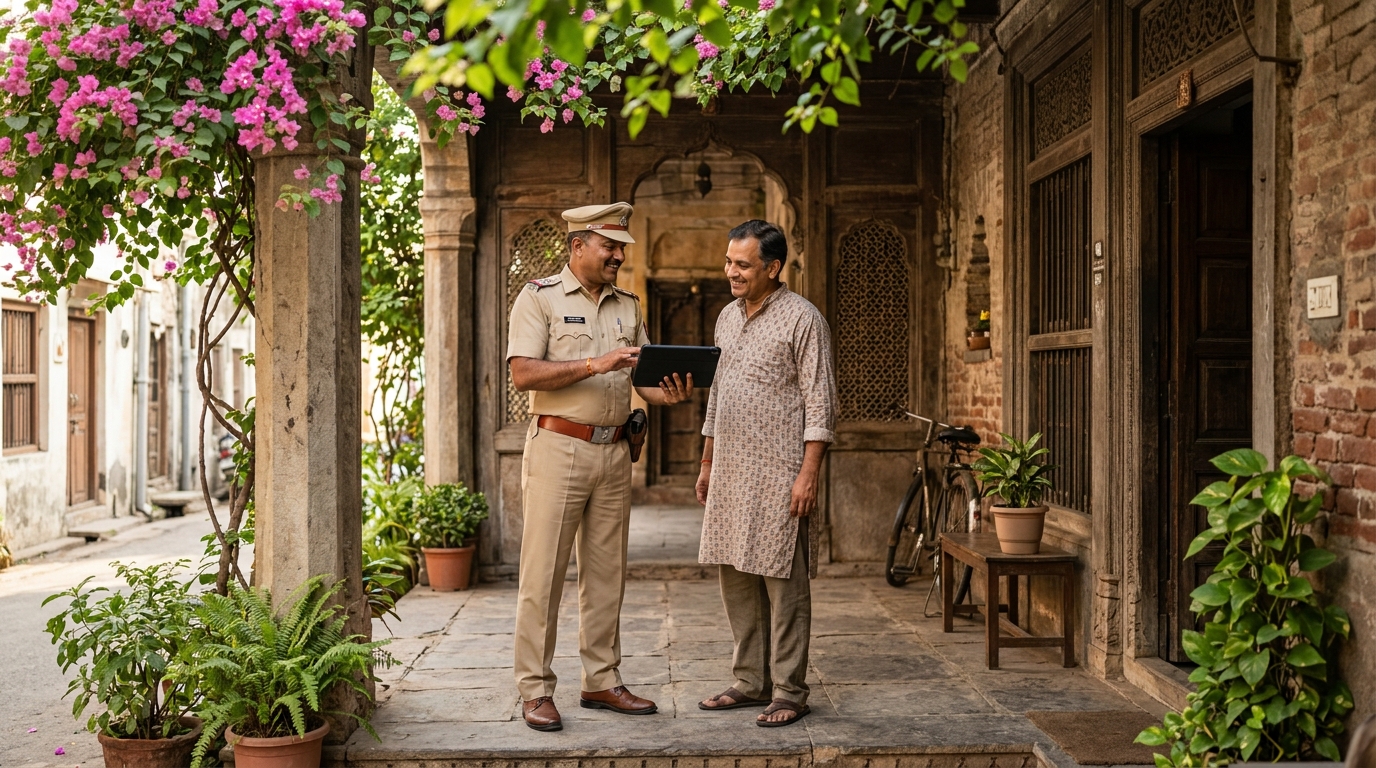
- Officer Visit: A designated police officer is assigned to verify your details. This officer will visit your home to confirm your residence and check your original documents. This stage explains why is police verification required for passport renewal: to verify that the applicant actually resides at the listed address.
- Report Submission: The verifying officer records their findings. They will submit a Police Verification Report (PVR) back to the district headquarters, marking your file as “Clear,” “Adverse,” or “Incomplete.”
- Final Dispatch: The RPO receives the PVR. If the report is clear, they will print and dispatch your passport (for pre-verification cases) or finalize your file (for post-verification cases).
“The mPassport Police App has reduced the average time for police verification from 21 days to under 6 days by allowing officers to submit reports digitally from the field.”
This digital update has made the process much faster. But still, the speed of your verification depends heavily on the local police station and your availability during their visit.
Essential Documents Required for Indian Passport Renewal
Before the physical process begins, the application must be backed by the right paperwork. Even when is police verification required for passport renewal, having organized files prevents delays. Gathering your documents beforehand ensures your visit to the PSK is quick and successful. For those planning international trips, securing these travel credentials is a key step. You can explore professional assistance with international travel requirements through our Visa services page to ensure all your travel documents are in order.
Depending on whether is police verification required for passport renewal, the required checklist will shift slightly. However, the standard documents required for a straightforward reissue include:
- Your original, expiring passport booklet.
- Self-attested copies of the first two and last two pages of your passport.
- Self-attested copies of any observation pages or ECR/Non-ECR pages.
- Proof of your current residential address, such as an Aadhaar card, utility bill, or active rent agreement.
- A copy of your spouse’s passport (if you want to add their name to your new booklet).
If you are applying under the Tatkaal scheme or updating your personal details, you will need to provide additional documents. These may include a Gazette notification for a name change, or an official FIR for a lost passport. Having these documents ready makes it easier for both the passport officer and the local police department to approve your application.
The table below details the official passport fee structure and expected delivery timelines as of 2026:
| Application Category | Booklet Size (Pages) | Government Fee (INR) | Estimated Processing Time |
|---|---|---|---|
| Normal Renewal (Adult) | 36 Pages | ₹1,500 | 10 – 15 Working Days |
| Normal Renewal (Adult) | 60 Pages | ₹2,000 | 10 – 15 Working Days |
| Tatkaal Renewal (Adult) | 36 Pages | ₹3,500 | 1 – 3 Working Days |
| Tatkaal Renewal (Adult) | 60 Pages | ₹4,000 | 1 – 3 Working Days |
Tips to Ensure a Hassle-Free Police Verification
Managing the security check successfully requires a proactive approach. Once it is decided that is police verification required for passport renewal, you can make the process smoother by preparing for the officer’s visit. A few simple steps can prevent your report from being marked as “Incomplete” or “Adverse,” which can delay your passport or lead to a penalties file.
Being prepared is half the battle when is police verification required for passport renewal. Following these practical tips can help you navigate the physical verification step with ease:
- Stay Reachable: Ensure the mobile number on your application is active. Verifying officers usually call to schedule their visit.
- Be Present: Try to be at home during the scheduled visit. If you must travel, make sure a family member is available with your documents to confirm your residence.
- Keep Originals Ready: Have your original documents, such as your Aadhaar card and address proof, ready for the officer to inspect.
- Inform Your Neighbors: The officer may ask your neighbors to confirm how long you have lived at the address. Letting them know beforehand can help prevent any misunderstandings.
If you have lived at your current address for less than a year, you must list all your previous addresses from the past year on your application. The system will initiate verification checks for each of these locations. Failing to list these previous addresses can lead to an “Adverse” report for concealing information, which can complicate your application.

Conclusion
Navigating administrative procedures can sometimes feel overwhelming, but knowing when is police verification required for passport renewal simplifies your preparation. The updated Passport Seva Project has made the renewal process much faster, with many applicants bypassing physical verification entirely. For most standard renewals with unchanged details, your new booklet will be processed and dispatched without any police involvement. This allows you to plan your upcoming travels with confidence.
Ultimately, determining if is police verification required for passport renewal relies on system-driven rules. If your renewal does trigger a physical check, being prepared with the correct documents and understanding the process will help you avoid any issues. By staying informed and organized, you can secure your updated passport quickly, leaving you free to focus on your next international journey.