
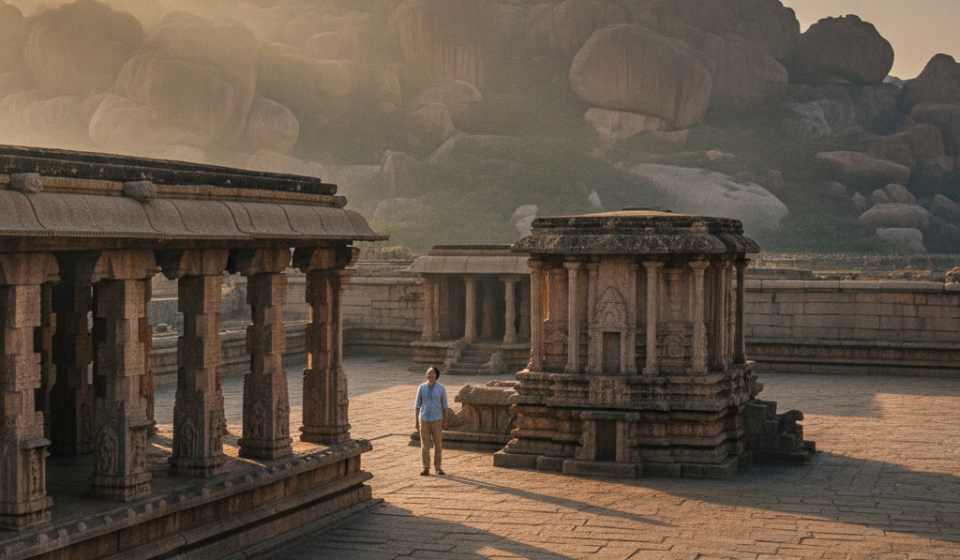

The boulder-strewn hills of central Karnataka hold the silent remains of what was once one of the grandest cities in the medieval world. It is basically an open-air museum stretching across miles of dramatic, rugged terrain. History enthusiasts and casual travelers alike flock to these ancient ruins to witness the remnants of the legendary Vijayanagara Empire. Planning a journey to this historical wonderland requires careful preparation to appreciate the sheer scale of the monuments, temples, and secular structures. To maximize the experience, utilizing a structured hampi guide becomes indispensable for understanding the complex layers of architectural mastery and spiritual heritage preserved here. Rather than viewing the ruins as mere piles of granite, visitors can peel back centuries of history to find a thriving, living cultural center that continues to capture global attention.
Key Takeaways for Your Hampi Journey
- Best Time to Visit: The winter season from November to February offers the most pleasant climate (15°C to 30°C) for day-long outdoor exploration.
- Essential Duration: Plan a minimum of 3 days to fully explore the distinct Sacred and Royal centers without exhaustion.
- Key Monuments: Don’t miss the iconic Virupaksha Temple, the Vittala Temple’s Stone Chariot, and the majestic Elephant Stables.
- Local Transport: Renting a bicycle or hiring an auto-rickshaw for the day are the most efficient ways to navigate the 25 sq. km. archaeological site.
- Practical Prep: Carry sufficient cash as local ATMs are unreliable, and dress modestly when visiting active religious temples.
Historical Overview of the Vijayanagara Empire
The historical significance of Hampi is deeply intertwined with the rise and fall of the Vijayanagara Empire, which ruled over Southern India from the fourteenth to the sixteenth centuries. Founded in 1336 by the brothers Harihara and Bukka, the empire grew into a massive economic and military powerhouse. The capital city, Vijayanagara, was strategically positioned along the banks of the Tungabhadra River, surrounded by defensive granite hills that provided natural fortifications. It is basically a geological fortress. To understand the layout of these vast ruins, using a dedicated hampi guide is essential for contextualizing how the defense walls and administrative zones once functioned together.
At its zenith under Emperor Krishnadevaraya in the sixteenth century, the city attracted merchants from Persia, Portugal, and Italy. These traders documented a metropolis of unimaginable wealth, where precious stones were sold openly in bustling street bazaars. As documented in the 1986 inscription records by UNESCO, the protected archaeological zone covers approximately 4,100 hectares, making it one of the largest medieval urban spaces in the world. Utilizing a comprehensive hampi guide helps travelers trace these ancient trade routes and irrigation channels, which remain visible among the banana plantations and agricultural fields today.
The golden age came to a devastating end in 1565 following the Battle of Talikota. A coalition of Deccan Sultanates defeated the imperial army, leading to a systematic pillage of the capital that lasted for several months. The city was abandoned, never to be rebuilt. Today, the ruins stand as a silent testament to this vanished glory. For anyone planning to explore this massive archaeological treasure, a comprehensive hampi guide serves as a vital bridge to understanding how these ruined structures once operated as the heartbeat of a great empire. Understanding the historical context allows visitors to visualize the empty bazaars filled with silk merchants and the silent temples echoing with royal chants.
Essential Hampi Guide: Planning Your Visit
Organizing transportation, accommodation, and ticketing can save days of confusion. The sheer physical footprint of the site means that visitors cannot simply show up and expect to see everything in a single afternoon. Proper preparation is the difference between a rewarding historical exploration and an exhausting trek through dusty fields. A reliable hampi guide provides the structure needed to plan daily routes, secure professional local guides, and select appropriate lodging options near the ruins.
Whether choosing to stay in the bustling town of Hospet or the quieter villages closer to the ruins, travelers must consider logistics carefully. Hospet serves as the primary gateway, offering modern hotels and reliable transport connections, while local guesthouses near the monument zones offer a more immersive heritage experience. By consulting a practical hampi guide, travelers can make informed decisions regarding their base of operations, ensuring easy access to both the sacred and royal centers of the ancient city.
Best Time to Visit Hampi
The climate in central Karnataka is notoriously arid, with summer temperatures regularly soaring past 40 degrees Celsius. Exploring the expansive ruins during these months can be physically punishing. The winter season, spanning from November to February, is widely regarded as the prime window for travel. Temperatures during this period range from a comfortable 15 to 30 degrees Celsius, making day-long walks among the stone monuments highly pleasant. According to a visitor density report published by the Karnataka State Tourism Development Corporation, the winter months see the highest influx of travelers, making early planning necessary. A winter-focused hampi guide is highly recommended for identifying specific dates for local cultural festivals and managing the larger crowds that arrive during peak season.
While winter offers the most comfortable weather, it also brings the largest crowds. Travelers who prefer a quieter experience might consider the transitional monsoon months of August and September. During this time, the surrounding hills turn a striking shade of emerald green. But still, the risk of sudden downpours and slick rocks means visitors must exercise extra caution when climbing the hills. To help travelers evaluate the seasonal shifts, a detailed hampi guide provides a breakdown of climate conditions and seasonal suitability:
| Season | Months | Average Temperature | Travel Suitability |
|---|---|---|---|
| Winter | November to February | 15°C – 30°C | Ideal for outdoor sightseeing and monument exploration |
| Summer | March to June | 28°C – 42°C | Extremely hot; outdoor exploration is challenging during midday |
| Monsoon | July to October | 22°C – 32°C | Lush greenery but boulders can become slippery and hazardous |
How to Reach Hampi
Reaching this remote heritage site has become much easier in recent years due to improved transport networks. The closest major transport hub is the town of Hospet, located approximately 13 kilometers away. Hospet is well-connected to major cities across Southern India via regular overnight trains and long-distance buses. Travelers can use a comprehensive hampi guide to map out the most efficient rail routes from major metropolitan centers such as Bangalore, Hyderabad, or Goa.
For those traveling from distant regions, the journey typically begins with a flight to a major airport. The options include the following hubs:
- Jindal Vidyanagar Airport (VDY): Located in Toranagallu, roughly 35 kilometers from the ruins. This regional airport offers domestic flights, primarily connecting to Bangalore and Hyderabad.
- Kempegowda International Airport (BLR): Located in Bangalore, about 350 kilometers away. This is the preferred entry point for international tourists, offering reliable taxi services and overnight trains to Hospet.
- Hubli Airport (HBX): Situated roughly 170 kilometers away, serving as a secondary domestic option with reliable road connectivity to the heritage site.
Once travelers arrive at Hospet railway station, they can easily secure a local auto-rickshaw or taxi to transport them to their accommodation. Consulting an updated hampi guide is highly beneficial for understanding standard transport rates, helping visitors negotiate fair prices with local drivers and avoid common tourist traps.
Getting Around the Ruins
Because the archaeological site covers more than 25 square kilometers, choosing the right mode of local transport is a critical decision. Walking between all the major monument clusters is practically impossible for most travelers. Fortunately, several local transport options cater to different budgets, physical fitness levels, and pacing preferences. A well-planned hampi guide outlines the pros and cons of each transport method, allowing visitors to tailor their transit to their specific physical needs.
Skeptics might argue that exploring such a vast area on foot is impossible. They are not entirely wrong. But they overlook how a simple bicycle rental completely changes the dynamic. For a modest daily fee, visitors can rent a basic geared or non-geared bicycle to pedal along the relatively flat paths connecting the main temples. It is a fantastic way to experience the scenery at a leisurely pace. But still, the midday heat can make cycling strenuous for those not accustomed to physical exertion in the sun (which is why carrying an umbrella is highly recommended). For a more comfortable and structured tour, hiring an auto-rickshaw for the entire day is a highly efficient choice. When using a local hampi guide to explore, travelers should note that motorized vehicles are restricted in certain protected heritage zones to prevent structural damage from exhaust vibrations.
| Transport Mode | Approx. Daily Cost (INR) | Best Suited For | Key Advantages |
|---|---|---|---|
| Bicycle Rental | ₹100 – ₹200 | Solo travelers & budget backpackers | Leisurely pace, cost-effective, great for scenic flat paths |
| Auto-Rickshaw (Full Day) | ₹1,000 – ₹1,500 | Families, couples, & group travelers | No physical exertion, covers vast distances quickly, local driver insight |
| Moped / Scooter | ₹400 – ₹600 | Independent explorers | Complete freedom, fast transit, ideal for crossing the river to Anegundi |
Key Attractions and Sacred Monuments
The archaeological remnants are broadly divided into two main zones: the Sacred Center and the Royal Center. The Sacred Center, situated along the riverbanks, is dominated by massive temple complexes designed for public worship. In contrast, the Royal Center features administrative buildings, military structures, and residential palaces once used by the royal family. Referencing a trusted hampi guide ensures that travelers do not miss the hidden architectural gems tucked behind the main hills, such as the subterranean temples and ancient stepwells.
Exploring these dual zones requires a methodical approach to fully appreciate the contrasting architectural styles. While the Sacred Center showcases Dravidian temple architecture characterized by towering entryways, the Royal Center displays a fascinating blend of Hindu and Islamic design elements. By following a structured hampi guide, visitors can gain a deeper understanding of how these distinct architectural styles coexisted and influenced one another during the height of the empire’s power.
The Virupaksha Temple Complex
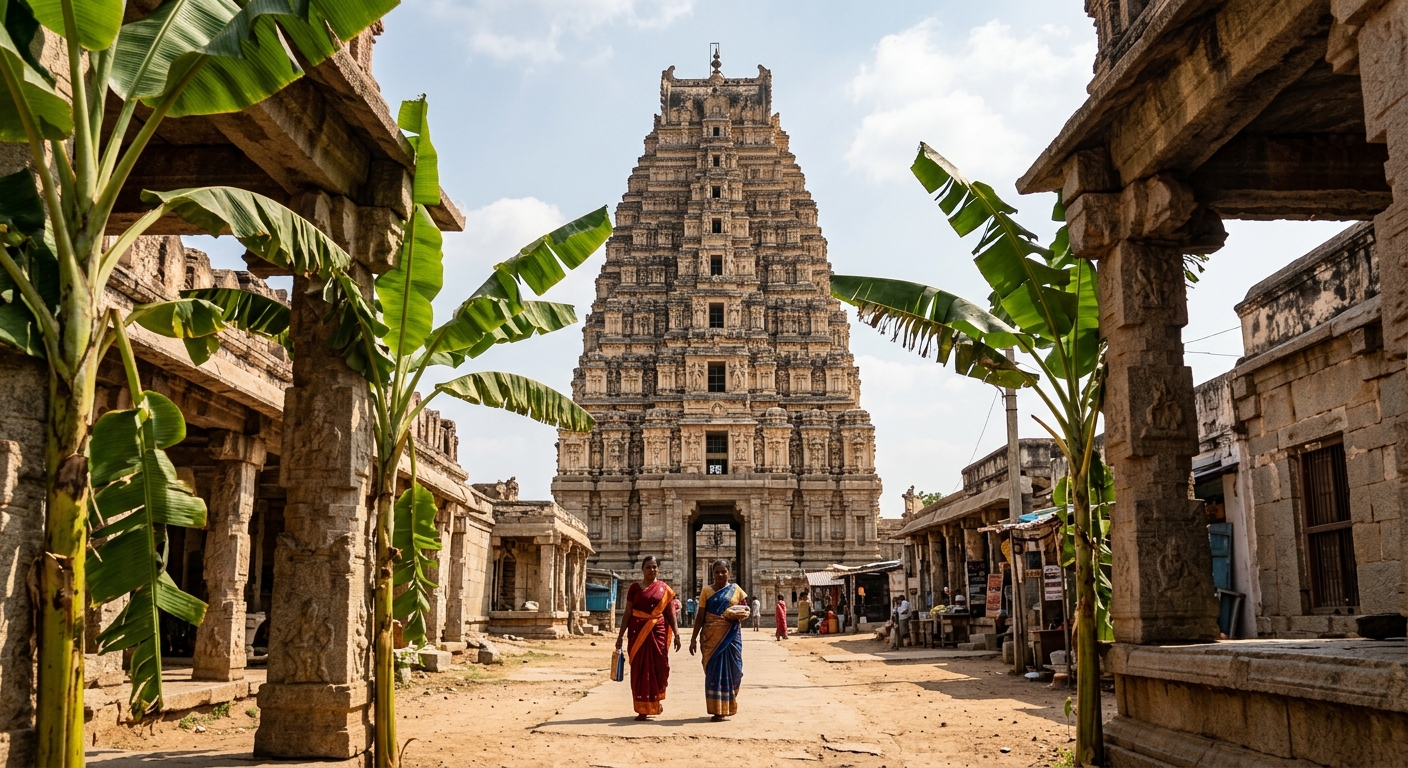
Standing tall in the heart of the ancient bazaar, the Virupaksha Temple is one of the oldest functioning temple complexes in India. Dedicated to Lord Shiva, known locally as Virupaksha, this structure predates the founding of the Vijayanagara Empire itself. The temple has survived centuries of conflict and remains an active place of worship, attracting thousands of pilgrims daily. A specialized hampi guide offers crucial cultural context for visitors, ensuring they respect local customs and dress codes while exploring this sacred space.
The defining feature of the temple is its majestic Gopuram (the monumental entrance tower), which rises nearly 52 meters into the sky. This nine-tiered brick and stone tower dominates the local skyline, serving as a landmark for miles around. Inside the main Mantapa (a pillared hall used for public rituals), the ceilings are decorated with rare, sixteenth-century paintings depicting scenes from Hindu epics. These murals are highly valuable historical artifacts, showcasing the advanced artistic techniques of the Vijayanagara painters. An experienced hampi guide can also point out the small, dark chamber where a tiny wall aperture projects an inverted shadow of the main Gopuram, demonstrating the early engineering and scientific curiosity of the temple architects.
The Vittala Temple and the Stone Chariot
Arguably the most famous monument in the region, the Vittala Temple represents the absolute pinnacle of Vijayanagara architecture. Dedicated to Lord Vishnu, this sixteenth-century temple is renowned for its extraordinary stone carvings, artistic innovation, and engineering marvels. Visitors utilizing a comprehensive hampi guide will find that dedicating at least two hours to this complex is necessary to fully appreciate the sheer density of its artistic details.
The focal point of the temple courtyard is the iconic Stone Chariot, a monumental sculpture that has become the symbolic face of Karnataka tourism. This structure is a shrine designed in the shape of a temple chariot, dedicated to Garuda, the mythical bird vehicle of Lord Vishnu. Surrounding the Stone Chariot is the main temple hall, famous for its “musical pillars.” These 56 slender granite pillars are carved from single blocks of stone and are engineered to resonate with different musical notes when tapped lightly. In the past, royal musicians used these columns as percussion instruments during sacred dance performances. Today, tapping the pillars is strictly prohibited to protect the delicate stone. A detailed hampi guide can help travelers locate the scenic riverside walking path that leads from the Virupaksha Temple to the Vittala Temple, passing through several minor ruins.
The Royal Center and Queen’s Bath
Moving away from the river toward the south, the landscape changes from sacred temples to the administrative heart of the empire. The Royal Center is where the courtly elite lived, worked, and conducted state affairs. This area is characterized by a fascinating blend of Hindu and Islamic architectural styles, reflecting the cultural exchanges between the southern empire and the neighboring northern sultanates. Exploring this zone with a dedicated hampi guide is highly recommended to understand the secular lifestyle of the Vijayanagara royalty.
The Queen’s Bath is typically the first monument visitors encounter in this zone. From the outside, the building appears as a simple, plain rectangular structure. But still, the interior reveals a stunning sunken bathing pool surrounded by ornate balconies, arched corridors, and plaster-molded ceilings. Other prominent highlights in the Royal Center include:
- The Lotus Mahal: A beautiful, two-story pavilion featuring symmetrical arches designed to resemble the petals of a blooming lotus flower.
- The Elephant Stables: A grand building used to house the royal ceremonial elephants.
- The Mahanavami Dibba: A massive, three-tiered stone platform covered in detailed reliefs depicting royal processions, hunting scenes, and foreign ambassadors.
A reliable hampi guide helps travelers trace the complex water supply systems and stone aqueducts that once fed these royal structures from distant reservoirs.
Hemakuta Hill and Sunset Points
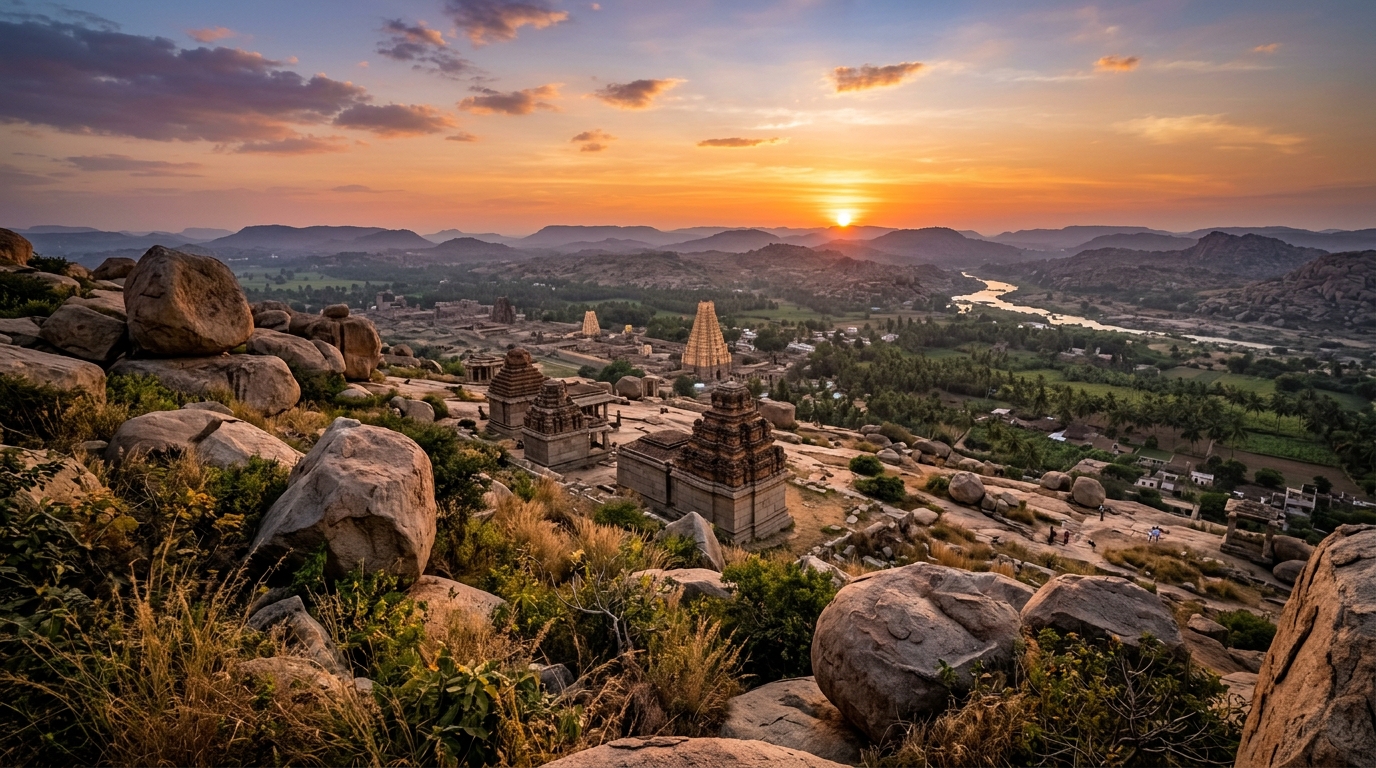
For those seeking panoramic views of the entire archaeological site, climbing the nearby hills is an absolute necessity. Hemakuta Hill, located immediately adjacent to the Virupaksha Temple, is a gently sloping granite hill dotted with a unique cluster of early ruins. These temples date back to the ninth and tenth centuries, pre-dating the main empire. They feature distinct pyramid-shaped stone roofs that resemble early Deccan architecture. Utilizing a hampi guide to explore this hill allows visitors to locate the early monolithic statues of Ganesha and understand the mythological significance of the site.
Because Hemakuta Hill is relatively easy to climb, it serves as one of the most popular sunset viewing spots in the region. As the sun dips below the horizon, the golden light bathes the entire valley, casting long, dramatic shadows across the boulder-strewn hills and ancient ruins. It is a deeply peaceful experience. For a more challenging climb, travelers can head across the river to Anjanadri Hill, widely believed to be the birthplace of the Hindu deity Hanuman (a highly underrated spot for quiet reflection). Climbers using an updated hampi guide should plan to start their climb of Anjanadri Hill by 4:30 p.m. to reach the summit in time for sunset, making sure to carry plenty of drinking water.
Itinerary Planning: Exploring Hampi in Three Days
To fully appreciate the historical depth and physical scale of the ruins, a three-day visit is highly recommended. Attempting to rush through the monuments in a single day often leads to physical exhaustion and historical oversaturation. A well-structured three-day plan allows for a balanced exploration of the sacred, royal, and natural landscapes. A detailed hampi guide provides a recommended distribution of activities to maximize time and energy over a three-day period.
| Day | Focus Area | Key Monuments to Visit | Best Time of Day |
|---|---|---|---|
| Day 1 | The Sacred Center | Virupaksha Temple, Hemakuta Hill, Sasivekalu Ganesha | Early morning for temples; late afternoon for Hemakuta Hill sunset |
| Day 2 | The Royal Center | Lotus Mahal, Elephant Stables, Queen’s Bath, Mahanavami Dibba | Morning to mid-afternoon (bring an umbrella or hat for shade) |
| Day 3 | Riverside and Anegundi | Vittala Temple, King’s Balance, Anjanadri Hill | Early morning for Vittala Temple; late afternoon for Anjanadri Hill |
On the first day, focusing on the Sacred Center provides an excellent introduction to the spiritual architecture of the region. The second day is best dedicated to the fascinating secular structures of the Royal Center, where a bicycle or auto-rickshaw is highly beneficial. On the final day, crossing the Tungabhadra River to the northern bank, known as Anegundi, offers a completely different perspective with its rustic village lanes and quiet paddy fields. For travelers seeking a detailed route map for this cross-river excursion, a comprehensive hampi guide is invaluable for locating operating ferry points and local scooter rental shops. To explore further heritage options across Karnataka and neighboring regions, travelers can browse curated itineraries via the TravelDham domestic packages portal.
Practical Tips for Modern Travelers
Traveling through this ancient site requires a bit of practical knowledge to ensure a smooth, comfortable journey. Because Hampi is a rural heritage site, it does not offer the same level of urban convenience found in major Indian cities. Being prepared for these localized challenges can prevent common travel headaches. A practical hampi guide always emphasizes the importance of carrying sufficient cash, as ATMs within the core heritage zone are notoriously unreliable and often run out of cash during peak tourist weekends.
To make preparation easier, keep the following travel checklist in mind:
- Modest Clothing: Respect the active places of worship by wearing clothing that covers shoulders and knees.
- Footwear: Opt for comfortable walking shoes or sandals that are easy to slip off, as footwear must be removed outside temple shrines.
- Hydration: Carry a reusable water bottle; the midday heat in Karnataka’s rocky terrain can dry you out rapidly.
- Official Visas: International tourists must secure a valid visa before landing. You can check current visa criteria and processing times via the TravelDham visa services page.
For budget planning, review the standardized ticketing structured for the site below:
| Visitor Category | Standard Ticket Fee (Vittala Temple & Royal Center Combo) | Inclusions | Validity |
|---|---|---|---|
| Indian Citizens / SAARC | ₹40 | Vittala Temple, Lotus Mahal, Elephant Stables | Single Day Entry |
| Foreign Nationals | ₹600 | Vittala Temple, Lotus Mahal, Elephant Stables | Single Day Entry |
| Children (Below 15 Years) | Free | All primary monuments | Single Day Entry |
By keeping these tips in mind and utilizing a reliable hampi guide, travelers can ensure a safe and enriching journey through one of India’s most extraordinary historical destinations.
Conclusion
Hampi stands as an unparalleled monument to human architectural genius and imperial ambition. The sprawling ruins of the Vijayanagara Empire offer a window into a past where art, commerce, and spirituality flourished in perfect harmony. Exploring this vast open-air museum requires time, patience, and a bit of preparation to fully appreciate its scale and historical significance. By using a detailed and structured hampi guide, travelers can seamlessly plan their routes, understand the rich history behind the stones, and enjoy a comfortable journey through the rugged Karnataka landscape.
Earlier, we noted the 1986 UNESCO World Heritage status. That designation matters because it highlights the universal value of these ruins, prompting global preservation efforts that help protect the temples for future generations. Whether marveling at the intricate carvings of the Vittala Temple, watching the sunset from the top of Hemakuta Hill, or exploring the quiet villages of Anegundi, a trip to Hampi is a deeply rewarding experience. Armed with a comprehensive hampi guide, visitors can step back in time and experience the magic of this legendary imperial capital, creating memories that will last a lifetime.