

Planning a Greece trip from India in 2026?
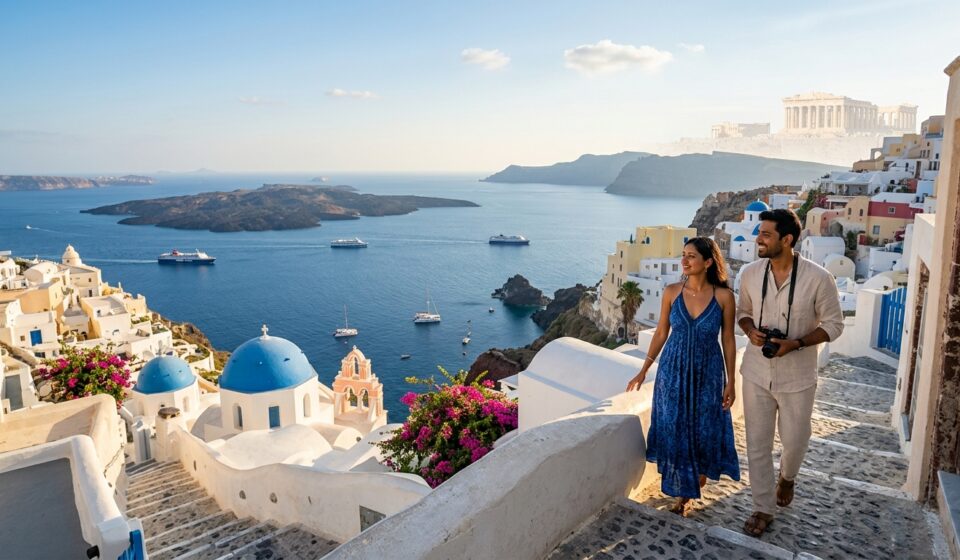
Here is the essential summary: a 7-night Greece trip (Athens + Santorini) costs approximately ₹2 lakh to ₹2.5 lakh per person including return flights and Schengen visa. Greece requires a Schengen visa – apply at least 6 to 8 weeks in advance with processing taking 15 to 25 working days in peak season. The best time is April to June and September to October: perfect Mediterranean weather without the crushing July–August crowds and prices. And the experience that no photograph adequately prepares you for: watching the Santorini sunset from Oia – when the sun drops behind the caldera and the white and blue village turns every shade of orange and gold – is one of the most beautiful things you will ever see.
Greece is the cradle of Western civilisation, a claim that could feel like marketing copy until you stand on the Acropolis in Athens and realise that the Parthenon above you has been standing for 2,500 years, looking over the same city it looked over when Socrates walked its streets. And then you take a ferry across the Aegean to a volcanic island where the buildings are carved from white volcanic ash and the sea below is so blue it looks like a film set. The contrast – ancient intellectual history and timeless Mediterranean beauty, is what makes Greece unlike any other destination on earth.
For Indian travellers, Greece is emerging as one of the most aspirational and increasingly accessible European destinations in 2026. Turkish Airlines via Istanbul offers competitive fares from all major Indian cities. The Schengen visa, while requiring preparation, has a good approval rate for well-documented Indian applications. And Greece, while not cheap, is meaningfully more affordable than France, Switzerland, or the UK — particularly outside Santorini and Mykonos.
This guide covers the visa process, a verified cost breakdown, an 8-day itinerary covering Athens, Santorini, and the island circuit, the honest difference between Greek islands, and the practical tips that make the difference between a smooth Greece trip and a logistically stressful one.
Greece Visa for Indians in 2026: Schengen Applies
Greece is a Schengen Area member, so Indian passport holders need a Schengen tourist visa. Here is the specific process for applying through Greece’s embassy or VFS centre:
Key Visa Details
| Detail | Information |
|---|---|
| Visa type needed | Schengen Type C Tourist Visa |
| Embassy fee | €90 per adult (~₹9,400 at current rates) |
| VFS service charge | Approximately ₹1,933–₹3,111 |
| Travel insurance required | Mandatory — minimum €30,000 coverage, valid across all Schengen states |
| Processing time (2026) | 15 to 25 working days — significantly longer during peak season. Apply 6 to 8 weeks before travel. |
| Recommended bank balance | ₹1 lakh+ per person for a 7 to 10-day trip |
| Visa validity | Up to 90 days within a 180-day period (standard Schengen) |
| Apply through | VFS Greece in Delhi, Mumbai, Bangalore, Chennai, Hyderabad, Kolkata |
💡 Important 2026 note on processing time: Greece’s Schengen visa processing takes 15 to 25 working days in 2026 — longer than many other Schengen countries. Apply a full 6 to 8 weeks before your intended travel date. For peak summer travel (June to August), apply in April or early May. Do not apply too early either — the visa cannot typically be issued more than 6 months before your intended entry date.
For the complete Schengen visa document checklist, process, and tips — refer to our detailed Schengen Visa from India 2026 guide. If Greece is your primary or only Schengen destination, apply through VFS Greece. If combining with France, Italy, or Switzerland, apply to the embassy of the country where you spend the most days.
Best Time to Visit Greece from India
| Season | Months | Weather | Crowds | Prices | Verdict |
|---|---|---|---|---|---|
| Spring | April to mid-June | Warm (18–26°C), wildflowers, clear seas, long days | Building — manageable | 20–30% lower than peak | TravelDham’s top pick — perfect weather, Santorini before the July crush |
| Peak Summer | Mid-June to August | Hot (28–36°C), very sunny, minimal rain | Very high — Santorini and Mykonos at absolute capacity | Highest of year | Best beach weather but overcrowded. Santorini sunset queues are enormous. |
| Autumn | September to October | Warm (20–28°C), sea still warm, fewer people | Dropping significantly from September | 20–35% lower than peak | Excellent — warm sea, thinning crowds, beautiful light, good prices |
| Late Autumn / Winter | November to March | Mild (10–16°C), some rain, quieter | Very low | Lowest — many island businesses closed | Best for Athens. Islands are quiet — some hotels and restaurants closed on Santorini and Mykonos. |
April to June is the best window for Indian travellers planning a Greece trip — the Mediterranean climate is beautiful without the aggressive heat of July and August, Santorini and Mykonos have their full season operational but at a fraction of August’s crowd levels, and flights and hotels are meaningfully cheaper than peak. September is an equally excellent alternative — the sea is at its warmest, the summer crowds have thinned dramatically, and the light has a golden quality that photographers specifically seek.
For Indian school holiday windows: the April–May break aligns perfectly with Greece’s spring beauty. October is still very good for a Greece trip — many hotels offer late-season discounts and the island atmosphere is quieter and more authentic.
Greece Trip Cost from India 2026: Verified Breakdown
| Expense | Budget (per person, 7 nights) | Mid-Range (per person, 7 nights) | Premium (per person, 7 nights) |
|---|---|---|---|
| Return flights from India to Athens (via Istanbul / Dubai) | ₹38,000–₹55,000 | ₹55,000–₹80,000 | ₹85,000–₹1,60,000 |
| Schengen visa (all charges) | ₹11,500–₹15,000 | ₹11,500–₹15,000 | ₹11,500–₹15,000 |
| Athens hotel (2 nights) | ₹4,000–₹8,000 | ₹8,000–₹16,000 | ₹18,000–₹45,000 |
| Santorini hotel (3 nights) | ₹15,000–₹25,000 | ₹30,000–₹65,000 | ₹80,000–₹2,50,000 |
| Mykonos hotel (2 nights) | ₹12,000–₹20,000 | ₹22,000–₹50,000 | ₹60,000–₹1,80,000 |
| Inter-island ferries (Athens → Santorini → Mykonos → Athens) | ₹6,000–₹9,000 (slow ferry) | ₹9,000–₹16,000 (high-speed ferry) | ₹16,000–₹25,000 (flight + premium ferry) |
| Meals (7 days — tavernas + local restaurants) | ₹8,000–₹14,000 | ₹15,000–₹28,000 | ₹30,000–₹70,000 |
| Sightseeing (Acropolis, museums, boat tours) | ₹4,000–₹7,000 | ₹7,000–₹15,000 | ₹15,000–₹35,000 |
| Local transport (Athens Metro, taxis, ATV on islands) | ₹2,000–₹4,000 | ₹4,000–₹8,000 | ₹8,000–₹18,000 |
| Travel insurance | ₹2,000–₹3,500 | ₹3,500–₹6,000 | ₹6,000–₹12,000 |
| Total per person (7 nights) | ₹1,02,500–₹1,60,500 | ₹1,65,000–₹2,99,000 | ₹3,29,500–₹8,10,000 |
The biggest cost variable in Greece is accommodation – specifically on Santorini, where caldera-view hotels with infinity pools are among the most expensive resort hotels in Europe. A basic room in Santorini in peak season costs €100 to €200 per night; a caldera-view cave hotel suite costs €400 to €2,000+ per night. The caldera view is genuinely extraordinary, but you do not need to stay in a caldera hotel to experience it — Oia’s sunset is free, the views from the village streets are free, and a boat excursion around the caldera costs approximately €30 to €50 per person. A well-located budget hotel in Fira or Imerovigli delivers the Santorini atmosphere at a fraction of the caldera-view price.
Greece is more affordable than France or Switzerland for daily expenses – a taverna meal costs €12 to €25 per person, local wine is €4 to €8 a glass, and the traditional Greek breakfast (yogurt, honey, fresh fruit, coffee) at a local cafe is €5 to €8. Outside Santorini and Mykonos (which have tourist-pricing markups), Greece is genuinely excellent value by European standards.
The Greek Islands: Which Ones to Visit
Greece has 6,000 islands (227 of which are inhabited) and choosing which to visit is one of the most important planning decisions. Here is an honest guide to the islands most relevant to Indian travellers:
Santorini: The Iconic One
Santorini is, arguably, the most visually stunning island in the Mediterranean. It is not a typical Greek island — it is the rim of a volcanic caldera, with villages built on the cliff edge above a submerged volcanic crater that is now the sea. The white cubic houses of Oia and Fira, the blue-domed churches, the black sand beaches, the caldera views, and the famous sunsets have made Santorini one of the world’s most recognisable travel images.
Honest assessment for Indian travellers: Santorini is extraordinary but expensive and crowded in peak season. In July and August, Oia’s sunset viewing point is packed to the point where the experience is compromised. The beaches are black sand (volcanic) — beautiful but hot underfoot, and the sea is rocky in places. The island is not about beaches — it is about the landscape, the light, the architecture, and the dining. Plan to spend at least 2 to 3 nights here.
Must-do in Santorini:
- Oia sunset — the definitive Greece experience. Arrive at least 90 minutes before sunset to secure a viewing spot. Walk the village, find a terrace, and watch the sun go down over the caldera. If visiting in peak season and wanting a seated view, book a restaurant table facing the caldera for the sunset hour — expect to pay €30 to €80 per person for dinner at a caldera-view restaurant, but the experience justifies it once.
- Caldera boat tour — a half-day or full-day boat excursion around the caldera, stopping at the active volcano (Nea Kameni), the hot springs (Palea Kameni), and the island of Thirassia. Approximately €30 to €60 per person for a group tour boat. Book through your hotel or local operators in Fira.
- Fira and Imerovigli walk — the 9-km cliff-top path from Fira to Oia (3 to 3.5 hours each way) offers the best views of the caldera from above. Do the walk in the morning (cooler, better light for photography) and finish in Oia for lunch. In peak summer heat, take the first section to Imerovigli only.
- Akrotiri Archaeological Site — a Bronze Age city buried by a volcanic eruption approximately 3,600 years ago. Often called the “Greek Pompeii” — the level of preservation is extraordinary. Entry: €12 (~₹1,010). One of the most important archaeological sites in the Aegean.
- Red Beach and Perissa Black Sand Beach — Santorini’s two most distinct beaches. Red Beach (accessible by boat from Akrotiri) has dramatic red volcanic cliffs. Perissa on the south coast has long black sand and good infrastructure. Both are beautiful, though the black sand gets very hot in summer sun.
Mykonos: Glamour and Beaches
Mykonos is Greece’s most cosmopolitan island — beautiful beaches (Psarou, Paradise, Platis Gialos, Super Paradise), the famous windmills above Little Venice, a genuinely charming whitewashed old town (Chora), and a party culture that makes it one of the Mediterranean’s most celebrated nightlife destinations. It is expensive — consistently more so than Santorini for similar accommodation quality — but the beaches are better than Santorini’s and the daytime atmosphere is more relaxed.
For Indian families and couples who are not primarily interested in nightlife, Mykonos offers beautiful beaches, excellent seafood, the charming Chora old town, and day trips to the ancient island of Delos (one of the most important archaeological sites in Greece — the mythological birthplace of Apollo, entry €12 per person). Mykonos works best as a 2-night addition to Santorini rather than a standalone destination.
Must-do in Mykonos:
- Mykonos windmills and Little Venice at sunset — the row of white windmills above the multicoloured Little Venice waterfront is the island’s signature image. Free to see. Best at golden hour.
- Chora old town walk — narrow whitewashed lanes, bougainvillea, pelicans (the island’s unofficial mascots), and tiny blue-domed churches at every turn
- Beach day at Platis Gialos or Agios Ioannis — calmer and more accessible than the party beaches, with excellent water and beach tavernas
- Delos day trip — a 30-minute ferry from Mykonos Old Port (approximately €22 return, ~₹1,850). A UNESCO World Heritage sacred island that was once one of the most important religious and commercial centres of ancient Greece
Athens: History and the Acropolis
Athens is where every Greece trip should begin and many travellers underestimate it. The city is chaotic, vibrant, and home to one of the world’s greatest historical sites — the Acropolis and Parthenon. But Athens has reinvented itself over the last decade — the Monastiraki flea market, the rooftop bars with Acropolis views, the Plaka neighbourhood with its tavernas and neoclassical lanes, the National Archaeological Museum (one of the greatest collections of ancient art in the world), and the hip neighbourhood of Psyrri and Exarchia have made Athens a destination in its own right, not merely a gateway to the islands.
Must-do in Athens:
- Acropolis and Parthenon — the defining historical experience. Visit at opening time (8 AM) for cooler temperatures and fewer crowds — the site becomes extremely hot and crowded by 11 AM. Entry: €20 for the Acropolis complex which includes 7 ancient sites. Pre-book online at etickets.tap.gr — on-site queues can be very long in peak season. Allow 2 to 3 hours.
- Acropolis Museum — opened in 2009, this world-class museum contains the surviving sculptures and artefacts from the Acropolis. The top floor — a glass-floored gallery through which you can see ancient ruins below — displays the Parthenon frieze in context. Entry: €10 (~₹840). Do this immediately after or before the Acropolis visit.
- National Archaeological Museum — one of the world’s great archaeology museums. The Mask of Agamemnon, the Antikythera Mechanism, and thousands of ancient Greek artefacts. Entry: €15 (~₹1,260). Allow 2 to 3 hours minimum.
- Monastiraki and Plaka — Athens’ most atmospheric neighbourhoods. Monastiraki has a famous Sunday flea market, street food, and the Stoa of Attalos. Plaka, the oldest continuously inhabited neighbourhood in Athens, has neoclassical architecture, traditional tavernas, and a genuine village feel within the city.
- Mount Lycabettus — the highest point in Athens at 277 metres, accessible by funicular (€7 return, ~₹590) or on foot. The 360-degree view over Athens, the Acropolis, and the Aegean is the best panorama of the city.
- Rooftop bar at sunset with Acropolis view — several rooftop bars in the Monastiraki and Thissio neighbourhoods offer direct Acropolis views. Watching the Acropolis turn gold at sunset over a glass of Assyrtiko wine is one of Athens’ most memorable experiences. Ask your hotel for the current best rooftop bar — the scene changes frequently.
Crete: Greece’s Largest Island (For Longer Trips)
Crete is Greece’s largest island and its most diverse — ancient Minoan civilization ruins at Knossos, dramatic mountain gorges (the Samaria Gorge, the longest gorge in Europe), beautiful beaches across the north and south coasts, traditional mountain villages, and some of the best Cretan cuisine in Greece. Crete is significantly more affordable than Santorini and Mykonos, making it excellent value. It works best for travellers with 10 or more days in Greece, or those who specifically want a beach-and-culture island combination without the Santorini price point.
Budget-Friendly Greek Islands: Naxos and Paros
Naxos and Paros — two Cycladic islands between Athens and Santorini — offer much of Santorini’s charm (whitewashed villages, blue-domed churches, crystalline Aegean water) at 40 to 60% lower hotel and restaurant prices. Naxos has some of the best beaches in Greece (Agios Prokopios, Plaka), excellent local food (the island produces distinctive Naxian potatoes, cheese, and wine), and a relaxed pace that is increasingly popular with repeat Greece visitors. Paros has beautiful traditional villages (Parikia, Naoussa), watersports, and a lively but not overwhelming atmosphere. Both are excellent alternatives or additions to the main Santorini-Mykonos circuit for travellers wanting to stretch their budget.
Getting Between Greek Islands: Ferry Guide
Inter-island travel in Greece is primarily by ferry — and understanding the ferry system is essential for planning a smooth trip. Getting this wrong is one of the most common sources of stress for first-time Greece visitors.
| Route | Ferry Type | Duration | Cost (approx.) | Notes |
|---|---|---|---|---|
| Athens (Piraeus) to Santorini | Conventional (Blue Star Ferries) | 7 to 8 hours | €40–€55 (~₹3,360–₹4,620) | Overnight option available — save a hotel night |
| Athens (Piraeus) to Santorini | High-speed (SeaJets, Golden Star) | 4.5 to 5 hours | €65–€100 (~₹5,460–₹8,400) | Faster but pricier. Can be rough in wind. |
| Santorini to Mykonos | High-speed | 2 to 2.5 hours | €50–€75 (~₹4,200–₹6,300) | Scenic inter-island route |
| Mykonos to Athens (Piraeus) | High-speed | 2.5 to 3 hours | €50–€75 (~₹4,200–₹6,300) | Or fly Mykonos to Athens (30 min, ~€60–80) |
| Athens to Santorini | Domestic flight (Aegean, Olympic) | 50 minutes | €70–€150 (~₹5,880–₹12,600) | Best option if time is short or sea is rough |
Book ferries well in advance for peak season (June to August) — the best cabin options and vehicle spaces sell out weeks ahead. Use ferryhopper.com or directferries.com for comparing routes and prices. Confirm your ferry port — Athens has two: Piraeus (the main port for most Cycladic islands) and Rafina (slightly further from the city centre but closer to the airport — used by some Mykonos services).
💡 The overnight ferry strategy: The Athens to Santorini conventional ferry (7 to 8 hours) offers cabin options (2 to 4-berth cabins). Taking the overnight ferry — departing Athens at 8 to 9 PM, arriving Santorini at 4 to 5 AM — saves a hotel night in Athens and the morning arrival gives you a full day on the island. This is a genuinely good strategy for budget travellers and those maximising their island time.
8-Day Greece Itinerary for Indians 2026: Athens + Santorini + Mykonos
Day 1: Arrive Athens + Monastiraki Evening
- Arrive at Athens International Airport (Eleftherios Venizelos — ATH). Take the Metro Line 3 directly to Monastiraki or Syntagma (35 minutes, €10 single ticket)
- Check in at Athens hotel — stay in Monastiraki, Plaka, or Thissio for best location near the Acropolis
- Evening: first walk through Monastiraki flea market and Plaka neighbourhood
- Dinner at a Plaka taverna — grilled octopus, Greek salad (real Greek salad with proper feta), moussaka, and a carafe of local Retsina or Assyrtiko wine
Day 2: Athens: Acropolis + Museum + Rooftop Sunset
- Early morning (8 AM): Acropolis and Parthenon — arrive at opening time for best conditions. Pre-book tickets at etickets.tap.gr.
- Acropolis Museum immediately after — do not skip this
- Late morning: Plaka neighbourhood walk — Anafiotika (a tiny neighbourhood of Cycladic white houses embedded into the Acropolis hill, utterly charming)
- Afternoon: National Archaeological Museum (30 minutes by taxi or Metro Line 1 to Victoria)
- Evening: Monastiraki rooftop bar for Acropolis sunset view — A for Athens is consistently excellent (book in advance)
- Dinner in Psyrri neighbourhood — more local, less touristy than Plaka, excellent tavernas
Day 3: Athens: Mount Lycabettus + Evening Ferry to Santorini
- Morning: Mount Lycabettus funicular for panoramic Athens view — best in the morning light
- Late morning: Benaki Museum (one of Greece’s finest art and history museums, entry €9, ~₹756) or the Athens Central Market (Varvakeios — a chaotic, beautiful covered food market)
- Afternoon: transfer to Piraeus ferry port (40 minutes by taxi or Metro)
- Evening departure: high-speed ferry to Santorini (4.5 to 5 hours) or overnight conventional ferry (depart 8 PM, arrive 4 to 5 AM)
Day 4: Arrive Santorini + Fira + Caldera First Look
- Arrive at Santorini’s Athinios Ferry Port — take a bus or pre-book taxi to your hotel in Fira or Imerovigli (approximately €20 to €30 by taxi, €2 by bus)
- Check in, rest briefly
- Afternoon: explore Fira — the island’s capital and main town, with caldera-facing cafes, shops, and excellent views
- Cable car down to the old port and back (approximately €6 return) — a short but dramatic descent to the water level
- Evening: first caldera sunset — find a terrace in Fira or walk towards Imerovigli. The view of the submerged volcano with the last light of the day across the water is extraordinary even before you reach Oia.
Day 5: Santorini: Oia + Caldera Boat Tour
- Early morning: drive or bus to Oia (10 km from Fira, 20 minutes). Walk Oia at 8 AM — almost empty, golden morning light, the best photography of the trip.
- Explore Oia’s lanes, the windmills, the Byzantine castle ruins
- Late morning: return to Fira for the caldera boat tour — most tours depart around 10 AM to noon. Book through your hotel. Half-day: approximately ₹2,500 to ₹5,000 per person for a group tour including swimming at hot springs and volcano walk.
- Afternoon: rest at hotel or beach. Perissa Black Sand Beach is 30 minutes south of Fira by bus.
- Evening: the Oia sunset. Arrive in Oia by 5 PM (sunset is typically 8 to 8:30 PM in summer, 7 to 7:30 PM in September–October). Find your spot — the northern castle viewpoint, a village terrace, or a restaurant with a caldera view reservation.
Day 6: Santorini: Akrotiri + Red Beach + Ferry to Mykonos
- Morning: Akrotiri archaeological site (book online) — the Bronze Age Pompeii of Greece. Allow 1.5 to 2 hours.
- Red Beach — accessible by boat from Akrotiri or a short walk. Distinctive red and black volcanic cliffs framing a small beach.
- Afternoon: ferry from Santorini to Mykonos (high-speed, 2 to 2.5 hours). Book in advance — this route sells out in peak season.
- Arrive Mykonos, check in
- Evening: first walk through Mykonos Chora — the whitewashed old town, the pelicans, the Little Venice waterfront
Day 7: Mykonos: Delos Day Trip + Windmills Sunset
- Morning: ferry to Delos (9 AM departure from Mykonos Old Port, approximately 30 minutes, €22 return plus €12 site entry). Allow 3 hours on the island — the archaeological site is extensive and genuinely extraordinary.
- Return to Mykonos by early afternoon
- Afternoon: beach at Platis Gialos or Agios Ioannis (Paradise Beach is more crowded and party-focused — not ideal for families)
- Evening: Mykonos windmills above Little Venice at sunset — the classic Mykonos image. Arrive 30 minutes before sunset for the golden light on the windmill sails.
- Dinner: Little Venice waterfront — the sea literally laps under the balconies of the restaurants here. An extraordinary setting.
Day 8: Mykonos Morning + Ferry / Flight to Athens + Departure
- Final morning on the Mykonos waterfront — coffee, fresh-squeezed orange juice, Greek yogurt
- High-speed ferry from Mykonos to Piraeus (2.5 to 3 hours) or domestic flight Mykonos to Athens (30 minutes)
- Transfer to Athens Airport for international departure
Greek Food: What Indian Travellers Should Know
Greek cuisine is one of the Mediterranean’s finest — and it is more vegetarian-accessible than many travellers expect, though not fully vegetarian-friendly by default.
Dishes every India traveller should try:
- Greek salad (Horiatiki) — tomato, cucumber, red onion, olives, and a thick slab of Feta cheese (not crumbled — a proper Greek salad has a block of feta on top with olive oil and oregano). Simple, perfect, and completely different from any salad back home. Available everywhere, €6 to €12.
- Moussaka — layers of eggplant (aubergine), minced meat, and béchamel sauce, baked until golden. The Greek version is significantly better than any international interpretation. €12 to €18 at a taverna.
- Souvlaki — grilled meat skewers or pita wraps with tzatziki, tomato, and onion. Greece’s quintessential street food. €3 to €5 per wrap. Every town has a souvlaki shop.
- Spanakopita — spinach and feta cheese pie in filo pastry. Vegetarian. Available at bakeries across Greece for €2 to €4. Excellent breakfast or snack.
- Tzatziki — a thick dip of strained yogurt, cucumber, garlic, and dill. The Greek meze staple, served with warm pita. Vegetarian.
- Feta — real feta is PDO-protected (only from Greece) and made from sheep’s milk. The taste is completely different from supermarket feta in India — sharp, creamy, salty, and complex. Try it in a Greek salad, in spanakopita, and on its own with olive oil and honey.
- Fresh seafood — grilled octopus, sea bass (lavraki), sea bream (tsipoura), calamari. On the islands, eating grilled fish caught that morning at a harbourside taverna is one of Greece’s defining dining experiences. Price by weight at traditional fish tavernas.
- Honey and yogurt — Greek yogurt (thick, strained, full-fat) with Cretan or Hymettus honey and walnuts. The definitive Greek breakfast. Available at any cafe. €4 to €8.
For vegetarian Indian travellers: Greek cuisine has excellent vegetarian options — spanakopita, tiropita (cheese pie), dolmades (rice-stuffed vine leaves — confirm no meat), fava (yellow split pea puree from Santorini, one of the island’s great local dishes), gigantes plaki (giant baked beans in tomato sauce), and the full range of salads and meze. Strict vegans will find the islands somewhat challenging as dairy (feta, yogurt, butter) is embedded in much of the cuisine, but vegetarians eat very well in Greece.
Practical Tips for Indians Visiting Greece in 2026
Apply for your Schengen visa 6 to 8 weeks before travel. Greece’s processing time is 15 to 25 working days in 2026 — longer than most other Schengen countries. This is the most common mistake Indian travellers make when planning a Greece trip. Do not leave the visa application less than 6 weeks before your travel date. Apply earlier if travelling in peak summer (June to August).
Book Santorini caldera hotels early. The best caldera-view properties in Oia and Imerovigli sell out 3 to 6 months ahead for peak summer. If the caldera-view experience matters to you, book as soon as your dates are confirmed. For budget and mid-range travellers — good hotels in Fira and Pyrgos offer the Santorini atmosphere at significantly lower prices than caldera properties.
Book inter-island ferries in advance. The Santorini to Mykonos high-speed ferry sells out weeks ahead in July and August. Book at ferryhopper.com or directferries.com as soon as your hotel bookings are confirmed. Carry printed or downloaded copies of all ferry bookings — apps can be unreliable at island ports with poor connectivity.
Acropolis tickets must be booked online. Walk-up tickets at the Acropolis gate in peak season often involve 1 to 2 hour queues. Book at etickets.tap.gr before your Athens visit. The online booking system allows you to select a specific entry time — book the 8 AM or 9 AM slot to beat the heat and the tour groups.
Use ATMs for Euros — carry some cash. Greece is more cash-friendly than Northern Europe. Many smaller tavernas, local buses, and market vendors prefer cash. Withdraw Euros from ATMs (Euronet ATMs charge higher fees — use bank ATMs like Alpha Bank, Piraeus Bank, or National Bank of Greece for better rates). UPI does not work in Greece.
ATV rental on Santorini and Mykonos — only if experienced. Renting an ATV (quad bike) is the popular way to explore the islands independently. The roads on both islands are narrow, steep, and busy with tourists who have varying levels of driving experience. Only rent an ATV if you are genuinely comfortable on two or four-wheeled vehicles on tight mountain roads. Many injuries on Greek islands involve tourist ATV rentals. Taxis and public buses are reliable and safer alternatives.
Sun protection at altitude and sea level. The Mediterranean sun is extremely intense — UV index reaches 10 to 11 in summer. SPF 50+ sunscreen applied frequently is essential. The combination of sea reflection and direct sun means sunburn happens faster than most travellers expect. A good sun hat and UV-blocking sunglasses are as important as the sunscreen.
Respect dress codes at religious sites. Orthodox churches throughout Greece require covered shoulders and knees for entry. Carry a light scarf or shawl for church visits. The Cathedral of Santorini (in Fira), the Blue-Domed churches (technically private chapels — many can only be photographed from outside), and Monasteries require modest dress.
Frequently Asked Questions: Greece Trip from India 2026
Do Indians need a visa for Greece in 2026?
Yes — Indian passport holders need a Schengen tourist visa to visit Greece. The embassy fee is €90 (~₹9,400) plus VFS service charges of ₹1,933 to ₹3,111. Travel insurance with minimum €30,000 coverage is mandatory. Processing takes 15 to 25 working days in 2026 — apply 6 to 8 weeks before travel. Apply through VFS Greece if Greece is your primary destination. If combining with France or Italy, apply to the embassy of the country where you spend the most days.
How much does a Greece trip from India cost in 2026?
A 7-night Greece trip (Athens + Santorini + Mykonos) from India costs approximately ₹1 lakh to ₹1.6 lakh per person at a budget level, ₹1.65 lakh to ₹3 lakh per person mid-range, and ₹3.3 lakh to ₹8 lakh per person premium — all including return flights, Schengen visa, accommodation, ferries, food, and sightseeing. Santorini accommodation is the biggest cost variable- caldera-view cave hotels can cost €200 to €2,000+ per night. Crete and Naxos are significantly more affordable alternatives to Santorini and Mykonos for budget-conscious travellers.
What is the best time to visit Greece from India?
April to mid-June and September to October are the best times for Indian travellers visiting Greece. These windows give warm Mediterranean weather (18 to 28°C), calmer ferry crossings, all tourist infrastructure fully operational, and prices 20 to 35% lower than peak summer. July and August offer the best beach weather but with crushing crowds on Santorini and Mykonos, very high prices, and reduced enjoyment of Oia’s sunset (thousands of people competing for viewpoints). For Indian school holiday windows, April–May is perfect for Greece.
How many days are enough for Greece?
7 to 8 days is the minimum for a satisfying Greece trip covering Athens, Santorini, and Mykonos. 2 days in Athens, 3 nights in Santorini, and 2 nights in Mykonos with a final Athens connection gives you the essential highlights. 10 to 12 days allows you to add Naxos or Paros (more affordable Cycladic islands), a proper Delphi day trip from Athens, or Crete for beach and culture depth. For a focused Santorini-only trip, 4 to 5 nights is ideal.
How do I get between Greek islands?
Inter-island travel is primarily by ferry. High-speed ferries connect Athens (Piraeus port) to Santorini in 4.5 to 5 hours (€65 to €100) and Santorini to Mykonos in 2 to 2.5 hours (€50 to €75). Conventional overnight ferries from Athens to Santorini take 7 to 8 hours and cost less (€40 to €55). Domestic flights are available between Athens and the main islands (Santorini, Mykonos, Crete) — approximately 50 minutes, €70 to €150. Book all ferries in advance at ferryhopper.com — they sell out in peak season.
Is Santorini worth the cost?
Yes — for the specific experience it offers. Santorini is not Greece’s best beach destination (that would be Naxos or Crete). It is not Greece’s most authentic or affordable island (that would be Naxos, Paros, or Milos). But the caldera landscape, the white and blue Cycladic architecture, and the Oia sunset are genuinely extraordinary — unlike anything else in Europe. For a first Greece trip, Santorini is worth including. The caldera-view hotel experience specifically is expensive and worth budgeting for at least one or two nights if this is a honeymoon or once-in-a-lifetime trip.
Is Greece safe for Indian tourists?
Yes – Greece is a safe and welcoming destination for Indian tourists. Crime against tourists is low. The Greek people have a culture of hospitality (filoxenia — love of strangers) that is genuine and warm. The main practical concerns are petty theft in crowded Athens tourist areas (keep bags in front of you at Monastiraki flea market and the Metro), ATV rental accidents on the islands, and occasionally rough ferry crossings in windy conditions. The islands themselves are extremely safe and family-friendly.
Are there direct flights from India to Greece?
No — there are currently no direct (non-stop) flights from India to Greece. All routes involve one stopover. The most popular connections for Indians are Turkish Airlines via Istanbul (often the cheapest – typically 11 to 13 hours total), Emirates via Dubai (12 to 14 hours), Qatar Airways via Doha (10 to 12 hours), and Aegean Airlines via a European hub. Athens International Airport (ATH, Eleftherios Venizelos) is the primary international entry point. Thessaloniki Airport (SKG) is a secondary option for Northern Greece trips.
Plan Your Greece Trip with TravelDham
Greece has more logistical complexity than it appears – the ferry system between islands requires advance booking and timing knowledge, the Greek visa takes longer to process than other Schengen countries, Santorini caldera hotels sell out months ahead in peak season, and the Acropolis entry has moved to a timed-slot online booking system that many first-time visitors discover only after arriving in Athens.
TravelDham builds fully customised Greece FIT trips for Indian travellers – handling the Schengen visa documentation and VFS appointment timing, booking inter-island ferries the moment your travel dates are confirmed, selecting accommodation across Athens, Santorini, and Mykonos matched to your budget and priorities, arranging travel insurance, and building an itinerary that makes the most of each island without the rushed feeling that over-ambitious Greece plans often create.
We plan Greece trips for honeymooners (Santorini’s caldera hotels and Oia sunset dinner arrangements), families (Athens and Crete circuit with the right beach focus), couples on their first Europe trip, and groups looking to combine Greece with other Schengen destinations like Italy or Turkey. Every itinerary is built from scratch for the specific people taking the trip.
Contact TravelDham today for a free Greece itinerary and quote we confirm Schengen visa timing, ferry availability, and hotel options for your specific travel dates within 24 hours.