
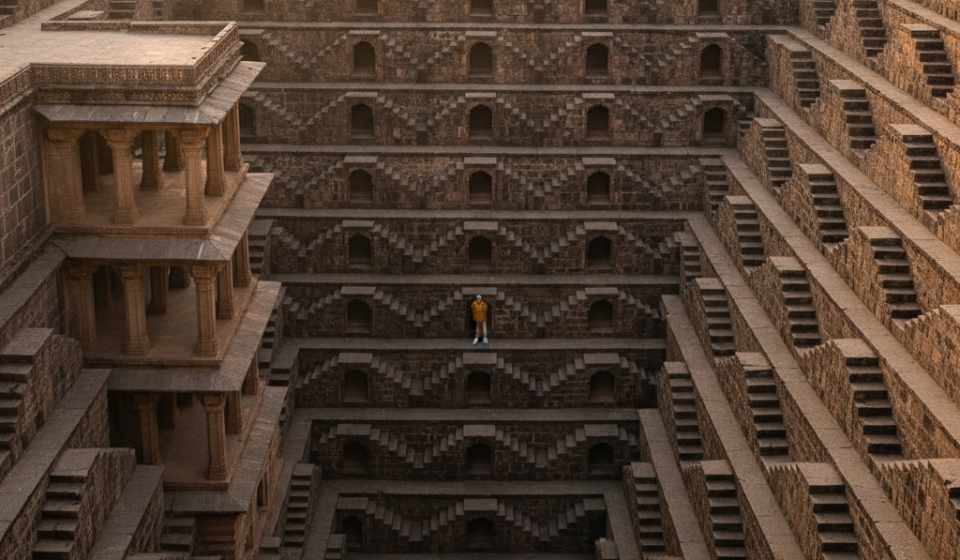

Long before modern plumbing and centralized reservoirs existed, ancient builders in the arid regions of western and northern India devised a sophisticated solution to seasonal water scarcity. These subterranean structures, known as stepwells, served as architectural achievements that successfully combined water conservation with civic life. Unlike typical vertical wells where water was drawn up using ropes and buckets, these structures allowed people to descend directly to the water level via massive flights of stone stairs. Today, these ancient reservoirs are celebrated as monumental engineering achievements that demonstrate a deep understanding of hydrology, geology, and aesthetic grace. For travelers and historians alike, exploring the famous stepwells in india reveals an extraordinary subterranean world that stands as a silent witness to centuries of artistic and societal evolution. Indeed, these famous stepwells in india are not merely historical relics; they represent a brilliant response to ecological challenges that remain relevant even today.
Key Takeaways
- Masterpieces of Engineering: India’s stepwells successfully combined hydrological science with structural stability to survive for centuries.
- Architectural Versatility: The structures evolved from simple linear designs (Nanda) to complex multi-entrance layouts (Vijaya).
- Cultural Centers: Beyond water storage, stepwells served as community spaces, cooling retreats, and sacred religious sites.
- Must-Visit Landmarks: Iconic sites like Rani ki Vav (UNESCO listed) and Chand Baori showcase world-class craftsmanship.
- Living Conservation: Many stepwells are transitioning from neglected relics to restored, active water systems and public parks.
The Origins and Engineering of Stepwells
Stepwells, known as vavs in Gujarat and baoris or baolis in Rajasthan, originated out of sheer survival necessity. The dry climate of western India, characterized by brief monsoon rains followed by scorching heat, required an ingenious way to harvest and preserve rainwater. By carving deep, builders bypassed rapid evaporation, creating cool chambers that stored clean groundwater. Critics argue that stepwells were built for prestige rather than utility. They are not entirely wrong – rulers used them to project royal power – but they underestimate how essential these wells were for basic survival.
The engineering behind these structures is remarkably sophisticated, requiring ancient builders to solve complex subterranean problems:
- Soil Dynamics & Pressure: Builders counteracted the immense inward pressure of the surrounding earth on deep trenches by constructing massive stone retaining walls.
- Structural Reinforcement: Cross-beams, sturdy pillars, and multi-storey underground pavilions served as functional buttresses to prevent collapse.
- Hydrology & Water Table: Construction demanded an advanced understanding of local aquifers to ensure water was accessible year-round without flooding the structure.
Furthermore, construction followed a brilliant thermodynamic design. As one descends, the temperature drops significantly, sometimes by as much as five degrees Celsius. This cooling effect (a life-saving feature in the heat) made lower pavilions desirable spaces for gatherings, rituals, and rest.
When visiting famous stepwells in india, one is struck by how these structures harmonized function and form. The engineering of famous stepwells in india highlights a sophisticated grasp of stone masonry and hydraulic flow. In practice, studying the famous stepwells in india reveals how these ancient communities managed their natural resources with unparalleled foresight and craftsmanship.
Architectural Styles of Stepwells
The architecture evolved over several centuries, reflecting the artistic styles of ruling dynasties. Stepwells are broadly categorized into four primary styles based on their entrance configuration.
- Nanda style: Features a single entrance and linear flight of steps.
- Bhadra style: Designed with two entrances placed opposite each other.
- Jaya style: Contains three distinct entrances that meet at a central point.
- Vijaya style: Characterized by four separate entrances arranged in a cross-shape leading to a circular well.
The architectural evolution of famous stepwells in india shows a transition in aesthetic tastes over time. Different styles of famous stepwells in india can be observed across different regions, influenced heavily by local materials. Early Hindu stepwells featured intricate carvings of deities, while later Islamic-era structures replaced figurative art with geometric patterns and calligraphic inscriptions. This synthesis of Hindu engineering and Islamic aesthetics created a distinct regional style that is highly visible in many of the famous stepwells in india today.
Rani ki Vav: The Queen’s Monumental Stepwell
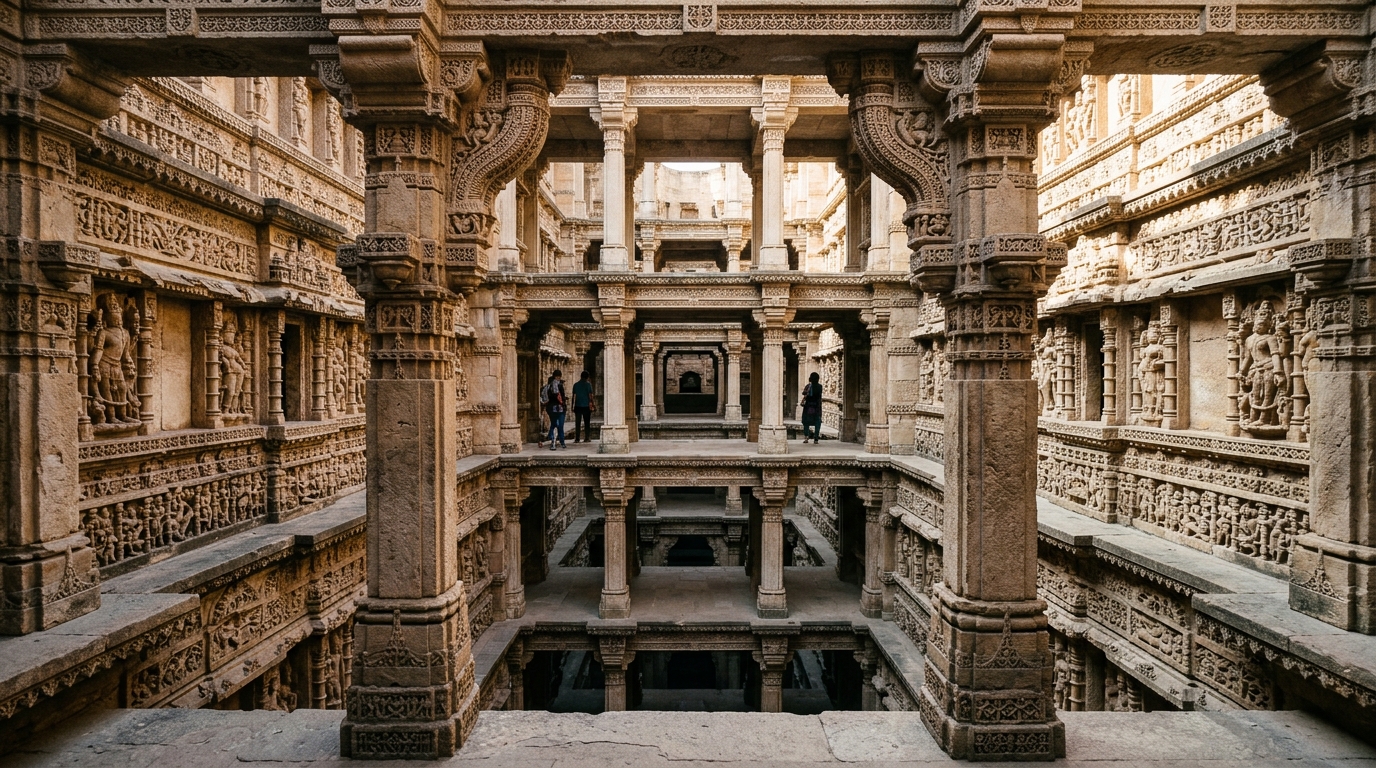
Located on the banks of the Saraswati River in Patan, Gujarat, Rani ki Vav is widely considered the pinnacle of stepwell architecture. Commissioned in 1063 AD by Queen Udayamati as a memorial to her late husband, King Bhimdev I, the structure was later buried under river silt. This natural disaster proved to be a blessing. Silt protected the delicate carvings from erosion and vandalism for nearly eight hundred years, until excavation in the late 1950s.
Because of its exceptional state of preservation and architectural brilliance, Rani ki Vav was declared a UNESCO World Heritage Site in 2014. It is also prominently featured on the reverse side of the Indian 100-rupee note, highlighting its national cultural significance.
The stepwell is designed as an inverted temple, emphasizing the sacred nature of water in Hindu culture. According to UNESCO data from its 2014 inscription, Rani ki Vav is roughly 64 meters long and 20 meters wide, plunging to a depth of approximately 28 meters. The structure is divided into seven distinct storeys of terraced stairs, each supported by beautifully carved pillars. As visitors descend, they are surrounded by more than five hundred principal sculptures.
The grandest of all famous stepwells in india remains a testament to queenly devotion. This site is far more highly decorated compared to other famous stepwells in india. For anyone looking to understand the pinnacle of ancient hydraulic engineering, Rani ki Vav is undoubtedly one of the most magnificent examples among the famous stepwells in india.
Chand Baori: The Labyrinth of Geometric Perfection
If Rani ki Vav represents sculptural elegance, Chand Baori in Abhaneri, Rajasthan, represents geometric precision. Located roughly 95 kilometres from Jaipur, this stunning structure was built in the 9th century by King Chanda. It served as a reliable water source and a cool community haven during the arid summer months.
Chand Baori is one of the deepest stepwells globally. According to the Archaeological Survey of India records, its key features include:
- Immense Depth: Descends over 13 distinct levels to a depth of approximately 30 meters.
- Unmatched Symmetry: Features roughly 3,500 narrow steps in a double-flight pattern along three walls.
- Visual Illusion: The steps repeat in perfectly clean diagonal lines, creating an optical masterpiece resembling a giant, stone-carved puzzle.
The fourth side features a multi-story pavilion with beautiful arched galleries and royal resting rooms. When planning an excursion, utilizing a structured itinerary like the TravelDham Jaipur Tour Package allows visitors to seamlessly combine a trip to Abhaneri with the Pink City. Among the ancient and famous stepwells in india, this structure stands out for its visual scale. The visual impact of famous stepwells in india is perhaps most intensely felt here. The sheer scale of Chand Baori makes it a standout attraction among the famous stepwells in india, drawing photographers, engineers, and history enthusiasts from around the globe.
Adalaj Stepwell: A Blend of Solanki and Islamic Craftsmanship
Located in Adalaj, Gujarat, the Adalaj Stepwell (also known as Adalaj ni Vav) showcases the harmonious fusion of Hindu engineering and Islamic ornamentation. Built in 1498, the stepwell has a tragic history. Commissioned by Queen Rudabai (the grieving widow of Vaghela chief Rana Veer Singh), construction was interrupted when Sultan Mahmud Begada invaded and killed Rana Veer Singh.
Sultan Begada proposed marriage to the beautiful Queen Rudabai. She agreed on the condition that he first complete the stepwell. Begada agreed, finishing the structure with a blend of Solanki design and Islamic details. Upon completion, Queen Rudabai performed a ritual pradakshina of the well and jumped into its deep waters.
The Adalaj Stepwell is built on five subterranean levels, supported by highly decorated pillars. As visitors descend through the levels, they can observe how the pillars are decorated with detailed carvings of foliage, and geometric designs typical of Islamic art, alongside traditional Hindu motifs such as elephants, musicians, and dancers.
The history of these famous stepwells in india is often intertwined with royal narratives. The structural design allows air and light to enter the deep shafts through open central light wells, keeping the interior cool. Today, the Adalaj Stepwell remains a prominent destination for travelers seeking to explore the historical depth of the famous stepwells in india.
Toorji Ka Jhalra: Jodhpur’s Restored Masterpiece
Unlike some static ruins, Toorji Ka Jhalra in Jodhpur, Rajasthan, represents a living part of modern urban culture. Built in the 1740s by the queen consort of Maharaja Abhay Singh, this stepwell was constructed using signature rose-red sandstone.
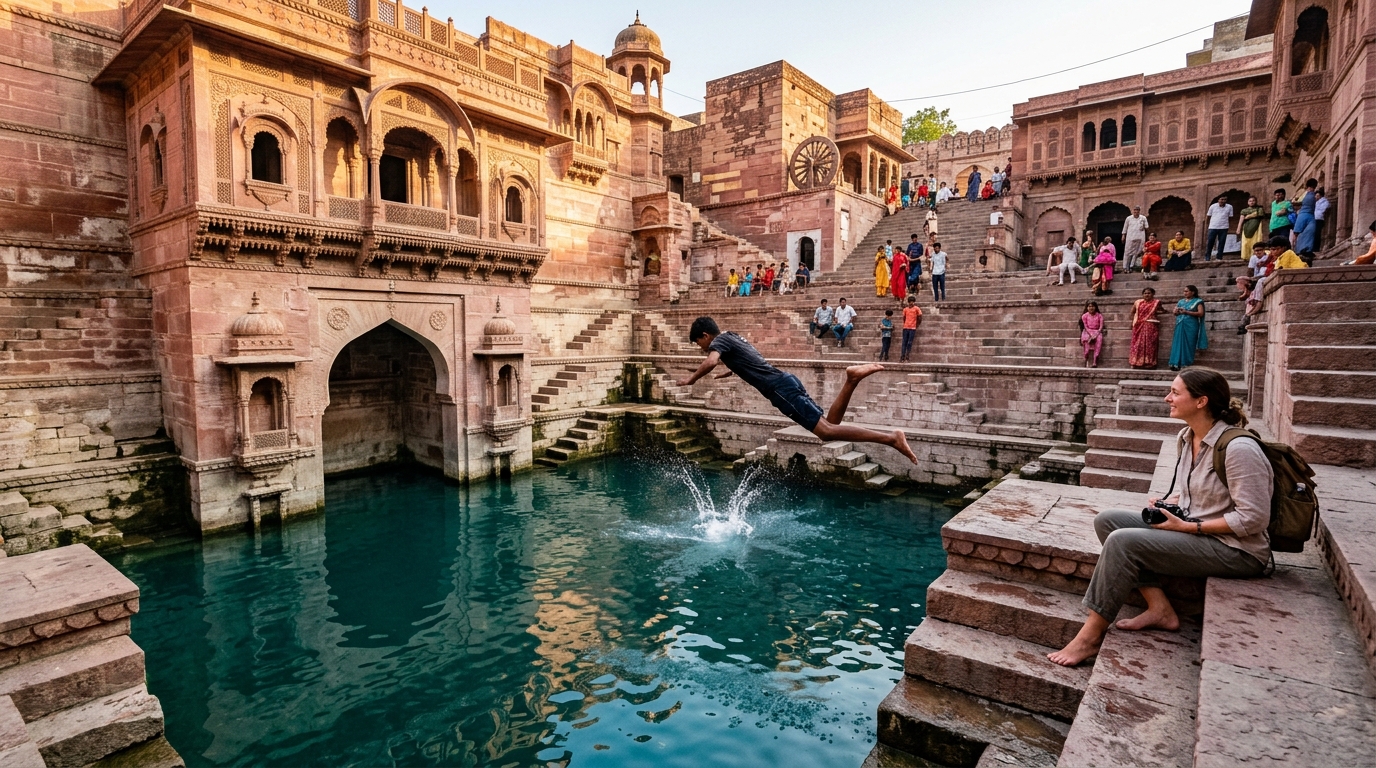
For decades, Toorji Ka Jhalra suffered from severe neglect. As modern plumbing became common, it lost its civic function and became a garbage dump, completely submerged under debris and stagnant water for nearly a century. However, a recent community-led cleanup successfully restored the structure to its former glory. Today, the water is crystal clear, and the site has become a vibrant public square where local children plunge into the cool waters to escape the summer heat. But still, the scars of long-term neglect serve as a warning about modern resource management.
The architecture of Toorji Ka Jhalra features highly detailed carvings of dancing elephants, medieval water wheels (known as Persian wheels), and ornate projecting balconies. The stepped design is asymmetrical and elegant, showing a highly advanced understanding of stone masonry. Visitors can sit on the steps of this restored monument to enjoy the lively atmosphere of the surrounding historic quarter, which is filled with boutique cafes and artisan shops.
For those eager to witness this blue-city landmark, the TravelDham Jodhpur Package connects you directly to the heart of Rajasthan’s heritage. Unlike some abandoned and famous stepwells in india, this site has been fully integrated into the daily life of Jodhpur. Visitors can experience the dynamic restoration of one of the most beloved and famous stepwells in india.
Panna Meena Ka Kund: The Symmetry of Jaipur
Located near Amber Fort in Jaipur, Panna Meena Ka Kund is a square stepwell celebrated for its flawless symmetry. Built in the 16th century, it was a social meeting place where residents gathered to collect water, wash clothes, and share news.
The layout consists of symmetrical, criss-crossing flights of stairs, demonstrating the traditional Sopana style (the classic stepped pathway defined in ancient Indian architecture). A local legend says it is impossible to use the same steps to walk down and climb back up. Whether a physical reality or a visual trick, it adds a touch of mystery.
The symmetrical design of famous stepwells in india is beautifully highlighted by the golden sandstone layers of this site. It is arguably one of the most stunning geometrical layouts in Rajasthan. The steps are painted in soft, golden hues that glow beautifully under the morning and afternoon sun, making it one of the most photographed and famous stepwells in india.
Agrasen ki Baori: Historical Sanctuary in New Delhi
Tucked away amidst the high-rise office buildings of Connaught Place in New Delhi, Agrasen ki Baori is a historic oasis. Measuring roughly 60 meters long, this stepwell is uniquely constructed along a linear path rather than a circular shaft.
While historical records are scarce, legends attribute its construction to King Agrasen. However, the existing sandstone structure was rebuilt in the 14th century, showing clear architectural influences from the Tughlaq or Lodi dynasties of the Delhi Sultanate.
Unlike the highly decorated stepwells of Gujarat and Rajasthan, Agrasen ki Baori is characterized by a more somber, raw architectural style. The layout of famous stepwells in india varied greatly, and this linear form is particularly rare in northern regions. As one of the few surviving historical water reservoirs in the nation’s capital, it remains an essential entry in any directory of the famous stepwells in india.
Comparative Analysis of Famous Stepwells in India
Understanding the diverse famous stepwells in india requires a comparison of their primary attributes. Comparing these famous stepwells in india helps travelers prioritize their visits based on architectural preference and accessibility.
Below is a comparative analysis of these historical landmarks:
| Stepwell Name | Location | Historical Period | Architectural Style | Key Feature |
|---|---|---|---|---|
| Rani ki Vav | Patan, Gujarat | 11th Century | Maru-Gurjara | Inverted temple with 500 sculptures |
| Chand Baori | Abhaneri, Rajasthan | 9th Century | Pratihara | Labyrinth of 3,500 steps |
| Adalaj Stepwell | Gandhinagar, Gujarat | 15th Century | Indo-Islamic | Blend of Hindu and Islamic designs |
| Toorji Ka Jhalra | Jodhpur, Rajasthan | 18th Century | Rajasthani | Fully restored public square |
| Agrasen ki Baori | New Delhi | 14th Century | Tughlaq/Lodi | Linear layout in urban city center |
This comparison highlights how regional geology and ruling dynasties influenced the shape and function of these water reservoirs.
Visitor Guidelines & Practical Information
| Stepwell | Entry Fee (Approx) | Best Time to Visit | Photography Allowed | Nearest Transport Hub |
|---|---|---|---|---|
| Rani ki Vav | INR 40 (Indians) / INR 600 (Foreigners) | 8:00 AM – 10:00 AM | Yes (Tripods require permission) | Ahmedabad Airport (125 km) |
| Chand Baori | INR 25 (Indians) / INR 300 (Foreigners) | Sunrise or Sunset | Yes (Only from upper terraces) | Jaipur Junction (95 km) |
| Adalaj Stepwell | INR 20 (Indians) / INR 250 (Foreigners) | Late afternoon | Yes | Ahmedabad Airport (15 km) |
| Toorji Ka Jhalra | Free Entry | Early morning or evening | Yes | Jodhpur Airport (6 km) |
| Agrasen ki Baori | Free Entry | 9:00 AM – 11:00 AM | Yes (DSLR requires permit) | Barakhamba Road Metro (Delhi) |
Cultural Legacy and Modern Conservation
The cultural legacy of stepwells extends far beyond their historical function as water reservoirs. They were hubs of feminine social life, spaces of religious devotion, and cooling sanctuaries for trade caravans. Today, the conservation of famous stepwells in india is crucial to preserving this unique architectural heritage. While some sites like Rani ki Vav are protected as monumental treasures, others are being actively restored by local communities to address modern water shortages. Preserving these famous stepwells in india ensures that future generations can appreciate the ecological wisdom of the past.
FAQs
What are the main purposes of stepwells in India?
Stepwells were designed to harvest and store rainwater in arid regions. They also served as cool gathering spaces, religious sanctuaries, and resting havens for desert caravans. The significance of famous stepwells in india lies in how they integrated civic and spiritual functions.
Which is the oldest stepwell in India?
The oldest surviving stepwells, such as rock-cut structures in Junagadh, Gujarat, date back to the 2nd to 4th centuries AD. However, the most mature and famous stepwells in india were constructed between the 9th and 18th centuries.
Why are stepwells dry today?
Many stepwells became dry due to a falling water table caused by modern groundwater extraction. Centralized piping introduced during the colonial era also led to the abandonment of these ancient reservoirs.
Can visitors walk down the steps of all famous stepwells?
No, access is restricted at several sites for preservation. For example, visitors cannot walk down the steps of Chand Baori. Knowing how to visit the famous stepwells in india safely is essential for a respectful experience.
What is the best time of year to visit these stepwells?
The best time to visit is between October and March, when the weather in northern and western India is relatively cool. This makes exploring the deep stone shafts comfortable.