


For years, international travelers returning to India packed luxury consumer electronics. Among these, flat-screen displays became a staple cargo for families seeking advanced technology at lower prices. However, changing customs policies and airline tariffs have made this task highly complex. The process of carrying TV in flight to India is no longer as simple as checking standard bags. Strict customs duties, immediate tax liabilities, and size limits now apply to everyone. Understanding these rules is critical to avoiding heavy fines and administrative delays. This guide outlines the essential tax codes, baggage policies, and financial realities associated with carrying TV in flight to India safely. Planning ahead ensures a smooth journey without unexpected airport surprises.
Key Takeaways for Carrying TV in Flight to India
- Mandatory 38.5% Duty: Every flat panel television (LCD, LED, Plasma) is taxed at a flat 38.5% customs duty rate, regardless of screen size.
- Excluded from Allowance: Televisions do not qualify for the standard INR 50,000 duty-free baggage allowance; tax is levied from the first rupee.
- Oversized Handling Fees: Standard airlines charge additional oversized baggage fees ranging from $50 to $200+ for shipping television boxes.
- Red Channel Declaration: Passengers must declare their TV at the Red Channel upon arrival to prevent confiscation, fines, or legal action.
- Warranty and Voltage: Foreign warranties are usually void in India, and 110V models (e.g., from USA) require an external step-down voltage converter.
Understanding Indian Customs Regulations for Televisions
Importing consumer electronics into India involves navigating precise tax frameworks designed to support domestic manufacturers. When planning on carrying TV in flight to India, travelers often struggle to distinguish between general baggage allowances and the unique tax codes applied to flat-screen displays. The Indian government treats television sets differently from other personal household items, which usually enjoy duty-free status. Today, the rules require immediate declaration and payment of customs duty on every television. Anyone carrying TV in flight to India must realize these rules apply regardless of screen size. In a policy update that changed the consumer electronics market, the Central Board of Indirect Taxes and Customs (CBIC) altered this framework to eliminate duty-free thresholds for televisions.
Flat Panel Television Baggage Rules
Under current baggage rules, any flat panel television (including LCD, LED, and Plasma models) is completely excluded from the standard duty-free baggage allowance. Even if a passenger is within their personal duty-free limit of 50,000 Indian Rupees (INR) for other items, that limit cannot be applied to a television. For those carrying TV in flight to India, the tax is assessed from the very first rupee of the display’s value. This strict exclusion applies to both short-term tourists and Indian residents returning after a long stay abroad.
The Flat Duty Rate of 38.5% Explained
The financial implications of carrying TV in flight to India are governed by a specific tariff rate. All flat panel televisions attract a standard import duty of 38.5%. This includes a basic customs duty of 35% and a social welfare surcharge of 3.5%. For example, if a traveler brings an LED television valued at 40,000 INR, the duty would be exactly 15,400 INR. Carrying TV in flight to India therefore requires ready access to local currency.
| TV Declared Value (INR) | Basic Customs Duty (35%) | Social Welfare Surcharge (3.5%) | Total Customs Duty Payable (38.5%) |
|---|---|---|---|
| ₹20,000 | ₹7,000 | ₹700 | ₹7,700 |
| ₹40,000 | ₹14,000 | ₹1,400 | ₹15,400 |
| ₹60,000 | ₹21,000 | ₹2,100 | ₹23,100 |
| ₹80,000 | ₹28,000 | ₹2,800 | ₹30,800 |
| ₹100,000 | ₹35,000 | ₹3,500 | ₹38,500 |
Baggage Allowance and Airline Packing Guidelines
When planning on carrying TV in flight to India, a traveler must consult the specific baggage conditions of their operating airline. Every carrier has its own limits on the weight, length, and width of checked items, and televisions frequently exceed these limits. Standard international checked baggage rules typically allow two bags up to 23 kilograms each. However, televisions are classified as fragile, oversized items. Successfully carrying TV in flight to India depends heavily on complying with these airline-specific baggage rules.
Oversized Baggage Fees and Cabin Class Allowances
Airlines charge handling fees for televisions because oversized boxes require manual sorting and transport to the cargo hold (a process that risks damage). As noted in the official Air India cargo manual last season, passengers pay an oversized baggage charge for televisions exceeding the standard dimension limit of 158 centimeters (62 inches). For instance, carriers like Emirates and Gulf Air charge handling fees from 50 to 150 US Dollars. The table below outlines typical dimensions and estimated airline handling fees for carrying TV in flight to India:
| Screen Size (Inches) | Average Box Weight (kg) | Linear Dimensions (cm) | Typical Airline Handling Fee (USD) |
|---|---|---|---|
| 32 to 43 | 10 to 15 | 120 to 140 | $0 to $50 |
| 49 to 55 | 18 to 25 | 145 to 160 | $50 to $100 |
| 65 and above | 30 to 45 | 170 to 195 | $100 to $200+ |
Always confirm the aircraft model before carrying TV in flight to India, as regional flights may refuse larger boxes.
Packing Requirements to Minimize Transit Damage
The physical safety of the television is entirely the passenger’s responsibility. Airlines require all electronics to be packed in durable, original manufacturer packaging to withstand the pressures of flight. The original box contains custom-molded polystyrene foam inserts that isolate the screen from impact. If the original packaging is unavailable, a heavy duty cardboard box with thick bubble wrap is required. Many airports offer professional wrapping services at the terminal. But still, the internal screen remains vulnerable to torsional stress. For travelers carrying TV in flight to India, this packaging step is the single most important factor in preventing physical damage.
Steps to Take at the Origin Airport and During Transit
The logistical process of carrying TV in flight to India begins long before landing at an Indian airport. It requires meticulous preparation during check-in and careful coordination during any connecting flights. A systematic approach at the departure airport will prevent delays, reduce fees, and minimize the risk of physical damage.
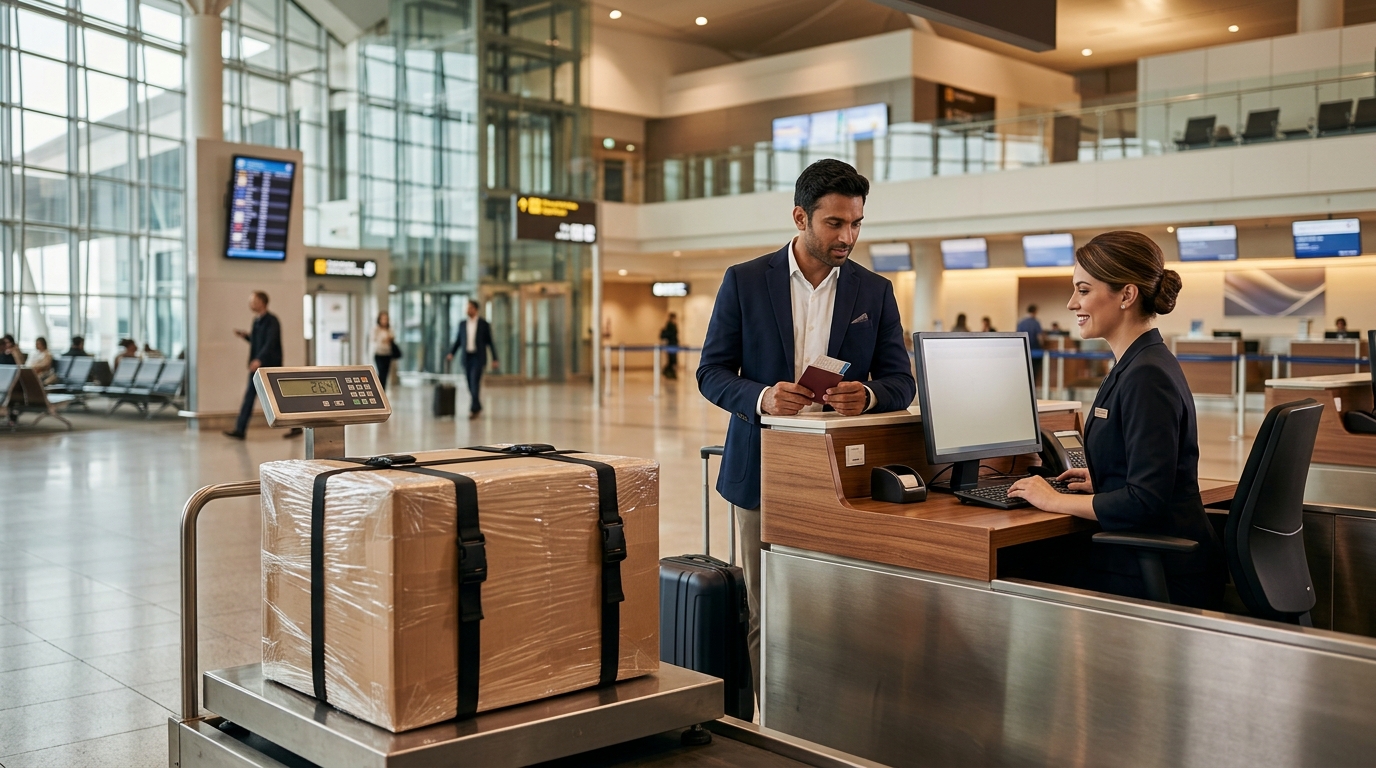
Checking In Your Television at the Counter
To ensure a hassle-free check-in process, follow these essential steps at the departure counter:
- Arrive Early: Arrive at least three hours before departure to allow sufficient time for oversized baggage handling and verification.
- Weigh and Measure: Present the boxed TV to the agent, who will weigh it and measure its linear dimensions to verify if it complies with the airline’s regulations.
- Pay Applicable Fees: If the television exceeds standard baggage size or weight limits, pay the oversized baggage fee immediately at the counter.
- Secure Fragile Tags: Ensure the agent affixes “Fragile” stickers to the box and hands you the baggage claim stub, which is required for retrieval.
Handling Connections and Baggage Transfers
Connecting flights introduce a significant point of vulnerability for fragile cargo. If the journey to India involves a layover, the television must be checked through to the final destination. When booking flights with multiple airlines, passengers should verify that a baggage interline agreement exists between the carriers. Even with through-checking, the physical transfer of an oversized box between aircraft cargo holds increases the chance of rough handling. To protect against these issues, travelers carrying TV in flight to India should consider securing a comprehensive travel insurance policy before departure. Having a dedicated Travel Insurance policy is an essential safeguard, as standard airline liability limits for damaged baggage are often capped at low amounts.
Managing Indian Airport Customs on Arrival
Upon landing in India, all passengers must retrieve their checked items from the baggage reclaim area. Televisions are usually delivered to a designated oversized baggage belt. Once the television is secured, the passenger must prepare to clear Indian Customs. Successfully carrying TV in flight to India requires navigating this process with absolute transparency.
The Red Channel vs. Green Channel Decision
Because flat panel televisions are subject to tax, anyone carrying TV in flight to India must proceed to the Red Channel. Attempting to use the Green Channel with a television is a serious customs violation. If caught, passengers face immediate confiscation of the item and heavy financial penalties. To avoid these penalties, travelers carrying TV in flight to India must declare the item immediately at the Red Channel.
Documentation Needed for Customs Clearance
To clear customs at the Red Channel, passengers must present specific documents:
- The original purchase invoice or store receipt showing the exact price paid.
- A valid passport containing the passenger’s travel history and flight details.
- The physical boarding pass from the flight.
- The completed Customs Declaration Form, which is distributed on the aircraft before landing.
The officer will inspect the box to verify the screen size and model, then calculate the 38.5% duty based on the official exchange rate for that week. Once paid, a receipt is issued and the television is released. For passengers carrying TV in flight to India, this receipt acts as proof of legal importation.
Financial Analysis: Is Carrying a TV to India Worth It?
With the duty rate fixed at 38.5% and airlines charging additional handling fees, travelers must perform a careful financial calculation. Carrying TV in flight to India was once a highly profitable endeavor, but the modern economic reality has changed. Let us break down the exact costs.
Cost Breakdown and Price Comparison
Compare the total transport cost with local retail prices before purchasing. The expenses include:
- The original purchase price of the television in the foreign country.
- The local sales tax paid at the origin.
- The airline’s oversized baggage handling fee.
- The 38.5% customs duty paid upon arrival in India.
- The cost of protective packing materials.
Some bargain hunters argue that purchasing during seasonal promotions abroad makes the trip worthwhile. They are not entirely wrong – but they often overlook the hidden fees. Let us analyze a 55-inch LED television purchased in Dubai for approximately 450 USD (roughly 37,500 INR):
| Expense Item | Cost in USD | Equivalent in INR |
|---|---|---|
| Purchase Price | $450.00 | ₹37,500.00 |
| Airline Oversized Bag Fee | $75.00 | ₹6,250.00 |
| Packing & Wrapping | $15.00 | ₹1,250.00 |
| Customs Duty (38.5% of Purchase Price) | $173.25 | ₹14,437.50 |
| Total Investment | $713.25 | ₹59,437.50 |
In this scenario, the total investment is nearly 59,438 INR. If the same model is available in India for 55,000 INR, carrying TV in flight to India actually results in a loss. Therefore, carrying TV in flight to India is often financially unviable for budget models.
Warranty and Voltage Compatibility Issues
Beyond the immediate financial costs, travelers must consider the long-term operational and technical risks. The two most critical factors are:
- Lack of International Warranty: Most major electronics manufacturers do not offer international warranties on televisions. A TV purchased abroad is only covered by a domestic warranty valid in that specific purchase region. If the display panel or internal circuits develop a defect after arrival in India, local authorized service centers will charge you full price for parts and labor.
- Voltage Compatibility Issues: Voltage standards vary significantly across the globe. Televisions purchased in North America (USA/Canada) operate on a 110-volt system, whereas India utilizes a 230-volt system. Connecting a 110-volt television directly to an Indian power outlet will instantly burn out the internal power board. To operate it safely, you must purchase and connect a heavy-duty step-down voltage converter, which adds bulk and additional cost to your setup.
Therefore, carrying TV in flight to India involves serious long-term technical and operational considerations.
FAQs
To help travelers make informed decisions, here are answers to some of the most frequently asked questions regarding the process of carrying TV in flight to India.
What is the maximum screen size allowed without paying customs duty?
There is no screen size that is allowed duty-free. Many travelers assume that small screens are exempt from customs duty. This is a common misconception. The Indian customs regulations state that every flat panel television, regardless of screen size or value, is subject to the flat 38.5% import duty.
Can I carry a TV as part of my free check-in baggage allowance?
Whether a television can be included in the free checked baggage allowance depends entirely on the airline’s policy. Some airlines allow you to count a television box as one of your free checked bags, provided it meets weight limits. However, almost all international airlines will still charge a mandatory oversized handling fee.
Is it possible to claim a GST refund on a TV purchased abroad?
Yes, it is possible to claim a local sales tax or Value Added Tax (VAT) refund at the departure airport if the country of purchase offers a tax-free shopping scheme for tourists. For example, if a traveler buys a television in the European Union or the United Arab Emirates, they can visit the designated tax refund counter before checking in. This refund can help offset a portion of the 38.5% customs duty that will be levied upon arrival in India.
Does travel insurance cover damage to a television during transit?
Standard travel insurance policies often contain specific exclusions for fragile electronic items, including television screens. While they may cover lost baggage, they rarely pay for physical damage to a television checked in as cargo. To protect such an investment, passengers must review the fine print of their policy or purchase specialized transit insurance. This is highly recommended for anyone transporting high-value displays. Travelers can explore coverage options through the TravelDham Travel Insurance portal.
Conclusion
Carrying a television to India on an international flight is a logistical and financial challenge that requires careful planning. Earlier, we noted the flat duty rate of 38.5%. This tax significantly shifts the balance of value for international shoppers. While the idea of purchasing a high-end display abroad remains appealing, the combination of customs duty, airline oversized baggage fees, and the lack of an international warranty often neutralizes any initial savings. Before making a purchase, travelers must conduct a detailed cost analysis, ensure they have the proper packaging, and prepare for a transparent declaration at the Red Channel upon arrival. By understanding these regulations, international passengers can make informed decisions. For most people, carrying TV in flight to India is no longer the bargain it once was, but with careful preparation, it can still be executed successfully.