
The Ultimate Guide to Accessible Tourism in India: Planning Wheelchair-Friendly Itineraries and Packages

Travel has historically been viewed as an activity reserved for the fully mobile. For decades, global tourism boards overlooked those with physical constraints. Today, that narrow perspective is shifting. The concept of accessible tourism india has transitioned from a niche policy discussion into an active infrastructure movement. Modern infrastructure reforms, though slow, are beginning to open up cultural landmarks that were once completely unreachable. For individuals relying on mobility aids, planning a journey across the subcontinent requires meticulous coordination, precise data, and a realistic understanding of local conditions. Exploring historic temples, bustling markets, and serene coastal backwaters is no longer an impossibility, provided the itinerary is structured with specialist local expertise.
Advancing the cause of accessible tourism india requires a shift in how travel planners evaluate destinations. It is not simply about placing a temporary ramp over a flight of stairs. It involves a systemic understanding of the entire travel chain, from airport transfers to bathroom door widths. For those seeking to explore, understanding the progress of accessible tourism india is vital. This comprehensive guide outlines the realities, the best destinations, and the key strategies for organizing a seamless, dignified, and enriching journey.
Key Takeaways for Accessible Travel in India
- Progressing Infrastructure: The Rights of Persons with Disabilities (RPWD) Act of 2016 and the Sugamya Bharat Abhiyan have initiated nationwide physical upgrades, though urban implementation remains uneven.
- Top Inclusivity Leaders: Delhi, Agra, Jaipur, Kerala, and Amritsar offer some of the most wheelchair-friendly attractions and accommodations in the country.
- Transit Planning is Key: Requesting airline mobility assistance (WCHR/WCHS/WCHC) 48 hours prior is essential for seamless boarding.
- Equipment Prep: Using sturdy manual wheelchairs with shock-absorbing tires and carrying portable telescoping ramps are highly recommended for Indian terrain.
- Expert Curation: Partnering with a specialized travel agency helps ensure pre-verified, barrier-free rooms and transport vehicles.
The Growth of Accessible Tourism in India
The momentum behind accessible tourism india has grown significantly over the last decade. Historically, ancient architecture and highly congested urban spaces made travel difficult for guests with limited mobility. But still, a concerted push from both private operators and government agencies is altering this dynamic. By focusing on accessible tourism india, public sector departments have begun updating monuments, transport hubs, and hospitality standards to ensure that physical limitations do not prevent cultural exploration. The tourism industry is finally acknowledging this. It is basically an evolution of social responsibility.
The Legal Framework and Infrastructure Realities
The legal frameworks governing accessible tourism india have been formalized through robust legislative measures. When examining accessible tourism india, the Rights of Persons with Disabilities (RPWD) Act of 2016 stands as a legislative milestone. This act mandates that all public buildings, transport systems, and commercial spaces provide barrier-free access. Roughly speaking, the implementation of these guidelines has been uneven, depending on the source of local municipal funding. Under the parallel “Accessible India Campaign” (Sugamya Bharat Abhiyan) launched by the government, hundreds of public structures have received physical retrofits. This includes the installation of tactile pathways for the visually impaired and standardized ramps for wheelchair users.
To understand how these universal design principles translate to the field, travelers must look at specific construction standards. The table below outlines the comparison between ideal universal design standards and what travelers typically find on the ground.
| Accessibility Feature | Universal Design Standard | On-The-Ground Reality in India |
|---|---|---|
| Ramp Gradient | 1:12 maximum slope (1:15 is preferred for independent users) | Often steeper (1:8 to 1:10), usually requiring assistant support |
| Doorway Width | Minimum 900 mm (about 35.4 inches) of clear opening width | Standard doors are often 750 mm; five-star hotels meet standards |
| Tactile Paving | Continuous warning and directional tiles near elevation changes | Present in major metro systems; rare on older city streets |
| Accessible Toilets | Minimum 1.5m x 1.5m turning area with reinforced grab bars | Highly variable; grab bars are sometimes installed incorrectly |
As far as current data suggests, newer infrastructure projects, such as modern airport terminals and metro systems, strictly adhere to these universal design principles. Older heritage sites require a different approach, often balancing historical preservation with physical modifications.
Key Challenges Faced by Wheelchair Users
A major hurdle in accessible tourism india remains the lack of seamless connectivity between different modes of transport. A traveler might easily board a modern, low-floor metro train, but finding an accessible sidewalk upon exiting the station is highly unlikely. High curbs, missing ramps, and street vendors frequently block pedestrian pathways. These obstacles require wheelchair users to travel via private, chauffeured vehicles rather than exploring cities on foot. Critics say India is too structurally chaotic to ever become fully accessible. They are not entirely wrong, but they underestimate the rapid pace of modern transit development in urban hubs.
Another significant issue is the inconsistent quality of accessible restrooms. Many heritage properties and mid-range hotels claim to have disabled-friendly facilities. But still, these spaces are often used as makeshift storage rooms or have doorways too narrow for a standard power wheelchair. These structural gaps mean that travelers must pre-plan their bathroom stops with extreme precision, relying on verified locations such as:
- Verified five-star luxury hotels along the route
- Modern shopping malls in major urban hubs
- Newly built airport terminals and metro stations
- Selected certified restaurants with disabled-friendly layouts

Top Accessible Destinations in India
Choosing destinations is central to accessible tourism india. While some regions remain challenging due to rugged terrain or ancient layouts, several key routes have emerged as highly accessible. These areas feature a combination of adapted monuments, modern accommodations, and trained local support staff who understand the nuances of mobility assistance.
Golden Triangle: Delhi, Agra, and Jaipur
As a major highlight of accessible tourism india, the Golden Triangle offers an excellent entry point for first-time visitors. Delhi, the capital city, features modern, highly accessible infrastructure, particularly within its metro network and premium hotel sectors. Historic sites like the Qutub Minar and the Red Fort now feature smooth wooden ramps and offer golf cart services for those who cannot walk long distances.
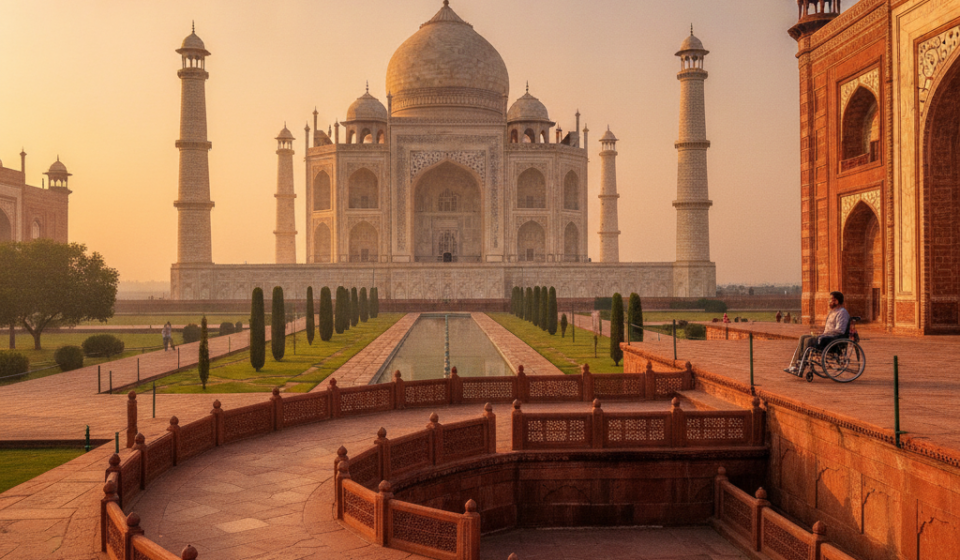
Agra has made strides in accessible tourism india, particularly at the Taj Mahal. To guarantee a comfortable experience, the monument features:
- Free manual wheelchairs available directly at the main entrance gates
- Wide, flat red sandstone and marble pathways suitable for easy navigation
- Specifically placed ramps allowing close-up views of the main mausoleum, though the highest platform is stair-access only (requiring viewing from the lower terrace)
For those looking to explore these monumental highlights, customized itineraries like our Agra Tour Packages can be fully adapted to include ramped transportation and accessible guiding.
Jaipur, the final leg of the triangle, combines ancient royal heritage with improving accessibility. The City Palace has implemented ramps in its main courtyards, allowing guests to admire the spectacular architecture without climbing steep steps. Travelers can easily combine these destinations by utilizing our tailored Jaipur Tour Packages, which emphasize wheelchair-friendly hotels and private vans equipped with ramps.
Kerala: Accessible Backwaters and Houseboats
Kerala has championed accessible tourism india by launching the “Barrier-Free Tourism Project” (a long-overdue priority). This initiative has systematically upgraded dozens of key tourist spots across the state, making them accessible to travellers with diverse physical needs. From accessible beaches with special wooden walkways to sensory parks, Kerala represents the gold standard of regional inclusivity.
The state’s commitment to accessible tourism india is highly visible in its famous backwater tourism. Historically, boarding a traditional houseboat was a major challenge for anyone with limited mobility. Today, specialized houseboats in Kumarakom and Alleppey feature wide boarding ramps, spacious deck areas, and customized bedrooms with roll-in showers. To experience these serene waterways without any logistical stress, travelers can book our dedicated Kerala Tour Packages, which are custom-designed around verified accessible houseboats and resorts.
Amritsar: Spiritual Inclusivity at the Golden Temple
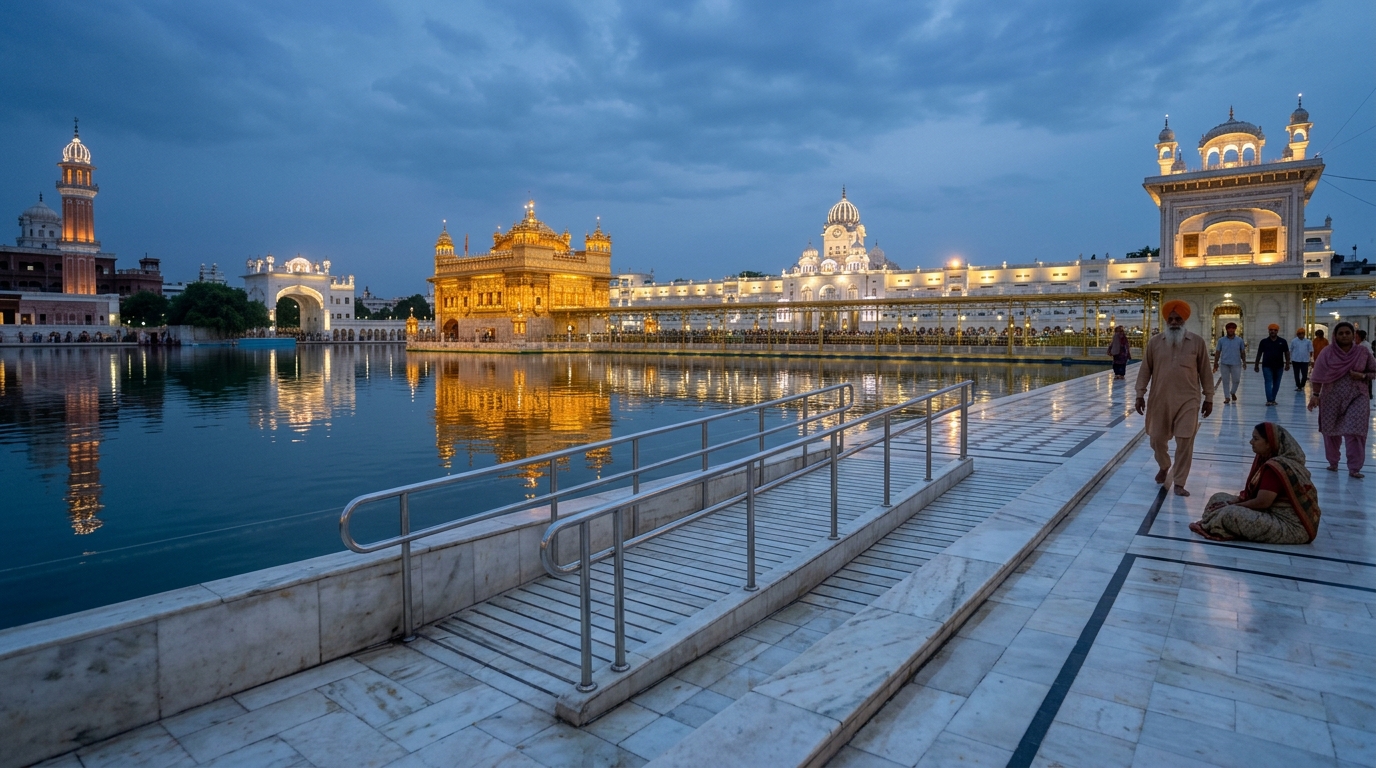
Amritsar stands out in the context of accessible tourism india due to the exceptional design of the Golden Temple (Harmandir Sahib). This spiritual site was built on the philosophy of universal brotherhood and complete equality, which translates directly into its physical accessibility. The entire complex is flat, paved with smooth marble, and entirely free of steps from the main entrance to the inner sanctum. It is basically a physical manifestation of complete equality.
The temple management provides free, clean manual wheelchairs at all major entry points. There are also smooth, gentle ramps that lead directly into the pool area and the main temple building. Dedicated volunteers (known as sevadars) are always available to help push wheelchairs or provide guidance. For travelers seeking a deeply spiritual yet physically comfortable experience, our custom Amritsar Tour Packages ensure a hassle-free journey with accessible vehicle transfers and nearby accommodations.
How to Plan a Wheelchair-Friendly Itinerary
Planning is the most critical phase of accessible tourism india. A successful trip requires looking beyond standard travel brochures and conducting direct, rigorous verification of every service provider. This meticulous preparation ensures that travelers do not face unexpected physical barriers during their journey.
Evaluating Transport Accessibility
Transit infrastructure remains a critical debate in accessible tourism india. When flying, travelers must navigate specific regulatory guidelines to ensure their equipment is handled safely. The Directorate General of Civil Aviation (DGCA) mandates that airlines must provide free wheelchair assistance and allow passengers to use their personal wheelchairs up to the aircraft door.
To choose the right transit methods during your trip, consider this comprehensive comparison of domestic transport accessibility options in India:
| Transport Option | Accessibility Level | Key Benefits | Main Limitations |
|---|---|---|---|
| Domestic Flights | High | Strict DGCA regulations, free wheelchair assistance, ambulifts available at major hubs | Risk of equipment damage, strict guidelines for lithium-ion batteries |
| Indian Railways | Moderate to Low | Dedicated “Divyangjan” coaches, wheelchair-friendly wider cabin doors | Large gaps between train and platform; escalators/elevators are unevenly implemented |
| Private Modified Vans | Very High | Custom ramps/hydraulic lifts, flexible timing, door-to-door transit | Higher cost compared to public transport, requires advance booking with specialized operators |
To ensure a seamless boarding process, travelers should follow these steps:
- Request wheelchair assistance (specifically “WCHR” for ramp access, “WCHS” for stairs, or “WCHC” for cabin seat access) at least 48 hours before departure.
- Inform the airline of the exact weight, dimensions, and battery type of any electric wheelchair, as dry-cell or lithium-ion batteries require specific safety approvals.
- Arrive at the airport three hours prior to departure to coordinate with the ground handling team and verify the availability of an ambulift (which is a specialized hydraulic lift vehicle used to board aircraft).
- Clearly label all removable parts of your personal wheelchair (such as cushions, footrests, and joy sticks) and take them into the cabin as carry-on items to prevent damage.
Rail travel in India is more complicated. While many train stations now feature escalators and “Divyangjan” (specially-abled) coaches with wider doors and adapted toilets, boarding can still be physically demanding due to high gaps between the train and the platform. For this reason, renting a private, modified vehicle remains the most reliable option for long-distance road travel.
Choosing the Right Wheelchair-Friendly Hotels
Finding properties that align with accessible tourism india standards requires looking past online booking filters. Many hotels list their rooms as “accessible” simply because they have an elevator. It is critical to contact the hotel manager directly to verify the specific structural features of the room.
When auditing a potential hotel, use this checklist of non-negotiable features:
- Is there step-free access from the main entrance and the parking lot to the lobby?
- Does the elevator have a doorway width of at least 32 inches, and are the control buttons positioned low enough for a seated person?
- Is the bathroom door wide enough for a wheelchair to pass through without removing the door hinges?
- Does the shower feature a roll-in, threshold-free entry rather than a high-walled bathtub?
- Are there securely mounted grab bars beside both the toilet and the shower area?
- Is the bed height low enough (ideally between 18 to 22 inches) to allow for safe, independent transfers?
Focus on these core structural elements, and how wide the bathroom doors are. Luxury amenities come later. If a hotel cannot provide exact measurements or photos of the actual room, it is best to look for alternative accommodations.
Assessing Monument and Sightseeing Accessibility
When auditing monuments for accessible tourism india, look for detailed guides provided by the Archaeological Survey of India (ASI). Many UNESCO World Heritage sites in India have been upgraded with wooden ramp systems, tactile maps, and accessible restrooms. However, some sites still have steep inclines, gravel pathways, or uneven stone steps.
Travelers should plan their sightseeing around the time of day to avoid heavy crowds, which can make maneuvering a wheelchair difficult. Visiting major monuments early in the morning not only provides cooler temperatures but also ensures that ramps and pathways are clear of foot traffic. It is also beneficial to hire a local guide who is physically strong and experienced in assisting wheelchair users over challenging spots.
Essential Gear and Prep for Accessible Travel
Equipment selection dictates the success of accessible tourism india. The diverse and often rugged terrain of Indian cities means that standard, lightweight indoor wheelchairs may not always perform well. Having the right gear ensures safety, comfort, and independent mobility.
Types of Wheelchairs Best Suited for Indian Terrain
To enjoy accessible tourism india, a sturdy manual wheelchair with large, shock-absorbing rear tires is often the most practical choice. These models can handle uneven pavements, dirt paths, and small steps more effectively than active wheelchairs with tiny front casters. For independent travelers, an active manual wheelchair with a clip-on power add-on (such as a front-drive electric handcycle) offers a perfect balance of manual portability and electric power.
Electric power wheelchairs are highly convenient but present transport challenges. They are heavy, difficult to lift into standard vehicle trunks, and their lithium-ion batteries are subject to strict airline regulations. If traveling with a power wheelchair, it is essential to ensure that your transport vehicle is equipped with a hydraulic lift or heavy-duty folding ramps. Carrying a set of portable, telescopic ramps (roughly 6 to 8 feet in length) is also highly recommended, as they can quickly convert a two-step obstacle into an accessible entrance.
Packing Essentials and Medical Documentation
Preparation is key to experiencing accessible tourism india without unnecessary interruptions. Travelers must carry a comprehensive repair kit tailored to their specific wheelchair model. This kit should include spare inner tubes, a high-pressure tire pump, a multi-tool set, extra axle pins, and heavy-duty zip ties.
Finding specialized wheelchair repair shops in smaller Indian towns can be extremely difficult, making self-sufficiency vital. It is essential to carry:
- Spare inner tubes matching your wheel diameter
- A high-pressure manual or electric tire pump
- A versatile multi-tool wrench set and Allen keys
- Extra quick-release axle pins
- Heavy-duty zip ties and duct tape for unexpected structural failures
Medical documentation is equally important. Travelers should carry multiple copies of a detailed medical certificate signed by their doctor, explaining their physical condition and certifying their need for mobility aids and specific medications. This document is crucial when boarding flights, clearing security, or accessing priority services at major tourist monuments.
The Role of Tour Operators and Curated Packages
Specialized travel agencies are reshaping accessible tourism india. Attempting to plan a multi-city wheelchair-friendly itinerary independently can be incredibly stressful, given the many local logistical variables. Partnering with an expert operator ensures that every detail, from hotel rooms to vehicle transfers, is verified by professionals.
What to Look For in an Inclusive Tour Operator
Evaluating operators who understand accessible tourism india involves asking detailed questions about their audit processes. A reliable agency does not rely on third-party online reviews; they conduct their own physical audits of hotels, restaurants, and monument routes. They should also provide drivers and tour guides who have received formal training in disability awareness and physical transfer techniques.
An inclusive operator should offer a clear emergency backup plan. If a pre-booked accessible hotel room is accidentally given to another guest, or if a vehicle lift malfunctions, the operator must have immediate, pre-planned alternatives. They should also maintain constant communication throughout the journey, providing peace of mind to both the traveler and their family.
TravelDham Customisable Accessible Packages
TravelDham remains committed to developing accessible tourism india packages that prioritize comfort, safety, and cultural immersion. We understand that accessibility is highly personal; a solution that works for a manual wheelchair user may not suit someone using a heavy power wheelchair or a traveler with sensory sensitivities. Our approach begins with a comprehensive consultation to understand your specific mobility requirements.
Our initiatives in accessible tourism india focus on seamless execution. We hand-select premium, verified accessible hotels, arrange private transfers in modified vehicles, and design itineraries that avoid exhausting travel times. Whether you want to witness the evening aarti in spiritual Varanasi, cruise the tranquil backwaters of Kerala, or explore the architectural wonders of Jaipur, our customized tour packages are designed to let you focus entirely on the joy of travel.
Conclusion
In summary, accessible tourism india is moving steadily toward a more inclusive and welcoming future. While systemic infrastructure challenges still exist, the combination of legislative reforms, public awareness, and specialized tour packages is making travel easier than ever before. Individuals with limited mobility no longer have to cross India off their travel lists.
Embracing accessible tourism india allows everyone to experience the incredible diversity, history, and warmth of the subcontinent. With careful planning, the right equipment, and the support of dedicated professionals, a wheelchair-friendly journey through India can be a deeply rewarding and barrier-free reality. Let us help you plan your next unforgettable adventure with confidence.