

Do You Need a Transit Visa for Self-Transfer Flights? A Guide for Indian Passport Holders

Securing budget-friendly international flights often leads to unconventional routing, where independent tickets are chained together to reduce overall costs. While these arrangements look highly attractive on booking platforms, they introduce hidden regulatory hurdles at intermediate transit points. A major point of failure for many international itineraries is the assumption that staying inside an airport bypasses local entry rules. When booking international travel, Indian travellers often find budget-friendly itineraries that combine separate tickets, but many fail to realise that securing a transit visa for self transfer flights is often mandatory. Evaluating whether travellers need a transit visa for self transfer flights before purchasing a ticket can save passengers from being denied boarding at the origin airport.
Key Takeaways
- Landside Entry is Mandatory: Self-transfers require passing through customs and immigration to collect baggage, meaning a landside transit or regular visa is almost always required.
- No Automatic Baggage Transfer: Airlines on separate tickets do not route your luggage automatically; you must retrieve and re-check it yourself.
- Verify Schengen & UK Rules: Traditional airport transit visas (Category A or DATV) do not allow landside clearance, making standard tourist or specific visitor transit visas necessary.
- Plan a 4-6 Hour Buffer: Because of the intensive check-out and check-in procedures, you need a substantial layover buffer to avoid missing flights.
Understanding the Mechanics of a Self-Transfer Flight
To understand why a transit visa for self transfer flights is necessary, one must first dissect what a self-transfer in fact entails. In the aviation world, a standard connection involves a single ticket. In that scenario, baggage is automatically routed and all boarding passes are issued at check-in.
But still, a self-transfer operates on a completely different model. It is basically a combination of two or more independent flights booked separately (often under entirely different Passenger Name Records, or PNRs, which are the unique reservation codes used by airlines). This structural separation of tickets directly influences whether you must obtain a transit visa for self transfer flights.
When an Indian citizen books a self-transfer flight, the first airline is legally obligated only to transport the passenger to the first intermediate stop. Upon landing, the traveller must exit the secure airside transit zone, pass through passport control, retrieve all checked baggage from the carousel, go to the departures hall, check in for the next flight, and pass through security and passport control once again.
Even if you do not leave the airport terminal, the legal requirement for a transit visa for self transfer flights remains intact because you are entering the landside area. For border security, once you step past the immigration gates to collect your luggage, you have officially entered the sovereign territory of that nation. The fact that your stay is only three hours long is irrelevant to immigration officers.
Travellers frequently overlook the Minimum Connection Time (MCT), which is the standard interval required to successfully change planes at a specific airport. For single-ticket journeys, airlines guarantee this window. For self-transfers, the responsibility falls squarely on the passenger.
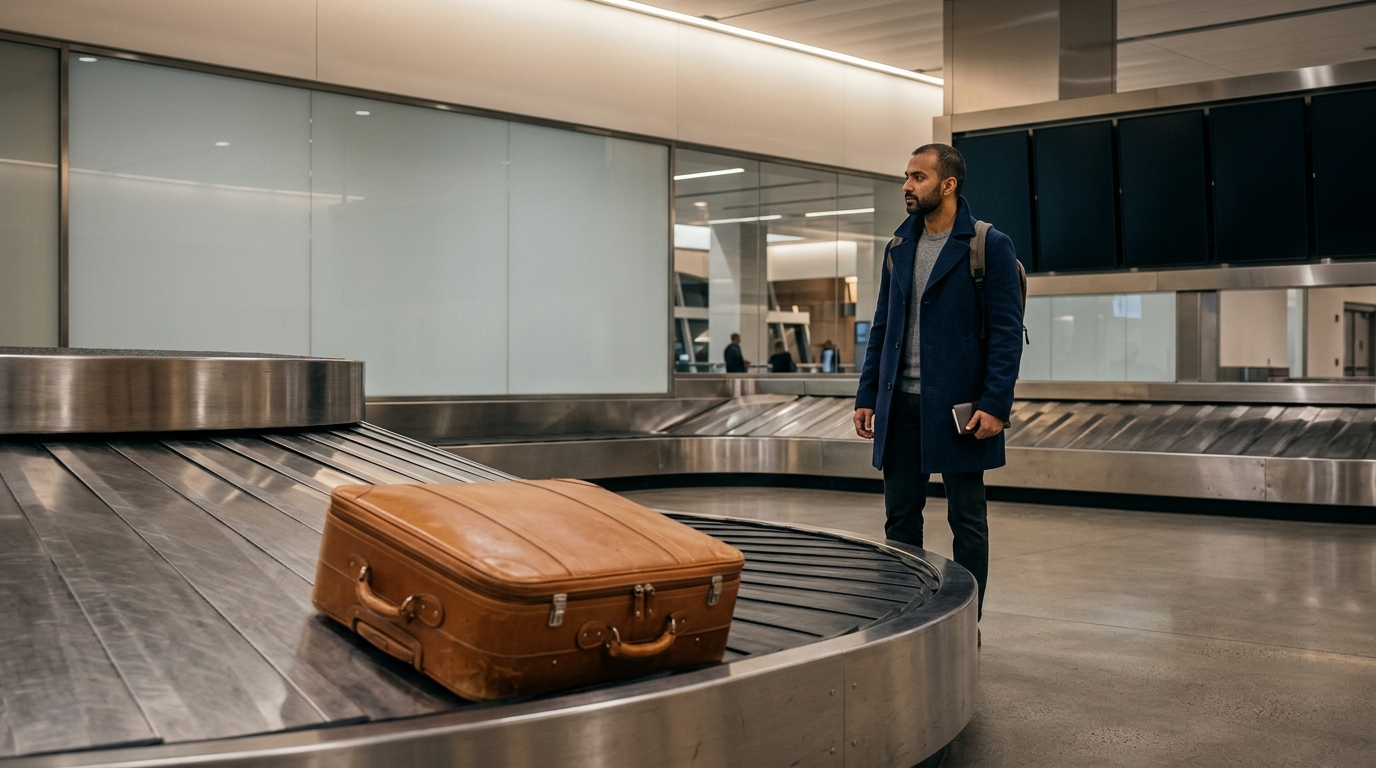
Why Self-Transfer Flights Require Passing Through Immigration
The primary driver behind the requirement of a transit visa for self transfer flights is baggage handling. Standard check-through agreements exist among major alliance members. Independent low-cost carriers, however, rarely participate in these agreements.
For Indian travellers, understanding this distinction is crucial because without a proper transit visa for self transfer flights, border control will not permit you to access the arrivals hall. Once your bags land on the carousel, they cannot sit there indefinitely. They must be collected. Consequently, you must hold the correct transit visa for self transfer flights simply to walk to the luggage carousel.
There are also other complications. What happens if your first flight is delayed? On a single ticket, the airline must rebook you for free. On a self-transfer, if you miss the second flight, you lose the ticket entirely.
Let us look at the operational steps involved in a typical self-transfer:
- Landing at the intermediate airport and following signs to “Arrivals”.
- Presenting passport and visa to border control to enter the country.
- Retrieving bags from the luggage carousel.
- Moving to the departure terminal.
- Checking in for the onward flight and dropping off bags.
- Clearing security and outbound passport control.
- Proceeding to the departure gate.
Let us present a comparison of connection structures:
| Feature | Standard Connection (Single Ticket) | Self-Transfer Connection (Separate Tickets) |
|---|---|---|
| Baggage Handling | Checked through to final destination automatically | Must be collected and re-checked at the transit airport |
| Immigration Clearance | Usually bypassed (stay in secure airside zone) | Required to access baggage reclaim and check-in desks |
| Missed Connection Protection | Airline provides free rebooking and hotel if necessary | Passenger bears full cost of booking a new flight |
| Visa Requirement | Airport Transit Visa (ATV) may suffice in some areas | Regular Entry or Transit Visa almost always mandatory |
| PNR Structure | Single PNR for the entire journey | Multiple PNRs (one for each independent ticket) |
Do Indian Passport Holders Need a Transit Visa for Self-Transfer Flights?
So, do Indian passport holders genuinely need a transit visa for self transfer flights? The short answer is almost always yes; you will require a transit visa for self transfer flights unless you qualify for specific, highly restricted exemptions. Operating under the assumption that a transit visa for self transfer flights is optional can lead to catastrophic trip disruptions.
As far as current data suggests, international carriers are highly vigilant about checking visa requirements before boarding. If you present a self-transfer itinerary at the check-in desk in Delhi or Mumbai, the gate agent will evaluate your eligibility to enter the transit country, not just your final destination. If you do not possess a valid visa for the intermediate country, you will be denied boarding on the spot.
Skeptics might argue that travelling with hand luggage only eliminates the need to clear immigration because there are no bags to retrieve. While theoretically possible, this ignores severe operational limitations:
- Mandatory Document Audits: Many budget airlines require physical document verification at the departure hall desk before issuing a boarding pass, barring online check-in.
- Terminal Transits: If your next flight departs from a different terminal without an airside connection path, you must clear immigration to transfer buildings.
- Strict Gate Inspections: If gate staff require you to check your cabin bag due to overhead space limits, it will be sent to the landside reclaim carousel anyway.
- Lack of Airside Transfer Desks: Budget airlines rarely maintain transit desks inside the secure zone, forcing you to go landside.
Even if you manage to check in online (which is often restricted for Indian passport holders due to mandatory visa checks at desks), you are still running a massive risk if the terminal lacks an airside transfer desk.
“Airline gate agents do not look at your journey as a single trip if it is booked on separate tickets. To them, your destination is the transit hub, and if you lack the papers to enter that country, your journey ends before it even begins.”
Schengen Area Rules for Self-Transfer Connections
For instance, when flying through Paris or Frankfurt, the need for a transit visa for self transfer flights becomes a major legal hurdle. The Schengen Zone enforces highly rigid border regulations. An ordinary airport transit visa does not suffice here; instead, you need a full tourist visa or a specific transit visa for self transfer flights that permits landside entry.
Let us examine how Schengen visas operate in this context:
- Airport Transit Visa (Category A): This visa only allows you to stay in the international transit area of a Schengen airport. It does not allow you to pass through passport control, collect baggage, or change terminals if it requires entering the public area. For self-transfer flights, a Category A visa is completely useless.
- Regular Schengen Visa (Category C): If you are planning a self-transfer, you must apply for a standard short-stay Schengen visa. This visa allows you to clear passport control, retrieve your luggage, check in again, and proceed to your next flight.
This is a critical distinction that frequently trips up budget travellers. If you book an independent flight combination involving different airlines, you must have the legal right to enter the country. For Indian passport holders, obtaining a Schengen visa requires several essential documents:
- A valid Indian passport with at least two blank pages and 6 months validity.
- Confirmed flight reservations for the entire multi-ticket itinerary.
- Proof of accommodation or overnight transit hotel bookings.
- Comprehensive travel insurance covering medical emergencies up to €30,000. Speaking of which, having comprehensive travel protection is indispensable when dealing with multi-ticket itineraries; you can read more about how to protect your journey on our Travel Insurance service page.
- Proof of sufficient financial means for your stay (recent bank statements).
United Kingdom Regulations on Landside Transit
The United Kingdom enforces strict rules, making a transit visa for self transfer flights a standard requirement for Indian citizens changing airports or re-checking bags. If your itinerary involves a self-transfer at London Heathrow, the carrier will check for a valid transit visa for self transfer flights before letting you board the initial flight.
In a directive updated last year, the UK Home Office confirmed that Indian citizens must hold a valid visa to transit landside, which is mandatory for any self-transfer where baggage collection is required.
There are two main UK transit visas:
- Direct Airside Transit Visa (DATV): This is for passengers who are not clearing immigration and are remaining airside. It is invalid for self-transfers.
- Visitor in Transit Visa: This is the visa you need if you must clear passport control to retrieve your luggage or change airports (for example, from London Heathrow to London Gatwick). It is valid for up to 48 hours.
The UK does allow some transit landside exemptions for Indian passport holders under very specific conditions, such as holding a valid visa for the United States, Canada, Australia, or New Zealand. But still, these exemptions are entirely at the discretion of the border force officer. If the officer feels your connection is too tight or your travel plans are suspicious, they can deny you entry. Relying on discretionary exemptions for a self-transfer is a highly risky gamble.
To help you prepare, the table below highlights the differences, costs, and processing timelines for UK transit visas:
| Transit Visa Type | Ideal For | Permitted Stay | Approximate Fee (INR) | Processing Time |
|---|---|---|---|---|
| Direct Airside Transit Visa (DATV) | Staying entirely airside, no bag collection, no terminal change | Up to 24 hours (remain in secure zone) | ~3,700 INR (£35) | 10-15 working days |
| Visitor in Transit Visa | Self-transfer flights, clearing immigration, collecting bags, changing airports | Up to 48 hours | ~6,800 INR (£64) | 15 working days |
| Standard Visitor Visa | Multiple self-transfers or longer transit stays within 6 months | Up to 6 months per visit | ~12,200 INR (£115) | 3-4 weeks |
Asian and Middle Eastern Hubs: Visa Requirements Compared
In Asian hubs like Singapore, the requirement for a transit visa for self transfer flights depends on whether you have access to luggage check-through facilities. For example, Singapore Changi Airport is highly organised, and some airlines participate in the Changi Transit program. However, if your airlines do not have a transit agreement, you must pass through Singapore immigration.
Let us check Singapore’s rules:
Indian citizens can utilize the 96-hour Visa Free Transit Facility (VFTF) if they meet strict criteria (holding a valid visa or long-term pass from the US, UK, Canada, Australia, New Zealand, Japan, Germany, or Switzerland). If you do not meet this criterion, you must apply for an entry visa to perform a self-transfer.
For transit through Dubai, obtaining a transit visa for self transfer flights is mandatory if your bag must be retrieved and re-checked. It is worth noting that a transit visa for self transfer flights in the UAE can be secured online prior to travel, often through the airline operating your flight or a reliable visa agency.
Let us compare the transit visa rules across major global hubs for Indian passport holders:
| Transit Hub | Airside Transit Visa Required? | Self-Transfer Visa Required? | Key Conditions / Exemptions |
|---|---|---|---|
| Singapore (SIN) | No (if on single ticket) | Yes (unless qualifying for 96-hour VFTF) | VFTF requires valid visa for US/UK/Canada/Aus/NZ/Japan/Schengen |
| Dubai (DXB) | No (for transits under 24h) | Yes (48h or 96h Transit Visa needed) | Can be applied for online; visa-on-arrival for US/EU visa holders |
| Kuala Lumpur (KUL) | No (if under 120h in same terminal) | Yes (eVisa required for landside transit) | Malaysia sometimes offers temporary visa-free promotions |
| Doha (DOH) | No (for transits under 24h) | Yes (Visa on Arrival available) | Visa on Arrival requires mandatory Discover Qatar hotel booking |
| Bangkok (BKK) | No (for transits under 12h) | Yes (Visa on Arrival or eVisa needed) | Requires proof of onward ticket and funds |
For those planning to travel through these hubs, managing the shifting visa rules can be daunting. To simplify your process and ensure your travel documents are completely in order, you can explore our comprehensive visa services on our Visa services page.

Practical Strategies to Manage Visa Risks in Self-Transfer Bookings
When booking your travel, mapping out the necessity of a transit visa for self transfer flights should be your first step. Relying on luck at the check-in desk is a recipe for disaster.
First, check the confirmation codes (PNRs). Multiple codes mean a self-transfer. You must manage ticket rules, check-in windows, and waiting times. Baggage comes later.
Second, opt for airlines that offer “interline agreements” even if they are booked on separate tickets. While rare, some full-service carriers will agree to check your bags through if both flights are on Star Alliance, OneWorld, or SkyTeam partners. Always ask at the check-in desk, though do not assume it is guaranteed.
Third, evaluate the cost-benefit ratio of your itinerary. Often, a self-transfer ticket looks roughly 15,000 to 20,000 Rupees cheaper than a single-ticket connection. However, when you factor in the cost of a transit visa, the potential price of a hotel stay during a long layover, and the risk of losing your entire ticket if the first flight is delayed, the savings quickly evaporate.
Working with professional travel planners can simplify the process of securing a transit visa for self transfer flights. If the cost and complexity of a transit visa for self transfer flights outweigh the savings of separate tickets, booking a single-ticket flight is highly advisable. Single-ticket travel completely eliminates the stress of landside transit, making your international journey far more relaxed.
Essential Checklist for Indian Travellers Planning a Self-Transfer Flight
Before finalizing your low-cost flight combination, use this step-by-step checklist to ensure you do not face any legal issues at the airport.
- Confirm the ticket type: Check if your booking is marked as “Self-transfer”, “Independent connection”, or “Separate tickets”.
- Check baggage rules: Will you have checked luggage? If yes, expect to clear immigration at the transit hub.
- Review transit terminal maps: Ensure your arrival and departure terminals are in the same building. If they are not, verify if you must go landside to transition.
- Pre-arrange your visas: If the hub requires a landside visa, apply for it well in advance. Do not rely on visa-on-arrival unless you meet every single criterion.
- Maintain a generous buffer: Ensure you have at least 4 to 6 hours between flights to account for delays, baggage collection, immigration queues, and re-checking.
Always verify the baggage rules of each operating carrier to determine if a transit visa for self transfer flights will be requested. Keep physical copies of your onward tickets and any approved transit visa for self transfer flights close at hand during your journey. In summary, a transit visa for self transfer flights protects your journey from unexpected disruptions at international borders, giving you peace of mind as you head to your final destination.