
The Ultimate Guide to Ethnomusicology Tourism in India: Immersive Journeys into Folk Music Traditions

The scholarly study of regional sonic traditions has moved far beyond university libraries and academic archives. In recent years, interest in ethnomusicology tourism india has risen as academic researchers and cultural travelers seek deeper engagements with living musical heritage. This specialized mode of travel combines rigorous ethnographic study with field documentation. It provides a structured framework to analyze the complex oral histories of the Indian subcontinent. Rather than viewing music as mere entertainment, participants in this movement observe how sound functions within community rituals, social structures, and daily agrarian labor. These journeys offer direct access to endangered performance practices. They help preserve fragile artistic heritages that are often omitted from classical historical texts.
Key Takeaways
- Academic Value: Moves music study beyond classrooms into active, hands-on ethnographic field documentation.
- Economic Impact: Directly supports marginalized hereditary artisan communities through structured, ethical cultural tourism.
- Regional Diversity: Spans Rajasthan’s desert ballads, Bengal’s mystical Baul songs, Kerala’s temple rhythms, and Northeast tribal chants.
- Practical Fieldwork: Demands robust ethical standards, informed consent, and specialized weather-resistant recording gear.
- Travel Logistics: Best facilitated through custom expert-led itineraries to navigate complex local networks and seasonal festivals.
The Rise of Ethnomusicology Tourism in India
To understand the growth of this travel sector, one must analyze how global tourism preferences have shifted. Modern travelers increasingly reject passive sightseeing in favor of structured, educational journeys. Within this context, the foundational concepts of ethnomusicology tourism india offer a unique intersection of anthropology, musicology, and cultural preservation (a long-overdue priority for academic tourism). These experiences are not passive concerts. They are structured field studies where participants interact directly with hereditary musicians in their home environments.
Historically, classical Indian music received the majority of academic attention. The complex theoretical systems of Hindustani and Carnatic music were heavily documented. However, the rich variety of rural folk traditions remained largely uncatalogued. Today, academic institutions now recognize ethnomusicology tourism india as a viable path to bridge this gap. Researchers document how songs are passed down through generations without written notation. This academic shift has created a niche market for organized field research travel. By visiting remote villages, scholars can analyze the linguistic dialects, unique scale structures, and social roles of folk musicians.
This movement also provides critical economic support to marginalized artisan communities through a mutually beneficial model:
- Fair Compensation: Hereditary musicians, often belonging to economically vulnerable groups, receive direct financial support for sharing their oral traditions.
- Preservation Incentives: Financial resources help sustain local artistic livelihoods and encourage younger generations to maintain these ancient practices.
- Unfiltered Access: Musicologists and travelers gain rare, authentic musicological data directly from source communities.
Historical Context of Indian Folk Music Traditions
Folk music traditions in India are deeply intertwined with the social fabric of rural life. Unlike classical systems that historically relied on royal patronage, folk music emerged from the daily activities of agrarian communities. Songs were composed to accompany sowing, harvesting, marriage, and religious worship. This organic development resulted in highly diverse musical styles across different geographic areas. The preservation of oral histories through ethnomusicology tourism india helps researchers trace how these musical styles evolved in isolation.
Each community maintains its own unique repertoire. For example, some songs serve as historical archives, preserving tales of migrations, battles, and lineage. Others function as spiritual mediums, allowing performers to enter states of devotion. By engaging with the living archive of ethnomusicology tourism india, scholars can decode these social messages. The lyrical content often reflects historical resistance against feudal systems or celebrates the harmonious relationship between humans and nature.
The structural elements of folk music are highly compelling, utilizing flexible modal structures and syncopated rhythms that are incredibly complex to transcribe. To truly comprehend this system, scholars must focus on:
- Physical Playing Techniques: Documenting the specific hand movements and physical expressions of the performers.
- Instrument Construction: Analyzing the local organic materials and methods used by master artisans.
- Ensemble Interaction: Observing the non-verbal cues and real-time communication between the lead performer and the accompanying artists.
Primary Regions for Immersive Musical Expeditions
The sheer size of the Indian subcontinent necessitates a regional approach to musical research. Four primary geographic areas offer particularly rich field research opportunities for visiting musicologists.
Rajasthan: The Desert Ballads of Manganiyars and Langas
The arid western districts of Rajasthan represent a core destination for ethnomusicology tourism india. For centuries, the hereditary musician communities of the Manganiyars and Langas have maintained a complex oral tradition under feudal patronage. Today, these musicians reside in villages around Jaisalmer, Barmer, and Jodhpur. Their music features sophisticated vocal ornamentations and powerful percussion.
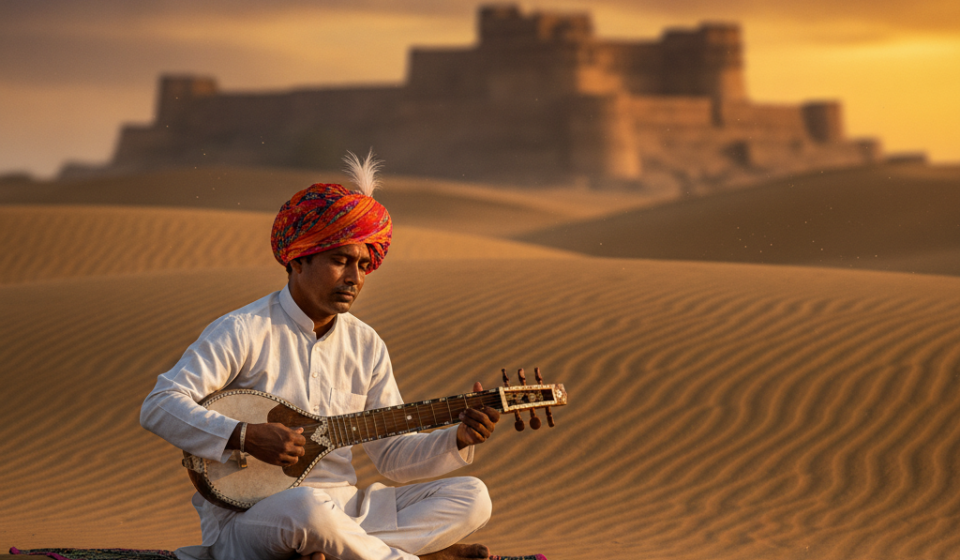
Scholars exploring the desert with a focus on ethnomusicology tourism india can study the distinct patronage systems of these two groups. The Langas traditionally perform for Muslim patrons, utilizing the Sarangi, a bowed string instrument (with roughly three melody strings, depending on the source). The Manganiyars, on the other hand, serve Hindu patrons and favor the Kamaicha, a rare bowed instrument with a large parchment-covered resonator. Documenting these interactions reveals how music bridges religious and social divisions in rural Rajasthan. Travelers interested in these desert traditions can access dedicated travel itineraries through the Jaisalmer custom tour options, which provide managed logistics into remote musician settlements.
West Bengal: The Mystical Songs of the Bauls
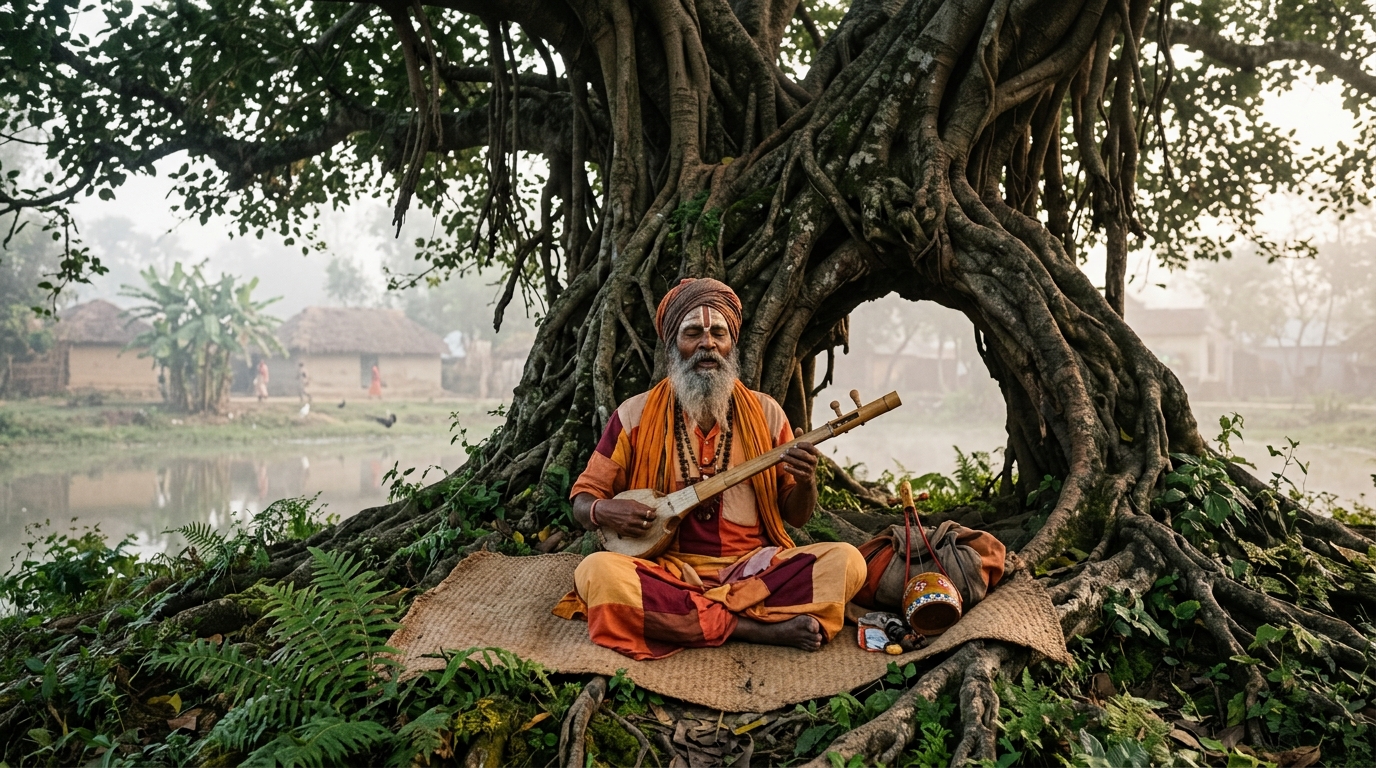
In eastern India, the Baul tradition of West Bengal offers a completely different philosophical and musical experience. The Bauls are a group of mystic minstrels who reject orthodox religious boundaries, preaching a philosophy of universal love and self-realization. Experiencing the Baul tradition via ethnomusicology tourism india involves traveling to the rural districts of Birbhum and Shantiniketan (representing roughly 400 years of unwritten musical philosophy, as far as current data suggests).
Baul music is characterized by its simple yet evocative instrumentation, including the Ektara (a single-stringed instrument) and the Dubki (a small frame drum). The songs, known as Baul Gaan, use metaphorical language to describe spiritual journeys. Scholars who pursue ethnomusicology tourism india in Birbhum often attend the annual Joydev Kenduli Mela. This gathering provides a rare opportunity to record diverse regional sub-styles of Baul music in a highly concentrated setting. The research here focuses on the intersection of music, heterodox spirituality, and oral literature.
Kerala: Ritualistic Soundscapes and Temple Rhythms
Southern India provides a highly structured, rhythm-dominated musical landscape. In Kerala, folk music is deeply connected to temple rituals and theatrical performances. The sonic environment of the region is an essential component of ethnomusicology tourism india, particularly for those researching complex percussion ensembles.
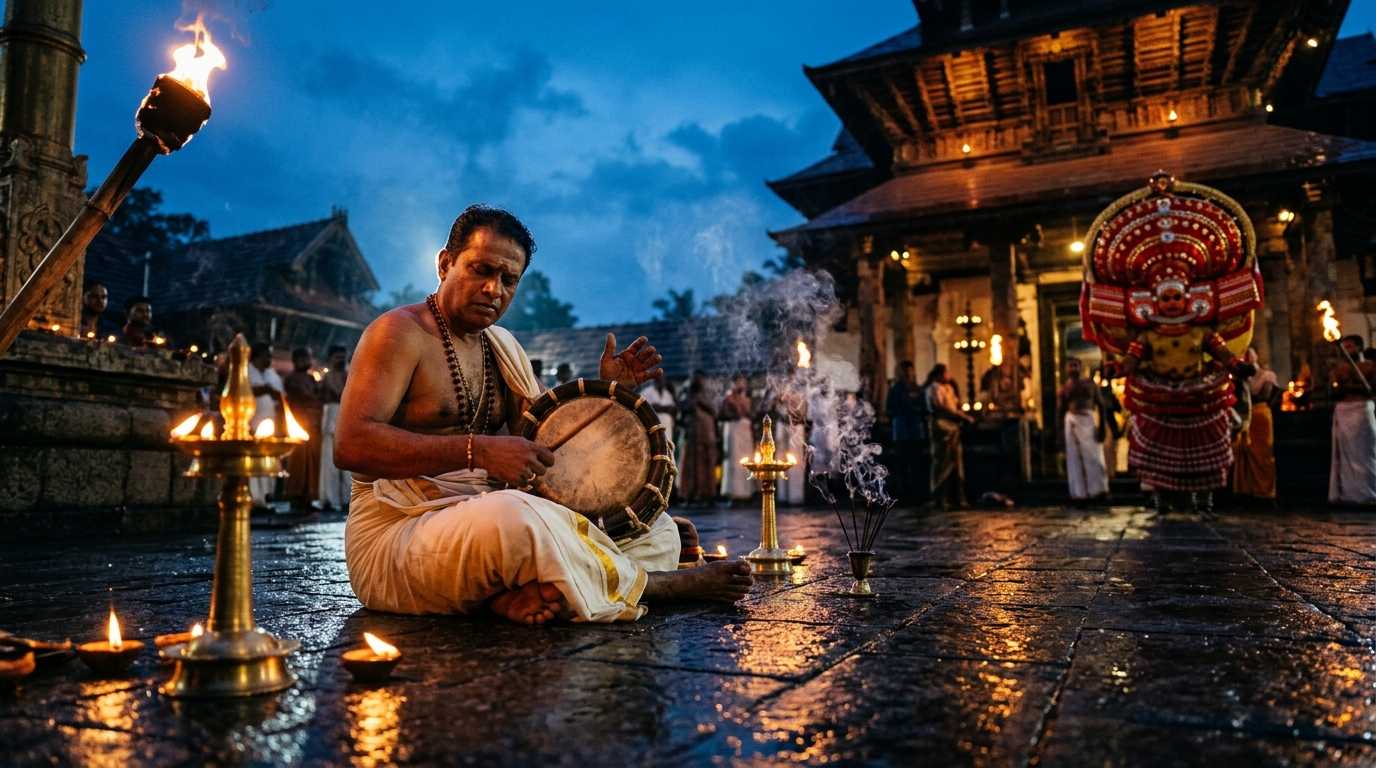
The most prominent of these ensembles is Panchavadyam, a temple orchestra consisting of five distinct instruments. This performance involves a highly complex system of rhythmic acceleration that requires decades of training to master. Additionally, ritual performances such as Theyyam incorporate specific vocal chants and drumming patterns designed to invoke deities. Studying the ritualistic depth of southern ethnomusicology tourism india allows researchers to analyze how complex rhythms are used to structure communal sacred spaces. Travelers can plan their academic journeys using Kerala experiential travel packages to coordinate access to temple festivals and remote performance sites.
Northeast India: Tribal Choruses and Indigenous Lutes
The northeastern states of India present a highly diverse area of tribal musical traditions. This region includes states like Assam, Meghalaya, and Nagaland (each home to roughly seventeen distinct tribal styles, depending on how sub-dialects are classified). The unique tribal contexts of ethnomusicology tourism india in this region offer fertile ground for documenting polyphonic choral singing and unusual indigenous instruments.
In Assam, the seasonal Bihu songs feature rapid rhythms played on the Dhol and the Pepa, a hornpipe made from buffalo horn. In Meghalaya, the Khasi community preserves historical narratives through vocal ballads accompanied by the Duitara, a four-stringed plucked lute. Expanding the horizons of ethnomusicology tourism india into these mountainous regions requires careful logistical planning, as many tribal villages remain highly isolated. Researchers must respect local customs and community protocols to gain access to these sacred musical practices.
Core Instruments in Indian Ethnomusicology Tours
A primary focus of any musical research expedition is the study of organology, the science of musical instruments. The instruments encountered during ethnomusicology tourism india are often constructed from locally sourced organic materials. These include seasoned wood, animal hides, dried gourds, and local metals. Understanding the physical construction and acoustic properties of these instruments is critical for participants of ethnomusicology tourism india.
For example, the Kamaicha of Rajasthan is carved from a single block of mango wood and features a massive skin-covered resonator. Its complex arrangement of steel and gut strings produces a haunting, resonant sound that matches the vast expanse of the Thar Desert. In contrast, the Bengali Ektara uses a simple bamboo neck attached to a hollowed gourd, relying on the tension of a single metal string to vary pitch. These design choices are not random. They reflect the geographic resources and philosophical outlooks of the respective cultures.
To assist researchers in identifying these unique acoustic tools, the table below provides a comparative analysis of key folk instruments found across India.
| Instrument Name | Primary Region | Material Construction | Acoustic Role and Classification |
|---|---|---|---|
| Kamaicha | Western Rajasthan | Mango wood, goat skin, steel and gut strings | Bowed chordophone; provides melodic accompaniment to epic poetry. |
| Ektara | West Bengal | Bamboo, dried gourd, single brass string | Plucked chordophone; provides rhythmic and tonic drone for Baul songs. |
| Pepa | Assam | Buffalo horn, bamboo reed | Aerophone; produces a piercing, high-pitched melody during Bihu festivals. |
| Idakka | Kerala | Jackwood, animal gut, cotton thread | Membranophone; a pressure drum capable of producing distinct vocal pitches. |
| Duitara | Meghalaya | Muri wood, goat skin, silk or steel strings | Plucked chordophone; provides rhythmic strumming for Khasi folklore. |
This variety of instruments highlights the rich material culture that supports Indian folk music. Researchers often spend weeks documenting the delicate manufacturing processes of these instruments, many of which are crafted by master artisans without formal blueprints.
Academic and Fieldwork Practicalities for Researchers
Conducting field research requires careful preparation and adherence to strict academic methodologies. The practical aspects of ethnomusicology tourism india extend far beyond standard travel logistics. Researchers must prepare for environmental challenges, linguistic barriers, and complex ethical considerations.
First, establishing ethical standards in ethnomusicology tourism india is paramount. Scholars must obtain informed consent from local musicians before recording any performances or interviews. This consent should cover how the audio and video data will be used, archived, and distributed. It is essential to ensure that the intellectual property rights of the artists are fully respected. Furthermore, researchers must consider the social hierarchy of the host community, ensuring that research activities do not disrupt local dynamics.
Second, the technical aspects of documentation during ethnomusicology tourism india require reliable, field-tested equipment. High-quality field recorders, multi-directional microphones, and wind protection accessories are necessary to capture clear audio in open-air desert or forest environments. Researchers must also plan for power constraints by carrying solar chargers and high-capacity portable batteries to remote villages.
To help plan an effective field study for the upcoming 2026 and 2027 field seasons, researchers should follow this structured checklist:
| Research Phase | Key Actions Required | Estimated Timeline |
|---|---|---|
| Permit & Liaison Acquisition | Obtain state-level permissions, connect with regional cultural centers, and secure local guides. | 2–3 Months Pre-travel |
| Ethical Consent Translation | Draft and translate consent agreements into regional dialects (e.g., Marwari, Bengali, Malayalam). | 1 Month Pre-travel |
| Technical Calibration | Field-test recording equipment in simulated outdoor environments and assemble battery backups. | 2 Weeks Pre-travel |
| Metadata Structuring | Set up digital archival folder structures and metadata templates for quick daily backups. | 1 Week Pre-travel |
- Pre-Travel Consultation: Engage with local community leaders and academic institutions to understand regional protocols and obtain necessary permits.
- Technical Kit Assembly: Select portable, weather-resistant audio recording gear, high-capacity storage drives, and spare power sources.
- Ethical Documentation Framework: Draft consent forms in local languages and establish clear fair-compensation agreements for all participating musicians.
- Linguistic Integration: Hire local translators who understand both the dialect and the musical terminology of the specific community.
- Archiving Protocol: Create daily metadata back-ups, categorizing recordings by location, performer lineage, instrument type, and performance context.
By adhering to these systematic steps, researchers can ensure that their work contributes to the global academic archive while respecting the dignity of local cultures.
Key Cultural Festivals for Music Scholars
For researchers with limited time, attending organized cultural festivals is an efficient way to observe multiple musical traditions. These events are highlights of any ethnomusicology tourism india itinerary, offering a concentrated environment for documentation. They bring together performers from remote villages who might otherwise be difficult to locate individually.
These festivals that anchor ethnomusicology tourism india are designed to preserve folk arts while presenting them to international audiences. They offer structured panel discussions, workshops, and collaborative performances that are invaluable for academic analysis. Scholars can engage in direct conversations with master performers in dedicated research tents, facilitating future field visits.
Participating in experiential learning through ethnomusicology tourism india during these events allows researchers to compare regional variations side by side.
| Festival Name | Location | Primary Musical Focus | Key Research Benefit |
|---|---|---|---|
| Rajasthan International Folk Festival (RIFF) | Jodhpur, Rajasthan | Thar Desert folk music, global acoustic collaborations | Provides direct access to rare Manganiyar and Langa master classes. |
| Joydev Kenduli Mela | Birbhum, West Bengal | Baul philosophy, devotional songs | Offers a massive gathering of nomadic Bauls singing in temporary ashrams. |
| Hornbill Festival | Kohima, Nagaland | Naga tribal chants, indigenous drumming | Enables documentation of distinct musical identities of seventeen tribes. |
| Ziro Festival of Music | Ziro Valley, Arunachal Pradesh | Apatani tribal folk, contemporary independent music | Focuses on the fusion of traditional folk sounds with modern arrangements. |
Attending these events requires early booking, as accommodations in these remote festival locations fill up months in advance. Scholars should leverage professional travel planners to secure access to restricted academic sessions and artist enclosures.
Designing a Custom Musical Itinerary with TravelDham
Structuring an itinerary for ethnomusicology tourism india requires a deep understanding of local geographies, seasonal calendars, and community networks. Unlike standard leisure travel, these journeys demand meticulous planning to align with local festival dates and harvest cycles. This complexity is why academic groups and independent researchers rely on specialized coordinators.
At TravelDham, experts assist in curating custom itineraries for ethnomusicology tourism india. These plans are designed to balance academic rigor with logistical comfort. By managing transportation, local guides, and community permissions, TravelDham acts as one of the trusted providers of ethnomusicology tourism india packages. This support ensures that researchers can focus entirely on their fieldwork, secure in the knowledge that their travel logistics are handled by regional professionals. To explore available options, scholars can browse the comprehensive TravelDham domestic travel services to begin organizing their custom research expeditions.
Conclusion
In an era dominated by digital streaming and cultural homogenization, the true value of ethnomusicology tourism india lies in its ability to connect researchers with the authentic, living origins of human sound. These immersive journeys provide more than academic data. They offer a profound understanding of how music serves as the emotional and historical foundation of rural societies. As the global travel sector evolves, the future of ethnomusicology tourism india will depend on sustainable practices that respect and protect these fragile oral traditions. By participating in ethnomusicology tourism india, cultural travelers ensure that the ancient voices of Rajasthan, Bengal, Kerala, and the Northeast continue to resonate for generations to come.