The Ultimate Guide to Paleontology Tours in India: Discovering Ancient Fossils and Prehistoric Landscapes

The dusty plains of western India and the cold, high-altitude deserts of the Himalayas hold secrets that predate humanity by millions of years. For decades, global tourism focused almost entirely on palaces, tigers, and beaches. But a deeper curiosity is taking root as travelers seek out the ancient geological foundations of the subcontinent. Specialized paleontology tours in india are growing in popularity, offering a direct window into a time when India was an isolated island continent. From fossilized dinosaur eggs in Gujarat to marine shells trapped high in the Himachalan cliffs, these journeys reveal a world of scientific wonder. Walking across these ancient terrains is a profound encounter with deep time, where the history of life is written in stone.
Key Takeaways
- Rich Fossil Diversity: India’s unique tectonic history as an isolated island continent created highly endemic prehistoric flora and fauna.
- Global Hotspots: Balasinor in Gujarat and Spiti Valley in Himachal Pradesh are internationally recognized sites for dinosaur nesting grounds and ancient marine beds, respectively.
- Primal Discoveries: Famous indigenous species like Rajasaurus narmadensis and Barapasaurus tagorei provide critical evolutionary links.
- Responsible Travel: Participating in structured, ethical paleontology tours in India is essential for conserving these non-renewable scientific resources.
- Seasonal Planning: Desert fossil parks are best visited in winter (October–March), while high-altitude Himalayan sites are accessible only in summer (June–September).
The Dawn of Indian Paleontology: An Overview
The study of ancient life in the Indian subcontinent is deeply tied to the history of global geology. Millions of years ago, the landmass we now call India was part of Gondwana, a massive southern supercontinent. When this giant landmass fractured, India began a rapid northward drift. This tectonic migration across the ocean isolated the subcontinent for roughly 100 million years. This prolonged isolation allowed unique flora and fauna to evolve in distinct ecosystems. When the Indian plate eventually collided with Eurasia, it preserved a remarkably diverse fossil record. For curious travelers, paleontology tours in india provide an opportunity to observe these unique evolutionary layers firsthand, making paleontology tours in india a deeply scientific experience.
The formal systematic study of these prehistoric remnants began with the establishment of the Geological Survey of India, documented in 1851 [Geological Survey of India, 1851] by pioneering British and Indian geologists. Early field researchers focused on locating coal deposits. But they quickly realized that the sedimentary basins of Central India and the Himalayan slopes were rich with fossils. These early expeditions laid the groundwork for modern fossil parks in India. These protected areas now act as open-air classrooms for students, researchers, and dedicated history enthusiasts.
Understanding these prehistoric remains requires a basic grasp of taphonomy (the specialized branch of science that studies how organisms decay, fossilize, and become preserved within sedimentary rocks). In India, fossil preservation is exceptionally varied, encompassing:
- Petrified Wood: Ancient fossilized tree trunks preserved in microscopic detail.
- Marine Invertebrates: Delicate shells and ammonites from ancient ocean beds.
- Vertebrate Fossils: Massive dinosaur skeletons, nesting grounds, and prehistoric reptilian bones.
Those who choose to participate in paleontology tours in india are not merely observing rocks. They are actively engaging with a geological canvas that spans more than a billion years.
Prime Destinations for Paleontology Tours in India
The geological diversity of India means that prehistoric remains are scattered across vastly different climates and topographies. From the dry salt flats of the west to the snow-covered peaks of the north, each region offers a unique window into a specific geological era. Travelers planning paleontology tours in india can choose from several major field sites, each famous for distinct types of fossils, which is why paleontology tours in india offer such diverse geological experiences.
Balasinor Dinosaur Fossil Park, Gujarat (The “Jurassic Park” of India)
Located in the Mahisagar district of Gujarat, Raiyoli in Balasinor is one of the most significant dinosaur fossil sites in the world. In the early 1980s, geologists discovered an incredible concentration of dinosaur fossils in India at this very site, revealing ancient nesting grounds where multiple species of sauropods and theropods laid their eggs during the Late Cretaceous period. The exceptional preservation at Raiyoli makes it a primary stop for any structured paleontology tours in india.
Visitors to Balasinor can experience several unique geological highlights:
- In-Situ Fossils: Observe fossilized remains still embedded naturally in the rocky matrix.
- Interactive Museum: Tour a state-of-the-art museum explaining the region’s Late Cretaceous paleogeography.
- Amateur-Friendly: An accessible destination highly recommended for families and amateur paleontologists.
For those planning a broader exploration of the state, integrating these excursions into paleontology tours in india pairs beautifully with visits to nearby natural wonders, such as the Rann of Kutch, which features its own unique geological formations and fossilized marine remains.
Spiti Valley, Himachal Pradesh (The Triassic Marine Beds)
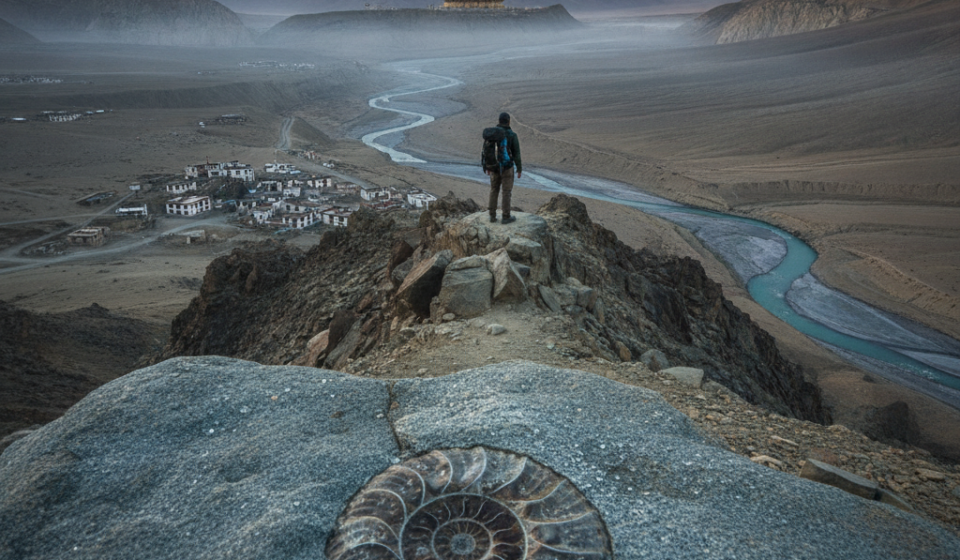
High in the cold desert of the Himalayas lies the Spiti Valley, a region that geologists often call the museum of Earth’s history. Millions of years ago, before the collision of the Indian and Eurasian tectonic plates, this entire area was the floor of the Tethys Ocean. Today, the high-altitude cliffs of Spiti are packed with Triassic and Jurassic marine fossils. For travelers who enjoy high-altitude trekking and scientific discovery, paleontology tours in india often focus on this remote valley as a premier destination.
The villages of Langza and Hikkim are particularly famous for their abundance of ammonite fossils. Locally known as “Shaligrams,” these coiled, spiral shells of extinct marine mollusks are considered sacred by some local communities. But still, they are also invaluable scientific records of Mesozoic marine life. Traveling through this high-altitude terrain requires careful preparation. For those interested in extended geological excursions, combining a trip to Spiti with a journey to nearby Leh Ladakh is an excellent option. Many of the specialized paleontology tours in india include both of these high-altitude regions to study the ocean floor thrust high into the sky.
Jaisalmer and Kutch (Jurassic Marine Treasures)
The arid expanses of Rajasthan and Gujarat were once thriving coastal ecosystems during the Jurassic period. Today, these dry terrains are treasure troves for marine paleontologists. Near the border town of Jaisalmer, the Akal Wood Fossil Park contains petrified logs that are roughly 180 million years old. These massive tree trunks are preserved in exquisite detail. They provide clear evidence of the warm, humid forests that once covered this now arid region. These sites are essential inclusions in comprehensive paleontology tours in india.
In the neighboring state of Gujarat, the Kutch region offers a different paleontological experience. The sedimentary rocks of Kutch are packed with fossilized bivalves, gastropods, and ancient marine reptiles. Geologists have found fossilized remains of ichthyosaurs and plesiosaurs in these dry salt flats. These coastal deposits are among the most accessible fossil parks in India. They allow visitors to study the transition from terrestrial forests to deep marine environments over a span of millions of years. This incredible geological shift explains why paleontology tours in india are highly valued by stratigraphers.
Wadadham Fossil Park, Maharashtra (The Sironcha Dinosaur Site)
Tucked away in the Gadchiroli district of Maharashtra, Wadadham Fossil Park is a hidden gem for dinosaur enthusiasts. This site is particularly famous for its Lower Jurassic sauropod fossils. Geologists working in this remote area have excavated massive fossilized bones belonging to some of the earliest giant dinosaurs. The park is unique because it features an in-situ display of dinosaur fossils in India, allowing visitors to see the bones exactly as they were found in the rock layers.
At Wadadham, geologists excavated sauropod bones dating back roughly 150 million years [Journal of Paleontological Society of India, 2012] from the local sandstone formations. The site also contains a well-preserved petrified forest, with large tree trunks lying flat on the ancient riverbed. For travelers who want to get off the beaten path, Wadadham offers an authentic field experience that is far removed from typical tourist crowds. It is a highly specialized destination, and including it in paleontology tours in india allows travelers to experience raw, unedited prehistoric science.
Key Prehistoric Discoveries in the Indian Subcontinent
The fossils found across India have played a crucial role in shaping our understanding of global prehistory. Because the Indian landmass was isolated for so long, it developed a highly endemic fauna. When planning paleontology tours in india, understanding these key discoveries helps travelers appreciate the scientific value of the sites they are visiting.
| Dinosaur / Reptile Species | Geological Era | Estimated Size | Key Defining Characteristics | Primary Discovery Location |
|---|---|---|---|---|
| Rajasaurus narmadensis | Late Cretaceous (~67 million years ago) | ~9 meters in length | Distinctive bony crown-like head crest; apex predator | Narmada Valley, Gujarat/Madhya Pradesh |
| Barapasaurus tagorei | Early Jurassic (~190 million years ago) | ~18 meters in length | One of the earliest large sauropods; highly complete skeleton | Pranhita-Godavari Basin, Southern India |
| Shringasaurus indicus | Middle Triassic (~240 million years ago) | ~3-4 meters in length | Bizarre horned herbivorous reptile; dual forward-curving skull horns | Denwa Formation, Madhya Pradesh |
Rajasaurus narmadensis: The Princely Lizard of Narmada
The most famous of all Indian dinosaurs is undoubtedly Rajasaurus narmadensis. This predatory theropod lived during the Late Cretaceous period, roughly 67 million years ago. It was a medium-sized carnivore, measuring about 9 meters in length, and was characterized by a distinctive bony crest on its head. Researchers in 1983 [Geological Survey of India, 1983] uncovered fossilized bones in the Narmada Valley, leading to the identification of this unique species.
The name Rajasaurus translates to “princely lizard,” a reference to the crown-like crest on its skull. This dinosaur was an apex predator, hunting the large sauropods that roamed the river valleys of Central India. Its discovery was highly significant because it showed close evolutionary links to abelisaurids found in Madagascar. For travelers on paleontology tours in india, visiting the Narmada Valley offers a chance to stand in the hunting grounds of this ancient predator.
Barapasaurus tagorei: The Giant of the Lower Jurassic
Going further back in time, Barapasaurus tagorei is one of the earliest known large sauropods. This massive herbivore lived during the Early Jurassic period, roughly 190 million years ago. It measured about 18 meters in length and weighed several tonnes. The fossilized remains of Barapasaurus were discovered in the Pranhita-Godavari basin of southern India in the early 1960s, a region frequently highlighted during specialized paleontology tours in india.
The name Barapasaurus is a blend of the local Bengali word “bara” (meaning big) and the Greek “saurus” (meaning lizard). The species name, tagorei, was chosen to honor the famous Indian poet Rabindranath Tagore. This dinosaur is highly important to science because its skeleton is remarkably complete. It has provided valuable information about the transition of sauropods from smaller ancestors to the giant long-necked herbivores. Discovering these fossils is a major milestone for any geological tours India.
Shringasaurus indicus: The Horned Reptile of Madhya Pradesh
Not all prehistoric giants in India were dinosaurs. Shringasaurus indicus was a bizarre, horned, herbivorous reptile that lived during the Middle Triassic period, roughly 240 million years ago. Discovered in the Denwa Formation of Madhya Pradesh, this creature had a pair of large, forward-curving horns on its skull, resembling those of a modern bull. This feature is highly unusual for a prehistoric reptile of that era.
The discovery of Shringasaurus revolutionized our understanding of Triassic ecosystems. The horns were likely used for combat or display, suggesting complex social behaviors much earlier than previously thought. This herbivore coexisted with large predatory amphibians in a lush, river-dominated environment. For anyone participating in paleontology tours in india, learning about creatures like Shringasaurus highlights the incredible diversity of life that existed before the age of the dinosaurs.
What to Expect on a Paleontology Tour
A specialized geological tour is very different from a standard sightseeing holiday. It requires a different mindset and a willingness to engage with the natural environment. These journeys are designed to be immersive, explaining why paleontology tours in india provide a deeper understanding of the earth sciences while ensuring comfort. Travelers on paleontology tours in india can expect a mix of physical activity, academic learning, and outdoor exploration.
Field Guiding and Geological Context
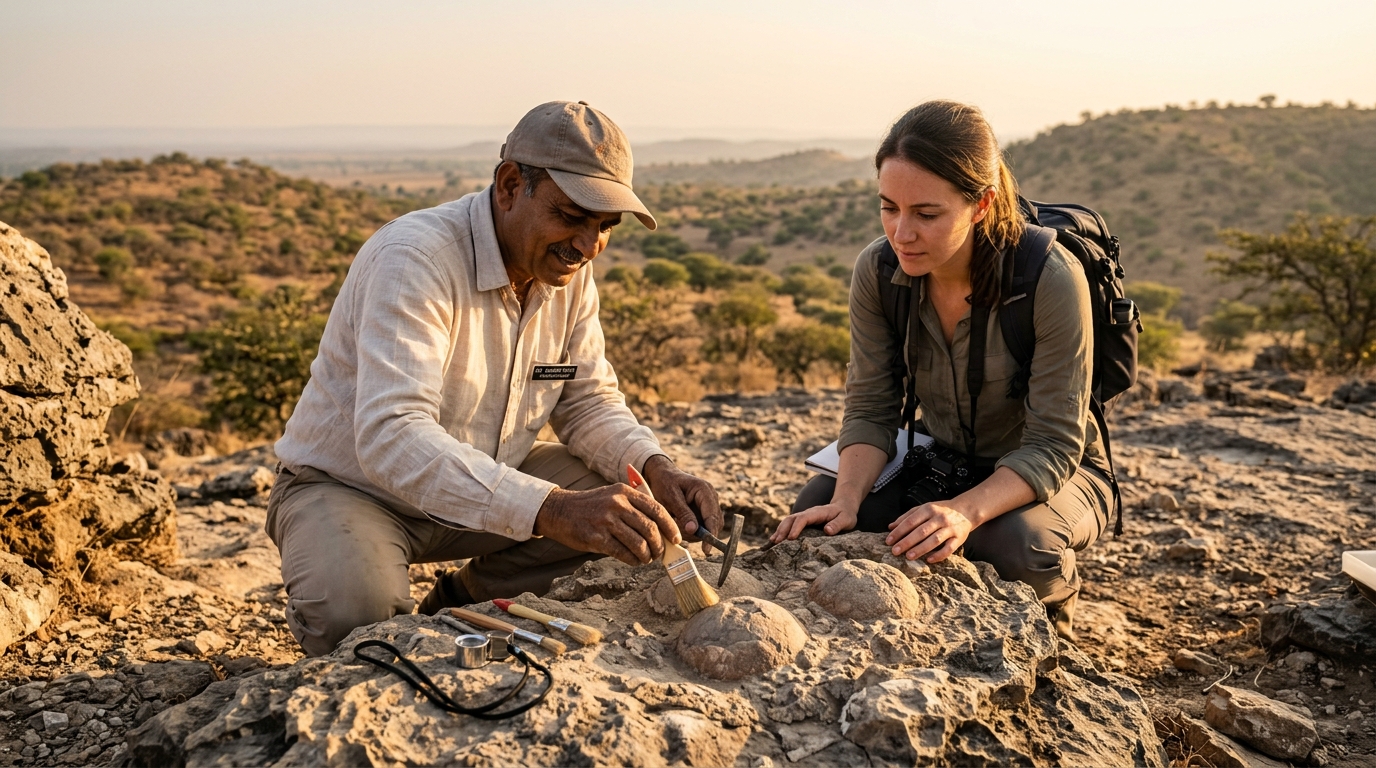
The success of any paleontological excursion depends heavily on the quality of the field guides. Unlike standard tour guides, geological guides are often trained scientists or academic researchers. They do not just point out interesting formations. They explain the sedimentary layers, the mineral compositions, and the taphonomic processes that preserved the fossils. This expert guidance is what transforms a simple walk in the desert into an educational adventure.
During these tours, participants learn how to use basic geological tools, such as hand lenses and rock hammers (though actual excavation is strictly regulated). Guides teach travelers how to identify fossilized wood, marine shells, and bone fragments in the field. This hands-on experience is incredibly rewarding, allowing participants to make their own discoveries under expert supervision. It is a key reason why paleontology tours in india are highly regarded by science enthusiasts.
Conservation and Ethical Fossil Tourism
One of the most important aspects of paleontology tours in india is the emphasis on conservation and ethics. Fossils are non-renewable scientific resources. Once they are removed from their geological context, they lose much of their scientific value. Therefore, all reputable tour operators enforce a strict “do not touch, do not take” policy during field excursions. This ensures that these precious remains are preserved for future scientific study.
Fossil parks in India face significant challenges from vandalism and illegal fossil collecting. By promoting ethical tourism, these tours help support local conservation efforts. They demonstrate to local communities that keeping fossils in the ground can generate sustainable tourism revenue. This economic incentive is crucial for protecting remote sites that lack government security. Participating in these structured tours allows travelers to contribute directly to the preservation of India’s prehistoric heritage.
Planning Your Paleontology Expedition in India
Organizing a trip to remote geological sites requires careful planning and coordination. Many of the best fossil localities are located in rural areas with limited infrastructure. To ensure a safe and comfortable trip, travelers need to plan their logistics well in advance. From choosing the right season to packing the correct gear, every detail matters when setting out on paleontology tours in india.
Best Time to Visit and Seasonal Mapping
India’s diverse climate means that the best time to visit fossil sites varies by region. For the desert sites of Gujarat and Rajasthan, the winter months from October to March are ideal. During this time, the weather is pleasant, and temperatures are comfortable for outdoor fieldwork. Conversely, visiting these arid regions in the summer can be challenging due to extreme heat. For the high-altitude sites in Spiti Valley, the travel window is much shorter. These mountain passes are only accessible during the summer months, from June to September. Planning your paleontology tours in india around these seasonal variations is crucial.
Essential Gear and Travel Logistics
Packing the right gear is essential for any field excursion. Travelers should focus on practical, durable clothing that can withstand rough outdoor conditions. Here is a quick checklist of essential gear for geological field excursions:
- Sturdy hiking boots with deep tread
- Hand magnifying lens (10x magnification)
- Polarized sunglasses and wide-brimmed hat
- Field notebook with waterproof paper
- Refillable water container and high-energy snacks
Sturdy hiking boots with good ankle support are a must, as much of the walking is done on loose gravel and rocky slopes. Sun protection, including wide-brimmed hats, polarized sunglasses, and high-SPF sunscreen, is also critical for long days in the sun. Since many of these sites are in remote areas, carrying a basic first-aid kit and ample water is essential. Specialized operators managing paleontology tours in india typically provide these safety essentials, but having your own gear ensures maximum comfort during your geological fieldwork.
Comparative Analysis of Fossil Sites in India
To help travelers choose the best destination for their interests, we have compiled a detailed comparison of the premier fossil sites in the country. This analysis highlights the geological age, primary fossils found, and travel accessibility of each location. It provides a quick reference guide for anyone planning paleontology tours in india.
| Fossil Site & Location | Geological Age | Primary Fossil Types | Accessibility & Nearest Hub | Ideal Visiting Months |
|---|---|---|---|---|
| Balasinor (Gujarat) | Late Cretaceous (67-65 million years) | Dinosaur eggs, sauropod bones, theropod remains | Easy; 90 km from Ahmedabad | October to March |
| Spiti Valley (Himachal Pradesh) | Triassic to Jurassic (240-150 million years) | Ammonites (Shaligrams), marine bivalves | Challenging; 12 hours from Manali | June to September |
| Akal Wood Fossil Park (Rajasthan) | Early Jurassic (180 million years) | Petrified wood, fossilized tree trunks | Easy; 17 km from Jaisalmer | October to March |
| Wadadham (Maharashtra) | Lower Jurassic (150 million years) | Sauropod dinosaur bones, petrified forests | Moderate; 150 km from Nagpur | November to February |
| Kutch Basin (Gujarat) | Mesozoic (200-100 million years) | Marine reptiles, belemnites, corals | Moderate; 60 km from Bhuj | October to March |
This table illustrates the incredible temporal span covered by various fossil parks in India. From the ancient marine life of the Triassic to the massive dinosaurs of the Cretaceous, the country offers a complete chronological record of earth history. Incorporating these varied destinations into your paleontology tours in india ensures a comprehensive understanding of the subcontinent’s geological journey.
Conclusion
India’s geological record offers an extraordinary window into deep time. The unique tectonic journey of the subcontinent has created a rich fossil heritage that is of global scientific importance. From the dinosaur nesting grounds of Gujarat to the high-altitude marine beds of the Himalayas, these sites provide a fascinating field for exploration. Participating in structured paleontology tours in india is the best way to experience these prehistoric wonders safely and ethically. By choosing expert-led excursions, travelers can engage with the science of paleontology while supporting the preservation of these critical sites. Whether you are a lifelong science enthusiast or a curious traveler looking for a unique adventure, these tours promise an unforgettable journey into the ancient past of our planet.