


Preparing for air travel with an infant can feel like managing a complex logistical operation. (While seasoned travelers understand standard boarding procedures, flying with a newborn introduces unique administrative challenges.) Airport security gates require rigorous identification checks, and even a minor administrative oversight can lead to a denied flight. This comprehensive guide outlines the documents required for infant air travel in India to ensure a seamless journey. It is basically a matter of organizing your travel portfolio well before reaching the terminal gates. Understanding the specific policies enforced by Indian civil aviation authorities helps families move efficiently through security checkpoints and boarding processes.
While some parents assume that infants do not require formal documentation for domestic travel, this is a risky misconception. In reality, airport security personnel and airline representatives must verify every passenger’s age and identity. Securing the necessary paperwork early protects your travel itinerary from sudden disruptions. This article provides a comprehensive overview of the rules, requirements, and expert recommendations for a stress-free flying experience.
Key Takeaways
- Age Definition: An infant is classified as a child who has not yet reached their second birthday on the date of travel.
- Primary ID: A valid birth certificate (original or DigiLocker) or passport is mandatory for domestic travel.
- International Requirements: Infants must have their own individual passport, valid visa/ETA, and a No-Objection Certificate (NOC) if traveling with one parent.
- Medical Clearances: Babies under 7 days are generally not permitted to fly; infants between 7 and 14 days require a pediatrician’s fitness certificate.
Understanding Infant Classification for Indian Aviation
In India, civil aviation authorities define an infant as a child who has not yet reached their second birthday on the date of travel. Knowing this definition is critical because it dictates the ticketing rules and the specific documents required for infant air travel in India. If a child turns two during the journey, airlines require a separate seat booking for the return leg. (This is a common ticketing trap that caught many families off guard last year.) Passengers must declare the exact age of the infant during the booking process to avoid discrepancies at the airport gate.
Age Definitions and Airline Thresholds
Indian airlines follow precise age limits for young passengers. An infant must be at least seven days old to fly under normal medical circumstances. For babies younger than seven days, airlines require special medical clearance. When booking, parents must understand that an infant ticket does not guarantee a separate seat. Instead, the baby must travel on the lap of an adult passenger. Because lap travel is the norm, the documents required for infant air travel in India must be presented to verify that the child is indeed under two years of age.
Every domestic airline in India enforces these thresholds strictly during check-in. The staff will cross-reference the passenger list with the physical proof of age. This makes the documents required for infant air travel in India the most critical component of your pre-flight preparation. (Even a discrepancy of a single day can result in the airline charging a full adult fare at the counter.)
| Age Category | Seat Requirement | Average Fare Structure |
|---|---|---|
| Under 7 Days | Lap travel with medical certificate | Standard infant fee |
| 7 Days to Under 2 Years | Lap travel or separate seat | Roughly 10% of adult basic fare |
| 2 Years and Above | Mandatory individual seat | Full child or adult fare |
While parents have the option to buy a separate seat for an infant, doing so requires an approved car seat or aviation restraint system. Most parents prefer lap travel because it is more economical. However, this choice means you must be ready to carry the baby on your lap for the entire flight duration. Airline staff will check your booking reference to ensure the infant is properly registered on the Passenger Name Record (the PNR acronym used by travel agents). If the infant is not listed on the PNR, you will be stopped at the boarding gate. This explains why verifying your ticketing details against your age proof is an essential step before departure.
Bassinet Seat Allocations and Policies
For long-haul domestic flights or international sectors departing from India, parents can request a bassinet seat. Bassinets are small, detachable cots that attach to the bulkhead wall of the aircraft. Airlines have strict weight and height limits for bassinet usage, usually restricting them to infants weighing under 11 kilograms. Because bulkhead seats are limited, parents must reserve these bassinets well in advance of their travel date.
To secure a bassinet, presenting the documents required for infant air travel in India is mandatory during check-in to prove the baby fits the age criteria. Most carriers will not allocate these specialized seats without verified age proof. (It is always wise to double-check the airline’s specific bassinet dimensions during booking.) Having the documents required for infant air travel in India ready ensures that ground agents can process the request without delaying other passengers.
Additionally, airlines enforce strict safety rules during turbulence. Even if your baby is asleep in the bassinet, you must remove them and hold them on your lap with an infant seat belt when the seatbelt sign illuminates. This policy can be frustrating for tired parents, but aviation safety is non-negotiable. Knowing these operational guidelines before boarding helps you mentally prepare for the journey.
Mandatory Identity and Age Proof Documents
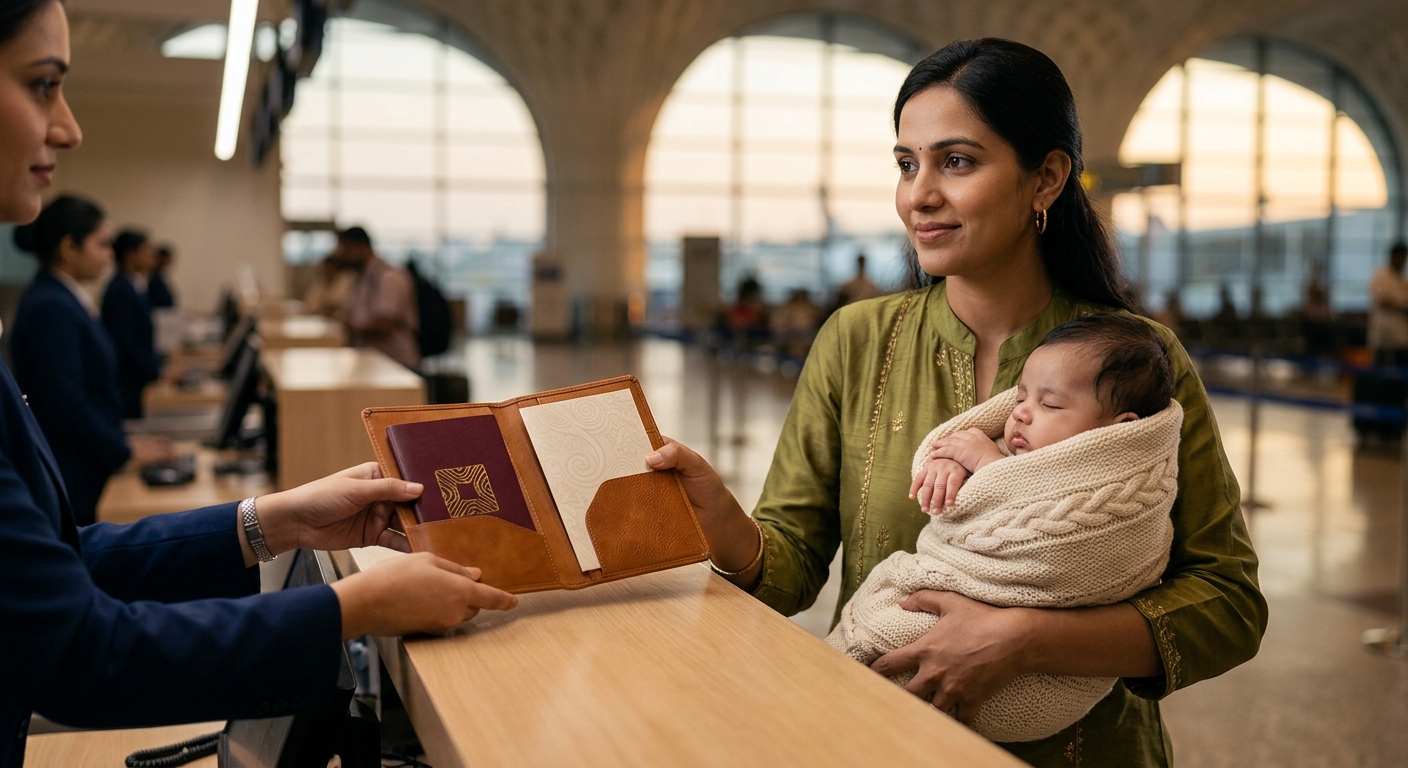
When traveling within India, the primary focus of security personnel is verifying the identity and age of the infant. The Bureau of Civil Aviation Security (BCAS) mandates that every passenger, regardless of age, must have a valid form of identification. For parents, compiling the documents required for infant air travel in India is the first step toward a successful boarding experience. Failing to present acceptable identification can lead to an immediate denial of entry into the terminal building.
Primary Identity Proofs for Infants
The most widely accepted primary document for an infant is a government-issued birth certificate. This document must clearly state the child’s name, date of birth, and parents’ names. Parents must carry the original birth certificate, although a clear digital copy on the DigiLocker application is also officially accepted at most Indian airports. The birth certificate serves as the definitive proof of age, which is why it is central to the documents required for infant air travel in India.
Another highly reliable primary document is a valid passport. While passports are mandatory for international travel, they are also excellent identity proofs for domestic flights. A passport contains a photograph of the infant, making identity verification much faster for Central Industrial Security Force (CISF) officers at airport entry points. When using a passport, parents must ensure that it is valid and has not expired, as expired passports are not accepted. The passport remains one of the safest documents required for infant air travel in India to carry, as it eliminates any doubts regarding identity or age.
Alternative Supporting Documents
In situations where the original birth certificate is unavailable, parents must provide alternative supporting papers. These papers must still carry the official seal of a recognized authority. These alternative papers are part of the critical documents required for infant air travel in India when primary identity proofs are undergoing renewal or are misplaced.
When primary documents are unavailable, parents can present the following alternative supporting credentials:
- Immunization Card: A hospital-issued vaccination card listing the baby’s name and exact date of birth (acceptance is subject to airline discretion).
- Hospital Discharge Summary: The official medical discharge summary issued to the mother and newborn at the time of birth.
- Municipal Birth Registration Slip: A birth registration slip issued by local municipal authorities, which should ideally be carried alongside the mother’s hospital discharge details to establish maternal relationship.
- Adoption Deed and Court Order: For adopted infants, legal documents establishing formal guardianship are strictly required by airport security and airline ground staff.
Documents for International Air Travel with an Infant from India
International travel with an infant requires a much more rigorous documentation process than domestic flying. Foreign immigration authorities and international carriers enforce strict safety and legal protocols to prevent child trafficking and unauthorized child transport. Consequently, the documents required for infant air travel in India for international flights involve multiple government agencies. Parents must allow ample time to secure these papers before booking any international holiday packages, such as those to Singapore or Switzerland. For international travel, you can check our visa services to understand the entry requirements for your destination.
When crossing international borders, airport staff must confirm that the infant is traveling with the explicit consent of their legal guardians. Any missing or inconsistent paperwork can lead to immediate detention and questioning by immigration authorities. This makes international preparation far more critical than domestic trips. Parents must ensure every stamp, signature, and visa page is perfectly in order.
Passport and Visa Requirements
Every infant traveling internationally must have their own individual passport. Indian passport authorities do not allow children to be endorsed on their parents’ passports. The infant’s passport must have at least six months of validity remaining from the date of arrival at the destination. This passport is the single most critical document among the documents required for infant air travel in India for cross-border journeys.
Before booking international travel, ensure you have arranged the following essential legal requirements for your baby:
- Individual Passport: A valid passport issued solely in the name of the infant, with at least 6 months of validity remaining from the date of entry.
- Valid Visa or ETA: A separate visa stamped in the passport or an Electronic Travel Authorization approval document linked to the child’s passport.
- Travel Insurance Cover: A comprehensive insurance policy covering international pediatric emergencies. You can explore and purchase travel insurance policies before your departure.
- Current Passport Photograph: Verify that the photo matches the baby’s current appearance. If the infant looks drastically different from their newborn passport photo, consider updating it.
| Document Category | Domestic Air Travel Requirements | International Air Travel Requirements |
|---|---|---|
| Primary Identification | Birth Certificate (Original or DigiLocker) or Passport | Individual Valid Passport (minimum 6 months validity) |
| Visa / Entry Permits | Not applicable | Individual Visa, e-Visa, or ETA for destination country |
| Parental Consent / NOC | Not required if traveling with either parent | Notarized NOC required if traveling with only one parent or guardian |
| Medical & Vaccine Records | Medical certificate required only for babies under 14 days | International vaccination certificates (e.g., Yellow Fever) as mandated |
No-Objection Certificates and Guardianship Proofs
When an infant travels with only one parent or with a legal guardian, additional legal authorizations are necessary. Immigration officers at Indian departure ports frequently request a No-Objection Certificate (NOC) signed by the non-traveling parent. This certificate must be notarized and accompanied by a copy of the non-traveling parent’s signed passport or government ID. This legal paper is a vital part of the documents required for infant air travel in India to prevent custody disputes and cross-border parental abductions.
If the infant is traveling with relatives or family friends, a formal authorization letter signed by both parents is required. This letter must outline the details of the flight, the destination, and the duration of the stay. (It must also state that the traveling adult has full authority to make medical decisions for the child.) These guardianship proofs form a protective shield for the minor and are scrutinized closely by border control agents. Ensuring these notarized letters are included in the documents required for infant air travel in India is essential for avoiding legal complications at the airport.
In cases where one parent has sole legal custody of the infant, the traveling parent must carry the official custody agreement or court ruling. This document must clearly state that the traveling parent has unilateral authority to travel internationally with the child. If the other parent is deceased, a certified copy of the death certificate is required. Having these sensitive papers organized ensures that immigration officers can verify your status quickly and allow you to proceed to your boarding gate.
Medical Clearances and Special Health Documents
Air travel introduces unique physiological stressors for infants, such as rapid changes in cabin pressure and dry air. Because of these factors, airport authorities and airline medical teams often require health-related certifications for very young or vulnerable infants. Knowing when a medical clearance is necessary is an important part of compiling the documents required for infant air travel in India. Parents should consult their pediatrician well in advance of the travel date to obtain any necessary medical forms.
Medical protocols vary slightly between domestic airlines, but the underlying safety concerns remain identical. The sudden change in barometric pressure during takeoff and landing can cause discomfort or pain in an infant’s ears. (Feeding the baby during these times helps relieve the pressure, though carrying a pacifier is also effective.) Let us review the specific medical papers you must carry to comply with aviation health guidelines.
Flying with Newborns Under Two Weeks Old
Most commercial airlines in India do not permit newborns under seven days of age to fly. For infants between seven and fourteen days old, airlines typically require a formal medical clearance certificate. This certificate must be signed by a registered pediatrician, confirming that the baby is clinically fit to undertake air travel. This medical certificate is a compulsory component of the documents required for infant air travel in India for families traveling with very young babies.
The medical certificate must specify that the infant does not have any respiratory distress or cardiovascular vulnerabilities. (The low oxygen levels in a pressurized cabin can be challenging for underdeveloped neonatal lungs.) During check-in, the airline’s duty manager will review the certificate to ensure it is dated within a specific window, usually within 48 to 72 hours of the flight departure. Carrying this pediatric clearance alongside the documents required for infant air travel in India is a mandatory safety protocol that cannot be bypassed.
In some situations, if the mother has had a complicated delivery or a Cesarean section, she may also require a separate medical clearance from her obstetrician. Airlines must ensure that both the mother and the newborn are healthy enough to fly. (This is particularly true for long flights where access to medical facilities is limited.) Having both medical certificates prepared avoids any check-in friction.
Vaccination Records and Medical Certificates
For domestic travel, a vaccination card is generally not required for boarding, but it is highly recommended to carry one as a backup. However, for international destinations, specific vaccination records are legally mandated. For instance, travel to certain African or South American nations requires proof of Yellow Fever or Polio vaccination, even for young infants. These vaccination records must be officially certified and included with the documents required for infant air travel in India.
Additionally, if an infant requires specialized medical equipment on board, such as a portable oxygen concentrator or a pediatric nebulizer, the airline requires a detailed medical prescription. This prescription must explain the medical necessity of the device and state that it is safe for aircraft use. The airline’s engineering and medical teams must approve this equipment before departure. These clinical documents must be filed together with the documents required for infant air travel in India to prevent security staff from confiscating the equipment during baggage screening.
Parents must also check if their destination has any specific health declarations or quarantine requirements. Some countries require online submission of health forms prior to arrival. Printing the receipt of these submissions is a wise choice. It ensures you have physical proof if digital systems are offline.
Step-by-Step Document Checklist for Airport Check-In
To ensure a stress-free experience, parents should follow a structured approach to managing their paperwork. The boarding process involves multiple touchpoints, from the initial airport entry gate to the check-in desk, security screening, and finally the boarding gate. At each stage, specific papers will be examined by different authorities. Understanding how to organize and present the documents required for infant air travel in India will save time and prevent last-minute panic.
Being systematic also helps you stay calm under pressure. Airports are busy environments, and navigating them while carrying a baby, a diaper bag, and a stroller requires focus. By setting up a step-by-step document check, you can avoid the classic panic of searching through bags at the front of a long queue.
Pre-Departure Document Bundling
Experienced travelers know that loose papers are easily lost in a crowded terminal. The best practice is to compile all the documents required for infant air travel in India into a single, water-resistant folder or travel organizer. This folder should contain the physical originals, clear photocopies, and any required medical certificates. (It is also wise to save high-resolution digital scans of these documents on a secure cloud drive or your smartphone.)
Having the documents required for infant air travel in India arranged in this manner allows parents to retrieve the necessary papers quickly while managing strollers and infant baggage. This simple preparation step reduces anxiety and demonstrates to airline staff that you are a well-prepared traveler.
- Original government-issued birth certificate of the infant.
- Valid infant passport with at least six months of validity remaining.
- Printed copies of the infant’s e-ticket showing the lap-held status.
- Approved pediatric medical fitness certificate for babies under two weeks.
- Notarized No-Objection Certificate if traveling with one parent.
- Digital copies of all identity proofs uploaded to DigiLocker.
- Verified vaccination card or international health certificate where applicable.
Security Screening and Boarding Gate Verification
At the security checkpoint, CISF personnel will verify the infant’s identity against the boarding pass. Parents must be ready to present the physical birth certificate or passport along with the infant’s boarding document. Security officers need to ensure that the infant matches the description and details listed on the documents required for infant air travel in India. (This process is quick but requires the parents’ full attention.)
Once you pass security, the final verification occurs at the boarding gate. The airline boarding agent will scan the boarding passes and perform a visual check of the infant. They may ask to see the age proof again to confirm that the infant is still under the lap-travel age limit. Having the documents required for infant air travel in India easily accessible in your hand luggage prevents boarding delays for your family and the passengers behind you. Proper organization ensures that your journey begins on a positive and organized note.