
Understanding Airline Baggage Limits for a 3-Night Trip
Planning a packing list for 3 night trip requires working around strict airline limits. A 3-night long weekend typically covers four travel days: your arrival day, two full days of sightseeing or relaxation, and your departure day. While four days of travel sounds manageable, fitting everything into carry-on luggage requires careful planning on Indian airlines.
Most Western packing guides suggest carrying 10-kilogram cabin bags, heavy winter coats, or bulky outfit rotations. However, Indian domestic budget carriers like IndiGo, Akasa Air, SpiceJet, and Air India Express strictly enforce a 7 kg cabin baggage limit (maximum dimensions of 55 cm x 35 cm x 25 cm) plus a 3 kg personal item allowance meant to fit under the seat in front of you. Full-service carriers like Air India permit 7 kg in the cabin alongside their 15 kg checked bag allowance, but relying solely on carry-on luggage speeds up your arrival and departure at busy airports.
Airline gate agents regularly enforce these weight restrictions using digital scales and metal sizers before boarding. If your bag exceeds 7 kg on IndiGo or Akasa Air—even by just 300 to 500 grams—you risk paying excess baggage fees of roughly ₹700 per kilogram or a gate-check fee between ₹1,500 and ₹2,000 to send your bag to the cargo hold. SpiceJet occasionally combines personal items into the overall 7 kg ceiling at strict stations, so aiming for a total weight of 6.5 kg keeps you safe across all carriers.
The biggest challenge to staying under 7 kg is often the bag itself. A standard hard-shell trolley case uses up nearly half your allowed weight before you pack a single shirt. Choosing the right bag structure makes a significant difference:
| Gear Type | Empty Bag Weight | Usable Capacity Left (for 7 kg Limit) | Recommendation |
|---|---|---|---|
| Standard Polycarbonate Hard Trolley | 3.2 kg – 3.5 kg | 3.5 kg – 3.8 kg | Risky. Leaves minimal space for clothing and secondary shoes. |
| Ultra-Light Polypropylene (PP) Trolley | 2.3 kg – 2.5 kg | 4.5 kg – 4.7 kg | Good. Recovers over 1 kg of usable packing space. |
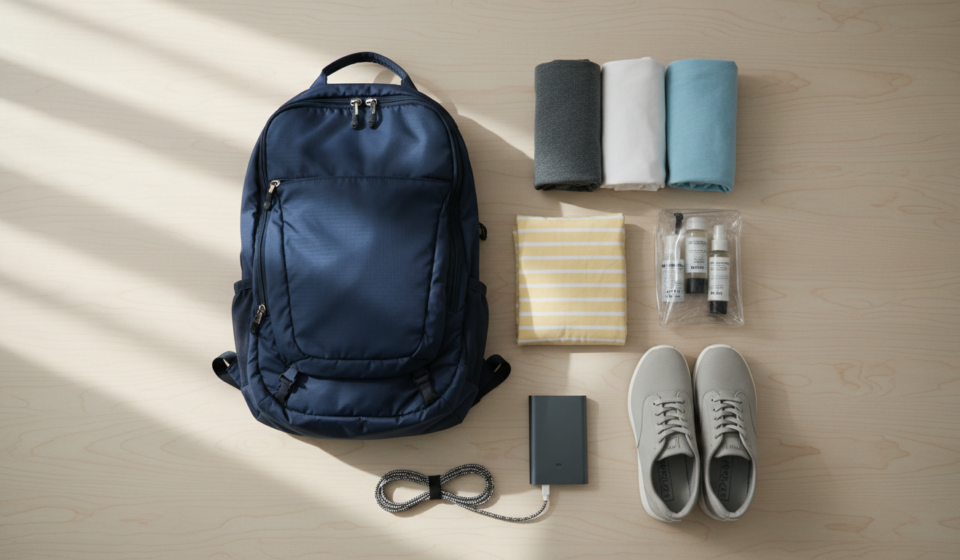
| Travel Backpack (25L–30L) | 0.9 kg – 1.2 kg | 5.8 kg – 6.1 kg | Best Choice. Maximizes usable packing capacity for cabin travel. |
To maximize space, use the Personal Item Leverage Strategy. Use your separate 3 kg personal item allowance—such as a small laptop backpack, handbag, or crossbody tote—to carry your heaviest dense items. Put your laptop or tablet, chargers, power bank, wallet, medication, and liquid ziplock pouch into your personal item. This leaves the full 7 kg weight allowance in your primary bag for clothes and shoes.
BCAS & CISF Flight Security Rules: What Belongs Where
Airport security screeners managed by the Bureau of Civil Aviation Security (BCAS) and the Central Industrial Security Force (CISF) strictly enforce cabin luggage rules. Knowing what to pack in your hand luggage prevents delays or discarded items at security checkpoints.
The rules for Liquids, Aerosols, and Gels (LAGs) are strictly applied across all Indian airports:
- 100 ml Container Ceiling: Every liquid, gel, lotion, or paste container in your hand luggage must be 100 ml or less. Containers larger than 100 ml—even if they are half-empty—will be confiscated.
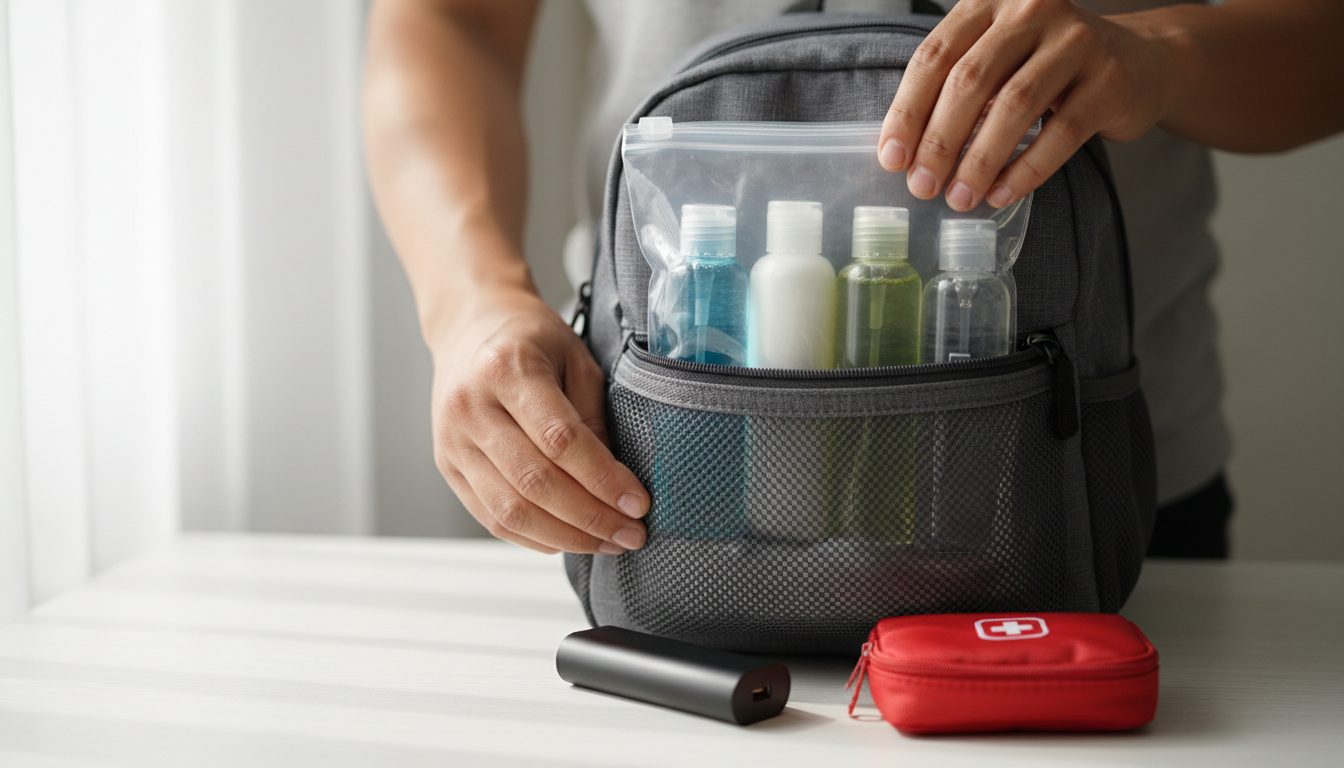
- 1-Litre Clear Bag: All 100 ml containers must fit comfortably inside a single transparent, resealable 1-litre plastic bag for security scanning.
- Prohibited Household Food Items: Homemade pickles (achaar), liquid ghee, homemade chutneys, liquid coconut oil, and full-sized perfume bottles cannot go in carry-on luggage. CISF screeners classify pastes and oils as liquids, regardless of their consistency. If you are a first-time flyer in India, keeping liquids clearly organized prevents unnecessary delays at security.
Power banks and spare lithium-ion batteries require careful handling under aviation safety guidelines. Per official regulations, power banks must be carried in your cabin luggage or personal item ONLY. Placing a power bank in checked luggage will result in security holding your bag, making offloading announcements, or removing the item. Power banks must stay under 100 Watt-hours (Wh). A standard 10,000 mAh to 20,000 mAh power bank operates between 37 Wh and 74 Wh, which fully complies with BCAS rules. For complete details on ratings and battery rules, consult our guide on rules for carrying a power bank on flights in India.
Finally, double-check your bag for prohibited items before leaving home. Sharp objects like nail clippers with fold-out blades, pocket knives, and scissors are not allowed in cabin luggage. Lighters and matchboxes are restricted, and whole dry coconuts (gola) are prohibited in cabin bags on domestic flights due to their flammability risk during security scans.
The Capsule Wardrobe: Packing List for a 3-Night Trip
Building a minimalist capsule wardrobe helps you pack light for a 3-night trip without running out of clothes. The core concept uses versatile, lightweight garments that mix and match easily, allowing you to wear one outfit during transit and pack 15 items in your main bag.
1. Worn on Travel Day (Transit Outfit)
Wear your heaviest and bulkiest items on the flight to save weight and space in your luggage:
- Comfortable stretch trousers, chinos, or dark denim jeans.
- A breathable cotton T-shirt or lightweight linen shirt.
- A versatile outer layer, such as an overshirt, denim jacket, or soft cardigan (helps stay warm in air-conditioned aircraft and airport terminals).
- Your heaviest pair of shoes, such as walking sneakers or trainers.
2. Packed in Main Bag (15 Items Total)
- 4 Tops / Kurtas: 2 casual T-shirts or tops, 1 smart-casual collared shirt, and 1 breathable cotton kurta.
- 3 Bottoms: 1 pair of tailored linen trousers, 1 pair of lightweight shorts or a skirt, and 1 comfortable pyjama bottom.
- 1 Extra Pair of Footwear: Slip-on flats, lightweight leather-free sandals, or slides stored in a fabric shoe bag.
- 1 Multi-Purpose Layer / Stole: A cotton stole, dupatta, or lightweight pashmina. This works as a wrap for chilly evenings, a plane blanket, or a head and shoulder cover for temple visits.
- 4 Sets of Undergarments & Socks: Quick-dry synthetic or lightweight cotton fabrics that can be rinsed in a hotel sink if needed.
- 1 Nightwear Top: A light cotton shirt or T-shirt to pair with your pyjama bottom.
To keep your clothes organized, roll casual T-shirts and trousers tightly to reduce wrinkles and save space. Fold delicate items like silk sarees or structured kurtas neatly, layer them with tissue paper to prevent creasing, and place them at the top of your bag.
Destination-Specific Add-Ons for Your Packing List for a 3-Night Trip
Different destinations require specific additions to your standard 3-night packing list. Here is how to adjust your pack based on your trip destination:
A. Heritage & Temple Towns (e.g., Varanasi, Jaipur, Madurai, Hampi)
Visiting historic and religious sites requires modest dress codes and careful footwear choices:
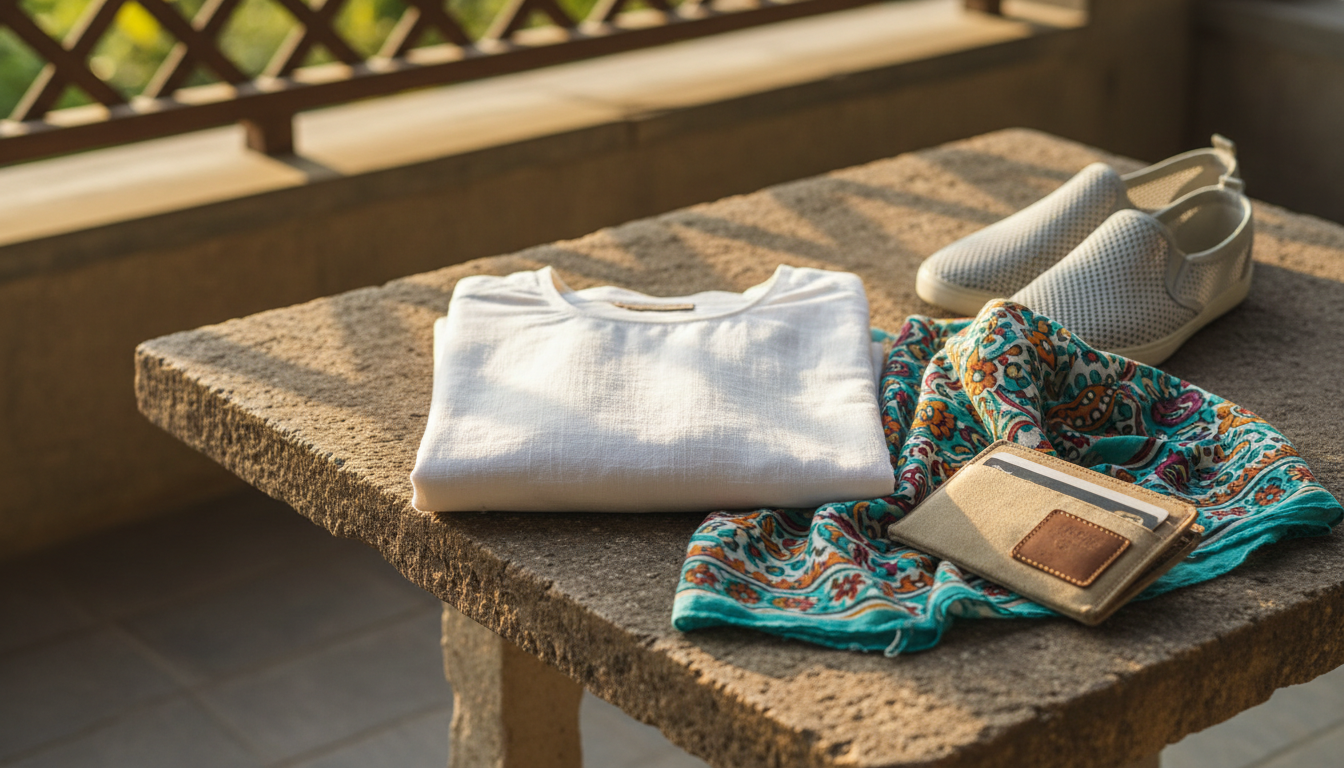
- Modest Clothing: Shoulders and knees must remain covered at major religious sites. Pack high-neck cotton kurtas, full-length salwar trousers, linen pants, or long skirts.
- Leather Restrictions: Sacred sites like the Padmanabhaswamy Temple in Thiruvananthapuram, Jagannath Puri, and major Jain temples prohibit all leather items inside the main compound. Avoid leather belts, leather wallets, and shoes with leather trim. Bring a fabric belt, a canvas wallet, and synthetic or cloth footwear instead.
- Footwear Logistics: Choose comfortable slip-on shoes or sandals without laces, as you will remove your footwear frequently outside temples. Carry a small canvas bag in your tote to store your shoes if official shoe counters are crowded.
B. Hill Stations & Nature Escapes (e.g., Shimla, Coorg, Munnar, Ooty)
Mountain environments feature changing microclimates, where sunny afternoons give way to chilly evenings:
- Warm Layer: Pack a lightweight fleece jacket or rollable windcheater. Place it at the bottom of your bag or keep it accessible in your personal item.
- Footwear: Wear sturdy sneakers or outdoor walking shoes with good traction during transit.
- Protection Essentials: Bring a tube of mosquito repellent cream (such as Odomos) and a compact umbrella or light raincoat for unexpected mountain showers.
C. Beach & Coastal Destinations (e.g., Goa, Gokarna, Pondicherry)
Coastal trips call for sun protection and quick-drying fabrics. If you are planning a coastal break, our Goa trip guide offers helpful context on regional weather and local travel choices.
- Swimwear: 2 swimsuits or swim trunks plus 1 lightweight linen beach cover-up.
- Footwear: Water-resistant flip-flops or comfortable sliders.
- Skincare & Comfort: High-SPF broad-spectrum sunscreen decanted into a 100 ml squeeze bottle, along with an anti-chafing balm for humid beach walks.
- Valuables Protection: A small waterproof dry pouch to protect your phone, room key, and cash from sand and water.
D. International Weekend Getaways (e.g., Dubai, Bangkok, Singapore, Vietnam)
Short international weekend trips require careful organization of essential travel documents. Reviewing an international travel packing list helps ensure you stay compliant with border requirements.
- Required Documentation: A passport valid for at least 6 months past your return date, printed copies of your E-Visa or Visa on Arrival confirmation, and a printed travel insurance certificate.
- Payment Methods: A forex card or an international credit card with global transactions enabled, plus a small amount of local currency cash for initial transit expenses.
- Tech Accessories: A universal international plug adapter to keep your devices charged.
Toiletries, Electronics, and the Indian First-Aid Mini
Avoid packing full-sized hygiene products or bulky electronics for a 3-night trip. Streamlining your toiletries and tech accessories saves valuable space and weight.
Smart Toiletries Setup
Switching to solid hygiene products eliminates liquid volume concerns. Consider solid shampoo bars, soap bars, and solid perfume sticks. Decant necessary liquids into reusable 100 ml travel bottles:
- Sunscreen, face wash, daily moisturizer, and hair serum (all under 100 ml).
- Travel-sized toothpaste tube and a compact toothbrush.
- A solid deodorant stick or a 50 ml roll-on spray.
The Essential First-Aid Kit
Changing environments, climate, and regional food can affect your stomach. Carry a compact pouch with these essentials:
- Hydration: 3–4 sachets of ORS or Electral to stay hydrated while sightseeing in warm weather.
- Digestive Care: Antacids (Digene, Pudin Hara, or Eno) for relief after eating rich, spicy local food, along with anti-diarrheal tablets (Loperamide) for unexpected stomach issues.
- General Relief: Paracetamol tablets for headaches or fever, adhesive bandages, and a small tube of pain-relief gel (Volini or Moov).
- Sanitation: Pocket-sized hand sanitizer, wet wipes, and a mini toilet seat sanitizer spray (such as PeeSafe) for public restrooms.
Compact Electronics
Simplify your charging setup with a single 65W GaN (Gallium Nitride) wall charger. This compact brick features multiple ports to fast-charge your laptop, smartphone, and power bank at the same time, replacing separate power adapters. Store your 10,000 mAh power bank alongside charging cables in a small padded organizer pouch inside your personal item.
5 Common Packing Mistakes to Avoid
- Packing Home-Cooked Food in Hand Luggage: CISF security agents at Indian airports treat homemade pickles, liquid ghee, and chutneys as restricted liquids. Any glass jar or container over 100 ml will be confiscated at security.
- Putting Power Banks in Checked Suitcases: Automated baggage scanners flag lithium-ion power banks in cargo holds. Placing one in checked luggage causes security delays, boarding announcements, or offloaded baggage. Keep all power banks in your carry-on bag.
- Ignoring Empty Luggage Weight: Choosing a heavy 3.8 kg luggage case leaves you with less than 3.2 kg for your clothes before reaching the 7 kg limit. Opt for an ultra-light bag to maximize usable space.
- Packing Too Many Shoes: Footwear is heavy and takes up substantial space. Limit yourself to two pairs maximum—wear your heaviest sneakers during transit and pack one light pair of sandals or flats in your bag.
- Carrying Leather Items to Strict Temples: Wearing leather belts or carrying leather wallets to temples like Jagannath Puri or Padmanabhaswamy forces you to queue at crowded storage counters before entering. Pack canvas or synthetic alternatives instead.
Frequently Asked Questions
Can I pack 3 nights of travel gear in just a 7kg cabin bag without paying extra?
Yes, you can easily stay under the limit by using a light 28-litre backpack (around 1 kg) or an ultra-light polypropylene trolley (around 2.3 kg). Pair this with your 3 kg personal item allowance for heavy electronics, chargers, and toiletries to keep your main bag well under the 7 kg cabin limit.
Does the 100ml liquid rule apply to domestic flights in India?
Yes, BCAS safety guidelines apply to all domestic and international flights departing from Indian airports. Individual liquid containers in your hand luggage must not exceed 100 ml and must fit inside a single, transparent, resealable 1-litre plastic bag.
What happens if my cabin baggage is 7.5 kg at the gate on IndiGo or Akasa?
Ground staff monitor bag weights with digital scales at the boarding gate. If your bag exceeds the weight limit, you will typically incur excess baggage charges of around ₹700 per kilogram, or a gate-check fee between ₹1,500 and ₹2,000 to move your luggage to the aircraft cargo hold.
How do I pack traditional ethnic wear without crushing it?
Roll casual cotton kurtas and pyjamas tightly to maximize space and reduce creasing. For embroidered kurtas, silk sarees, or formal ethnic wear, fold them neatly with sheets of tissue paper between the layers to cushion the fabric, then lay them flat at the top of your bag.