
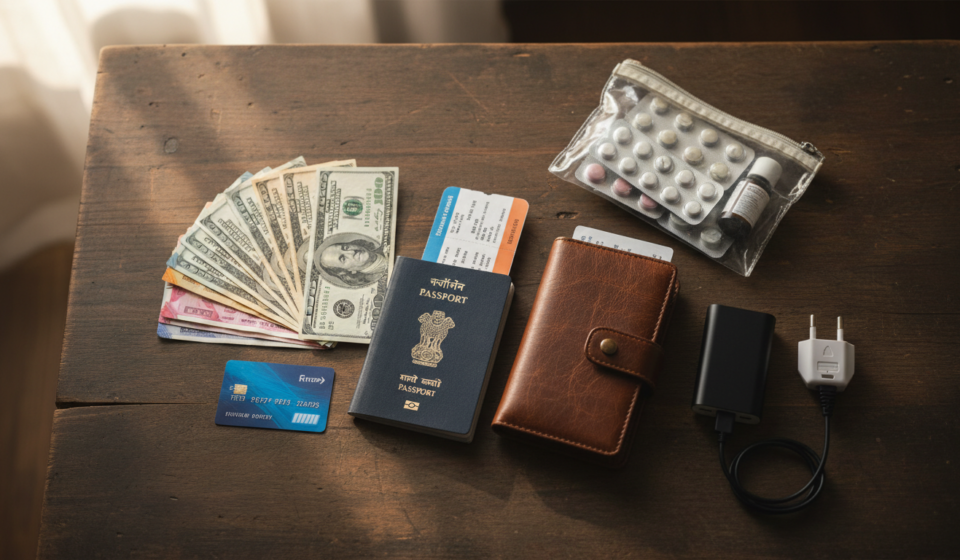

A comprehensive packing list for international travel from india must cover foreign exchange limits, strict airline security rules for power banks, country-specific medicine restrictions, and biosecurity food regulations. Packing properly prevents unexpected airport delays, confiscations, or heavy customs fines at your destination.
Essential Documents & Money Bag Checklist
Keep all vital documents, identity proofs, and financial instruments in your personal carry-on bag or neck pouch. Never store these inside your main checked baggage.
1. Documents & Identification
- Passport: Must be valid for at least 6 months beyond your scheduled return date and contain a minimum of 2 to 3 blank pages.
- Visas & Approvals: Printed copies of your eVisa, visa sticker page, or Visa-on-Arrival (VOA) confirmation vouchers. Immigration counters in destinations across Southeast Asia and the Middle East often mandate paper copies.
- Flight Tickets & Accommodation Vouchers: Hard copies of round-trip flight itineraries and hotel bookings.
- Travel Insurance Policy: Printed policy copy highlighting coverage details and emergency helpline numbers. (Note: A minimum emergency medical coverage of €30,000 is compulsory for Schengen visa holders).
- International Driving Permit (IDP): Required alongside your original Indian driving license if you plan to rent cars or two-wheelers abroad.
- Emergency Contacts Sheet: A physical list containing embassy contact details, local emergency services, doctor details, and international card-blocking hotlines.
2. Forex & Payment Setup for Indian Travellers
Relying on a single payment method while travelling abroad leaves you vulnerable to card blocks or machine reader failures. Modern travel planning calls for a 3-tier financial setup: zero-forex credit/debit cards, a loaded multi-currency forex card, and physical cash. Building this structure thoughtfully also fits naturally into setting your overall travel budget as an Indian traveler.
- Primary Card: An international credit or debit card offering zero (or low 1%) foreign transaction markup. Ensure you log into your Indian bank’s mobile app before departure to enable “International Usage” and set daily POS, tap, and ATM transaction limits.
- Backup Prepaid Forex Card: A multi-currency card pre-loaded with USD, EUR, GBP, or your destination currency to lock in conversion rates and serve as an emergency fallback.
- Foreign Currency Cash: Reserve crisp, undamaged foreign banknotes for small local purchases, street food, and tipping. Under Reserve Bank of India (RBI) regulations, Indian residents can carry up to **USD 3,000** (or its equivalent in other foreign currencies) in physical banknotes per trip for general tourism.
- Indian Currency (INR): Carry **₹2,000 to ₹5,000** in cash to pay for airport cabs, parking, or meals upon returning to India. Under Foreign Exchange Management Act (FEMA) rules, you can carry up to **₹25,000** in cash out of and back into India. (Note: Carrying INR 500 notes into Nepal and Bhutan remains strictly prohibited).
Customs Declaration Alert: If you are carrying more than USD 5,000 in physical foreign banknotes, or a cumulative total of USD 10,000 or more in combined foreign exchange (cash plus prepaid forex cards), you must submit a mandatory Currency Declaration Form (CDF) to Indian Customs upon departure.
Tax Collected at Source (TCS) Rules for Forex Spending
Under current regulations, TCS rules apply differently depending on how you spend money abroad:
- Multi-Currency Forex & Debit Cards: **0% TCS** on foreign exchange spent up to **₹10 Lakhs** per individual per financial year under the Liberalised Remittance Scheme (LRS). A **20% TCS** applies on cumulative LRS amounts exceeding ₹10 Lakhs in a financial year.
- Overseas Tour Packages: Booking through tour operators incurs a flat **2% TCS** rate with no lower exemption threshold.
- International Credit Cards: Spending abroad on international credit cards is deferred from LRS TCS tracking rules.
Note: TCS is an advance tax collected by the government. It is reflected in your Form 26AS/AIS and is fully refundable or adjustable against your final tax liability when filing your annual Income Tax Return (ITR).
Electronics & Flight Safety Guidelines
Aviation security agencies, including India’s Bureau of Civil Aviation Security (BCAS) and international airport authorities, maintain strict regulations regarding power banks, liquid containers, and high-wattage electronics.
Power Bank & Battery Regulations
The single most common airport security mistake Indian travellers make is packing lithium-ion power banks or spare camera batteries in their main checked luggage.
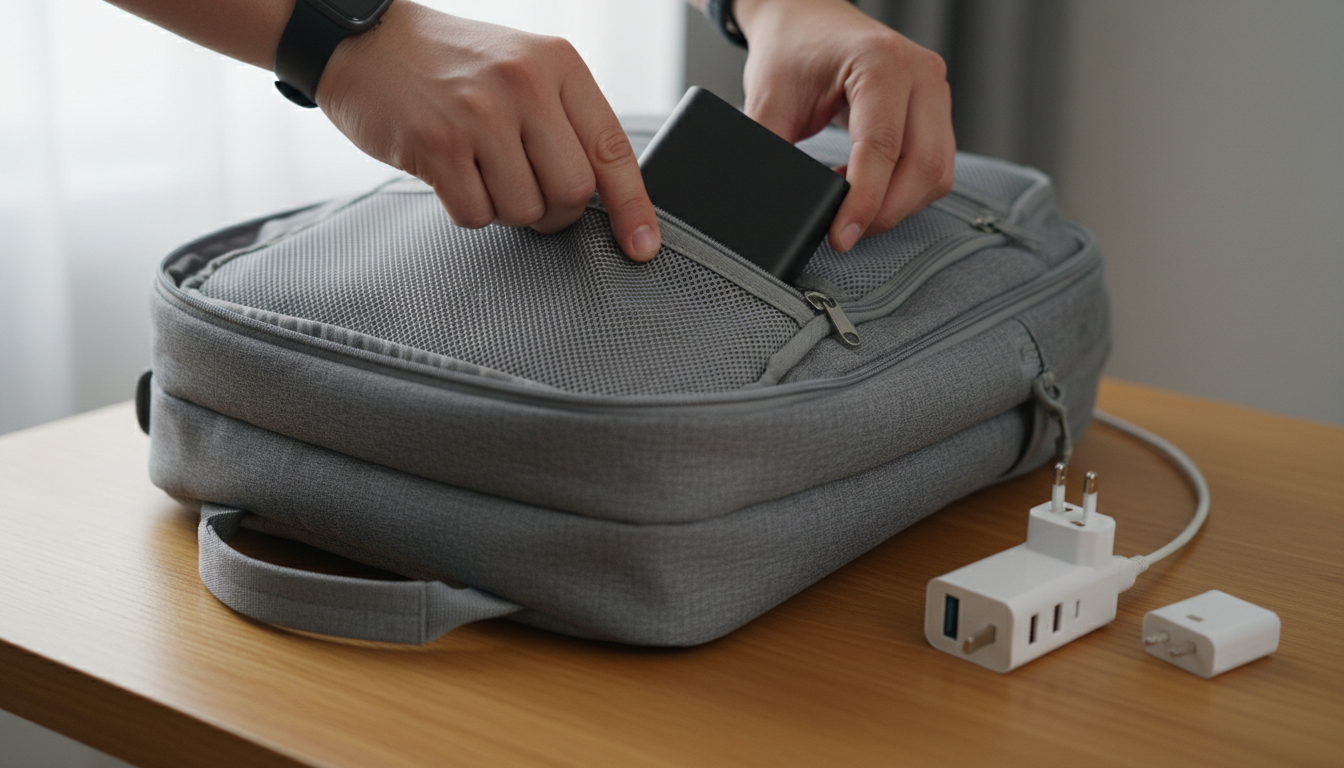
- Cabin Baggage ONLY: All power banks and spare lithium batteries must be carried in your personal hand luggage. Packing them in checked suitcases causes bags to be flagged, opened, or delayed. Review the exact rules for carrying power banks in flights in India before you head to the terminal.
- Capacity Up to 100 Wh (~27,000 mAh at 3.7V): Permitted in hand luggage without special airline authorization.
- Capacity Between 100 Wh and 160 Wh: Requires prior approval from the airline at the check-in desk, with a restriction of maximum two spare units per passenger.
- Above 160 Wh: Strictly prohibited on passenger aircraft.
Universal Adapters & Voltage Requirements
Indian heavy appliances and chargers use **Type D or Type M 3-round pin plugs**. Most commercial universal travel adapters are built for 2-pin configurations and will not accommodate a thick Indian 3-pin plug directly. Pack a compact 2-pin to 3-pin Indian plug converter to bridge this gap.
- Universal Adapter: Carry a high-wattage multi-plug adapter featuring built-in Type-A, Type-C, Type-G, and Type-I wall connections along with integrated USB-C Fast-Charging (PD) ports.
- Voltage Compatibility Check: Standard Indian electrical systems operate at 230V (50Hz). Countries like the USA, Canada, Japan, and Taiwan run on 110V–120V systems. Check the label on hair dryers, straighteners, and trimmers. If a device reads only “230V” rather than “110V–240V”, it will not operate at full power in North America or Japan without a heavy step-up voltage transformer.
- Luggage Trackers: Place an Apple AirTag or Samsung SmartTag inside your main checked bag to track its real-time location across international connecting hubs.
First-Aid Kit & Destination Drug Restrictions
Carrying a complete medical kit is essential, but doing so without reviewing local destination drug laws can lead to legal issues. Always carry all medications in their original pharmaceutical packaging inside your carry-on luggage, accompanied by an official English doctor’s prescription stating your full name and the generic chemical names of the drugs.
Essential Indian First-Aid Kit Checklist
- Fever & Pain: Paracetamol / Crocin (500mg/650mg).
- Acidity & Stomach Upset: Pantocid / Digene / Pudin Hara.
- Motion Sickness & Altitude Nausea: Avomine / Ondem (especially for long flights, cruises, or mountain road journeys).
- Diarrhoea & Infection: Enterogermina / Sporlac, along with ORS / Electral rehydration sachets.
- Muscle Aches & Sprains: Combiflam / Ibuprofen and pain relief spray.
- Basic First Aid: Adhesive band-aids, Neosporin antiseptic ointment, digital thermometer, and alcohol wipe pads.
Strict Country-Specific Medication Rules
Common over-the-counter (OTC) medicines sold legally in India may contain active ingredients that are strictly illegal or controlled substances in other countries:
| Destination | Restricted / Banned OTC Ingredients | Required Formalities & Rules |
|---|---|---|
| Japan | Pseudoephedrine (found in OTC decongestants like Actifed/Sudafed/Vicks inhalers) and Amphetamines. | Drugs containing Pseudoephedrine are illegal under the Stimulants Control Act. Carried prescription drugs or supply over 1 month require an advance Yunyu Kakunin-sho import permit. If you are planning a trip, review our detailed guide on planning a trip to Japan from India. |
| United Arab Emirates (UAE) | Codeine, Tramadol, Diazepam (Valium), Alprazolam (Xanax). | Heavy painkillers and sedatives require electronic pre-approval from the MoHAP (Ministry of Health & Prevention) portal 10 to 14 days before travel. |
| Singapore | Codeine, strong sedatives, and sleeping pills. | Requires pre-approval from the Health Sciences Authority (HSA). Allowed maximum supply of 3 months with a valid English prescription. |
Packing Indian Foods, Snacks & Biosecurity Regulations
Carrying familiar dry snacks or ready-to-eat meals can keep daily costs manageable during long overseas trips. However, strict international biosecurity laws govern what agricultural and food products cross international borders.
Packing Rules for Liquids, Pickles & Ghee
- Checked Luggage Only: Liquids, pastes, and gels in containers larger than 100 ml—including homemade pickles (achaar), ghee, and chutneys—are strictly banned in cabin luggage under international 3-1-1 TSA rules.
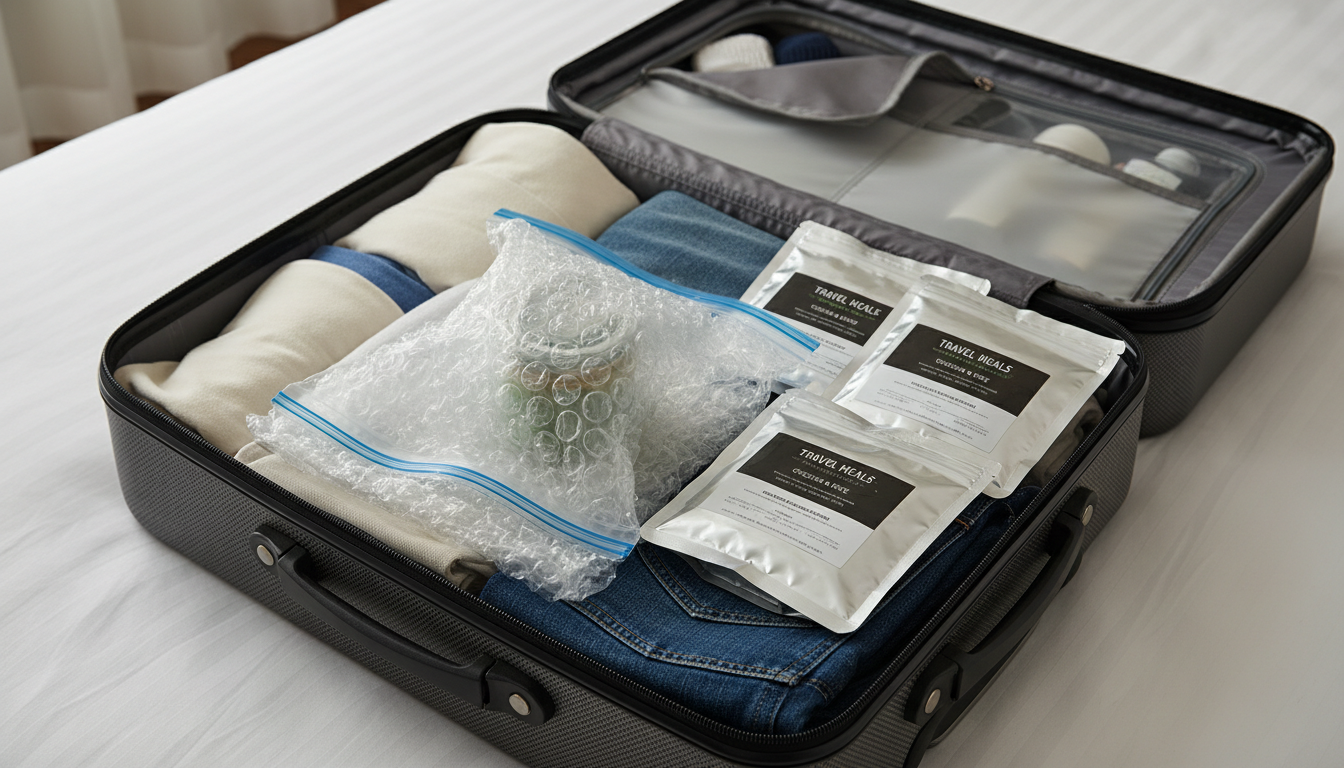
- Leakproof Packing Method: Wrap the jar tightly in plastic cling wrap, seal the lid with tape, place it inside a heavy-duty double ziplock bag, wrap it in bubble wrap, and nestle the parcel securely in the center of your checked suitcase surrounded by soft clothing.
- Ready-to-Eat Packets: Prefer factory-sealed, commercially packaged brands (such as MTR or Haldiram’s) with printed ingredients lists written in English.
Biosecurity Declarations (Australia, New Zealand & Beyond)
Australia and New Zealand enforce strict agricultural biosecurity laws (governed by frameworks like BICON). You must declare all food items on your Incoming Passenger Card upon arrival.
- Must Declare Always: Packaged snacks, spices, mithai, ghee, tea bags, pickles, and dry fruits. Commercially sealed vegetarian products are usually cleared upon inspection.
- Strictly Prohibited: Fresh fruits or vegetables (mangoes, green chillies, curry leaves), loose/unsealed market spices, non-commercial dairy (paneer, fresh peda/burfi), and home-cooked meat or poultry items. Failing to declare these can result in immediate fines starting from AUD 300 to AUD 2,000+.
- USA, Canada & Europe: Unsealed fresh seeds, home-cooked meat products, and unpasteurized dairy are banned. Sealed commercial vegetarian snacks are generally permitted if declared. Make sure to review general Indian customs baggage rules for allowed duty-free bring-back limits when returning.
Master Packing List for International Travel from India
This master checklist categorizes items by luggage type so you can organize your bags efficiently and pass through security checkpoints without hassle.
1. Hand Luggage / Carry-On Pouch Checklist
- Passport, physical Visas, flight tickets, travel insurance copy, and hotel vouchers.
- Primary zero-forex credit/debit card, prepaid forex card, emergency foreign cash, and INR.
- Power banks (under 100 Wh), laptop, tablet, camera, and spare camera batteries.
- Prescription medications along with an English doctor’s prescription.
- TSA 3-1-1 compliant toiletry pouch: Hand sanitizer, lip balm, travel moisturizer, and small toothpaste (all containers strictly 100 ml or less, fitted inside a 1-litre transparent bag).
- Noise-cancelling headphones, neck pillow, light jacket, and a change of clothes (in case checked luggage is delayed).
2. Checked Baggage Checklist
- Clothing & Apparel: Breathable cottons for tropical destinations; thermal innerwear, fleece, and down jackets for cold regions. Pack enough undergarments for 7–10 days.
- Footwear: 1 pair of comfortable walking sneakers (worn during flight to save bag weight), 1 pair of flip-flops/sandals, and 1 pair of formal or dress shoes.
- Full-Size Toiletries: Sunscreen (SPF 50+), full-sized shampoo, body wash, hair oil, shaving kit, and sanitary hygiene products (all sealed in ziplock bags).
- Sealed Packaged Food: Commercially sealed MTR packets, khakhra, dry roasted nuts, tea bags, double-sealed pickles, and travel electric kettle (if staying in self-catering apartments).
- Accessories: TSA-approved 3-digit combination locks, packing compression cubes, a foldable duffel bag (for extra shopping on the return leg), and a crossbody anti-theft sling bag.
Common Mistakes Made by Indian Travellers
- Putting Power Banks in Checked Baggage: Triggers manual luggage inspections by airport security (CISF/BCAS), delaying transit bags or requiring you to return to the check-in desk.
- Carrying Unlabeled Homemade Food to Biosecurity-Strict Nations: Transporting loose homemade sweets or unsealed spices to Australia or New Zealand without declaring them leads to instant fines.
- Forgetting International Card Authorizations: Failing to activate “International Transactions” on debit/credit cards via your Indian bank app before departure leaves cards non-functional abroad.
- Ignoring Destination Drug Laws: Carrying common OTC cold medicines containing pseudoephedrine into Japan, or codeine-based pain relievers into Dubai, can result in customs detention or confiscation.
- Carrying Soiled or Scribbled USD Currency Notes: Money changers and hotels abroad regularly refuse USD banknotes that are torn, heavily creased, stained, or written on with pen.
- Relying Only on Digital Documents: Depending entirely on your mobile phone battery for boarding passes, hotel vouchers, and eVisas can lead to unnecessary stress if your phone dies at immigration.
Frequently Asked Questions
How much cash in INR and foreign currency can I legally carry abroad from India?
Indian residents can carry up to USD 3,000 (or equivalent in other foreign currencies) in physical foreign banknotes per trip for general tourism. Under FEMA rules, you can also carry up to ₹25,000 in physical Indian Currency (INR) notes. If your total foreign exchange across cash, traveller’s cheques, and prepaid forex cards combined equals or exceeds USD 10,000 (or physical cash alone exceeds USD 5,000), you must submit a Currency Declaration Form (CDF) to Indian Customs at departure.
Can I carry MTR packets, homemade snacks, and pickles in checked luggage?
Yes. Factory-sealed ready-to-eat packets, commercially labeled dry snacks, tea, and packaged spices are permitted in checked luggage. Liquid pickles and ghee must be double-bagged in sealed ziplock pouches and placed in checked luggage to comply with liquid limits. Always declare all food items upon arrival in strict biosecurity countries like Australia and New Zealand.
Which plug adapter works universally for Indian electronic devices?
Because Indian electronics often use Type D or Type M 3-pin plugs, standard universal travel adapters (which cater to 2-pin plugs) will not fit them directly. Carry a universal travel adapter alongside a small 2-pin to 3-pin Indian converter plug so your laptop, phone, and battery chargers connect easily overseas.
Is TCS charged on international credit card expenses while travelling?
Under current tax regulations, international credit card purchases made while travelling abroad remain excluded from the Liberalised Remittance Scheme (LRS) TCS framework. Multi-currency prepaid forex cards and debit card spends attract 20% TCS only if your cumulative LRS forex remittance exceeds ₹10 Lakhs within a single financial year.
Can I pack power banks or e-cigarettes in my main checked suitcase?
No. Both power banks (lithium-ion batteries) and e-cigarettes/vapes are strictly forbidden in checked baggage by international aviation safety rules. They must be carried inside your cabin/hand luggage. Power banks up to 100 Wh (~27,000 mAh) are permitted in hand luggage without prior airline approval.