

Planning a journey to the Land of the Thunder Dragon requires a clear understanding of the financial commitments involved. A Bhutan trip cost from India is influenced by several specific policies, including the mandatory Sustainable Development Fee (SDF) and various logistical requirements that differ from other regional destinations. Preparing for this trip in 2026 demands awareness of both the official government levies and the fluctuating costs of daily travel services within the kingdom.
Key Takeaways for Your 2026 Bhutan Trip
- Mandatory SDF: Indian nationals must pay a Sustainable Development Fee of 1,200 INR per adult per night.
- Permit vs. Visa: Indian citizens do not need a visa but must obtain an entry permit using a valid Passport or Voter ID.
- Transportation: Private vehicles with local drivers are highly recommended due to limited public transport options.
- Currency: Indian Rupees (INR) are widely accepted alongside the local Bhutanese Ngultrum (BTN).
- Seasonality: Traveling during off-peak months (monsoon/winter) can significantly reduce accommodation and transport costs.
Understanding the Sustainable Development Fee
The most significant component of any budget for this region is the daily fee imposed by the government. This charge is not merely a tax, but an investment in the national infrastructure, education, and healthcare systems. For Indian nationals, this structure remains a critical consideration when calculating the total Bhutan trip cost from India.
As of late 2026, the fee structure is applied per person, per night of stay. It is essential to distinguish between the adult rate and the discounted rates for children. If you are planning a family trip, note that the government provides specific concessions for younger travellers (typically those between the ages of 6 and 12 years).
- Adult Fee: 1,200 INR per night.
- Child Fee (Age 6-12): 600 INR per night.
- Children under 6: Exempt from the fee.
This fee must be paid in full during the permit application process. Because the amount is fixed in INR for Indian citizens, it provides a stable baseline for your budget. However, be aware that this fee is non-refundable in most circumstances, so confirm your travel dates before proceeding with payments.
Visa and Permit Requirements
Unlike many international destinations, Indian passport holders do not require a formal visa to enter the country. Instead, you must obtain a permit at the port of entry. While the entry permit itself does not carry a direct application fee, the administrative effort requires careful preparation. You must present valid travel documents at the border office in Phuntsholing or at the Paro International Airport.
To ensure a smooth entry, keep the following key points in mind:
- Entry Points: Permits can be processed at the land border office in Phuntsholing or upon arrival at Paro International Airport.
- Documentation: You must present valid identity proof (Passport or Voter ID) to the immigration officers.
- Processing Time: Land border permits are typically issued on the spot, but peak seasons can see longer queues.
Ensure your passport or Voter ID card is valid for at least six months beyond your planned return date. If you are entering via land, the permit process is usually handled on the spot, but be prepared for potential wait times during peak tourist seasons (which generally occur in the spring and autumn).
| Document Type | Requirement Status |
|---|---|
| Passport | Mandatory (minimum 6-month validity) |
| Voter ID Card | Accepted for entry |
| Entry Permit | Required (obtained at port of entry) |
| Visa | Not required for Indian citizens |
To help you decide your entry route, here is a direct comparison of the primary entry points for Indian travelers:
| Feature | Paro International Airport (Air) | Phuntsholing Border (Land) |
|---|---|---|
| Convenience | High (Direct flights from major Indian cities) | Moderate (Requires road travel from Bagdogra/Hasimara) |
| Permit Processing Time | Fast (Usually under 30-45 minutes) | Variable (Can take 1-3 hours depending on queue) |
| Scenic Value | Spectacular aerial views of the Himalayas | Gradual, beautiful transition from plains to hills |
| Best For | Short trips, luxury travelers, families | Budget travelers, road trip enthusiasts |
Accommodation and Transport Expenses
Once the government fees are accounted for, your budget shifts to personal spending. Your choice of stay will play a major role in your total expenses. Accommodation options generally fall into three categories:
- Budget Homestays & Guesthouses: Ideal for experiencing local culture, costing around 1,500 to 3,000 INR per night.
- Mid-Range 3-Star Hotels: Provide standard amenities, comfortable rooms, and in-house dining, costing 3,000 to 5,000 INR per night.
- Luxury Resorts: High-end international properties offering premium wellness services, starting from 15,000 INR per night.
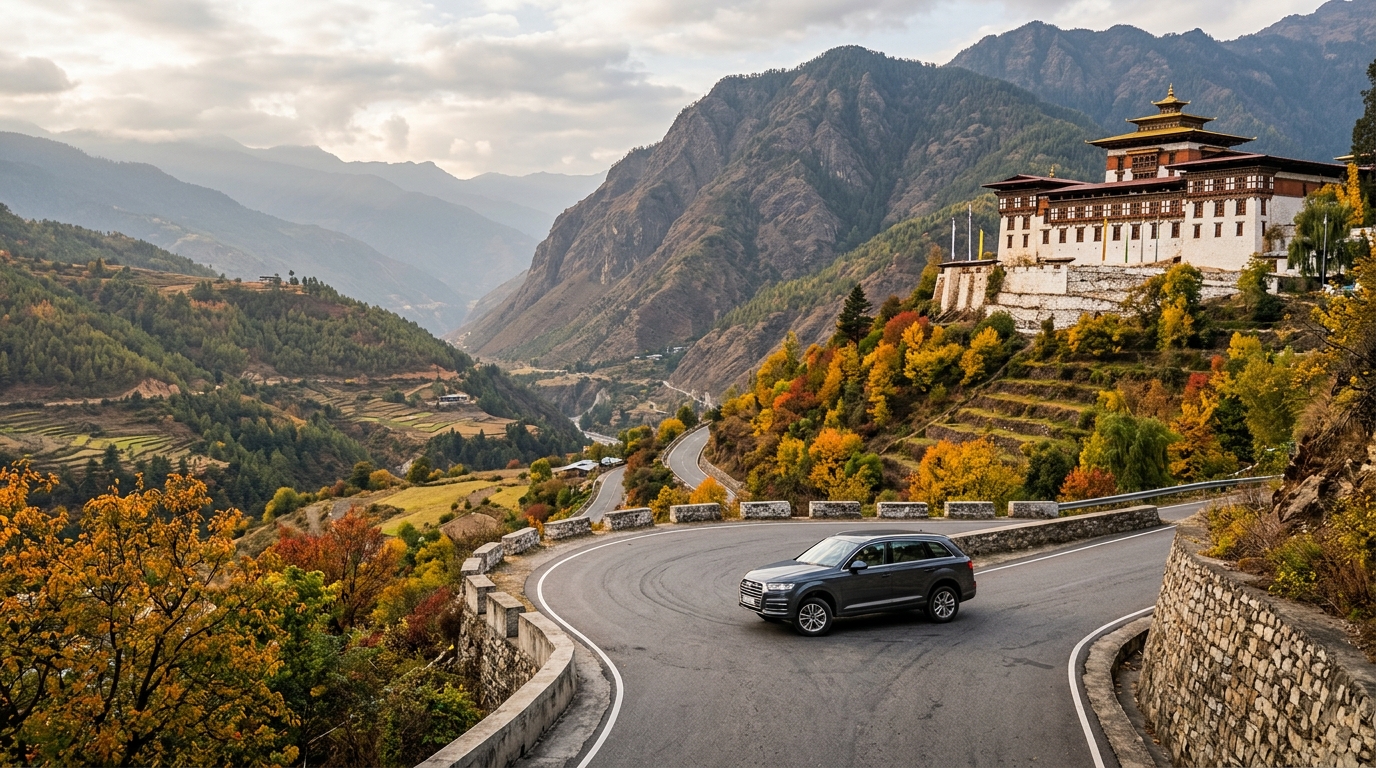
Transport is another area where costs vary based on your itinerary. Hiring a private vehicle with a local driver is the standard way to navigate the winding mountain roads. Most travellers opt for this method, as it offers the flexibility to stop at various dzongs and viewpoints along the route from Paro to Thimphu or Punakha.
Private transport provides the most reliable way to experience the kingdom, as public bus networks are limited and often infrequent for international visitors.
Daily Living Costs
Beyond the mandatory government fees, you should set aside a daily budget for meals, local sightseeing tickets, and incidentals. To manage your daily spending effectively, consider these typical cost ranges:
- Local Meals: 500 to 1,200 INR per day (dining at local cafes and standard restaurants).
- Sightseeing & Monument Entry: 300 to 1,000 INR per ticket (for dzongs, museums, and national monuments).
- Miscellaneous Expenses: 500 to 1,000 INR per day (for SIM cards, water, snacks, and small souvenirs).
For those interested in exploring the rich cultural heritage of the area, remember that many monasteries and museums charge entrance fees. While these individual tickets are relatively inexpensive (usually ranging from 300 to 1,000 INR), they do accumulate over a ten-day itinerary. It is prudent to carry enough local currency (Ngultrum) or Indian Rupees, which are widely accepted throughout the country, to cover these incidental costs.
Seasonality and Its Impact on Your Budget
The time of year you choose for your visit can influence the overall expense. The year is generally split into three distinct travel seasons:
- Peak Season (March-May, September-November): Ideal weather, colorful festivals, but higher hotel rates and limited availability.
- Off-Peak Season (June-August): Monsoon showers, but lowest hotel rates, lush green valleys, and fewer tourists.
- Shoulder Season (December-February): Cold but clear winter skies, good mountain views, and moderate discounts on lodging.
Conversely, the monsoon season and the colder winter months can offer reduced rates for hotels and transport. If you are comfortable with the trade-off of potentially rainier weather or colder temperatures, traveling during the off-peak season may help you manage your Bhutan trip cost from India more effectively.
Summary of Estimated Expenses
To provide a clear overview, the following table summarizes the typical budget ranges for a standard trip. These estimates assume a mid-range travel style for one person over a seven-day period, excluding international flights.
| Expense Category | Estimated Cost Range (7 Days) |
|---|---|
| Sustainable Development Fee | 8,400 INR |
| Accommodation (Mid-range) | 21,000 to 35,000 INR |
| Transport (Private vehicle) | 14,000 to 21,000 INR |
| Food and Incidentals | 14,000 to 24,500 INR |
| Total | 57,400 to 88,900 INR |
For expert guidance on structuring your travel plans and managing these logistics, you can consult the resources available through TravelDham services. They offer tailored advice to help streamline your planning process.
Conclusion
Successfully managing the Bhutan trip cost from India relies on thorough preparation and a clear understanding of the fixed government levies. By accounting for the mandatory fees early and choosing travel dates that align with your budget, you can experience the beauty of the kingdom without unexpected financial strain. Always confirm current regulations before your departure, as policies can be updated. For additional support, the team at TravelDham remains a reliable point of contact for those looking to finalize their itinerary.