

Essential Documents for Dependent Visa Applications: A Comprehensive Guide for Indian Citizens

Global mobility continues to rise, making family reunification a top priority for professionals relocating abroad. Securing a career overseas is only the first step. The ultimate challenge often lies in bringing family members along, an objective that relies entirely on paperwork. For Indian applicants, the administrative pathway is highly rigorous. Understanding and preparing the precise documents for dependent visa applications India is crucial to preventing delays or outright rejections. While assembling these files seems overwhelming, a methodical approach simplifies the process. This guide provides a definitive breakdown to ensure a smooth transition.
Key Takeaways
- Eligible Dependents: Dependent visas are typically restricted to legally married spouses, civil partners, and unmarried children under 18.
- Relationship Verification: Pristine, legally registered marriage and birth certificates are mandatory and must match passport details exactly.
- Financial Solvency: Sponsors must demonstrate sufficient liquid funds (savings, FDs) held for specified periods (e.g., 28 days for the UK) to support the household.
- Attestation Requirements: Indian civil certificates must undergo State-level verification, MEA Apostille, or consular legalization.
Understanding the Fundamentals of Dependent Visas
Immigration policies exist to keep families together. When a professional secures an employment visa abroad, they are designated the primary visa holder. Accompanying family members are classified as dependents. Understanding this framework is the first step when preparing the required documents for dependent visa applications India. It is basically the platform upon which the entire family relocation plan is constructed. Countries establish these visa categories to ensure that incoming families can support themselves without relying on public state funds.
Who Qualifies as a Dependent?
Immigration authorities restrict dependent status to immediate family members. This typically encompasses legally married spouses, civil partners, and unmarried children under the age of 18 (though some countries allow older children under highly specific conditions). Parents and siblings are rarely classified as dependents, which requires organizing the documents for dependent visa applications India separately. For Indian applicants, establishing these relationships requires legally recognized civil certificates.
The Core Objective of a Dependent Visa
The primary purpose of this immigration pathway is to facilitate family unity. Consular offices must verify that incoming dependents will not become a financial burden. Consequently, the documents for dependent visa applications India must conclusively prove two distinct facts: the relationship must be legally valid, and the sponsor must possess sufficient financial resources to maintain the household. Without meeting these dual thresholds, approval is highly unlikely.
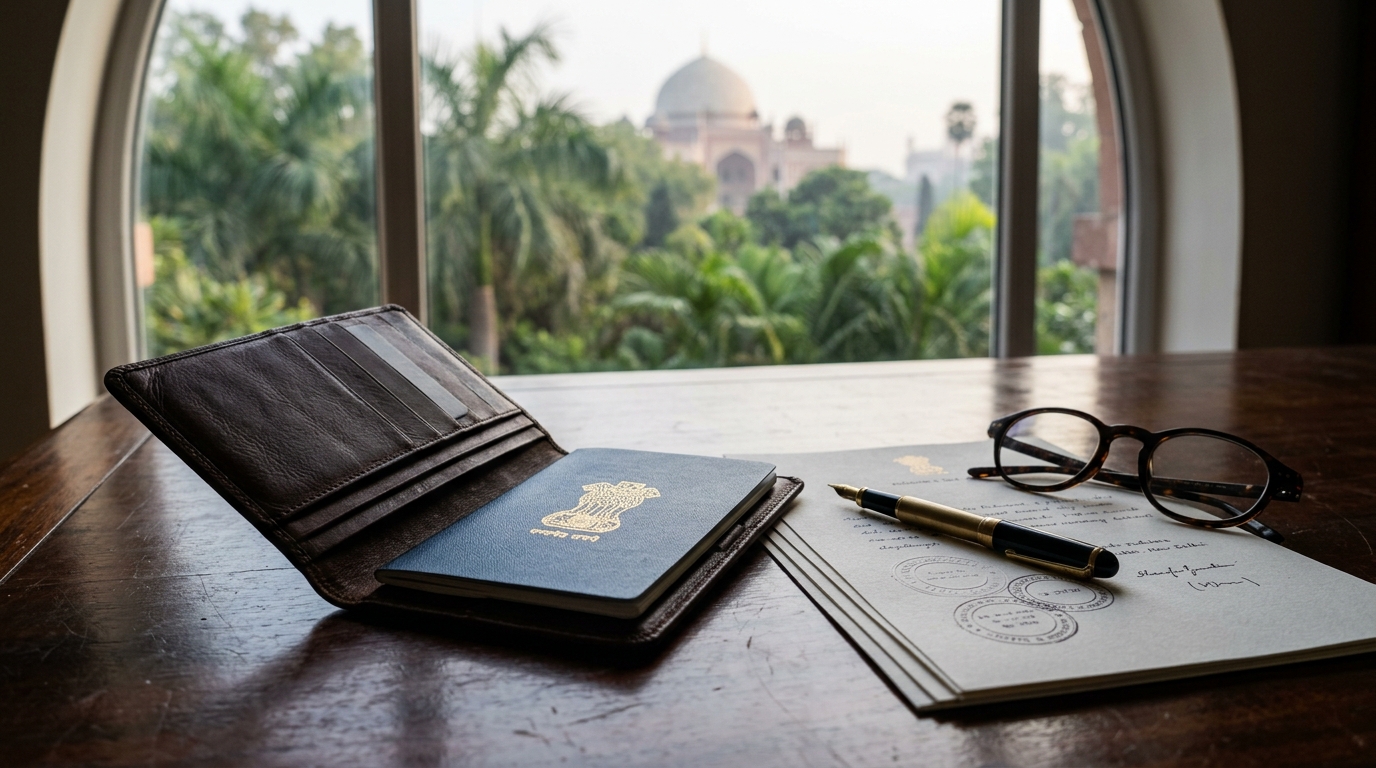
Essential Checklist: Documents for Dependent Visa Applications India
To compile a successful petition, applicants must systematically gather records from both the primary sponsor and the dependent. The following checklist outlines the baseline documents for dependent visa applications India that form the core of most international applications.
| Document Category | Key Document Required | Issuing Authority / Source | Primary Purpose in Application |
|---|---|---|---|
| Identity Proof | Current Indian Passport | Ministry of External Affairs (MEA) | Verifies identity of applicant |
| Relationship Proof | Marriage Certificate | Registrar of Marriages | Establishes legal marital bond |
| Relationship Proof (Minors) | Birth Certificate | Municipal Corporation | Proves parentage and age |
| Financial Support | Employment Contract | Sponsor’s Employer | Demonstrates financial capacity |
| Taxation Records | Form 16 / ITR | Income Tax Department | Proves earning history |
| Character Reference | PCC | Passport Seva Kendra | Confirms clean record |
Having these records structured prevents the typical confusion that arises when managing complex applications. But still, simply having the certificates is not enough; their authenticity must be unquestionable when finalizing the documents for dependent visa applications India.
Primary Sponsor’s Financial and Professional Records
The primary sponsor serves as the anchor for the entire visa process. Consular officials will closely examine the sponsor’s status in the destination country. Therefore, when preparing the documents for dependent visa applications India, several sponsor-specific files are mandatory:
- Valid Visa Copy: A legible copy of the primary sponsor’s current visa or residence permit.
- Employment Agreement: A signed, valid employment contract in the destination country.
- Consecutive Payslips: Recent pay records (usually covering the last three to six months) showing active employment and minimum required earnings.
Civil Status Documents and Proof of Relationship
Proving a genuine, legally binding relationship is the most critical hurdle. For spouses, the legally registered marriage certificate is the absolute bedrock of the application. For children, a formal birth certificate listing both parents’ names is required. Consular officers are trained to spot fraudulent certificates, meaning that these documents for dependent visa applications India must be pristine, legally registered, and fully attested.
Applicant Personal and Identity Records
The dependent applicant must submit comprehensive personal files to establish identity. Chief among these files representing the primary personal documents for dependent visa applications India are:
- Valid Indian Passport: Must have at least two blank pages and remain valid for at least six months.
- Biometric Photographs: Standardized passport-sized photographs matching destination-specific dimensions.
- Proof of Accommodation: Documented evidence of a suitable place of residence in the destination country.
- Tuberculosis Test Results: Clearance certificates from approved medical clinics (where applicable).
Destination-Specific Requirements for Indian Applicants
While the foundational guidelines remain consistent worldwide, different sovereign nations enforce unique regulations. Indian citizens must tailor their documents for dependent visa applications India to align with the specific rules of their target country. Some observers suggest that family relocation is merely a bureaucratic formality. They are not entirely wrong if the paperwork is flawless, but they fail to recognize how minor clerical errors can disrupt lives for months.
| Destination Country | Key Dependent Visa Route | Average Processing Time (2026) | Major Document Highlights |
|---|---|---|---|
| United Kingdom | PBS Dependent Visa | 3 to 8 weeks | 28-day bank balance proof, Relationship proof |
| United States | H-4 / L-2 Visas | Varies (Months) | Sponsor’s Form I-797 Approval, Visa copy |
| Canada | Spouse Open Work Permit | 12 weeks | Proof of sponsor’s skilled job or full-time study |
| European Union | Schengen Family Reunification | 4 to 12 weeks | National D-visa forms, €30,000 health insurance |
United Kingdom (PBS Dependent Visa)
If the sponsor holds a Skilled Worker or Student visa, the dependents must apply under the Points-Based System (PBS) dependent route. The UK Home Office focuses heavily on financial self-sufficiency. As noted in the 2026 UK Home Office briefing, roughly 85% of dependent visa applications from India were approved on their first attempt, provided all required certifications were attached. To secure this approval, applicants must present explicit bank statements showing that the required maintenance funds have been held consistently for at least 28 consecutive days. Spouses must also provide evidence of a subsisting relationship. These are crucial components of the documents for dependent visa applications India for the UK.
United States (H-4, L-2, and F-2 Visas)
The United States utilizes separate visa classes for dependents of temporary workers and students. Spouses of H-1B visa holders apply for H-4 visas, while those of L-1 visa holders apply for L-2 visas. The US Department of State reported that in fiscal year 2025, H-4 visa issuances for Indian dependents accounted for over 70% of the global total, reflecting the massive scale of Indian IT professional relocation. To apply successfully, the dependent must present the sponsor’s Form I-797 (Approval Notice) and their current visa copy. These are the mandatory documents for dependent visa applications India when moving to the United States.
Canada (Spouse Open Work Permit and Visitor Visa)
Canada offers a progressive approach, often allowing spouses of skilled workers to apply for a Spouse Open Work Permit (SOWP). Consular filings from Immigration, Refugees and Citizenship Canada (IRCC) indicate that the average processing time for spouse open work permits from India remained around 12 weeks during the first half of 2026. When submitting documents for dependent visa applications India for Canada, the primary applicant must provide proof of their skilled employment or enrollment in an eligible program.
European Union (Schengen Family Reunification)
Moving to the European Union under a family reunification scheme involves both national laws and Schengen-wide security protocols. Each EU member state (such as Germany, France, or the Netherlands) has its own specific national D-visa requirements for long-stay family reunification. However, they uniformly require highly structured documents for dependent visa applications India. For instance, Germany requires a formal obligation letter if the sponsor’s income is borderline, along with certified proof of basic German language proficiency (A1 level) for spouses in many circumstances. The Schengen zone also strictly mandates comprehensive travel medical insurance with a minimum coverage of €30,000.
Financial Solvency and Proof of Maintenance Guidelines
The financial capability of the primary sponsor is arguably the most scrutinized element of any family relocation application. Consular officers must be entirely satisfied that the family will not require access to public funds in the destination country. Demonstrating this requires a clear, auditable trail of financial documents for dependent visa applications India.
Acceptable Financial Instruments for Indian Sponsors
Consular officers prefer liquid funds that are immediately accessible for household maintenance.
- Active Savings Accounts: Standard bank accounts with a consistent history of balances are preferred.
- Fixed Deposits (FDs): Legally registered FDs are widely accepted, provided they can be liquidated immediately.
- Provident Funds (PF/EPF): These are accepted if accompanied by an official letter stating that the funds can be withdrawn.
Conversely, real estate holdings, gold, and share portfolios are rejected as primary proof of maintenance. They can, however, be presented as supplementary evidence. These are crucial elements of the documents for dependent visa applications India.
Minimum Balance Thresholds and Holding Periods
Each country establishes explicit monetary thresholds that sponsors must meet. For example, the UK mandates specific maintenance funds that must remain untouched in the bank. These funds must be held in the account for a minimum of 28 consecutive days before the application date. Any sudden, unexplained cash deposits into the sponsor’s account immediately prior to filing will raise flags. Consular officers will suspect temporary borrowing and may issue an immediate rejection. Therefore, maintaining a clean, steady ledger is essential when compiling the documents for dependent visa applications India.
Legalization, Translation, and Attestation of Indian Documents
Because Indian civil certificates are issued by local municipal bodies, foreign governments require independent verification of their authenticity. This is where legalization and attestation play a pivotal role. Failure to properly legalize the documents for dependent visa applications India is one of the most common administrative reasons for application delays.
The MEA Apostille Process for Indian Civil Certificates
For countries that are member signatories to the Hague Apostille Convention, the document legalization process is standardized. India is a member, meaning that civil documents must undergo a three-step attestation process to receive the MEA Apostille:
- State-Level Attestation: The document must first be verified by the designated state authority where it was issued.
- MEA Attestation: The Ministry of External Affairs (MEA) of India applies the official Apostille sticker.
- Consular Legalization: For non-Hague Convention countries, an additional step of consular attestation in India is required.
These steps are mandatory to validate the documents for dependent visa applications India.
Certified Translations for Non-English Documents
In India, many birth and marriage certificates are issued in regional languages such as Hindi, Punjabi, Tamil, or Marathi. Most international consulates require all documents for dependent visa applications India to be in English or the official language of the destination country. If the original certificate is in a regional language, a certified translation is mandatory. The translation must be performed by a registered, professional translator. It must include a formal declaration of accuracy, the translator’s credentials, and their official stamp and signature. Self-translations are strictly rejected.
Step-by-Step Application Process
Securing a dependent visa is a linear journey that requires precision at every stage. For those seeking professional support to ensure compliance, utilizing dedicated visa services can dramatically reduce the likelihood of clerical mistakes. The typical timeline progresses through several clear steps.
Step 1: Document Compilation and Validation
The journey begins months before the actual filing date. Applicants must audit all personal, professional, and civil certificates. This involves checking that names match exactly across all identity documents. For instance, if a spouse’s passport still lists her maiden name while the marriage certificate shows her married name, supplementary proof must be added to the documents for dependent visa applications India. All necessary attestations and certified translations must also be secured during this initial phase.
Step 2: Online Form Submission and Fee Payment
Once the physical files are organized, the online phase begins. This involves creating an account on the destination country’s official immigration portal. The applicant must fill out the appropriate dependent visa form with absolute accuracy. Any discrepancy between the online form and the supporting paper documents can lead to delays. After completing the form, the applicant must pay the visa fee and, if applicable, the mandatory healthcare surcharge.
Step 3: Biometric Appointment and Interview Preparation
The final administrative hurdle involves a visit to an official visa application center. Here, the applicant submits their physical documents for dependent visa applications India, undergoes biometric scanning, and submits their passport for processing. For certain visa classes, a personal interview at the embassy or consulate is required. During this interview, the applicant must confidently answer questions regarding the sponsor’s employment, their relationship history, and their relocation plans.

Common Reasons for Dependent Visa Refusals
Understanding why applications fail is the most effective way to protect your own filing. Consular officers operate under strict regulatory guidelines, and they will not hesitate to issue a refusal if any standard is unmet. Most rejections of documents for dependent visa applications India stem from two primary areas.
Insufficient Relationship Proof
Consular officers must be convinced that the relationship is genuine. Simply providing a marriage certificate is sometimes insufficient if the marriage is very recent. Officers look for supplementary proof of a shared life.
- Lack of Historical Evidence: A lack of shared photographs or communications can raise suspicion.
- Inconsistent Interview Answers: If the spouse and sponsor provide contradictory answers, the visa will be denied.
- Discrepancies in Official Records: Spelling variations in names across passports are major red flags.
Inadequate Financial Maintenance
Even if the relationship is fully authentic, a dependent visa will be refused if the financial proof falls short of the mandated legal thresholds. Consular officers must see that the sponsor can comfortably house and feed the dependents.
- Insufficiency of Funds: The balance in the sponsor’s bank account is even slightly below the required minimum threshold on any single day during the mandatory holding period.
- Unexplained Deposits: Large, sudden sums of money deposited into the sponsor’s account without a clear, documented source are viewed as fraudulent.
- Expired Financial Statements: Submitting bank statements that are older than the specified limit will lead to immediate rejection.
Frequently Asked Questions
For clarification on specific, common dilemmas faced by applicants, the following sections address some of the most frequent queries regarding the required documentation.
Can a dependent work in the destination country?
Whether a dependent can work depends entirely on the destination country and the primary sponsor’s visa class. For example, spouses of H-1B visa holders in the United States can only work after securing an approved Employment Authorization Document (EAD). Conversely, spouses of skilled workers in Canada and the United Kingdom generally receive full working rights immediately upon visa approval. It is critical to verify these labor regulations before planning your career transitions.
How long does it take to process a dependent visa from India?
Processing times vary widely based on the country, the visa category, and the time of year. Generally, standard processing takes anywhere from 3 to 12 weeks from the date of the biometric appointment. For instance, UK PBS dependent visas are often processed within 3 to 8 weeks, while Canadian spouse open work permits can take up to 12 weeks. Many countries offer expedited or priority processing services for an additional fee.
What should I do if my marriage certificate has a spelling mistake?
Spelling discrepancies on critical civil documents are a frequent cause of visa processing delays. If your marriage certificate contains a typographical error, you should ideally have it rectified by the issuing municipal authority or marriage registrar before submitting your application. If time constraints make this impossible, you must obtain a formal, notarized One and the Same name affidavit. This affidavit, sworn before a first-class magistrate, officially declares that the names written on different documents refer to the exact same individual.
Is a separate Police Clearance Certificate (PCC) required for minor children?
In almost all international jurisdictions, minor children are exempt from providing a Police Clearance Certificate. Adult dependents, however, must provide a PCC from India (and any other country where they have resided for more than six months continuously over the past ten years). The PCC must be obtained through the official Passport Seva Kendra portal, as certificates issued by local neighborhood police stations are generally not accepted by foreign embassies.