


Dealing with commercial airport entry in India requires strict adherence to security protocols enforced by the Central Industrial Security Force. Preparing the correct documents for air travel in india before reaching the departure gate is crucial for a hassle-free boarding process. While the digital shift has modified check-in procedures, physical and official digital identification remain the standard for airport entry. Missing or mismatched identification can lead to immediate denial of entry, resulting in canceled bookings and travel disruption. Civil aviation authorities dictate that every passenger must present verified identification to clear the initial security gates. Knowing the exact requirements saves time and reduces friction at the terminal. This guide details the essential requirements, digital tools like DigiYatra, and the specific paperwork needed for different categories of travelers.
Key Takeaways
- Mandatory Photo ID: Every domestic traveler in India must present a government-approved physical or validated digital photo identity document.
- Name Matching: The name on your flight ticket must match your identity document exactly to prevent denial of entry.
- DigiYatra Benefits: Utilizing the DigiYatra app significantly reduces airport entry times to under 15 seconds through facial recognition.
- Infant & Minor Rules: Children under two years require a birth certificate or hospital discharge certificate, while minors above two need standard identity proof.
- Physical vs. Digital: While digital documents via DigiLocker and m-Aadhaar are accepted, simple screenshots of IDs are strictly prohibited.
The Regulatory Framework for Domestic Flights in India
The rules governing domestic aviation in India are established by the Bureau of Civil Aviation Security (BCAS). This authority operates under the Ministry of Civil Aviation and continuously updates guidelines to counter emerging security concerns. Ensuring that passengers possess verified documents for air travel in india is a core mandate of these regulations. BCAS works in tandem with security forces to enforce these entry rules at every commercial airport across the nation.
Security officers at terminal gates do not merely glance at papers. They perform a meticulous verification process to ensure airport security. This systematic check focuses on the following criteria:
- Exact Name Match: The name on the ticket must match the identification document exactly. Even minor spelling discrepancies can trigger additional screening or denial of entry.
- Visual Authenticity Check: Officers verify the physical features of the document to ensure it has not been tampered with or counterfeited.
- Passenger Verification: Confirming that the passenger intending to board matches the individual who purchased the ticket to prevent unauthorized security access.
Over the years, the Ministry has expanded the list of acceptable documents for air travel in india to accommodate changing digital habits. But still, the fundamental rule remains that every traveler must carry at least one government-approved photo identification. While the transition to paperless systems is underway, possessing a clear understanding of the regulatory expectations is critical for anyone planning a domestic journey.
Primary Identification Documents for Air Travel in India
For the vast majority of citizens, a select group of government-issued IDs serves as the primary means of airport entry. The authorities have compiled a strict list of documents for air travel in india that security forces will accept at the gate. These documents must be original, current, and issued by a competent government authority. Laminated photocopies or scanned images stored on personal mobile phones are generally rejected by security personnel at the gate.
The verification process relies heavily on visual matching, so the photograph on the document must be clear and recognizable. The security personnel must be able to link the face of the traveler to the image on the document. Additionally, the spelling of the passenger name on the ticket must match the ID.
Here is a quick overview of the most common documents for air travel in india that adult passengers can present:
| Document Type | Issuing Authority | Key Features & Validity Details |
|---|---|---|
| Aadhaar Card | UIDAI | Includes biometric data and unique 12-digit number. Accepted in physical, e-Aadhaar, and m-Aadhaar formats. |
| Indian Passport | Ministry of External Affairs | Serves as both identity and citizenship proof. Highly recommended for international connecting passengers. |
| Voter ID Card | Election Commission of India | Must feature a clear, recognizable photograph of the holder. |
| Driving License | State RTOs | Must be valid and unexpired. Digital versions are accepted if retrieved from verified lockers. |
| PAN Card | Income Tax Department | Useful as a secondary photo ID, but some airports prefer addresses which PAN cards lack. |
While this selection of documents for air travel in india is widely recognized, travelers often ask about the specific rules governing each type. Each document carries its own set of guidelines, which can affect its acceptability at different airport terminals.
Aadhaar Card and Its Digital Formats
The Aadhaar card, issued by the Unique Identification Authority of India (UIDAI), has become the most widely used among the documents for air travel in india. Its ubiquity makes it the default choice for security personnel. The physical card contains crucial details for rapid verification:
- Passenger’s full name
- Recent photograph
- Gender and Date of Birth
- Unique 12-digit identification number
However, carrying the physical card is not the only option. The government has approved digital versions of Aadhaar, provided they are presented through authorized channels. The e-Aadhaar (a digitally signed PDF downloaded from the UIDAI portal) and the m-Aadhaar application are fully accepted (which is actually a frequent point of confusion at terminal gates). But still, the presentation of these digital formats must comply with specific rules. A simple screenshot of an Aadhaar card is not considered a valid representation. Security officials are trained to spot falsified screenshots, which can lead to immediate detention.
When using digital versions of documents for air travel in india, the passenger must show the live application on their device or present a printed copy of the e-Aadhaar containing the secure QR code. This requirement ensures that the document has not been altered. As far as current guidelines suggest, roughly 90% of domestic travelers choose Aadhaar as their primary validation source due to its ease of verification.
| Platform / Format | Acceptability Status | Verification Requirements |
|---|---|---|
| Physical Aadhaar Card | Highly Accepted | Must be original and in good physical condition. |
| DigiLocker App | Fully Accepted | Must be accessed live within the official application; no offline files. |
| m-Aadhaar App | Fully Accepted | Must display the live profile with the secure QR code. |
| e-Aadhaar (PDF printout) | Accepted | Must contain the clear, scannable secure QR code. |
| Photo / Screenshot on Phone | Strictly Rejected | Screenshots are not accepted due to security and manipulation risks. |
Passport as an Identity and Citizenship Document
The Indian passport is arguably the most secure and internationally recognized form of identification. While not mandatory for domestic travel, it remains the gold standard of documents for air travel in india. The strict issuance protocols followed by the Ministry of External Affairs give passports a high degree of credibility among security personnel.
Using a passport for domestic travel is highly advantageous for travelers who are connecting to international flights. It consolidates all travel papers into a single document, reducing the risk of administrative errors. In addition, the passport contains crucial details like the holder’s nationality, which other documents do not explicitly state. This detail is useful at certain restricted-area airports in India where citizenship must be verified.
Even though passports are durable, passengers must ensure the document is not severely damaged or expired. An expired passport is not considered a valid piece of documents for air travel in india, even for domestic routes. Security personnel will inspect the physical integrity of the booklet, and any missing pages or torn bindings could lead to rejection at the gate.
Other Government-Issued Photo Identity Cards
Beyond Aadhaar and passports, several other photo identification options are permitted under civil aviation guidelines. These alternative documents for air travel in india provide flexibility for individuals who may not carry their primary identity cards at all times. A Voter Identity Card issued by the Election Commission of India is a prime example of an acceptable document.
Similarly, driving licenses issued by state Road Transport Offices are recognized at terminal gates. These licenses must contain a clear photograph and must be within their validity period. For corporate employees and public sector workers, identity cards issued by central or state government agencies, public sector undertakings, and scheduled commercial banks are also accepted. These cards serve as highly reliable documents for air travel in india when official duty is involved.
Here is a list of other approved documents:
- PAN (Permanent Account Number) Card issued by the Income Tax Department.
- Service ID cards issued by Central or State Governments or Public Sector Undertakings.
- Student Photo Identity Cards issued by recognized government colleges and universities.
- Nationalized Bank Passbooks containing a clearly stamped photograph of the account holder.
- Pension cards containing the photograph of the retiree.
It is important to remember that credit cards with photos or membership cards from private clubs are not valid documents for air travel in india. The issuing authority must always be a government body or a recognized public institution.
Digital Verification and the DigiYatra Initiative
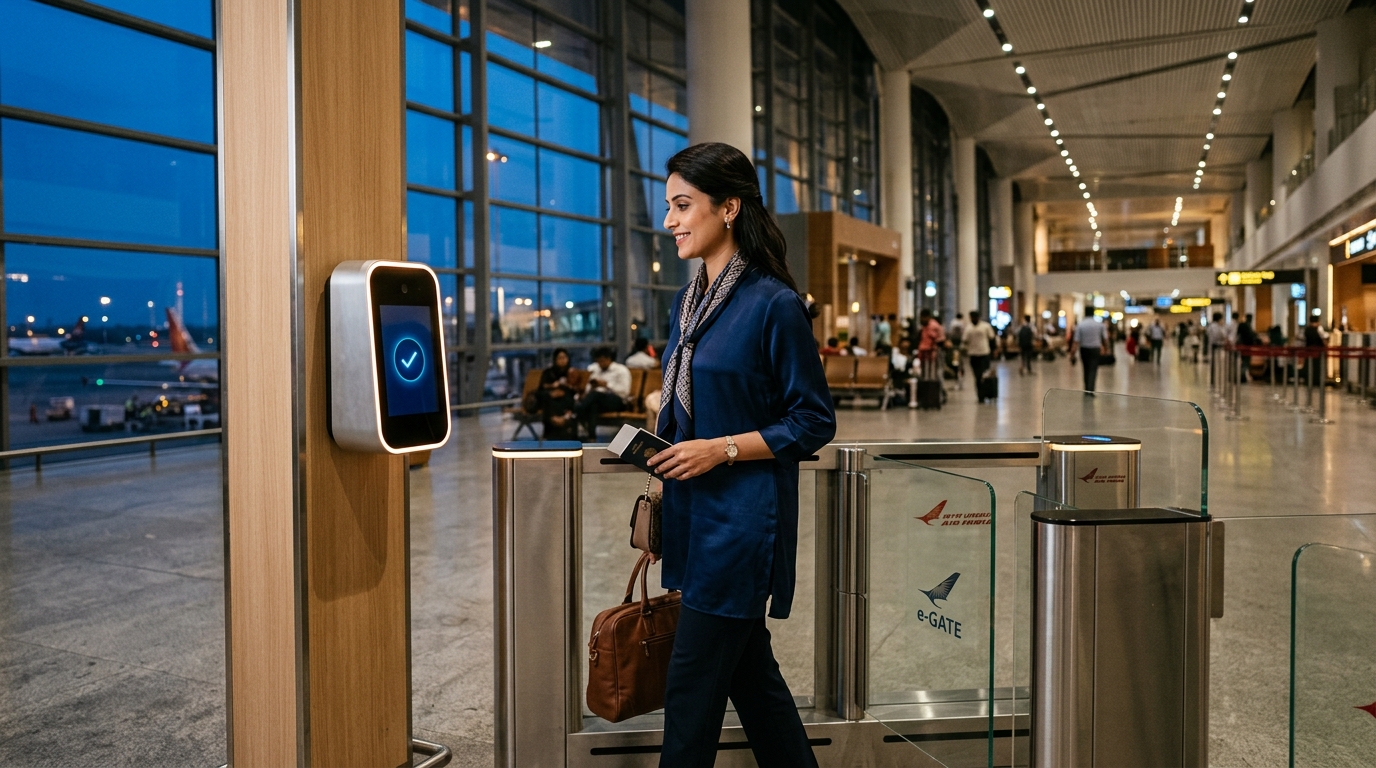
The Indian domestic aviation sector has experienced a major technological shift with the introduction of the DigiYatra initiative. This platform, launched by the Ministry of Civil Aviation, uses Facial Recognition Technology (FRT) to create a seamless, paperless travel experience at participating airports. By digitizing documents for air travel in india, the platform eliminates the need for manual physical verification at multiple checkpoints.
The process begins by downloading the DigiYatra application and linking it to an Aadhaar card. The application performs a real-time biometric validation using a facial scan. Once the system verifies the passenger’s identity, the boarding pass can be uploaded directly to the application. This links all necessary documents for air travel in india to the traveler’s unique face biometric profile.
At the airport, DigiYatra users enter through dedicated gates equipped with camera scanners. The gate opens automatically upon a successful scan, bypassing the traditional physical queue. But still, the program is voluntary. Travelers who prefer manual verification can continue to use traditional documents for air travel in india at standard security counters.
Critics might argue that digital-only validation should be the mandatory standard for speed. They are not entirely wrong. It is basically a risk to rely solely on digital systems when biometric scanners experience temporary downtime.
For those planning their next getaway within the country, exploring curated domestic tour packages can simplify the logistical journey significantly. Combining professional travel planning with digital verification tools like DigiYatra ensures that transit times are minimized. According to early deployment statistics from major metro airports, the use of digital documents for air travel in india via DigiYatra reduces the average entry time from several minutes to under 15 seconds. This is an improvement in airport operational efficiency.

Required Documents for Air Travel in India for Special Categories
While the standard guidelines apply to the general public, specific rules exist for passengers requiring special consideration. The list of necessary documents for air travel in india changes when traveling with dependents or under official military capacity. Student concessions come later. Security agencies and airlines have established clear protocols to manage these exceptions without compromising national security.
These rules ensure that vulnerable passengers travel safely while preventing identity fraud. Whether traveling with infants, under administrative orders, or as a student, knowing the specific documents for air travel in india is crucial. Failure to present the correct supplementary paperwork can result in boarding delays or the cancellation of special discounts.
Infants and Minor Passengers
Traveling with infants (children under two years of age) or minors presents unique documentation requirements. For infants, airlines do not typically require a photo identity card. Instead, parents must present proof of age to confirm that the child qualifies for infant fares, which are lower than adult fares.
A birth certificate is the primary document required for infants. Alternatively, a valid passport or a hospital discharge certificate can be used. These documents for air travel in india for minors must be presented during check-in to verify the child’s age. For minors above the age of two, a separate seat must be booked, and they must have their own identity proof.
If a minor is traveling with parents, an Aadhaar card or a school identity card is recommended. But still, if a child does not possess any photo ID, a physical validation by the accompanying parents is often accepted, provided the parents carry their own verified documents for air travel in india. In cases where a minor is traveling unaccompanied, the airline will require a specific indemnity form signed by the parents, along with valid contact details of the guardians at both airports.
Armed Forces Personnel and Government Officials
Members of the Indian Armed Forces, including the Army, Navy, and Air Force, are held to distinct verification standards. When traveling on official duty or utilizing defense personnel discounts, these passengers must present their official Service Identity Cards. These cards are respected and serve as valid documents for air travel in india at all commercial terminals.
For dependents of defense personnel traveling under concessional fares, a dependent card or a family certificate issued by the military authorities is required. Security agencies verify these specialized documents for air travel in india to prevent the misuse of government-subsidized tickets. This verification helps protect national resources.
Similarly, government officials traveling on state business may carry official or diplomatic passports. These papers must be accompanied by the travel authorization orders issued by the respective ministry. It is critical for these travelers to keep both their official IDs and their boarding passes easily accessible, as double-verification is common at sensitive military-civilian dual-use airports. To maintain security integrity, officials are requested to cooperate with inspectors.
Conclusion
Having a clear understanding of the necessary documents for air travel in india ensures a seamless and stress-free journey. From Aadhaar cards to digital verifications through DigiYatra, being prepared is the key to avoiding airport delays. Carrying both physical and digital backups of all travel documents remains the safest approach. Double-checking all paperwork before leaving for the airport ensures that your travel remains uninterrupted and enjoyable. Security protocols are strict, and presenting the correct documents for air travel in india is the first step toward a successful trip. Taking a few minutes to verify names and dates on tickets will prevent major issues at the departure gate. Maintaining organized papers ensures that airport transit is as smooth as possible, allowing passengers to focus on their upcoming destination. Proper preparation ensures that transit gates do not represent an obstacle.