


Securing an Indian passport opens doors to international travel. But as the expiration date nears, applicants face the task of renewing this vital document. A common point of confusion during this renewal stage involves security checks. Specifically, applicants often ask: is police verification required for passport renewal? The answer is not always a simple yes or no. The government has updated policies to make things faster. For many, the process goes smoothly without any visits. For others, local authorities must verify identity details before printing the booklet. Knowing how these rules apply saves time. It prevents delays before booking flights or finalizing visa applications. For travelers planning their next international trip, securing the right visa services is just as crucial as having an active passport. This exhaustive guide explains the renewal rules, status tracking, and paperwork.
Key Takeaways
- Verification Depends on Profile: Police verification is generally not required if your old passport is active and your personal details (like address and name) remain unchanged.
- Mandatory Triggers: Changes in address, name, spouse details, a damaged/lost passport, or a passport expired for over 3 years will automatically trigger a police verification.
- Process Types: The verification can be Pre-Police Verification (before issuance), Post-Police Verification (after issuance, common for Tatkaal), or No Verification.
- Digital Integration: The implementation of systems like the ‘mPassport Police App’ has significantly reduced physical verification times to 7–10 days in most major districts.
- Tracking & Action: You can track your Police Verification (PV) status online; an ‘Adverse’ or ‘Incomplete’ status requires immediate contact with the local police station or Regional Passport Office.
Understanding Police Verification for Passport Renewal
The Ministry of External Affairs (MEA) works with local ministries to run these checks. Basically, a passport is a secure travel booklet. The state must confirm your identity before extending it. Under the Passport Act of 1967, authorities can verify your details. This rule ensures that travel documents do not fall into the wrong hands.
Over the years, the government has updated its digital systems. The Passport Seva System is now linked with crime databases in many districts. This modern link makes checking records much faster. But still, the human element remains necessary. Local officers often need to physically verify your residence. This check ensures you actually live where you claim to live. It also verifies that you do not have any pending criminal cases that might bar you from travel abroad. Critics say physical checks are slow. They are not entirely wrong – but these checks protect security.
For government employees, public sector workers, or statutory body members, the process is slightly different. They can bypass verification by submitting an Identity Certificate or a No Objection Certificate (NOC) from their employer. This official declaration acts as a trust signal. However, for private sector employees and self-employed individuals, the standard rules apply without exceptions.
Is Police Verification Required for Passport Renewal?
The core question is simple: is police verification required for passport renewal? In short, it depends on your profile. If you submit your renewal application with the exact same details as your old passport, you may bypass police checks entirely. The system often marks such cases as ‘No Verification Required’.
However, the system will trigger a check under certain conditions:
- If you have changed your address, your spouse’s name, or other significant personal details.
- If your current passport has been expired for more than three years.
- If you have resided at your current address for less than one year (subject to recent regional relaxation).
The passport officer at the counter makes the final decision during your physical appointment.
Types of Police Verification Processes
To understand how your application will move, you must know the three main types of verification. The authorities use these categories to process booklets based on urgency and risk factors.
Below is a comparative overview of Normal vs. Tatkaal schemes to help you decide which option matches your urgency and budget:
| Scheme Type | Processing Timeline | Police Verification Timing | Standard Fee (Adult, 36 Pages) |
|---|---|---|---|
| Normal Scheme | 15 to 30 days | Pre-Police Verification (usually) or No PV | ₹1,500 |
| Tatkaal Scheme | 1 to 3 days | Post-Police Verification (after issuance) | ₹3,500 (₹1,500 normal fee + ₹2,000 Tatkaal charges) |
Pre-Police Verification (Pre-PV) is the most common form. In this case, the passport office sends your files to the local police station before printing your new booklet. The police officer must complete the check and submit a clear report. Only then does the passport office print and dispatch your document. This path is standard for applications with significant profile changes.
Post-Police Verification (Post-PV) is the opposite. Here, the passport office prints and dispatches your passport first. The police check happens after you receive the booklet. This process is common for Tatkaal applications. It allows citizens to travel quickly in emergencies. But still, you must cooperate with the police when they call. If you fail the post-issuance check, your passport can be impounded.
No Police Verification (No PV) is the smoothest path. If your record is clean and you have not changed your address, you will likely fall into this category. The passport office prints and mails your new booklet without involving the local police station. This path saves time and effort for both the applicant and the state.
| Verification Type | Process Timing | Typical Scenario |
|---|---|---|
| Pre-Police Verification | Before passport is printed | Address changes, expired passport, or major particular changes |
| Post-Police Verification | After passport is printed and sent | Tatkaal schemes, urgent business travel, or family emergencies |
| No Police Verification | No physical check is required | No changes in personal details and active old passport |
When is Police Verification Mandatory During Renewal?
Specific situations always demand a check. The system automatically flags these triggers. Police verification is mandatory during passport renewal under the following circumstances:
- Address Change: If you have moved since your last passport was issued, you must declare it. The police must verify this new location to confirm your residence.
- Major Change in Personal Details: This includes correcting your birth date, modifying spelling, or adding a spouse’s name after marriage. The state must ensure double identities are not being created.
- Lost or Damaged Passport: If you lose your travel document, the police must confirm that the loss was genuine and ensure it is not being misused.
- Expired Over Three Years: Renewing a passport that has been expired for more than three years triggers automatic verification to confirm you are still residing in India and haven’t acquired foreign citizenship.
- Minor to Adult Transition: Moving from a minor’s passport (5-year validity) to an adult’s passport (10-year validity) requires a fresh adult verification record.
So, when you ask is police verification required for passport renewal, look at your own profile. If you fit any of these categories, prepare for a physical check.
The Step-by-Step Passport Renewal Police Verification Process
The entire passport renewal police verification process is highly systematic. It is designed to be transparent, though local practices can vary slightly. Knowing what to expect at each stage helps you prepare.
- Submitting the Online Form: Applicants must log into the official Passport Seva portal. You will fill out the online renewal form. Here, you must select whether you need a normal or Tatkaal passport. You will also input all changes to your address or personal details.
- Attending the PSK Appointment: You must book an appointment at a Passport Seva Kendra (PSK). You will go there with your printed application receipt and original documents. The officers at the PSK will verify your biometric data. They will take your fingerprints and photograph. The granting officer at the last counter will decide if your file needs pre-verification or post-verification.
- Request Generation: Once the PSK clears your file, the system sends an electronic request to your local police station. This request moves through the digital District Police Headquarters.
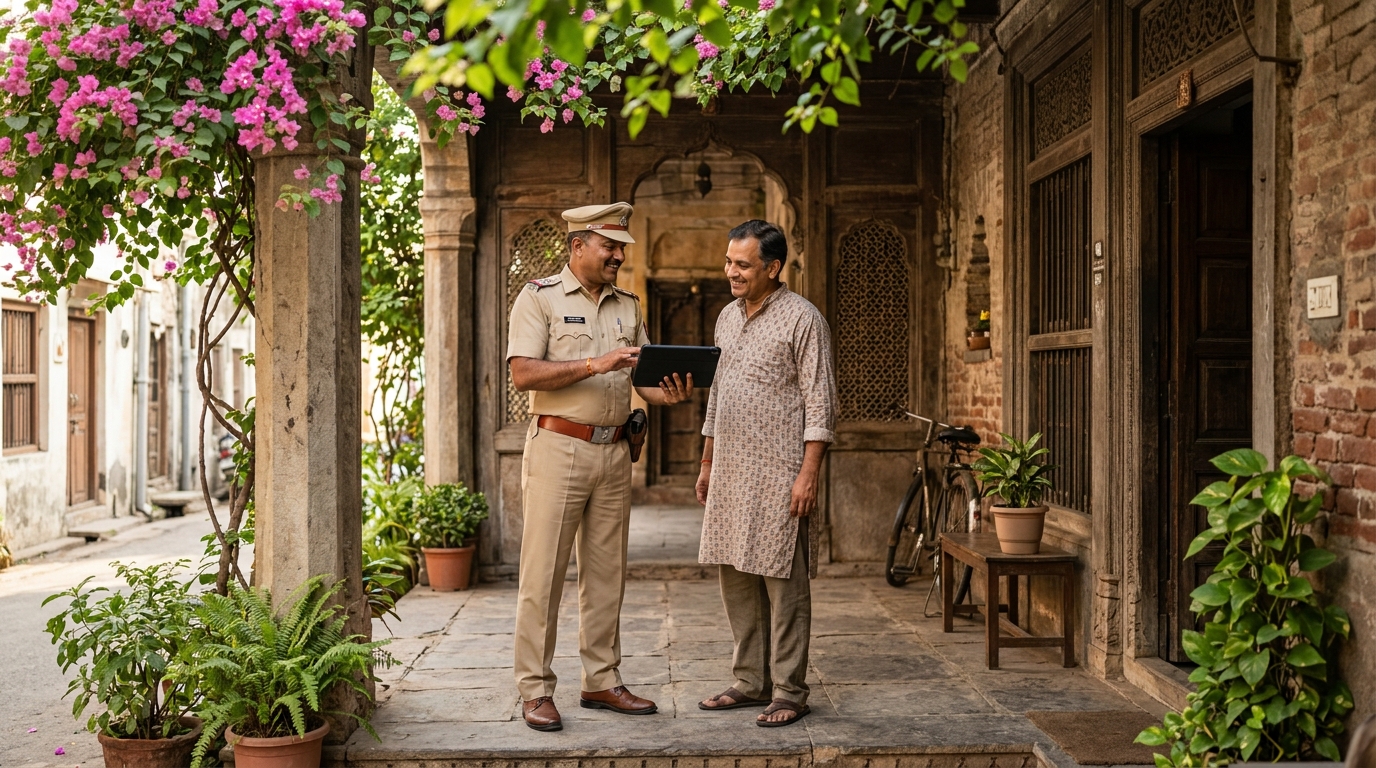
- Physical Police Visit: A local police officer will contact you. They may call your mobile phone to schedule a visit to your home. (Sometimes they may ask you to visit the local station instead). During this visit, the officer will check your original documents. They will also talk to two neighbors to confirm your character and residence. When the officer visits, they look for specific physical proof. You should have your physical files ready. They will inspect your Aadhaar card or bank passbook. In some states, officers now use a mobile application called ‘mPassport Police App’ to upload data on the spot. This digital tool has cut verification times from weeks to just a few days, making the entire journey highly efficient for citizens.
- Report Submission: The officer writes a report. They submit this report to the district police headquarters. From there, it is sent electronically to the Regional Passport Office (RPO). If the report is positive, your passport moves to the printing stage.
This passport renewal police verification process usually takes about fifteen days from the date of your PSK appointment, depending on your local station’s speed.
Documents Required for Passport Renewal and Verification
To ensure your application moves forward without hitches, you must gather the correct paperwork. Missing papers can delay your application by weeks.
For a standard renewal, you need your original old passport. You must also bring self-attested photocopies of its first and last pages. If your address has not changed, these files may be enough.
But if you are updating your address, you must show proof of your current residence. The passport office accepts several documents. These include your Aadhaar card, recent utility bills, or a registered rent agreement. Gathering the correct documents required for passport renewal ensures a smooth experience at the registration desk.
Let us look at the complete list of documents required for passport renewal based on different scenarios. Having these ready avoids multiple trips to the PSK.
| Scenario | Mandatory Documents | Optional/Additional Documents |
|---|---|---|
| Standard Renewal (No Changes) | Original old passport, self-attested copies of first and last pages | None |
| Address Change | Aadhaar card, active bank passbook with photo | Water bill, electricity bill, or gas connection bill |
| Spouse Name Addition | Marriage certificate or joint photo declaration | Spouse’s passport copy (if available) |
| Lost or Damaged Passport | Police FIR copy, affidavit (Annexure F), birth proof | Old passport copy (if available) |
How to Track Your Passport Police Verification Status
Once your appointment is complete, you should monitor your application. You do not need to sit and worry about whether your files are moving. The Passport Seva system offers a reliable online tracking tool.
You can visit the official portal and select the ‘Track Application Status’ option. You will need to enter your file number and date of birth. Roughly speaking, this tracking system shows your file’s current stage in real-time.
When you track your files, you will encounter a PV Status Code (Police Verification Status Code). This internal code tracks where your application is currently resting. There are four primary status updates you might see during the check:
- Pending: The request has reached your local police station, but the officer has not completed the check yet.
- Clear: The police have submitted a positive report. Your passport is now ready for printing or dispatch.
- Adverse: The police found a discrepancy. This could be due to an incorrect address, missing documents, or a pending court case.
- Incomplete: The officer could not complete the verification. This usually happens if you were not home during their visit.
Monitoring these status codes allows you to act quickly. If you see an ‘Incomplete’ or ‘Adverse’ status, you should contact your local police station or the Regional Passport Office immediately.
What Happens If Your Police Verification Report is Adverse?
An adverse report is not the end of the road. It simply means there is a hurdle to clear. The most common reasons for an adverse report include:
- Address Mismatch: If the police find you do not reside at the declared address.
- Missing Documents: Failure to provide requested proof of identity, age, or address during the visit.
- Pending Criminal Cases: Active court cases or disputes that require judicial clearance.
- Inaccessibility: Not being present during repeated visits by the verification officer.
If your report is marked adverse, the Regional Passport Office will send you a letter. This is usually a Show Cause Notice. The letter will ask you to explain the discrepancy. You must respond within the specified timeline, which is often thirty days.
To resolve this, you must book an inquiry appointment at your Regional Passport Office. Do not just turn up; use the online portal to schedule an appointment. Bring all your original documents, the Show Cause Notice, and clear evidence to support your explanation. If you have a pending legal case, you must show court permission to travel.
Once the passport officer is satisfied with your explanation, they can manually clear your file. They may also order a fresh verification check if needed.

Frequently Asked Questions
This section addresses common queries that applicants raise during the passport renewal cycle. If you are preparing for a trip and need assistance with your travel documents, exploring professional visa support services can help simplify your planning.
Is police verification required for passport renewal if the address is the same?
Generally, no. If your old passport is still active and there are no changes to your address or personal details, you will not need a police check. The passport office will typically issue your passport under the ‘No Verification’ category, which speeds up the process significantly.
What is the timeline for completing the verification?
According to official guidelines, the local police should complete their inquiry within 21 days. However, the actual time depends on your local police station’s efficiency. In major cities, digital systems often help complete the check in 7 to 10 days.
Can I renew my passport in Tatkaal without police verification?
You can receive your passport under the Tatkaal scheme before verification. But still, a post-police verification is mandatory in most Tatkaal cases. The local police will visit your home after the passport is issued to verify your details. You must be prepared for this check.