
The architectural history of the Indian subcontinent is deeply etched into its mountains, basalt cliffs, and granite hillsides. Those who seek to understand the origins of religious art and engineering on the subcontinent must inevitably look toward the magnificent ancient caves in india. These rock-cut sanctuaries served as monasteries, temples, and trade route rest houses, carved entirely by hand from solid basalt, granite, or sandstone cliffs. From the painting-filled chambers of Maharashtra to the monolithic carvings of Karnataka, these ancient caves in india reveal a stunning level of craftsmanship that developed over fifteen centuries. Actually, travelers who venture deep into the interior regions will discover that these ancient caves in india are among the country’s most valuable historical archives. Exploring these subterranean marvels is not merely a lesson in historical architecture, it is an immersion into the spiritual and artistic evolution of early Indian society.
Historically, these subterranean structures offered shelter and permanent places of worship for Buddhist, Hindu, and Jain monastics. While many modern travelers focus on the freestanding temples of the plains, the true architectural genius of early builders remains preserved inside the ancient caves in india. By examining these ancient caves in india, visitors gain an appreciation for the structural engineering and artistic devotion that shaped the subcontinent’s heritage.
Key Takeaways
- Spiritual & Cultural Diversity: The ancient caves in india represent a harmonious blend of Buddhist, Hindu, Jain, and Ajivika traditions.
- Engineering Marvels: Many caves, such as the Kailash Temple at Ellora, were carved top-down from a single monolithic rock, requiring precise spatial planning.
- Artistic Preservation: Sites like Ajanta preserve frescoes and murals created with natural minerals that have lasted for over 1,500 years.
- Strategic Locations: Most rock-cut shrines were systematically excavated along ancient trade routes, funded by wealthy merchants and royal patrons.
The Architectural Significance of Ancient Caves in India
The transition from timber and thatch construction to permanent stone excavations represents a crucial milestone in Indian art history. Excavating the ancient caves in india required precise planning, as a single error in carving could compromise the entire structural integrity of the cavern. Master builders began by chiseling into the rock faces from the top down, a technique that eliminated the need for scaffolding but demanded absolute spatial accuracy. This top-down method is particularly visible when studying the structural progression of the ancient caves in india across different dynasties. Artisans carved pillars, beams, and arches out of the living rock, mimicking the wooden architecture of the era.
These rock-cut caves were rarely isolated projects. Instead, the creation of ancient caves in india was closely tied to ancient trade networks and commercial routes, funded by wealthy merchants and royal patrons seeking spiritual merit and safe harbors for caravans. The interior layouts of these ancient caves in india typically serve distinct purposes:
- Chaitya: A congregational worship hall designed with a stupa at its center for prayer and meditation.
- Vihara: A monastic residential hall equipped with small sleeping cells for monks and scholars.
Actually, the geographic positioning of these ancient caves in india shows how closely they monitored and supported the movement of ancient trade.
The Magnificent Ajanta Caves: Masterpieces of Buddhist Art
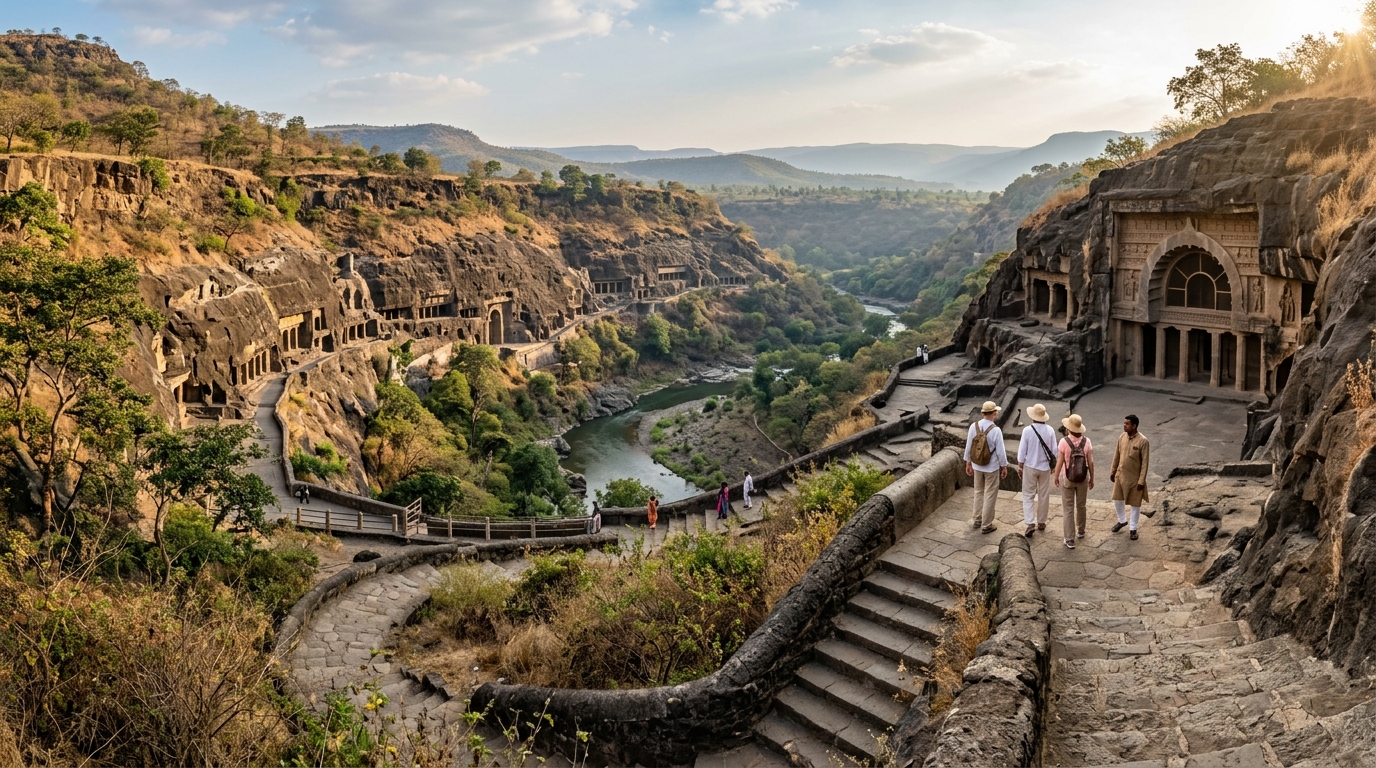
The horse-shoe shaped gorge of the Waghur River in Maharashtra houses one of the world’s most spectacular artistic achievements. The Ajanta Caves, comprising 30 rock-cut Buddhist monuments, represent the zenith of early classical Indian painting and sculpture. Visiting these ancient caves in india offers an unmatched view of the evolution of Buddhist art from the 2nd century BCE to the 6th century CE. Today, they stand as a protected UNESCO World Heritage Site, drawing scholars and travelers from across the world.
Historical Context and Patronage
The construction of the Ajanta site occurred in two distinct historical phases. The first phase, associated with the Hinayana school of Buddhism, began under the Satavahana dynasty around the 2nd century BCE. The second phase occurred during the 5th century CE under the prosperous Vakataka dynasty. This Mahayana phase introduced massive Buddha statues and highly sophisticated murals, transforming these ancient caves in india into active centers of theological study and artistic expression. Funding came from royal elites, ministers, and international merchants who walked the nearby trade routes.
Key Caves and Iconic Murals
Among the thirty excavations, specific chambers stand out for their exceptional state of preservation. Cave 1, a magnificent vihara, contains the world-famous murals of the Bodhisattvas Padmapani and Vajrapani. These paintings display deep emotional expression, subtle shading, and naturalistic postures. Cave 19 and Cave 26 serve as spectacular examples of chaitya halls, featuring intricate ribbed ceilings and large stupas. Observing the details in these ancient caves in india reveals how painters used natural pigments derived from local minerals to create colors that have survived for over fifteen hundred years.
Ellora Caves: A Harmonious Blend of Three Faiths
Located roughly 100 kilometers from each other, the sites of Ajanta and Ellora demonstrate a remarkable spirit of religious tolerance in ancient India. Spanning over two kilometers along the basaltic hills of the Sahyadri range, these 34 excavated monasteries and temples represent three major religious traditions: Buddhism, Hinduism, and Jainism. For anyone researching the ancient caves in india, Ellora offers a structural contrast to Ajanta, focusing heavily on monumental stone sculpture and complex architectural engineering rather than delicate plaster paintings. This transition from paint to colossal stone carving reflects a broader shift in regional artistic focus.
The Kailash Temple: A Monolithic Marvel
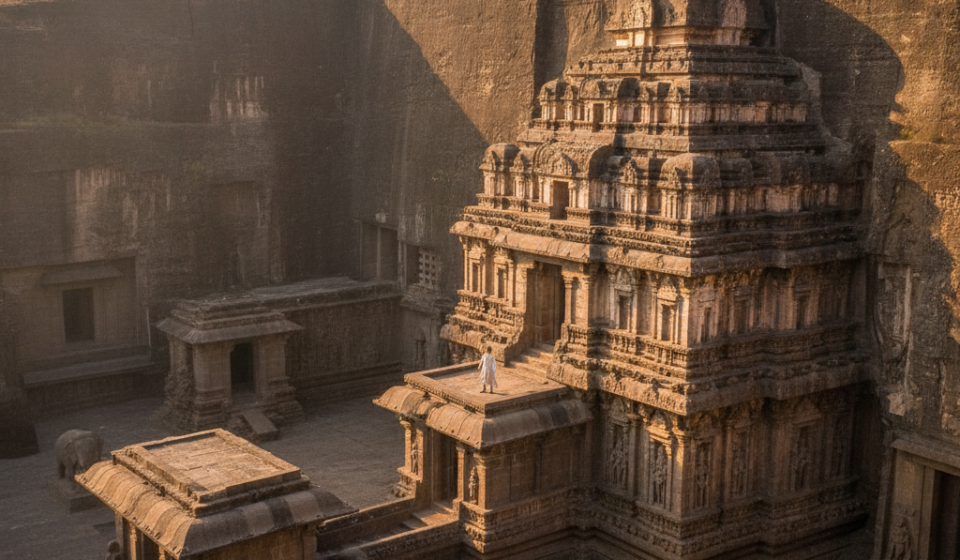
At the heart of the Ellora complex lies Cave 16, known globally as the Kailash Temple. This structure is a colossal monolithic temple carved from a single mountain of basalt rock. Commissioned by King Krishna I of the Rashtrakuta dynasty in the 8th century, the project required workmen to excavate over 200,000 tons of rock from the top down. It remains the largest single monolithic rock-cut structure on Earth, designed to represent Mount Kailash, the celestial abode of Lord Shiva. The sheer precision required to carve double-story galleries out of a solid cliffside makes this site a premier destination among all ancient caves in india.
Buddhist, Hindu, and Jain Monasteries
The broader Ellora complex is systematically organized into three distinct geographic groups representing an incredible progression of religious coexistence:
- The Buddhist Group (Caves 1 to 12): Carved between 500 and 700 CE, these caves feature large, multi-story viharas and the solemn, vaulted-roof Vishwakarma cave.
- The Hindu Group (Caves 13 to 29): Characterized by dramatic, high-relief mythological panels depicting scenes of cosmic dance and divine strength.
- The Jain Group (Caves 30 to 34): Dating from the 9th and 10th centuries, showcasing fine, intricate decorative detailing and ascetic themes.
This structural and spiritual evolution highlights why Ellora is considered one of the most culturally diverse collections of ancient caves in india.
Elephanta Caves: The Island of Lord Shiva
Situated on Gharapuri Island in the Mumbai Harbour, the Elephanta caves are a spectacular testament to rock-cut Shaivite iconography. Accessible via a scenic ferry ride from the Gateway of India, these ancient cave temples date back to the 5th and 8th centuries CE. The main cave, known as the Great Cave, is designed as a geometric mandala dedicated to Lord Shiva. When examining the ancient caves in india, Elephanta stands out for its dramatic use of light and shadow, where natural sunlight filters through multiple entrances to illuminate colossal stone panels. Visitors interested in these coastal marvels can find tailored travel options through the comprehensive Maharashtra tour packages offered by TravelDham.
The Trimurti Sculpture and Iconography
The artistic masterpiece of the Elephanta complex is the massive 20-foot-tall bust of Shiva, known as the Trimurti or Sadashiva. This colossal sculpture depicts the three primary aspects of the divine: the creator, the preserver, and the destroyer. Surrounding panels portray other major mythological scenes, including Ardhanarishvara (the half-male, half-female form of Shiva) and Shiva Tandava (the cosmic dance). The preservation of these sculptures, despite centuries of exposure to sea air and colonial damage, cements Elephanta’s status as a critical site among the ancient caves in india.
Badami Cave Temples: Chalukya Rock-Cut Architecture
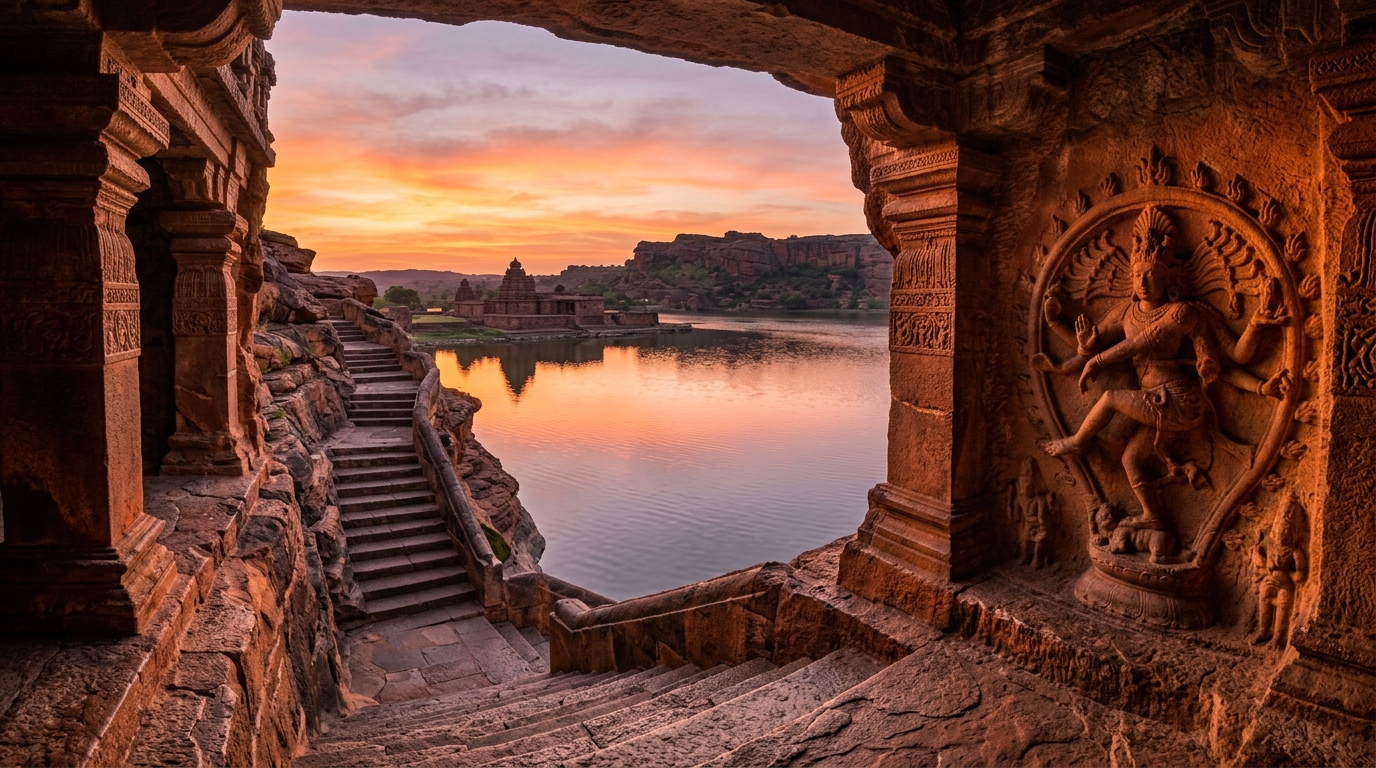
Moving south to Karnataka, the red sandstone cliffs of Badami present a different style of subterranean excavation. Built during the 6th and 7th centuries CE, the Badami caves represent a beautiful transition phase between rock-cut excavations and structural temples. These four cave shrines are carved into the sheer cliffside overlooking the tranquil Agastya Lake. For travelers looking to study the regional diversity of the ancient caves in india, Badami provides a crucial link showing how rock-cut techniques influenced subsequent freestanding stone architecture in South India.
The Four Distinct Cave Shrines
The Badami complex is organized chronologically as one ascends the steep steps of the sandstone hill. Cave 1 is dedicated to Lord Shiva, featuring an iconic eighteen-armed carving of Nataraja executing eighty-one distinct dance poses. Cave 2 and Cave 3 are dedicated to Lord Vishnu, with Cave 3 standing as the largest and most decorated shrine, containing massive relief carvings. Cave 4 is a Jain temple, carved in the late 6th century, which features beautifully detailed figures of Mahavira and Parshvanatha. This systematic sectarian division makes the Badami group a highly organized and educational example of ancient caves in india.
Other Significant Rock-Cut Shrines Across India
While Maharashtra and Karnataka host the most famous subterranean temple complexes, several other regions of India contain exceptional rock-cut monuments. From the eastern shores of Odisha to the ancient plains of Bihar, the ancient caves in india display a wide variety of architectural experiments. Understanding these lesser-known sites is essential for developing a complete perspective on the subcontinent’s ancient rock-cut heritage, as they represent early steps and regional adaptations of the same architectural traditions.
Udayagiri and Khandagiri Caves
Located near Bhubaneswar in Odisha, the twin hills of Udayagiri and Khandagiri contain 33 rock-cut caves carved during the 1st century BCE. Commissioned by King Kharavela, these caves served primarily as residential retreats for Jain ascetics. Designed for solitary meditation, these structures are mostly simple, shallow cells with low ceilings. The exterior facades, however, are adorned with lively carvings depicting royal processions, daily life, and athletic contests. As some of the earliest examples of Jain rock-cut architecture, they are an important part of the ancient caves in india, proving that the carving tradition flourished across the eastern coast of the subcontinent.
Bhaja and Karla Caves
Situated in the Western Ghats near Lonavala, the Bhaja and Karla complexes represent some of the oldest Hinayana Buddhist sanctuaries in the region. Dating back to the 2nd century BCE, these sites are famous for their magnificent wooden-ribbed chaitya halls. Karla Cave 8 houses the largest early rock-cut chaitya hall in India, featuring a vaulted ceiling fitted with actual teak wood beams that have remained intact for over two thousand years. Exploring these sites alongside nearby Bhaja offers a clear look at the early development of monastic architecture among the ancient caves in india.
Barabar Caves: The Oldest Surviving Rock-Cut Caves
To discover the absolute origins of rock-cut architecture in the subcontinent, one must travel to the Jehanabad district of Bihar to visit the Barabar Caves. Dating back to the Maurya Empire in the 3rd century BCE, these caves were commissioned by Emperor Ashoka for the monks of the Ajivika sect. The four caves of Barabar feature a highly advanced engineering feat: the granite interiors are polished to a mirror-like sheen, reflecting light and creating a remarkable acoustic echo. The Lomas Rishi Cave, with its detailed ogee-arch entrance, stands as the oldest surviving rock-cut cave temple in the country, establishing the foundational design language for all subsequent ancient caves in india.
Comparative Overview of Major Ancient Caves in India
To help travelers and heritage enthusiasts plan their next historical expedition, the following comparison table details the location, patronage, religious affiliation, and primary architectural highlights of the most prominent ancient caves in india. This matrix highlights the chronological and geographic diversity of these structural marvels.
| Cave Complex | State & Region | Historical Period | Primary Religion | Key Architectural Feature |
|---|---|---|---|---|
| Ajanta Caves | Maharashtra (Aurangabad) | 2nd Century BCE – 6th Century CE | Buddhism | Exquisite wall paintings and murals of Bodhisattvas. |
| Ellora Caves | Maharashtra (Aurangabad) | 6th Century CE – 10th Century CE | Buddhism, Hinduism, Jainism | The monolithic Kailash Temple (Cave 16). |
| Elephanta Caves | Maharashtra (Mumbai Harbour) | 5th Century CE – 8th Century CE | Hinduism (Shaivism) | The colossal 20-foot-tall Trimurti bust. |
| Badami Caves | Karnataka (Bagalkot) | 6th Century CE – 7th Century CE | Hinduism, Jainism | Red sandstone carvings and multi-pose Nataraja. |
| Udayagiri & Khandagiri | Odisha (Bhubaneswar) | 1st Century BCE | Jainism | Shallow residential cells with decorative relief panels. |
| Barabar Caves | Bihar (Jehanabad) | 3rd Century BCE (Maurya Period) | Ajivika Sect | Mirror-polished granite walls and Lomas Rishi arch. |
Analyzing this comparative data reveals that the construction of the ancient caves in india was not localized to a single empire or school of thought. Instead, the practice of carving monumental shrines from solid rock was a pan-Indian phenomenon that evolved continuously for over a millennium. For travelers seeking customized travel planning to explore these heritage sites, booking a package through trusted agencies like TravelDham can help structure an efficient, informative itinerary across India’s domestic destinations.
Practical Travel Guide for Visiting Cave Sites
Planning a journey to explore the ancient caves in india requires careful attention to climate, accessibility, and local regulations. Because these historical monuments are often carved directly into deep rock faces, physical preparation is key to a comfortable and rewarding visit. The following guidelines are designed to help you prepare for a successful historical tour of these subterranean wonders.
- Optimal Season to Visit: The most comfortable time to visit these sites is during the winter months (between October and March) when temperatures are mild. Monsoons (June to September) offer lush landscapes, but wet rock surfaces can be slippery.
- Appropriate Footwear and Apparel: Since visiting these cave complexes involves climbing steep steps and walking on uneven rocky paths, comfortable walking shoes with excellent grip are essential.
- Photography and Lighting Rules: To protect the ancient cave paintings, flashes are strictly prohibited inside Ajanta and other painted chambers. Carrying a small, low-intensity flashlight can help you view fine relief carvings in darker chambers.
- Hiring Authorized Guides: To truly appreciate the complex iconography and architectural techniques of the ancient caves in india, hiring a licensed local guide registered with the Ministry of Tourism or the ASI is highly recommended.
- Preservation and Eco-Tourism: These monuments are irreplaceable cultural treasures. Avoid touching the fragile murals, do not lean on ancient stone pillars, and strictly follow “no-litter” rules to help preserve these environments.
To ensure a comfortable journey, always check the operational hours of each monument before planning your travel. Traveling with a reliable domestic itinerary can make a massive difference in handling local transport, securing entry tickets, and finding quality accommodations near these ancient caves in india. To arrange an expert-guided tour, explore the tailored itineraries available on TravelDham Domestic Tours.
Conclusion
The rock-cut architecture of the Indian subcontinent represents an extraordinary chapter in human artistic and engineering history. From the quiet monastic cells of Barabar to the monumental, multi-faith carving of Ellora, these sanctuaries demonstrate a profound synthesis of spiritual devotion and master engineering. Visiting the ancient caves in india offers a direct window into the minds of the ancient artisans, patron kings, and wandering monastics who together carved out a highly sophisticated civilization from solid stone. Each cave complex, with its unique structural style and cultural focus, tells a story of trade, devotion, and artistic triumph that has survived the test of time.
Ultimately, the preservation of these subterranean wonders allows modern travelers to connect with a glorious heritage that continues to inspire global architectural design. Whether your interest lies in the delicate frescoes of Ajanta, the massive monolithic structures of Ellora, or the coastal shrines of Elephanta, exploring these ancient caves in india is a journey that rewards careful study and quiet contemplation. By stepping inside these cool, dark stone chambers, one leaves behind the modern rush to touch the very foundation of India’s classical golden age.