


An overland crossing from Asia to Europe represents the pinnacle of long distance transit, demanding meticulous logistical coordination, psychological endurance, and an unwavering commitment to regulatory compliance. While commercial aviation bridges the distance between New Delhi and London in a matter of hours, completing an India to London road trip offers an entirely different caliber of engagement with geography. The route unfolds across diverse administrative zones, high-altitude passes, and geopolitical corridors, making it far more than a simple drive. Executing such a journey requires deep operational intelligence, comprehensive vehicle preparation, and a precise understanding of international customs protocols before the first engine ignition.
The transition from driving on the left side in India to managing right-side traffic across continental Europe is symbolic of the larger operational shifts required. Preparing for the logistical realities of an India to London road trip before departing ensures that what should be an enriching adventure does not devolve into a bureaucratic nightmare.
Key Takeaways for Your India to London Road Trip
- Carnet de Passages (CPD): This vehicle “passport” is legally mandatory to temporarily import your vehicle duty-free and requires a bank guarantee of 100% to 200% of your vehicle’s value.
- Route Options: Overlanders can choose between the Classic Asian Highway (crossing Myanmar, Thailand, China, and Central Asia) or the Middle Eastern maritime shipping alternative via the UAE.
- China Transit Planning: Crossing China requires a local guide, temporary Chinese driver’s licenses, and local plates, which must be arranged months in advance.
- Robust Preparation: Upgraded suspensions, dual spare tires, recovery gear, and mechanical self-sufficiency are non-negotiable for remote terrains like the Central Asian steppe.
The Feasibility of an India to London Road Trip
Historically, driving overland from India to the United Kingdom was a popular route during the Hippie Trail era of the 1960s and 1970s. Modern geopolitics, stricter border controls, and regional conflicts have drastically altered the feasibility of this transcontinental journey. But still, the dream remains entirely viable for those equipped with the correct documentation and an appropriate vehicle. Planning an India to London road trip in 2026 demands a rigorous assessment of current border closures, visa protocols, and vehicle regulations.
One must recognize that this is not a continuous highway drive. It is a series of complex border negotiations, ferry crossings, and challenging terrains (such as the high-altitude passes of Central Asia). The journey spans roughly 15,000 kilometers, crossing at least 15 countries. Thus, feasibility relies heavily on preparation, time, and financial liquidity. Physical endurance is paramount; drivers must cope with rapid altitude variations and long hours of sustained concentration on unfamiliar roadways. Therefore, any vehicle owner embarking on an India to London road trip must prepare for a test of endurance. For those willing to invest the necessary operational planning, this transcontinental journey offers an unparalleled perspective on geographical transition.
Choosing Your Route: Standard vs. Alternative Pathways
Deciding on the correct geographic path is the structural core of organizing an India to London road trip. Historically, travelers utilized the southern overland route through Pakistan, Iran, and Turkey. However, current geopolitical tensions and safety advisories make traversing certain borders highly restrictive or impossible for civilian vehicles carrying foreign registration plates. As a result, alternative overland corridors have gained prominence among international overlanders.
The Classic Asian Highway Route
This trajectory primarily utilizes the Asian Highway network, specifically proceeding eastward from India before looping northward. Vehicles exit India through the eastern border at Moreh in Manipur, entering Myanmar. From Myanmar, the route runs south-east into Thailand, which features developed infrastructure and accessible highway networks. From Thailand, the journey turns sharply north, entering China.
Traversing China is arguably the most logistically demanding phase of the India to London road trip. The Chinese government does not recognize international driving permits or foreign vehicle registrations. To successfully cross this territory, travelers must fulfill several strict regulatory steps:
- Hire a Local Guide: You must hire a registered local guide authorized to accompany you through the country.
- Obtain Temporary Licenses: Secure a temporary Chinese driver’s license and temporary Chinese registration plates.
- Pre-Plan Months in Advance: Arrange all permits through specialized overland agencies well ahead of your departure date.
Once these requirements are met, vehicles typically exit western China into Kyrgyzstan or Kazakhstan, entering the vast Central Asian steppe corridor.
To bypass Russia, many travelers cross the Caspian Sea via vehicle ferry from Aktau, Kazakhstan, to Baku, Azerbaijan, or negotiate the southern route through Caucasus nations to reach Turkey. Once in Turkey, the European highway network offers a direct drive to the English Channel, making the Caucasus bypass a crucial stretch of an India to London road trip.
The Middle Eastern and Central Asian Detours
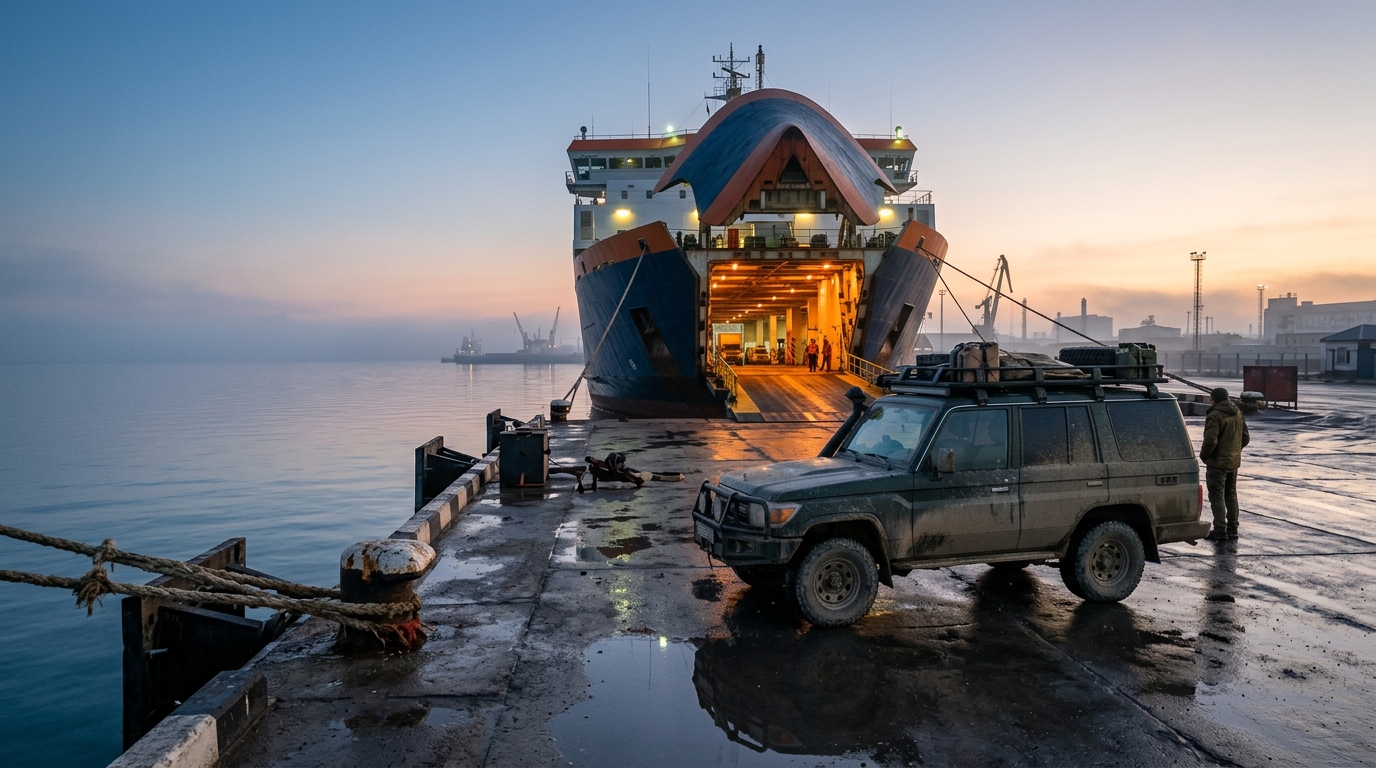
For those seeking to bypass the eastern loop through Myanmar and China, shipping the vehicle presents an alternative entry point for an India to London road trip. Under this strategy, the vehicle is loaded into a shipping container in Mumbai and sent via sea freight to a major port in the United Arab Emirates (such as Jebel Ali in Dubai). From the UAE, drivers traverse the Arabian Peninsula, crossing into Saudi Arabia, Jordan, and eventually shipping or driving into Turkey.
This alternative bypasses the stringent regulatory barriers of China but introduces maritime logistics, customs clearance delays at ports, and shipping costs. But still, for teams wanting to avoid the mandatory guided-group requirements of the Chinese territory, the Middle Eastern detour is a highly practical choice. Understanding these routes is essential for an India to London road trip through the region, as route planning dictates all subsequent visa and permitting applications.
Essential Border Crossings and Regulatory Requirements
No matter how mechanically sound a vehicle is, the success of an India to London road trip depends entirely on administrative compliance. One cannot simply drive up to an international border and present a standard domestic driver’s license. Each sovereign territory requires specific permits, bonds, and endorsements to allow the temporary importation of a foreign vehicle and the passage of its occupants.
Visas and Custom Clearances
Securing visas for a transcontinental drive is a multi-month endeavor. Travelers must obtain visas for every country along the route, with many requiring physical passport submission and precise entry dates. This is highly challenging because overland travel is inherently unpredictable; a mechanical breakdown in Kyrgyzstan can disrupt a precisely scheduled Schengen visa entry window in Europe. This makes coordinate timing highly complex for an India to London road trip.
For Indian passport holders, navigating the visa landscape is a complex, multi-phased task. The entry requirements vary greatly across the route:
- Online E-Visas: Available for countries like Turkey, Uzbekistan, and Azerbaijan (depending on current bilateral agreements).
- Physical Consular Applications: Required for the Schengen Zone, China, and Myanmar, necessitating physical passport submission.
- Third-Party Coordination: Many travelers coordinate with professional visa services, such as the TravelDham Visa Hub, to avoid administrative delays that could jeopardize the expedition.
| Country / Zone | Visa Type Required | Key Documentation Needed | Estimated Processing Time |
|---|---|---|---|
| Myanmar & Thailand | Tourist Visa / Border Permits | Valid Passport, Vehicle Details, Approved Escort Details | 4 – 6 Weeks |
| China | Group/Special Tourist Visa | Custom Government Invitation, Chinese Driver’s License Application | 8 – 12 Weeks |
| Central Asia (Kazakhstan, Kyrgyzstan) | E-Visa / Visa-Free (varies) | Passport, Vehicle Registration, Letter of Invitation (if applicable) | 1 – 2 Weeks |
| Turkey | E-Visa (for eligible passport holders) | Passport, Third-Party Vehicle Insurance (Green Card) | 3 – 5 Days |
| Schengen Zone & UK | Standard Schengen / UK Visitor Visa | Detailed Itinerary, Bank Statements, Multi-Country Travel Insurance | 4 – 8 Weeks |
Furthermore, acquiring comprehensive travel insurance policies that offer third-party vehicle liability coverage across multiple jurisdictions is non-negotiable. Many European and Central Asian borders require physical proof of active insurance before allowing vehicle entry.
The Carnet de Passages en Douane
The Carnet de Passages en Douane (commonly referred to as a CPD or a “passport for the vehicle”) is the absolute cornerstone of an India to London road trip. The CPD is an international customs document that permits the temporary importation of a motor vehicle without payment of import duties and taxes in each transit country. It acts as a financial guarantee that the vehicle will eventually be exported out of the transited nation.
In India, the CPD is issued by the Western India Automobile Association or the Automobile Association of Upper India. To secure a Carnet, the vehicle owner must post a bank guarantee or a cash deposit. This security deposit typically ranges from 100% to 200% of the vehicle’s market value. If the vehicle is sold, abandoned, or stolen and not legally exported during the India to London road trip, the transit country can claim the import duties from this deposit.
The Carnet de Passages en Douane is not merely a recommendation; it is a legally binding international customs treaty. Without this document, driving an Indian-registered vehicle across the borders of many Asian and Middle Eastern countries is legally impossible.
Vehicle Preparation and Mechanical Contingencies
Driving across mountain ranges, deserts, and poorly maintained highways puts immense stress on a vehicle. Selecting the right vehicle and preparing it mechanically is a critical safety priority. While high-clearance four-wheel-drive vehicles (such as modified SUVs) are highly recommended, travelers have successfully completed the India to London road trip in standard sedans, hatchbacks, and even on motorcycles. However, the level of mechanical preparation directly determines the safety and reliability of the crossing.
Recommended Upgrades and Spares
A standard factory-specification vehicle requires specific modifications to handle the diverse road conditions of a transcontinental journey. Suspension systems must be reinforced to cope with heavy payloads (including water, fuel, recovery gear, and spare parts) and uneven terrain. Engine filtration systems must be upgraded, particularly when operating in the dusty terrains of Central Asia. Preparing a vehicle properly is critical to matching the rugged demands of an India to London road trip.
Drivers should carry a comprehensive inventory of spare parts and recovery equipment. At a minimum, the vehicle must be equipped with:
- Dual spare tires mounted on heavy-duty rims
- A high-lift jack and recovery boards (for sand, mud, or snow)
- Heavy-duty tow straps and a 12V winch system
- Replacement engine oil, transmission fluids, and coolant
- Spare air, fuel, and cabin filters (essential for Central Asian dust)
- A basic mechanical toolset, including OBD-II diagnostic scanners
- Auxiliary fuel canisters (such as jerry cans) to extend the vehicle’s driving range
In addition to hardware, drivers must possess basic mechanical knowledge. Understanding how to replace a flat tire, change fuel filters, and diagnose minor electrical faults is essential when driving through remote regions where professional mechanical assistance is unavailable. Furthermore, maintaining an active relationship with professional off-road groups or global overlanding networks can provide critical real-time road condition updates during the crossing.
Detailed Financial Projections and Budgeting
Executing an India to London road trip is a highly capital-intensive project. The total cost varies widely based on travel style, vehicle fuel efficiency, shipping requirements, and accommodation choices. Roughly speaking, a realistic budget for a single-vehicle expedition with two passengers ranges from ₹25,00,000 to ₹40,00,000 (depending on how long the journey takes and the specific route chosen).
Fuel, Tolls, and Daily Operational Costs
Fuel consumption is one of the largest ongoing expenses. Prices fluctuate widely across continents; for instance, fuel is exceptionally inexpensive in Central Asian nations like Kazakhstan but becomes a major financial line item once entering Western Europe. Tolls, road taxes, and vignette fees also accumulate rapidly on European motorways. Planning for these fluctuations is a core competency of any experienced long-distance driver.
To provide a clear financial overview, the table below outlines the estimated breakdown of major expenses for a standard 60-day India to London road trip:
| Expense Category | Estimated Cost (INR) | Key Considerations / Inclusions |
|---|---|---|
| Carnet de Passages Security Deposit | ₹10,00,000 – ₹20,00,000 | Refundable bank guarantee or cash deposit (depends on vehicle value) |
| Visa Fees & Guide Requirements | ₹3,50,000 – ₹6,00,000 | Mandatory guide fees for China, individual visas, and consular charges |
| Fuel & Road Tolls | ₹4,00,000 – ₹6,00,000 | Calculated over roughly 18,000 km at an average of 10 km/liter |
| Vehicle Shipping & Logistics | ₹2,50,000 – ₹4,00,000 | Required for Caspian Sea ferry or direct UAE maritime shipping |
| Accommodation & Daily Living | ₹3,00,000 – ₹5,00,000 | Varies by preference (budget guest houses vs. mid-range hotels) |
| Vehicle Insurance (Multi-Country) | ₹1,00,000 – ₹1,50,000 | Third-party liability for non-Schengen and Schengen zones |
| Mechanical Contingency Fund | ₹1,50,000 – ₹2,00,000 | Emergency vehicle repairs, spare parts, and towing services |
It is critical to maintain a substantial emergency reserve. Unexpected delays, such as border closures forcing a sudden route change or a major mechanical failure, can instantly inflate the budget. Having accessible liquid funds is a vital safety measure that directly influences the financial viability of an India to London road trip.

Safety Protocols and Regional Driving Considerations
Safety must remain the primary priority throughout an India to London road trip. Driving across multiple continents exposes travelers to vastly different driving cultures, road quality, and security situations. A professional overlander must adapt their driving habits and daily schedules to suit the local context.
In Southeast Asia, road networks are often congested, and local driving behavior can be unpredictable. But still, the risk is manageable if one avoids driving at night. In contrast, Central Asian highways are characterized by vast distances between service stations, severe crosswinds, and occasional livestock hazards on the road. Maintaining a moderate speed and monitoring fuel levels closely is essential.
Upon entering Europe, road conditions improve dramatically, but traffic regulations become extremely strict. Drivers must strictly adhere to speed limits, lane discipline, and urban emission zones. To explore the destination’s road structure and prepare for local driving laws, reviewing resources on driving in the United Kingdom and Western Europe is highly recommended, as this knowledge will streamline the final legs of an India to London road trip.
Additionally, carrying satellite communication devices, maintaining active GPS tracking for family members, and keeping physical copies of all emergency contacts are essential security practices. It is also advisable to keep digital backups of all critical documents encrypted on a secure cloud server, ensuring accessibility even in the event of physical document loss.
FAQs
Is it legal to drive an Indian-registered vehicle on an India to London road trip?
Yes, it is entirely legal to drive an Indian-registered vehicle across international borders to the United Kingdom, provided you hold all necessary legal documentation. This includes an active Carnet de Passages en Douane (CPD), an International Driving Permit (IDP) issued by your local RTO, valid registration documents, and country-specific third-party vehicle insurance. Having these documents meticulously organized and stamped at every customs checkpoint is vital for an India to London road trip.
How much does an india to london road trip cost?
The total cost of an India to London road trip varies based on several parameters. A realistic estimate for a single vehicle with two passengers is between ₹25,00,000 and ₹40,00,000. This encompasses visa processing, mandatory Chinese guiding agencies, fuel, road tolls, accommodation, food, and shipping fees. It is separate from the refundable Carnet de Passages security deposit, which requires a substantial bank guarantee.
How long does the entire India to London road trip take?
The overall duration of the India to London road trip is typically between 50 and 70 days. This timeframe permits a sustainable daily driving average of 300 to 400 kilometers while accommodating rest days, customs processing at borders, and mechanical maintenance. Rushing this transcontinental drive is highly discouraged due to driver fatigue and bureaucratic delays.
What is a Carnet de Passages and do I need it for an India to London road trip?
The Carnet de Passages en Douane (CPD) is a globally recognized customs booklet that functions as a passport for your vehicle. It is absolutely essential for an India to London road trip. This document guarantees to transit nations that you will temporarily import and subsequently export the vehicle. To secure it, you must place a deposit of 100% to 200% of your vehicle’s value with the issuing automobile association in India.